Welcome - Explore my Blog

I've been keeping this blog for all of my beekeeping years and I am beginning my 19th year of beekeeping in April 2024. Now there are more than 1300 posts on this blog. Please use the search bar below to search the blog for other posts on a subject in which you are interested. You can also click on the "label" at the end of a post and all posts with that label will show up. At the very bottom of this page is a list of all the labels I've used.

Even if you find one post on the subject, I've posted a lot on basic beekeeping skills like installing bees, harvesting honey, inspecting the hive, etc. so be sure to search for more once you've found a topic of interest to you. And watch the useful videos and slide shows on the sidebar. All of them have captions. Please share posts of interest via Facebook, Pinterest, etc.

I began this blog to chronicle my beekeeping experiences. I have read lots of beekeeping books, but nothing takes the place of either hands-on experience with an experienced beekeeper or good pictures of the process. I want people to have a clearer picture of what to expect in their beekeeping so I post pictures and write about my beekeeping saga here.Master Beekeeper Enjoy with me as I learn and grow as a beekeeper.

Need help with an Atlanta area swarm? Visit Found a Swarm? Call a Beekeeper. ‪(404) 482-1848‬

Want to Pin this post?

Friday, June 27, 2014

And About the Neighbors.......

The house next door to me has been on the market and vacant for about a year.  Other houses in my area of Atlanta sell the minute they are put on the MLS, but not this one.  It's a really pretty house, but needs updating and has an odd floor plan that doesn't work well for children - at least that's why the realtor told me it has taken so long to sell.

I'm currently renovating my kitchen and since my house is very tiny, I've moved to the finished attic to live for the forever number of weeks it is taking to finish the job.  So a few days ago, I was sitting on my upstairs bed, talking to my friend Gina on the phone, and gazing out the window at the roof peak at the side of my house.  As I am watching the exterior of the house next door, I realized I was looking at what may be honey bees flying in and out above a second floor dryer vent.


The dryer vent looks like it is on the second floor and as you can see is rather high up since the house has a basement, a first floor and then the dryer vent.

I don't have a powerful enough zoom on my camera to get a clear picture of the insects flying in and out, but they do act like honey bees.


When we were little my Daddy used to say a poem to us:

"Daddy!"
"Whatcha' want?"
"I see a bear..."
"Big bear or a little bear?"
"Little biddy bear."
"Eat grass and watch him"
"Daddy!"
"Whatcha' want?"
"I see a bear..."
"Big bear or a little bear?"
"GREAT BIG BEAR!"
"Run for your life, run for your life!!!!!"

I keep thinking about this as I watch the bees flying in and out of the hole entry above the dryer vent.  Do I eat grass and watch 'em or do I call the realtor and tell her the news.  You can see the hole entry above and to the left of the center of the dryer vent.


I have tried to photograph the insects with both my phone and my camera but neither have the necessary zoom capacity.

So a couple of days ago, I called the realtor.  I told her I thought there might be honey bees living above the dryer vent.  I told her that there are five beekeepers within a block of my house and although I thought they were honey bees, they were not likely to be my honey bees since bees when they swarm to a new home, generally go at least a mile away if they can.  I gave her the names and numbers of three master beekeepers I know who do bee removals.  I also offered my phone number for the owner (whom I don't know - the house was rented when I moved in next door) in case he had questions.  I hung up relieved but still a little wary.

Finally this morning I decided to take a pair of binoculars upstairs and look out of the window.  I think these might NOT be honey bees but rather yellow jackets.  One view through the binoculars looked like their bodies were more yellow than orange and more pointed at the end than the bee.  I am giving you a blurry photo which is the best I can do so you can see what YOU think!


When I talked to the realtor, she told me the house was pending contract, waiting on the inspection and the loan.  She commented that the inspection had already happened and the inspector did not notice the insect activity.

At least it has me thinking about the new neighbors and I will certainly take them honey when they move in and possibly (as one of my friends suggested) my Canadian honey buttermilk rolls!


Thursday, June 26, 2014

Good Use for the Boardman Feeder

At this time of year, feeding the bees is not something anyone needs to do.  The bees in Atlanta are at the end of the nectar flow, but there is still some nectar to be had.  I haven't fed any bees this year in 2014.  All of my new hives were either nucs and were installed while we were having a nectar flow or the hives had overwintered and were just fine and not starving.

The Boardman feeder is particularly dangerous to use because it is like a billboard on the front of the hive screaming, "EAT HERE.  FREE FOOD!"

It's an invitation to robbing and that is a disheartening thing to happen to a beehive.

Last year at the Morningside Community Garden, we got complaints that my bees were showing up to take a swim at the neighbors' swimming pool.  They have a pool just over the fence from the beehives.  It's like Mr. McGregor's Garden - the bees feel tempted by the chlorinated water and are determined to visit the pool for a treat.  Only instead of going through a hole in the fence like Peter Rabbit, they fly right over it!

So to solve the problem last year, I put Boardman feeders on the front of both hives.  I filled the feeders with water, each with a drop of Clorox in it.  The bees got their water happily from the Boardman's and the neighbor complaints disappeared.

Since that worked so well last year, I've done it again on the Morningside hives.


So far, we haven't heard from the neighbors.  I was away a couple of weeks ago and as I drove home I noticed that the top was off of the hive with the blue markings.  I walked up to check and found the top on the ground at the bottom of the hill.  The hives look in this photo as if they are on flat ground, but actually they are at the top of a hill, the dropoff for which is right by the blackberry bushes on the back left.  

The top was lying face down at the foot of the hill about 15 feet below.  The hive was intact with the inner cover still tightly propolized.  I expect a storm blew the top off, but it seemed weird that it was located where the wheelbarrow and other equipment is kept and not directly below the hive on the ground.  

So far it hasn't happened again, so I feel sure it was the wind.  Maybe someone saw the top and just moved it with the rest of the equipment????

Friday, June 13, 2014

Honey Moon - Tonight, Friday the 13th

I saw this on Facebook (I do go there sometimes) and on the Weather Channel.  Thought you'd like to know:

Here's the link!

Sunday, June 01, 2014

Amazing Gift for My Crush and Strain Honey

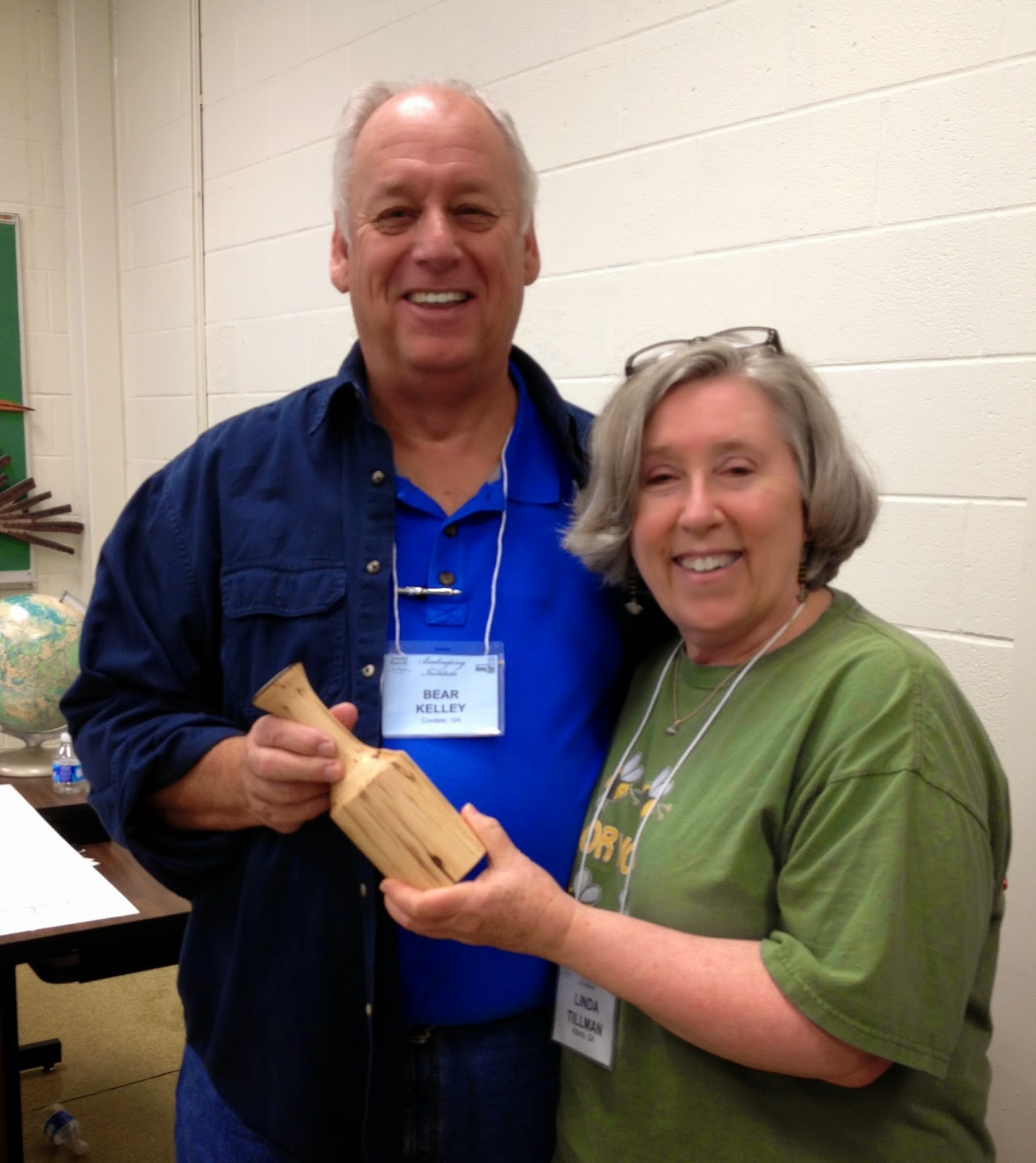
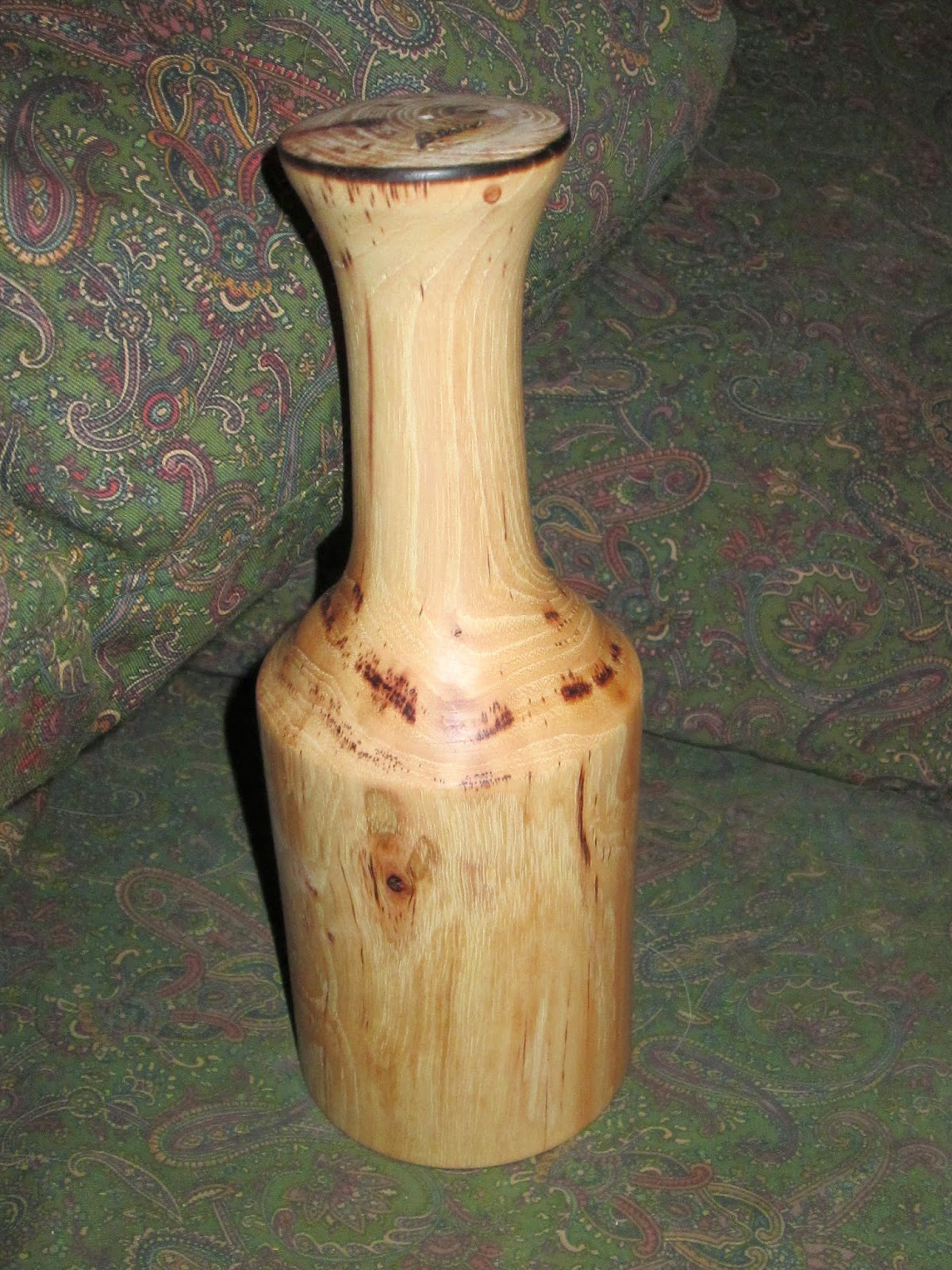
My friend, Bear Kelley, president of the Georgia Beekeepers Association, made me a gift.    I was talking to him about the difficulty of getting an effective pestle for crush and strain honey.  I have been using the same two since I began and they are small with the then requirement of lots of crushing.

I told him that when I was at the Chimneyville Crafts Fair in Jackson, Mississippi in December, I had asked a Mississippi craftsman to make one for me.  That one had a larger surface area but the handle had a pointed tip and over time, really hurt my hand.

Bear came to the rescue and made me a gorgeous honey crusher.  He hand-turned it out of southern pecan - more fitting than he knew because the southern pecan has had quite a role in my life.  My parents lived on land with giant southern pecan trees.  I remember feeling frightened as I watched the tall trees bend and parts of them break off in the hurricanes that came up the river from New Orleans to my hometown of Natchez.

Then when I was a senior, I asked my father if I could buy a class ring.  He said a class ring was a complete waste of money and if I wanted one, I'd have to earn the $50 that it cost by myself.  So I picked up pecans under those trees on our land and sold them to a pecan packing plant.  I quickly learned that I could make more money if I sold them shelled, so I became an expert at getting the shells and the bitter interior lining off of the meat of the pecan.  I earned my $50 and got my class ring - and as my father predicted - never wore it.

So southern pecan is a part of my history and actually represents hard work to me, so it is fitting that Bear's honey crusher is made of pecan and I will be using it to work to get the honey out of the honey comb.


Before he gave it to me, he entered it in a honey contest where he won a blue ribbon for his efforts.
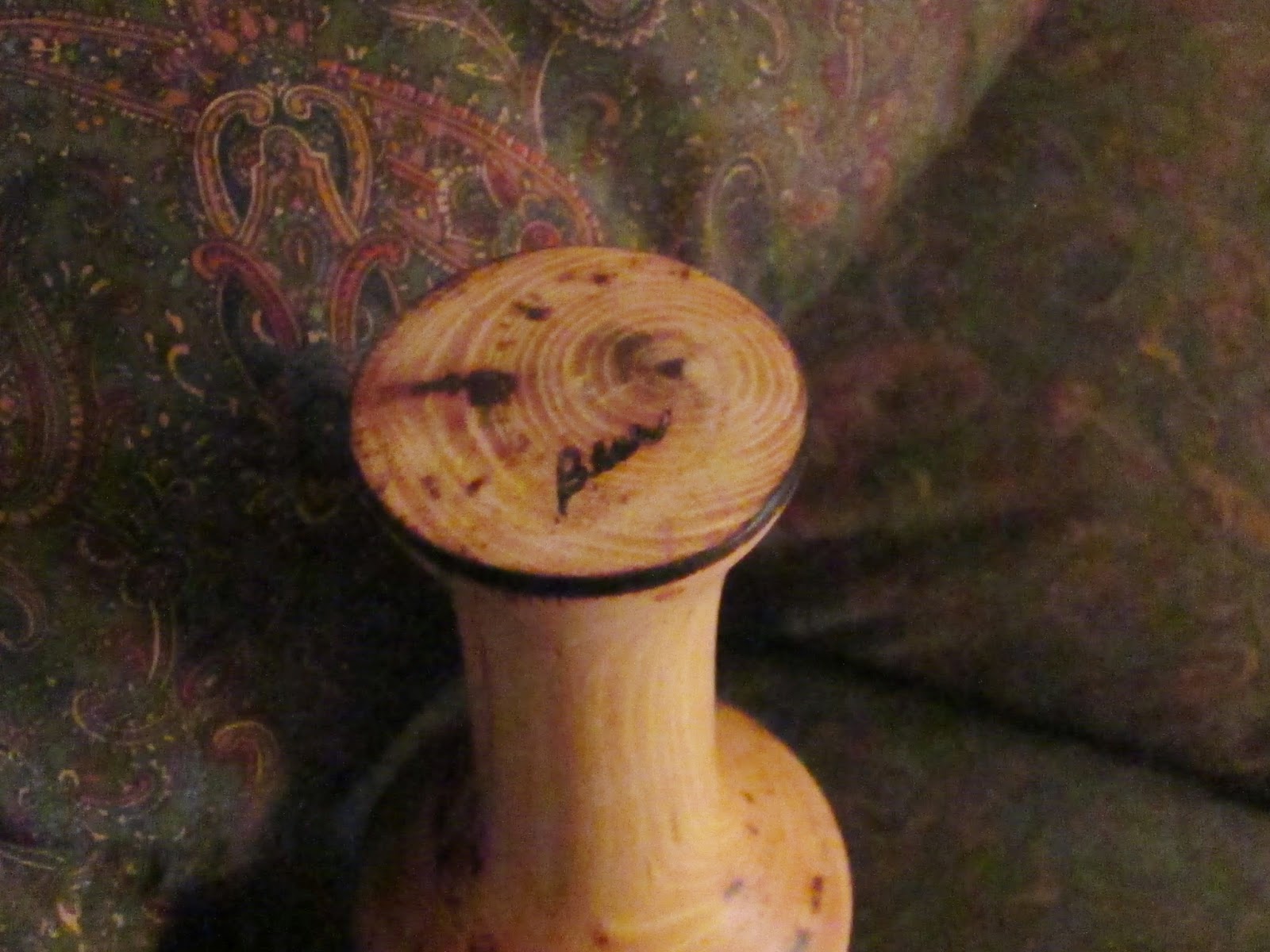
After the contest, he branded it with his name Bear in the top of the handle.

Thanks, Bear - I'm SO EXCITED to have this lovely piece and to get to use it.


Wednesday, May 28, 2014

A Chastain Quick-Stop

This morning I had to drive to the north part of Atlanta to pick up my tax data from my accountant.  Easy to go by the Chastain hive as I drove back to my office, so I did.  I was in business clothes, no camera, but helpfully, all of my beekeeping equipment was in my car from the mountains this past weekend.

I had an apron to put under my jacket to protect my nice pants.  I lit the smoker, put on my jacket and veil and went up to the hive.

When last I was at Chastain (about a week ago), the hive looked anticipatory.  They were not making a queenless roar, but they definitely did not have a laying queen.  The hive was full of queen cells that had been opened.  The brood cells were not back-filled with nectar but instead were polished and waiting at the ready for the advent of a new queen.

I thought I had read somewhere that it is not unusual for a swarm to requeen once it is settled into its new hive, but I now can't find a reference for that, so I'm not stating that as a fact.  This swarm hive has definitely made that decision.  Clearly the hive had requeened itself and was in no distress except for the fact that I was disturbing their peaceful anticipation.

The top two boxes were all honey - not completely filled.  As a matter of fact, no more honey had been put up than before I left for Memorial Day.

When I got to Box 2 (second from the bottom), there were open brood cells, polished.  So I held the frame with the sun over my shoulder and there they were:  EGGS - tiny new beautiful evidence that these bees have successfully requeened.

I closed the hive back up, took off my bee gear, tried to wipe the campfire smell off of my hands with wipes, and headed back for work.

It was a good day in my bee world.

Monday, May 26, 2014

Robbing Peter to Pay Paul and the Taste of Honey

The front hive at Tom's house is desperately queenless, so on Thursday I went over to Stonehurst Place to steal a frame of brood and eggs from one of the deep boxes over there.  The new Ray Civitts hive was looking good and needed a new box.  I checkerboarded them top box into the new box and then went into the lower box.


I put the beautiful frame of mostly eggs and young brood into a pillow case and put it in the back of my warm car (it was 87 in Atlanta that day).  I drove to Jeff's office and picked him up to go to Tom's.  We opened the hive.  

Inside the hive, the frames had some brood but it was all drone.  I think after the swarm the queen must have either been short bred (a Keith Fielder term meaning that she only mated with a couple of drones - not enough to allow her to function as a good layer).  Anyway we pulled a frame from the bottom box that had a baseball sized circle of drone brood in the center.  The rest of the frame had all the worker cells back-filled with nectar and there was honey at the corners, as is typical in a brood frame.  

We added the beautiful Stonehurst brood/egg frame to the hive.  I am crossing my fingers that they will now be able to make a successful queen.  

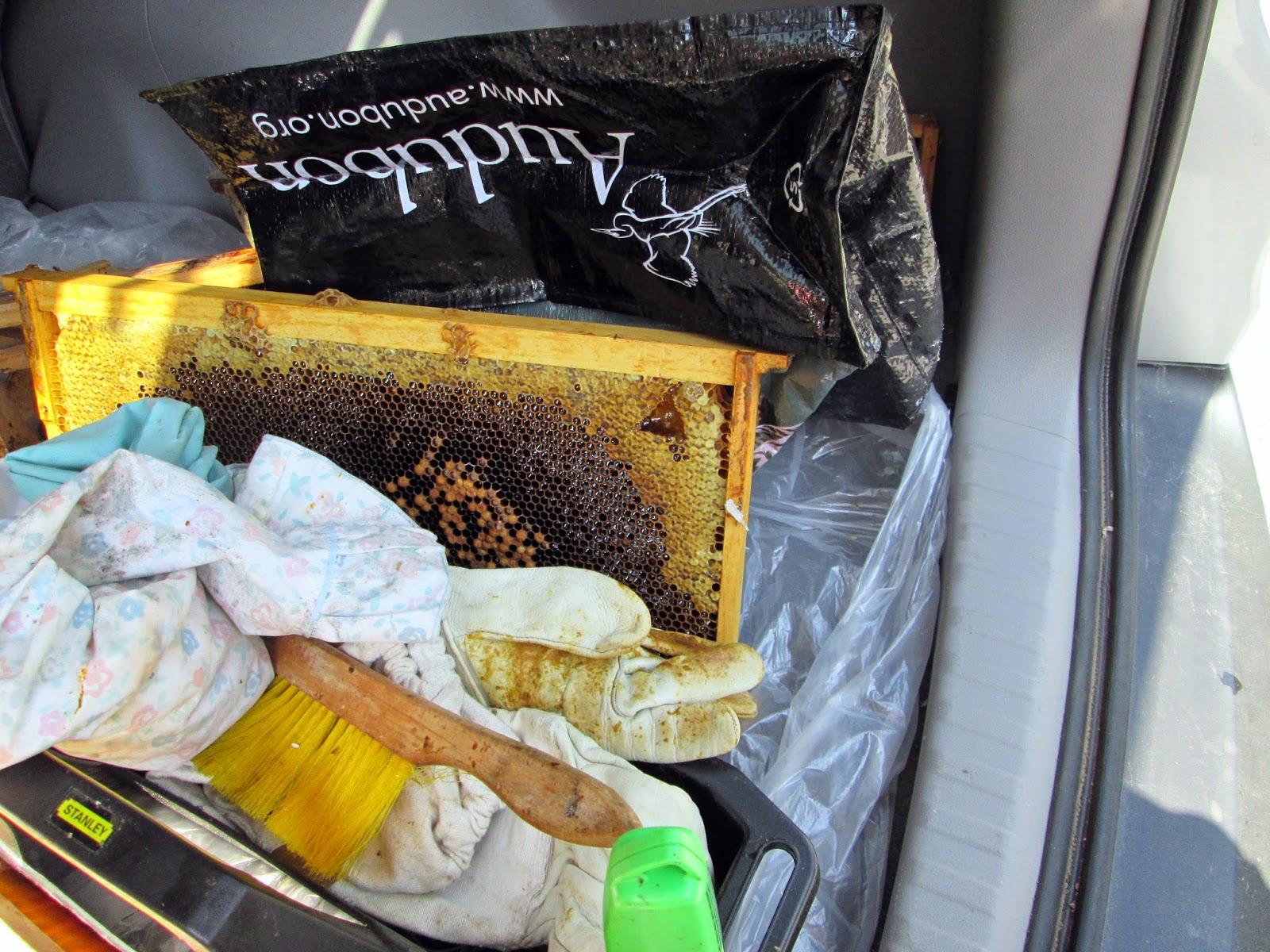
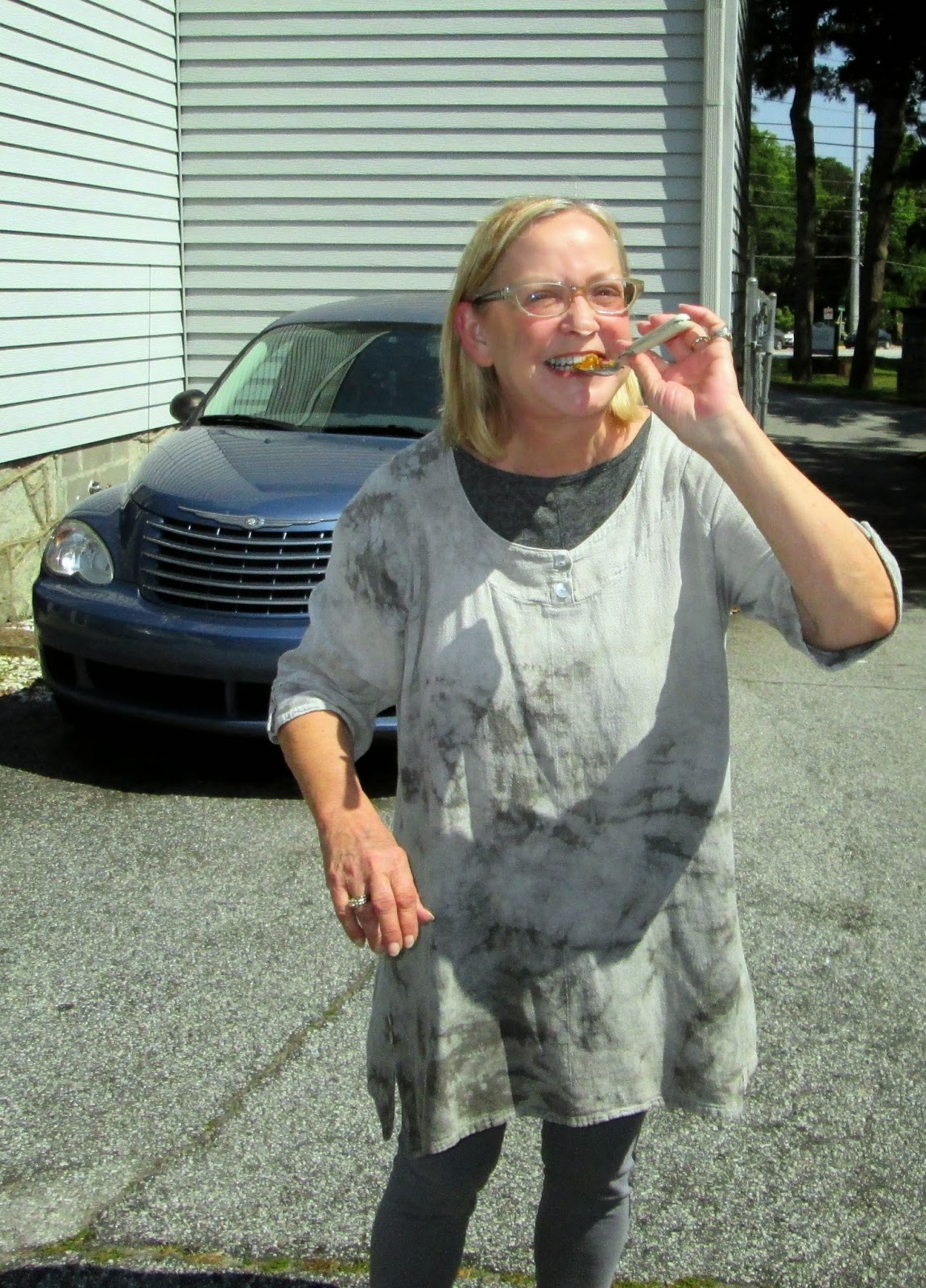
Jeff and I couldn't resist sticking our finger hive tool into the corner of the frame to taste the honey.  Yum - it had a sweetness followed by a spicy end note - delicious.  We didn't have anywhere else to put the frame, so I put it in the back of the car to take home.


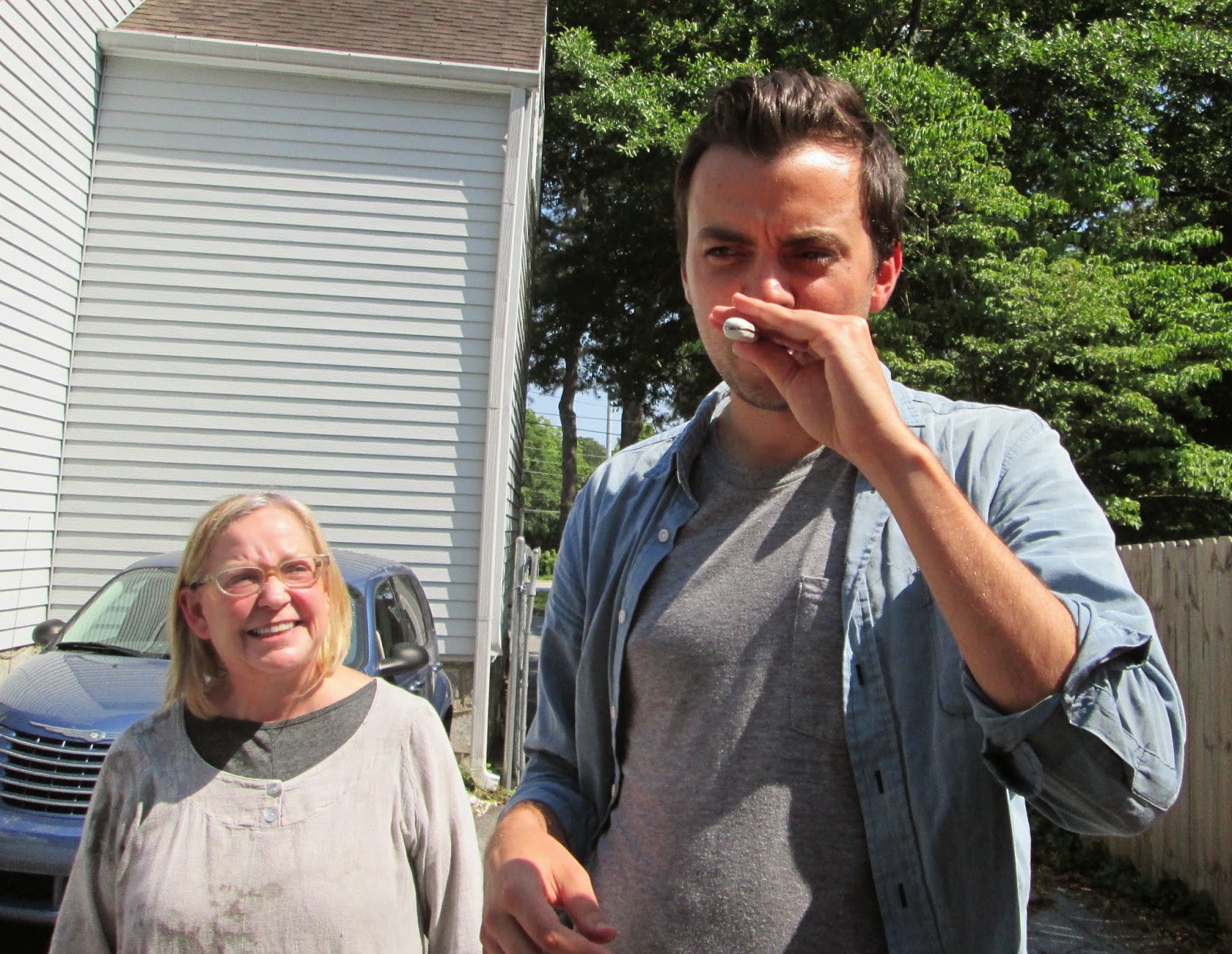
I let Jeff out at his office and he went in to tell the staff that we had a taste of honey in the car.  At least six people came running out of the building brandishing spoons!  I didn't get the camera up and running fast enough.  


All six of them had a taste.  Jeff works at a casting agency and they know how to have fun!  All of them enjoyed the honey adventure, I think.  And I had a great time sharing our honey moment with them as well.

Wednesday, May 21, 2014

Where I Bee

I don't think I've posted this year about my hives and where they are.

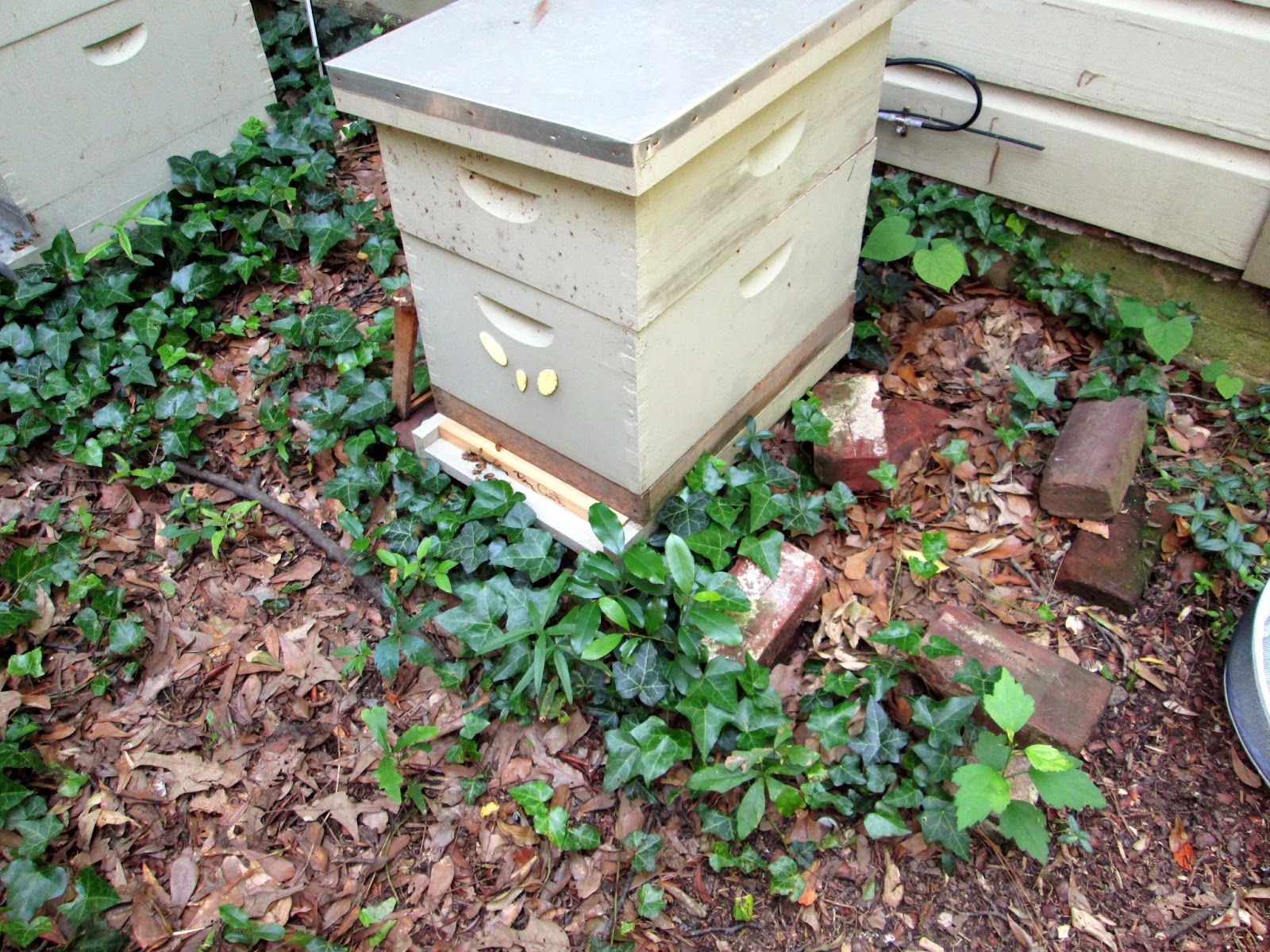
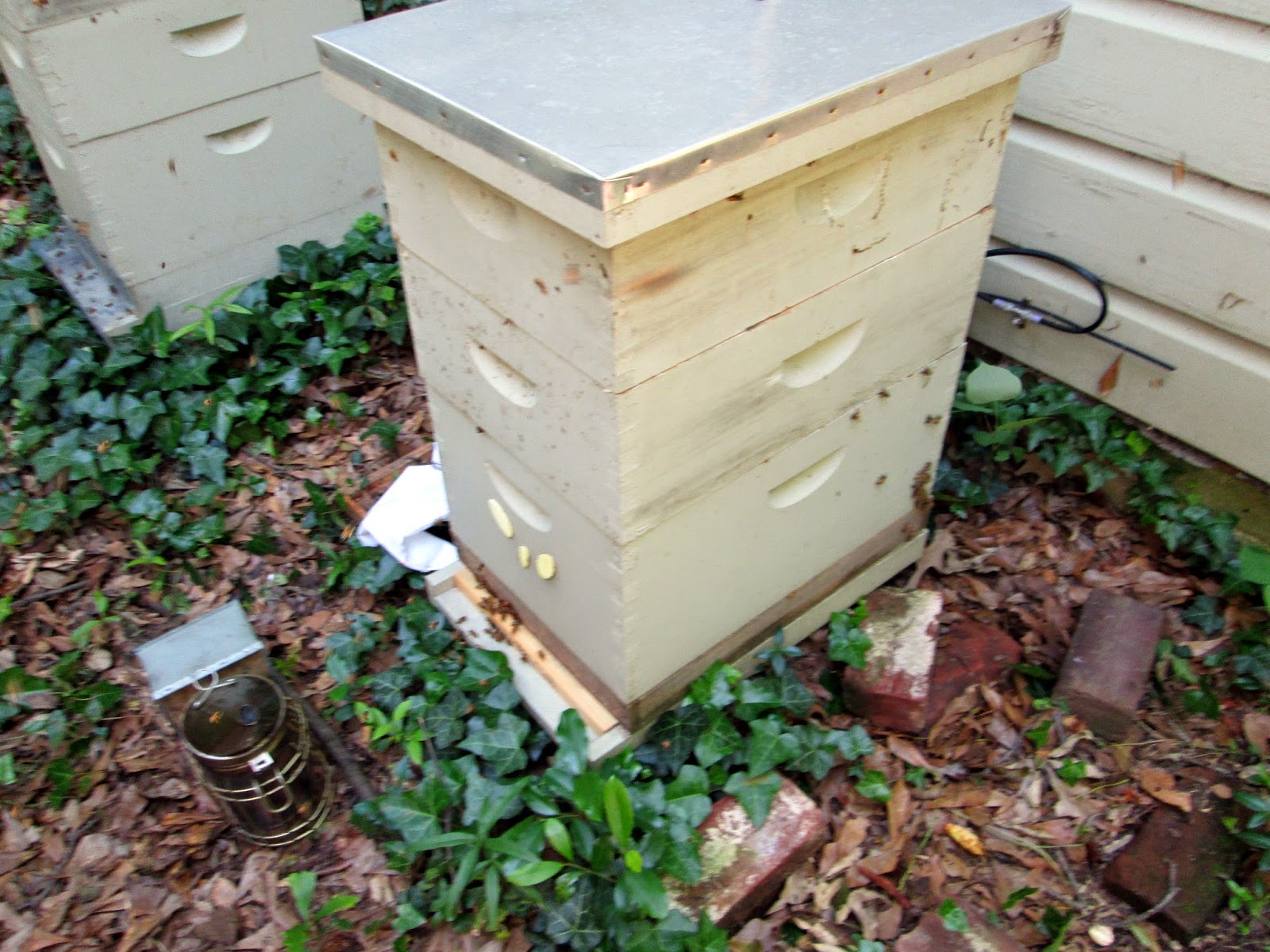
I have one hive at Chastain Conservancy.  It's a teaching site for my bee club and Julia, Noah and I all have hives there.  I have one hive that was made from the swarm that a beekeeper donated to the teaching cause.  It came to us on April Fool's Day and has done well.

I checked on it today, planning to take a frame of brood and eggs from it to another hive.  BUT they had requeened themselves.  I found the opened queen cell and many others that had been opened.  The bees were quiet and contained.  They had many cells cleaned and polished waiting for the new queen to start laying.

This must have been a well-regulated plan in that they had two frames of capped brood, about ready to emerge (dark biscuit) and probably their new queen is in the process of her mating days right now.  This means that when the capped brood was laid, they made a queen cell from one of those eggs.  The queen emerges in 16, compared to 21 for the worker, so she has emerged (before the remaining brood laid on the same day) and should soon start laying.

So I didn't take a frame from them!                                  


I also have two hives at my friend, Tom's house.  These were the Bill Owens hives that I got at auction in September, 2013.  These two hives were doing great as spring began.  Since they are in deep boxes and don't have medium supers, I was unable to spread out the brood nest when we added the first new boxes to these hives.  Both hives swarmed.  


I captured both swarms which are now in my backyard.  The hives at Tom's are probably not going to produce much honey this year although both hives have two full boxes of honey on them.  They are struggling with post-swarm.  They swarmed on March 30 and April 9, respectively.  

The front hive (March 30) apparently failed to get a good queen and is now queenless.  We have put in one frame of brood and eggs but on inspection on Monday, did not see any evidence of a queen cell.  The hive was quiet and has not developed a laying worker.  I will take another frame of brood and eggs over there to it tomorrow.  I wanted to today from the Chastian hive but they were not in any kind of shape to do that.

The back hive (swarmed April 9) has a queen who is up and running and has been laying but they are slow to rebuild.  These hives have had the same number of boxes on them for the last three weeks when many other hives are adding a box a week.

I have two hives at the Stonehurst Place Inn.  One of them overwintered and is doing well, making honey, expanding, etc.  I will check on them tomorrow as well.  I last checked them a week ago.  The second hive at Stonehurst is a nuc that I got rather late (4/27) from Ray Civitts.  They have now been installed three and a half weeks.  I don't expect honey with this late a start.


(For anyone keeping tabs, we are up to five)


I have two hives in Rabun County at my friends' farm.  Those hives were installed on April 26 and May 3 - again unlikely to get much honey with this late start, but the flora in the mountains is about three weeks behind Atlanta, so if the bears leave us alone, maybe we'll get something from these hives.

I was in the area this past weekend and stopped to add needed boxes to each hive.  The moving straps are to make us think we are keeping the bears at bay!  I think a determined bear might argue with both us and the bees.


In his backyard, Jeff has two hives that we got from Buster's Bees when I ordered them in December, thinking my hives would not make it through the winter.  We installed them on April 11.  He is mostly managing those but he and I keep bees together.  They now have new boxes on them - maybe two - I'm not certain.


The other two hives from Buster are at the Morningside community garden and are rocking along.  I gave each of them a new box yesterday.  They were installed on April 26 and now each is composed of three boxes.


So I have 11 hives in other places.


In my own backyard, I have one hive that overwintered, the hive from Sebastian's yard that we moved at the end of March, the two swarm hives from Tom's house, a swarm I caught in my neighborhood just down the street from my house, a split in a three box nuc that I made from one of Tom's hives as a swarm prevention measure (didn't work, obviously), and a small hive of failure-to-thrive bees that I got from a beekeeper who thought they had swarmed.  

It was a tiny swarm and is not doing well.  I got them on April 1 and they are still on just three frames in a nuc.  I don't want to combine them with another hive because they are from a beekeeper who treats his bees and I don't know what their problem is but they don't seem to be doing anything.  I think they were actually absconding to get away from the treatment.  I'm just going to leave them alone and they may die, but I'm not going to take any action.

So not counting the two nucs (Failure to Thrive and the Tom Split), I have five decent hives in my backyard.  If I eventually move the Tom Split into a full box, I'll count it but not for now.  So sixteen altogether.  Some will have honey for me this year.  Others will just build up hopefully to go through the winter.


Saturday, May 17, 2014

The Delight of Hearing Mark Winston

When I studied for my Master Beekeeper in 2010, it was Mark Winston's book, The Biology of the Honey Bee, that was my mainstay.  I read it cover to cover, underlined important places, dog-eared the pages.  I consumed the book.  And thankfully, I passed and got my Master Beekeeper.

This weekend I had my first opportunity to hear him in person and he was delightful.  When he speaks, he is poetic and lyrical, so he is easy to listen to and easy to absorb.


First I heard him speak on queen pheromone.  I learned some things about QMP (queen mandibular pheromone) that I didn't know before.  The workers absorb the QMP both through touch and with their tongues.  The pheromone is passed throughout the hive by touch and tongue until about thirty minutes have passed.  Then the rest of the pheromone the worker is carrying is absorbed into her.

QMP, the presence or absence of, may have impact on swarming.  If the colony is congested, then the pheromone is less dispersed and the workers may feel more impelled then to leave.  QMP also has an effect on worker development.  It slows down speed of the worker's development as they move toward the job of foraging so that the worker is a more mature bee when she finally begins foraging.

My previous understanding of QMP had only to do with its effect on the workers in the hive.  Apparently artificially created queen pheromone (we can't actually duplicate the exact product because we know five elements of it but there are others yet unidentified) is sometimes sprayed on crops.  When blooms are sprayed with artificial QMP (called FruitBoost), bees are drawn to the flower for pollination, thus increasing crop production.  Amazing.

I also heard him give what I would call a photo essay on the anatomy of the honey bee.  He had lovely photos of the bee, up close and personal.  He spoke of the pollen gathering anatomy of the bee, with hair everywhere, including her tongue.

A mystery question that he asked was, "Why do bees have hair on their eyes?"  I didn't know but it turns out that the hair on their eyes helps the bees sense wind and speed of flight.  They have to know how far away home is and the hair on their eyes helps them gather this information.

I'm always amazed that the bee can carry out one of her dead sisters in a housekeeping effort.  That bee is the same weight as she is.  Winston said that a bee can carry her own body weight in honey.

He spoke today on his new book, coming out in October, titled:  Bee Time: Lessons from the Hive.  In talking about his book, he addressed three issues:  agriculture, beekeeper issues, and pesticides.  Agriculture is hard on the bees because of the stress of bees being moved for pollination.  In addition, the fields to which the bees are moved are monocultures - only almonds and no weeds; only plums, no weeds; only pears, no weeds, etc.

He discussed the need for agriculture to change.  The concept that there must be no weeds in the fields leaves the bees with a diet of one item, unhealthy for them.  He pointed to a recent study on economics of crops.  The study used canola fields for testing.  In the study, the farmer left 30% of his/her fields fallow and only planted 70%.  The other 30% was left to lie fallow, grow weeds, whatever.  The comparative data was taken from farms planted 100% with no weeds.  The farmer made a profit of $70000 in the 70% planted group.  The farmer only made a profit of $65000 in the 100% planted farm fields.  The first farmer had the luxury of making more money with less area planted and the bees were healthier.  Not so for the second farmer.

The promotion of ecological services is essential, he said.  The bees need forage and less is more.  Natural life depends on a natural type of agriculture.

He spoke of the beekeepers overusing pesticides.  He described beekeeping today as a chemically dependent occupation.  In addition there is the problem of beekeepers treating with both pesticides and antibiotics in the hive, both of which are overused and often used off-label.  I didn't ask him if he treats his bees and I so wish I had.

He also talked about the collaborative nature of discussion, interaction and essentially trust in other people.  His example was a project by two young women, 11th graders, in Canada who spearheaded a project called Once Upon a Bee.  The project brought awareness of the honey bee to young people in school and resulted in a grant of $70,000 to accomplish this.


He mentioned the Hives for Humanity project in Vancouver.  This project is another example of cooperation and collaboration involving bees and bee hives.  And he showed us a lovely photo of two dancers and Mark Winston involved in collaborative art, showing the connection of art and the scientist.

Finally I participated in a Writing about Bees workshop with him.  This was just pure fun.  He talked about his own joy derived from his writing.  All of us discussed elements that make writing effective.  Then we took ten minutes to write an essay and heard some of the essays read.

In a moment of pure shameless GBA Spilling the Honey promotion, I suggested that anyone who wanted to could send their essay to gbanewsletters@gmail.com for publication in the state newsletter.  I do hope some of the participants will.  Gina and I would love to publish them!

Pin this post

LinkWithin

Related Posts Plugin for WordPress, Blogger...