Welcome - Explore my Blog

I've been keeping this blog for all of my beekeeping years and I am beginning my 19th year of beekeeping in April 2024. Now there are more than 1300 posts on this blog. Please use the search bar below to search the blog for other posts on a subject in which you are interested. You can also click on the "label" at the end of a post and all posts with that label will show up. At the very bottom of this page is a list of all the labels I've used.

Even if you find one post on the subject, I've posted a lot on basic beekeeping skills like installing bees, harvesting honey, inspecting the hive, etc. so be sure to search for more once you've found a topic of interest to you. And watch the useful videos and slide shows on the sidebar. All of them have captions. Please share posts of interest via Facebook, Pinterest, etc.

I began this blog to chronicle my beekeeping experiences. I have read lots of beekeeping books, but nothing takes the place of either hands-on experience with an experienced beekeeper or good pictures of the process. I want people to have a clearer picture of what to expect in their beekeeping so I post pictures and write about my beekeeping saga here.Master Beekeeper Enjoy with me as I learn and grow as a beekeeper.

Need help with an Atlanta area swarm? Visit Found a Swarm? Call a Beekeeper. ‪(404) 482-1848‬

Want to Pin this post?

Showing posts with label hive location. Show all posts

Saturday, May 05, 2012

Location, Location, Location: What a Difference a Zip Code Makes

My hives in my Atlanta locations: 30342, 30306, 30316 are thriving.  I have honey boxes on all of the overwintered hives, sometimes stacking up to seven boxes.  The new hives are rocking along as well, with most now up to three boxes on the hives.

My hives in Clayton (30568) are a different story.  The nectar flow in Rabun County about 120 miles north is about a month behind Atlanta.  So these hives are really moving slowly.

A lazy spider has the luxury of creating her abode under the top cover of the Rabun Blue hive.


That hive hasn't drawn out the box I gave it on the 20th of April.  I adjusted a few things but didn't add a box although I had one with me for that purpose.


The frames in the top two boxes that were being used were filled with nectar, which is a good sing, but none of it capped as it would be in Atlanta.


The green swarm hive in Rabun is drawing that pretty yellow wax I frequently see in hives in Rabun at this time of year.  And they are raising brood and growing.  But they, too, didn't need any more space.


By the way, I think this swarm came from a feral hive that lives in this old abandoned school that is on the edge of the meadow where the community garden is.  I've shown pictures of this hive before.  I walked over to look at it on Thursday when I was there, and they were still busy as bees.


Posted by Picasa

Tuesday, March 27, 2012

A New Bee Place

The Internet has a wonderful way of connecting people.  I recently got an email from a professor at Georgia State.  He found me on my blog.

 He had friends in the northeast who arranged with beekeepers to have beehives in their yards in exchange for some honey.  He wanted to know if I would be interested in having hives in his yard.

Jeff and I jumped at the chance to expand our apiary capacity.  Sebastian, the GSU professor, lives near Jeff and Valerie's old house in East Atlanta, about 20 minutes from my house.  His partner, Christina, comes from Canada where she says everyone has bees and honey is sold in huge gallon jars.  They are both so enthusiastic about this.

Jeff, Valerie and I arrived to find that Sebastian and Christina have the perfect yard.  The bees can have an eastern exposure and should do well and be happy.  We'll install nucs that I am getting from Jerry Wallace in April.  Jeff and I brought cinder blocks and equipment to use for these bees - we thought it would be good to get it all set up and that Sebastian and Christina could think about the idea more concretely if the hive items were there.


Before the final photo above, we talked about hive location.


They had all kinds of questions about what to expect from the bees.


We set up one 10 frame hive (we're running out of equipment!) and one eight frame hive on a 10 frame slatted rack and SBB (we're running out of equipment - did I say that already?)


We only brought three frames for the 8 frame because there will be 5 frames in the nuc and we brought five frames for the 10 frame box.


We're so excited to share bees with this enthusiastic couple.  And I remember the kudzu in this neighborhood - this is where we had Topsy and Topsy was filled with dark honey, probably from the kudzu.

So here's to a good partnership with Sebastian and Christina and lots and lots of honey!

And on the good news side of things:

  • Today many bees were still voting on my swarm trap - in and out, in and out, measuring and determining their vote about location, location, location.  
  • The Decatur swarm is still in Topsy and apparently settling in, and 
  • The SOS1 into which I put two frames of eggs - one from New Lenox, and one from Five Alive had bees flying in frantically with pollen on their legs today.

Posted by Picasa

Tuesday, March 20, 2007

Advantages of having my hives on my deck

There are many advantages of having my hives on my deck. Some of them are:

1. In my neighborhood, my house is at the highest point on my street. To see into my deck my neighbors have to look up. The bars on the rail keep them from seeing my hives.

2. I can watch the bees at all times of the day from the comfort of my sunporch. This allows me to learn more than if they were located on the fence line of my yard.

3. I can observe what comes out of the hive quite easily because the deck offers more for me to see than if the hives were in grass - so I can get a pretty good idea of how many dead bees are being brought out.....hey, we don't have snow much in Atlanta and this gives me the advantage those of you with hives in the snow have of being able to see what comes out of the hive in the winter

4. One could argue that the small hive beetle might be thwarted by not being able to breed in the dirt below the hive since there's only wood there, but I can attest to the thriving presence of the SHB, despite being 14 or 15 feet above the ground.

Here's what I see from my table on the sunporch.


5. If I am feeding the bees, it's quite easy to refill the feeder at night (or at least it was easy on Mellona and Bermuda). When I got to Proteus, home of the aggressive bees, I lifted out the feed bottle to find a bee attached to it. I left the bottle on the deck and went inside to make more syrup. When I came out 30 minutes later the bee had returned to her hive, but when I placed the bottle in the Boardman (it's 11:30 PM) the bees inside the hive roared a loud buzz and several came out to see what I was doing.


I visited P.N. Williams today (source of my two nucs) and I asked him about the different nature of the bees in Proteus compared to the bees in Mellona. Did he think they might be Russian? He laughed and said that these bees were "what we call mutt bees" because the queen is naturally mated and who knows who she was with in the process!

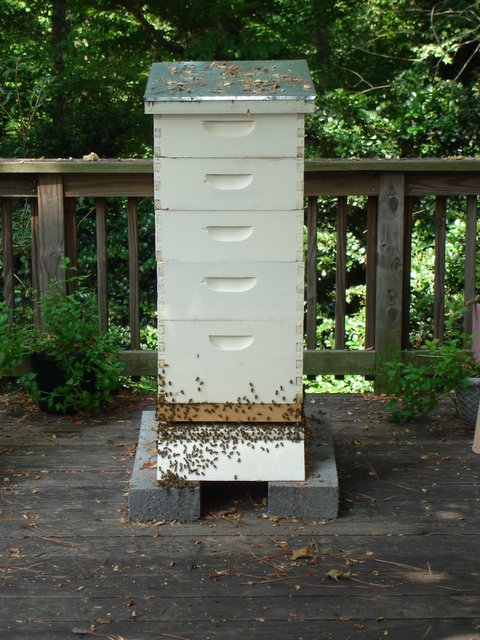
Below is a picture of Proteus before I removed the bottle and bee that came with it. Notice that the bottom board (formerly the roof) now has no bees on it.


6. People can stand inside my sunporch and watch me work the bees without worry of being stung. My daughter Becky took this picture through the door last summer while I was inspecting the hives.


Posted by Picasa

Saturday, August 05, 2006

No sunlight in August


It's 12 noon on August 5 (birthday of two of my daughters) and as I look out on the hives, I noticed that they are not in the sun at all. This is a good thing in Atlanta when it feels like 105 and very humid as it does today.
However, it is my understanding that the bees feel much more inspired in the sunshine to go out and forage and work hard in the hives. This will not be a day of inspiration for them - as you can see by their hanging out on the front porch. Usually in the middle of the day there are only a few bees hanging out - most are inside working or outside foraging.
So is the shade a problem? If I decide that it is, I can trim some branches from the oak tree that is causing the August morning shade.
Posted by Picasa

Pin this post

LinkWithin

Related Posts Plugin for WordPress, Blogger...