Yesterday (before the current monsoon rains hit Atlanta) we went to the Blue Heron preserve and did a powdered sugar shake on the hives there.
The idea of using powdered sugar is to cover the bees with sugar and encourage their grooming. In the grooming process, they knock off the varroa mites on their bodies. The mites fall through the screened bottom board and can't get back to the hive.
While there is research to suggest that this isn't really an effective mite control, I still do it because by using it in my oldest hive that almost died from Varroa vectored disease, I could really see a difference. The hive is quite healthy today.
Randy Oliver is trying to research this in three articles. Here's the first one and you can find the others on his site.
We used powdered sugar on all three Blue Heron hives. Sam, Julia's youngest son who is in the FOURTH grade, took amazing pictures of the process. I have labeled his pictures with his name on the slide show.
We found two things during the inspection - one great and one not so good.
Great: Julia's hive that appeared to have no queen at our Sunday inspection actually has a laying queen. We didn't see her but saw a good frame of brood and eggs - Woohoo!
Not so good: Our first nuc at Blue Heron came from a supplier who gave us the nuc without a queen . To make good on this he gave us a second nuc - this one had a big beautiful queen. We installed her in another hive, since the first queenless hive had successfully made their own queen.
In the second hive the bees were doing a lousy job of comb building in the second box. We cut out the bad comb, put a drawn frame in the center of the hive (instead of the frame of foundation that was originally there) and moved the frames around so that the badly drawn frames (without the badly drawn comb) were on the edges.
Here's the slide show. Click to see it larger and to be able to read the captions.
Monday, May 04, 2009
Friday, May 01, 2009
Inspecting and Festooning
Since we are in the middle of the 2009 honey flow, I keep a close watch on my hives over the next two months to make sure they have boxes when they need them. Today I did a 30 minute inspection of the four hives on my deck and found good work going on there.
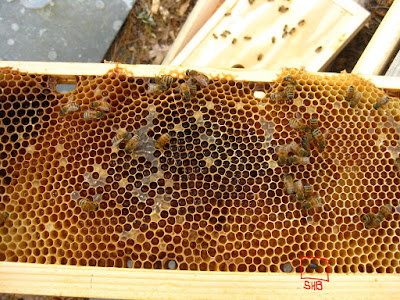
In the tiny swarm nuc, they still weren't building up in the second five frame medium box, but they had begun to store honey in the bottom box. Here's an example. At the lower right of the picture, I've drawn a square around a small hive beetle, calmly living in the hive.
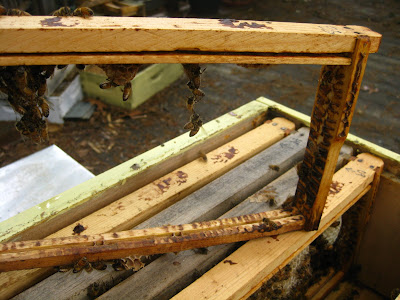
In Aristaeus2, I found the bees working in the top box, festooning as they build wax. A post on Beemaster right now deals with the feeling some beekeepers have of intruding on something private when you find the bees festooning.
I feel like the beekeepers who posted there - when I find festooning, the bees immediately take action to stop what they were doing. It feels like I have invaded their privacy and I want to leave them in peace. But before I left, I shot this picture. It's not the best festooning picture but you can see how the bees hang in a thread as they create wax.
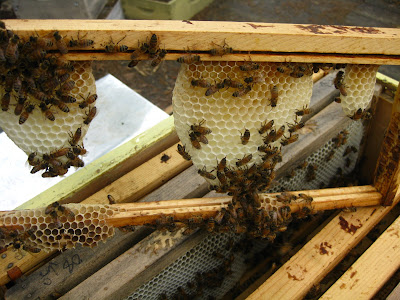
The picture below shows you how the bees first draw comb in a foundationless frame. They usually make these three startup combs and over time they fill out the frame entirely. You can't delineate these three starter parts when the frame is fully drawn. It's amazing to me that they can do this.
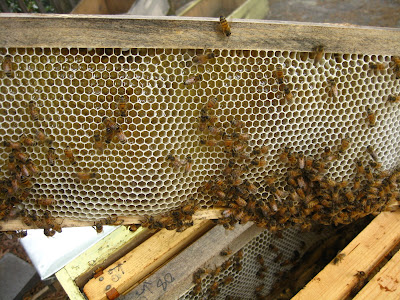
In this frame you can see how they took the frame and built it entirely out before storing nectar in it. If you look at the bottom of the picture you can see that the next frame in the box is built out the same way. They have just started work on this box in this hive. Only a few days ago there was NO wax in this box - just empty frames.

In the tiny swarm nuc, they still weren't building up in the second five frame medium box, but they had begun to store honey in the bottom box. Here's an example. At the lower right of the picture, I've drawn a square around a small hive beetle, calmly living in the hive.

In Aristaeus2, I found the bees working in the top box, festooning as they build wax. A post on Beemaster right now deals with the feeling some beekeepers have of intruding on something private when you find the bees festooning.
I feel like the beekeepers who posted there - when I find festooning, the bees immediately take action to stop what they were doing. It feels like I have invaded their privacy and I want to leave them in peace. But before I left, I shot this picture. It's not the best festooning picture but you can see how the bees hang in a thread as they create wax.

The picture below shows you how the bees first draw comb in a foundationless frame. They usually make these three startup combs and over time they fill out the frame entirely. You can't delineate these three starter parts when the frame is fully drawn. It's amazing to me that they can do this.

In this frame you can see how they took the frame and built it entirely out before storing nectar in it. If you look at the bottom of the picture you can see that the next frame in the box is built out the same way. They have just started work on this box in this hive. Only a few days ago there was NO wax in this box - just empty frames.


Wednesday, April 29, 2009
Great Article in NY Times about Honeybees
This is a wonderful article by Leon Kreitzman. His field of expertise is chronobiology and he writes about seasonal rhythms. The bees fit right into that picture. I'm not going to try to recreate the article here, but rather, just send you there!
Note: Many thanks to the GBA member who sent all of us in Georgia this link.
Note: Many thanks to the GBA member who sent all of us in Georgia this link.


Monday, April 27, 2009
Inspection at Blue Heron: The Good and The Bad
We had our second inspection of the hives at Blue Heron yesterday. Noah, Julia's son, led the inspection and did a fabulous job. He was well-informed, could answer questions, and gave the participants lots of helpful information.
One of the nice things about having two of us at the inspection is the proof of the old adage: Ask 10 beekeepers a question and you'll get 10 different answers. In fact, Julia and I do things a little differently so when questions were asked, there was a demonstration of the fact that beekeeping is a matter of choice. We all make decisions and not always the same decision!
In the bad news column, Julia's hive was filled with swarm cells and apparently no longer had the original queen. We counted 12 queen cells on the bottom of one frame. The hive was calm and didn't have a queenless roar when it was opened, however.
This may mean that there is a virgin queen in the hive who may or may not have successfully mated but at least is not yet laying. We decided to add a frame from one of my hives to her hive.
This is like an insurance policy. If the virgin queen is in the hive and just hasn't started up yet, the frame we added would provide a jump in numbers as the eggs and larvae mature. If there is no queen or an ineffective one, we gave the bees the resources to make a new queen.
Another choice that could be made is to order a new queen. Julia will have to decide if she wants to wait for the maturation of this queen or to do that.
Either way, the hive is now behind in the middle of the nectar flow. It will take about a month for the hive to be up and running well if they have to make their own queen - which will be half way through the nectar flow. And if they have a queen, they still will be behind since she isn't laying yet, but not as far behind.
On the good news side, my hive in which the bees made their own queen was thriving. We took a frame from that hive to add to Julia's. We didn't see the queen so we were very careful to make sure the queen didn't leave with the frame we gave to Julia's hive. There were good brood patterns and lots of eggs and larvae in that hive.
On the second hive of mine we saw the queen with remnants of her red dot - the bees frequently eat the paint off in the process of grooming the queen. She had been laying well also.
On all three hives the box we added about 2 1/2 weeks ago remained untouched, so we didn't add any further boxes although we had brought them along. Since we'd like to get honey from these hives, the slow progress in the middle of the nectar flow is a little discouraging, but my hives at home are doing exactly the same thing.
Below is a slide show of photographs from the inspection. Click on the slideshow to be able to view it larger and with captions for the pictures:
One of the nice things about having two of us at the inspection is the proof of the old adage: Ask 10 beekeepers a question and you'll get 10 different answers. In fact, Julia and I do things a little differently so when questions were asked, there was a demonstration of the fact that beekeeping is a matter of choice. We all make decisions and not always the same decision!
In the bad news column, Julia's hive was filled with swarm cells and apparently no longer had the original queen. We counted 12 queen cells on the bottom of one frame. The hive was calm and didn't have a queenless roar when it was opened, however.
This may mean that there is a virgin queen in the hive who may or may not have successfully mated but at least is not yet laying. We decided to add a frame from one of my hives to her hive.
This is like an insurance policy. If the virgin queen is in the hive and just hasn't started up yet, the frame we added would provide a jump in numbers as the eggs and larvae mature. If there is no queen or an ineffective one, we gave the bees the resources to make a new queen.
Another choice that could be made is to order a new queen. Julia will have to decide if she wants to wait for the maturation of this queen or to do that.
Either way, the hive is now behind in the middle of the nectar flow. It will take about a month for the hive to be up and running well if they have to make their own queen - which will be half way through the nectar flow. And if they have a queen, they still will be behind since she isn't laying yet, but not as far behind.
On the good news side, my hive in which the bees made their own queen was thriving. We took a frame from that hive to add to Julia's. We didn't see the queen so we were very careful to make sure the queen didn't leave with the frame we gave to Julia's hive. There were good brood patterns and lots of eggs and larvae in that hive.
On the second hive of mine we saw the queen with remnants of her red dot - the bees frequently eat the paint off in the process of grooming the queen. She had been laying well also.
On all three hives the box we added about 2 1/2 weeks ago remained untouched, so we didn't add any further boxes although we had brought them along. Since we'd like to get honey from these hives, the slow progress in the middle of the nectar flow is a little discouraging, but my hives at home are doing exactly the same thing.
Below is a slide show of photographs from the inspection. Click on the slideshow to be able to view it larger and with captions for the pictures:
Friday, April 24, 2009
Is there a Queen and Is she Laying?
The swarm I collected a couple of weeks ago looked like a secondary swarm and probably had a virgin queen. So the big questions are is there a queen and is she laying?
We've had terrible weather in Atlanta since I got this swarm and you never know how well it will do. The virgin queen had to brave wind, storm, hail, etc. to make the mating flight and get back in one piece. I had no idea if this had happened.
I was thrilled to open the hive today to find capped brood, lots of eggs and tiny larvae on two of the five frames in the bottom medium nuc box! If you can click on the pictures below, there are some good pictures of egg and tiny brood larvae. I was so thrilled!
In such a small hive, I should have been able to see the queen. I looked hard for her on the two frames of brood and larvae but didn't try too hard on the other frames. I was so relieved to see evidence of her.


My goal for this hive is for it to build up enough numbers and supplies to make it through the 2009 winter. We've gotten off to a good start. They are not in the upper box yet. The comb pictured below was all that had been made and the bees hadn't moved into this upper box.

Most of the time, the queen will only lay the amount of eggs that her workers can manage, so I suspect she is going slowly. She'll lay more and more as there are more workers to be nurse bees, and it will be a while before she gets into the second box. I'll bet that I move this hive into a full-sized box at the beginning of June - we'll see.
We have a Blue Heron inspection on Sunday that Julia is leading but we will inspect my hives in the process. We'll get to see if the "made" queen is laying and if the nuc hive is doing well. Decisions will be made about whether the hives need to be combined or if they can stay as two hives.
We've had terrible weather in Atlanta since I got this swarm and you never know how well it will do. The virgin queen had to brave wind, storm, hail, etc. to make the mating flight and get back in one piece. I had no idea if this had happened.
I was thrilled to open the hive today to find capped brood, lots of eggs and tiny larvae on two of the five frames in the bottom medium nuc box! If you can click on the pictures below, there are some good pictures of egg and tiny brood larvae. I was so thrilled!
In such a small hive, I should have been able to see the queen. I looked hard for her on the two frames of brood and larvae but didn't try too hard on the other frames. I was so relieved to see evidence of her.


My goal for this hive is for it to build up enough numbers and supplies to make it through the 2009 winter. We've gotten off to a good start. They are not in the upper box yet. The comb pictured below was all that had been made and the bees hadn't moved into this upper box.

Most of the time, the queen will only lay the amount of eggs that her workers can manage, so I suspect she is going slowly. She'll lay more and more as there are more workers to be nurse bees, and it will be a while before she gets into the second box. I'll bet that I move this hive into a full-sized box at the beginning of June - we'll see.
We have a Blue Heron inspection on Sunday that Julia is leading but we will inspect my hives in the process. We'll get to see if the "made" queen is laying and if the nuc hive is doing well. Decisions will be made about whether the hives need to be combined or if they can stay as two hives.
Drones and Drips
I checked on all of my own hives today to see if I needed to add a box to any of them. All of the hives were working in the box below the most recent addition, so I'm leaving them alone for another week.
In Bermuda, there was an opportunity to photograph a great drone. They look sort of like cigars - blunt on the end. Their eyes are huge compared to the workers in the picture. I saw drones walking around in every hive.

In Bermuda, the box below the top box is a shallow that I stuck on for honey production while I was not bee-ing and was away at my daughter's wedding. The queen is laying in two frames of the shallow. Here is a good shot that shows eggs in the early stages as well as very young larvae. There is also another good big-eyed drone photo op at the upper left corner.

In Mellona, one frame of honey was attached to the frame next to it. When I removed it, comb broke off creating a huges honey drip. The bees immediately marshall forces to repair the problem. I hate creating the drip, but watching the bees circle the edge of the honey puddle and work their way to the middle is fascinating. The ones in the circle around the comb are collecting the spilled honey.

In Aristaeus2, the queen has also been very active. She has also been laying in the third box. It is only an 8 frame box so brood in the third box is to be expected.

In Bermuda, there was an opportunity to photograph a great drone. They look sort of like cigars - blunt on the end. Their eyes are huge compared to the workers in the picture. I saw drones walking around in every hive.

In Bermuda, the box below the top box is a shallow that I stuck on for honey production while I was not bee-ing and was away at my daughter's wedding. The queen is laying in two frames of the shallow. Here is a good shot that shows eggs in the early stages as well as very young larvae. There is also another good big-eyed drone photo op at the upper left corner.

In Mellona, one frame of honey was attached to the frame next to it. When I removed it, comb broke off creating a huges honey drip. The bees immediately marshall forces to repair the problem. I hate creating the drip, but watching the bees circle the edge of the honey puddle and work their way to the middle is fascinating. The ones in the circle around the comb are collecting the spilled honey.

In Aristaeus2, the queen has also been very active. She has also been laying in the third box. It is only an 8 frame box so brood in the third box is to be expected.

Monday, April 13, 2009
Hive Check Easter Sunday
The tulip poplar flow began in Atlanta last week, so I am anxious that my hives take advantage of this, our best honey flow. I checked the boxes yesterday afternoon to see if any new boxes were needed.
On Saturday I had put a new box on Aristaeus2 (the swarm hive from last year) so I didn't expect it to need anything. I did peek in, but the bees were not happy to see me since I had disturbed them only the day before!
My daughter is getting married and I won't be paying attention to the bees next weekend, so before I get totally distracted by the wedding, I'll put a new box on both Bermuda and Mellona. Each of those hives is very active.
In Bermuda, with four boxes on the hive, the queen was avidly laying in the third box. The fourth box given to them to invite honey production still has three undrawn frames. I attributed the lack of wax work to the weather in the earlier part of last week when we had two nights in the 20s/30s - probably slowed them down a lot. So given warmer weather is on the way, I'll put a new box on Bermuda before I leave for the wedding.
Mellona also has a few undrawn frames in the top box and a very actively laying queen. I saw eggs everywhere. I'll, for the same reasons as Bermuda, give her a new box on Tuesday or Wednesday before I leave for the wedding.
When I lifted one of the honey frames out of Mellona, I unintentionally ripped wax off of the tops of a 1 1/2 inch vertical strip of honey stored. The bees anxiously recollected the honey from the tops of the frames. In the picture below they are congregating around a drip of honey.

In Aristaeus2 they were drawing wax in the new box I had given them. I'm sorry for the unfocused picture. I think the camera thought I wanted it to focus on the deck rather than the honeycomb! I'll try to pay better attention to the focus next time because I loved seeing the bees in action.

In Blue Heron news, I added a box to both hives on Friday morning and added a box to Julia's hive. Her hive still had undrawn frames and seemed lackluster by comparison to the other two. There have been four swarms seen or captured in the vicinity of the Blue Heron hives and I wonder if her hive has swarmed.
While I was there on Saturday, (and I didn't have my camera #$&#$&) Kevin, the overseer of the garden, was moving a swarm that he collected on Friday night just before the tornadic rains came down. He had had it in a temporary box arrangement and was moving it to a real hive box.
The swarm was hived in a cluster around the queen in the hive box but a handful about the size of a baseball remained on the tree where they had been found. He, his brother Peter, and I looked carefully through the "baseball" and didn't see a queen. We surmised that the bees were still drawn to the queen pheromone that remained where she had been on the branch.
Our decision was to cut the branch and move it bees and all to sit in front of the hive to see if the bees would move to the stronger smell of the queen from within the hive. I wish I had pictures.
Lesson learned: Always have the camera in the car (and an extra hive tool) - you never know!
SHB note: Still not a sign of small hive beetles in the hive with the Freeman trap on it. To be fair, I didn't see a single small hive beetle in any hive yesterday.
On Saturday I had put a new box on Aristaeus2 (the swarm hive from last year) so I didn't expect it to need anything. I did peek in, but the bees were not happy to see me since I had disturbed them only the day before!
My daughter is getting married and I won't be paying attention to the bees next weekend, so before I get totally distracted by the wedding, I'll put a new box on both Bermuda and Mellona. Each of those hives is very active.
In Bermuda, with four boxes on the hive, the queen was avidly laying in the third box. The fourth box given to them to invite honey production still has three undrawn frames. I attributed the lack of wax work to the weather in the earlier part of last week when we had two nights in the 20s/30s - probably slowed them down a lot. So given warmer weather is on the way, I'll put a new box on Bermuda before I leave for the wedding.
Mellona also has a few undrawn frames in the top box and a very actively laying queen. I saw eggs everywhere. I'll, for the same reasons as Bermuda, give her a new box on Tuesday or Wednesday before I leave for the wedding.
When I lifted one of the honey frames out of Mellona, I unintentionally ripped wax off of the tops of a 1 1/2 inch vertical strip of honey stored. The bees anxiously recollected the honey from the tops of the frames. In the picture below they are congregating around a drip of honey.

In Aristaeus2 they were drawing wax in the new box I had given them. I'm sorry for the unfocused picture. I think the camera thought I wanted it to focus on the deck rather than the honeycomb! I'll try to pay better attention to the focus next time because I loved seeing the bees in action.

In Blue Heron news, I added a box to both hives on Friday morning and added a box to Julia's hive. Her hive still had undrawn frames and seemed lackluster by comparison to the other two. There have been four swarms seen or captured in the vicinity of the Blue Heron hives and I wonder if her hive has swarmed.
While I was there on Saturday, (and I didn't have my camera #$&#$&) Kevin, the overseer of the garden, was moving a swarm that he collected on Friday night just before the tornadic rains came down. He had had it in a temporary box arrangement and was moving it to a real hive box.
The swarm was hived in a cluster around the queen in the hive box but a handful about the size of a baseball remained on the tree where they had been found. He, his brother Peter, and I looked carefully through the "baseball" and didn't see a queen. We surmised that the bees were still drawn to the queen pheromone that remained where she had been on the branch.
Our decision was to cut the branch and move it bees and all to sit in front of the hive to see if the bees would move to the stronger smell of the queen from within the hive. I wish I had pictures.
Lesson learned: Always have the camera in the car (and an extra hive tool) - you never know!
SHB note: Still not a sign of small hive beetles in the hive with the Freeman trap on it. To be fair, I didn't see a single small hive beetle in any hive yesterday.
Friday, April 10, 2009
Swarm is Settling In to New Home
I borrowed a frame of honey from another hive to fill the empty space in the medium nuc.

I opened the nuc to find the bees busy at work, cleaning and settling in. I was easily able to insert the frame of honey to add to their jump start.

My grandson came out to watch the settling in process.

I have a reduced entrance and the bees are falling all over themselves as they enter and leave their new home.


I opened the nuc to find the bees busy at work, cleaning and settling in. I was easily able to insert the frame of honey to add to their jump start.

My grandson came out to watch the settling in process.

I have a reduced entrance and the bees are falling all over themselves as they enter and leave their new home.

Subscribe to:
Posts (Atom)
Pin this post

LinkWithin
