


Starting the smoker by Romas, the Musteikiai, a set on Flickr. Click on the link at the beginning of the sentence to see the entire slide show and not just these thumbnails.
Romas uses flint to start his smoker and a dried mushroom as his first fuel. He then stokes his smoker with dried wood chips. It was a fascinating process.Friday, July 26, 2013


Beekeeper in Musteikiai Village


Beekeeper in Musteikiai Village, a set on Flickr. Click on the link at the beginning of the first sentence to see the entire slide show instead of just these thumbnails.
On our second day in Lithuania, we visited Romas, a beekeeper who practices ancient ways of beekeeping in Musteikiai Village, very near the Poland and Belarus borders in southeast Lithuania. These are photos of his museum and set up there.
Thursday, July 25, 2013
So Why Go to Lithuania on a Beekeeping Tour?
One might well ask.
I got an email from Simona Cibirkaite at the Visit Lithuania travel agency in Vilnius. The trip sounded interesting and I thought it would be neat to meet beekeepers from another country.
When Julia, Noah and I signed up for this, it sounded like a lark and lots of fun. We've travelled together before - to a beekeeping conference in Massachusetts last summer and every year to Young Harris where although we don't drive up together, we hang out for the whole conference.
My mother was certain I was never coming back home. My children wanted to know where my will was. My son-in-law was sure it would be like the tours in Everything is Illuminated. But despite all of the doubt from others, we had a fabulous experience in Lithuania and I'd love to go back again. What a gorgeous countryside and what interesting beekeeping traditions were there!
When we got there, we were so pleasantly surprised to find out that beekeeping is a cornerstone of Lithuanian history and culture. Our wonderful guide, Lukas, explained on the first day that beekeeping has been an important part of Lithuania for hundreds of years (I think he may have said thousands!). The goddess of beekeeping, Austėja, is a very common girl's name in Lithuania.
There are actually two gods of beekeeping in that country, Austėja (pronounced ous-stay-uh) who is the goddess of fertility and a protector. In 2005 Austeja was the fifth most popular girl's name in the country, according to Wikipedia.
Here is Austeja:
 At Romas' bee museum
 Austeja at the museum of ancient beekeeping on our next to last day.
The other pagan god was Babilas - he was like a drone - a sort of good for nothing consumer, gluttenous and hairy.


I got an email from Simona Cibirkaite at the Visit Lithuania travel agency in Vilnius. The trip sounded interesting and I thought it would be neat to meet beekeepers from another country.
When Julia, Noah and I signed up for this, it sounded like a lark and lots of fun. We've travelled together before - to a beekeeping conference in Massachusetts last summer and every year to Young Harris where although we don't drive up together, we hang out for the whole conference.
My mother was certain I was never coming back home. My children wanted to know where my will was. My son-in-law was sure it would be like the tours in Everything is Illuminated. But despite all of the doubt from others, we had a fabulous experience in Lithuania and I'd love to go back again. What a gorgeous countryside and what interesting beekeeping traditions were there!
When we got there, we were so pleasantly surprised to find out that beekeeping is a cornerstone of Lithuanian history and culture. Our wonderful guide, Lukas, explained on the first day that beekeeping has been an important part of Lithuania for hundreds of years (I think he may have said thousands!). The goddess of beekeeping, Austėja, is a very common girl's name in Lithuania.
There are actually two gods of beekeeping in that country, Austėja (pronounced ous-stay-uh) who is the goddess of fertility and a protector. In 2005 Austeja was the fifth most popular girl's name in the country, according to Wikipedia.
Here is Austeja:
 At Romas' bee museum
 Austeja at the museum of ancient beekeeping on our next to last day.
And here is Babilas:

There was reverence for the colony in the hive and they were called in the Lithuanian language the family. This is still how beekeepers refer to the colony. The beekeeper at the Nine Honey Apiary that we visited kept talking about the family in each hive. The queen was called in Lithuanian, the mother - motina or motinella (little mother).

In Lithuanian the word for death for bees is the same as the word for death for humans. They have a different word for death for other animal and insect species. In other words, in the Lithuanian language, the bee is held in as high esteem as the human, unlike other species.
Here is a great write-up about how the bee museum guide describes the bee/human relationship.
At our candle-making workshop (photos in another post), the guide told us that the beekeeper was revered in Lithuanian society at the same level as the priest. People removed their hats when they saw the beekeeper. In a community, if there was a need, the beekeeper often sat as judge over disputes.
When the bees would swarm, the beekeepers followed the swarms and made friends with the people on whose land the swarms took up residence. Sometimes marriages were made through following the swarm. Even today, although people in Lithuania may not realize the origin of the word, best friends are called bičiulis - which is a derivative of the word for bee: bite - and means dear fellow beekeeper. Simona, the tour director, wrote us just yesterday with the emails for the beekeepers whom we visited and suggested that we might become “biciuliai” with them.
The Lithuanians sold stones of wax that each weighed 16 kilos all through Europe. The purchasers needed the wax to make cannons and bells, using the lost wax process. Lithuania was the biggest producer of wax and honey in all of Europe.
Side note: We didn't learn much Lithuanian while we were there, but our guide, Lukas, taught us to count to ten. We also learned and said a lot, the Lithuanian word for thank you that sounds like "Achoo." The other person responds, "Brashom," which often to me sounded like "Bless You." So we went around saying Achoo and receiving Bless You throughout our journey!
Sunday, July 21, 2013
Visit to a Lithuanian Apiary

It was raining as we arrived which limited our ability to get into the hives and it was late in the afternoon. He did lift up the tops of many hives to let us see, however. The traditional Lithuanian hive is a large box surrounding the hive. It has handles like drawers. In essence it is a chest to hold the hive. Inside they have a deep box of frames for the brood. They put another box on top of it for the honey. That's it. They harvest as the bees fill it and do not super in these old time boxes.
We visited his old fashioned apiary with interesting insulated as well as HUGE boxes but those photos are on my camera and I can only post photos from here in Lithuania that are on my iPhone or iPad. So you'll see those when I'm back in Atlanta. Now I'm in Atlanta, so click here to see all of the photos. Some of the boxes we saw before my camera battery ran out were old large boxes. Inside each had a couch/chair cushion as insulation against the cold.
When we got to the apiary below, I used my cell phone as a camera since my camera battery had lost its charge.
When we got to the apiary below, I used my cell phone as a camera since my camera battery had lost its charge.

We also went to his friend's apiary who uses Langstroth boxes. In Lithuania the beekeepers are dealing with cold conditions so they cover the tops of their boxes with food grade plastic. This helps with warmth but Julia and I wondered about hive ventilation.
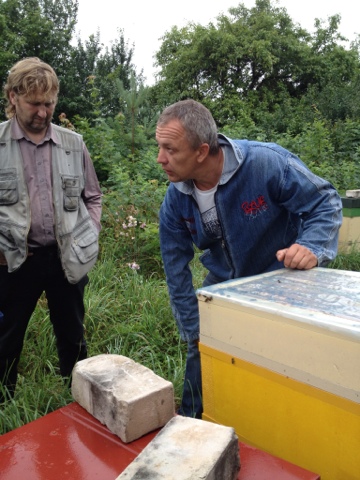
This beekeeper uses screen bottom boards and adds a completely empty box under his hive in winter to add another layer of space between the bees and the cold. They put foam board under the hive tops and the exterior walls of the hives are thicker.
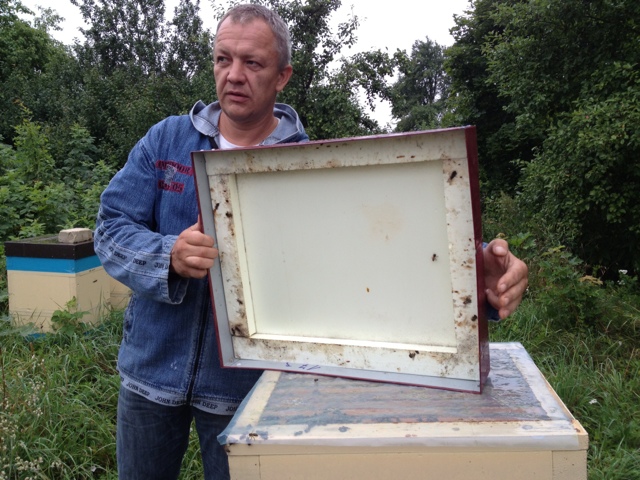
We laughed when he used his cigarette as his smoker! I've known that some beekeepers do that but have never seen it in action! The entrance is a hole drilled through the foam board.


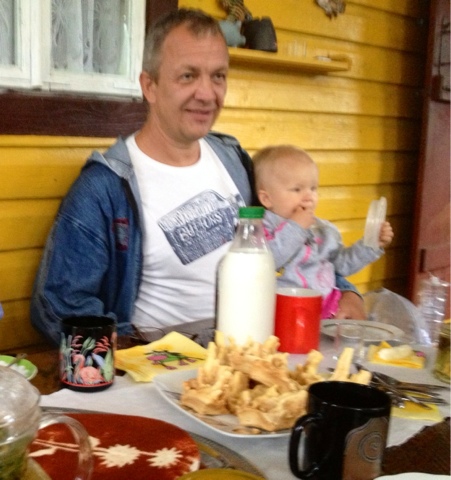
After visiting with them - BTW, they spoke no English and we spoke no Lithuanian, so our guide translated all of the conversations - we went to one of their houses and were treated to beekeeping and Lithuanian delights.


We tasted Linden honey as well as honey that was a mix of Linden and raspberries. We had their traditional tree cake and tasted Lithuanian cheese with honey. Julia and I each downed a shot glass of Lithuanian mead which isn't what we call mead at all. This was 50% alcohol and burned all the way down! Whoooooo!

The beekeepers' daughter was named Austeja for the Lithuanian bee goddess!
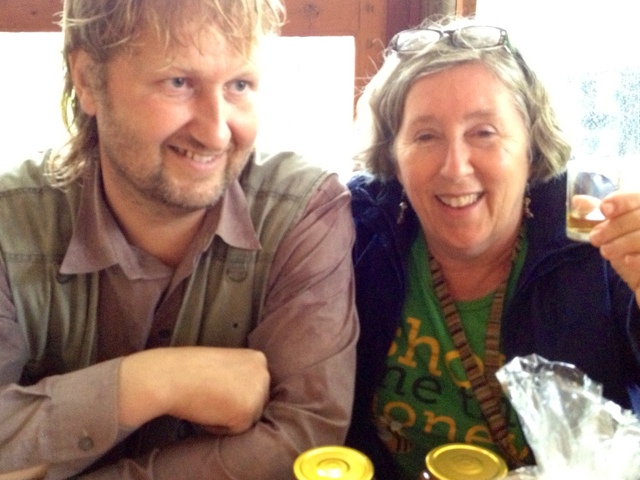
We don't keep bees the same way. Solys was quite displeased that Julia and I practice treatment free beekeeping. He is a great proponent of oxalyic acid for Varroa treatment and thinks it is wrong not to use it on your bees. I don't think oxalyic acid has yet been approved as a treatment in Georgia, but I still think no treatment and splitting the colonies that survive the winter is the way to go.
Subscribe to:
Posts (Atom)
Pin this post

LinkWithin
