While I was checking on my own hives, I discovered that one needed a new box. I decided to video the process of checkerboarding.
There are two ways to employ checkerboarding to open up space in your hive. First is in the early spring when you checkerboard an overwintered hive to fool the bees into thinking they don't need to swarm because there is plenty of space. In this instance, you move every other frame in the top box of the hive into an empty box and replace their previous space in the old box with empty frames. You do this with the honey box that is typically above the brood nest. This gives the bees more space to use and may interrupt their desire to swarm for more space.
Michael Bush wrote this on Beemaster to explain the basics of checkerboarding:
"For a bee colony:
o Survival is the primary motivation
- Survival of the existing colony takes priority.
- Bees will not do a reproductive swarm if they perceive it to jeopardize survival of the existing colony.
o Survival of the species runs a close second.
- Generation of a reproductive swarm is the secondary objective of every over-wintered colony.
- The over-wintered colony expands the brood volume during the build-up by consumption of honey.
- When the colony has expanded the brood nest to the amount of reserve that they consider appropriate, they are now able to move into the swarm preparation phase.
- The first activity of swarm preparation is to reduce the brood volume by providing additional stores. As brood emerges, selected cells are filled with nectar or pollen.
- Alternating empty drawn combs above the brood nest "fools" the bees into thinking they don't have enough stores yet for swarming and causes them to expand the brood nest, giving both a bigger field force and avoiding reproductive swarming.
During honey production, checkerboarding can help open up room for honey production. In fact the bees will not draw wax or store nectar when there is no nectar flow. I've found during the nectar flow, though, that employing checkerboarding in honey boxes increases the storage of honey. I did this in my hive today (we are still in an ongoing nectar flow).
I use foundationless frames and it is essential to provide checkerboarding when you add a box of foundationless frames. The full frames moved up to a new box provide a "ladder" for the bees to get to the tops of the frames to draw wax.
Here is a video of how to do it:
Sunday, May 03, 2020
Saturday, May 02, 2020
Hive Inspection during the coronavirus - Inspection on May 1, 2020
We can't gather in groups and I continue to offer virtual hive inspections to members of my local bee club, including the people who took our short course this year. Every virtual inspection has about 15 people in attendance and while some people come more than once, I also have new people each time.
In this inspection one of the key things was to notice the difference in honey production between the over-wintered nuc, the swarm I installed on March 11, and the tiny new hive from a three frame nuc in a queen castle. My biggest conclusion after I made this video is that the three frame nuc hive needs to be in a nuc and not in a hive. The space is just too big for them. I will move the hive into a stacked nuc hive before the next inspection.
In this inspection one of the key things was to notice the difference in honey production between the over-wintered nuc, the swarm I installed on March 11, and the tiny new hive from a three frame nuc in a queen castle. My biggest conclusion after I made this video is that the three frame nuc hive needs to be in a nuc and not in a hive. The space is just too big for them. I will move the hive into a stacked nuc hive before the next inspection.
Sunday, April 26, 2020
MapMyDCA.com and my friend Julia
My friend and beekeeping buddy, Julia Mahood, is a multi-talented woman. Among other things, she designed the license plate now sported by lots of Georgia cars; she was beekeeper of the year for GBA in 2018; and she is a Master Beekeeper. She, her son Noah, and I went together to Lithuania on a beekeeping tour back in 2013.
Always up for becoming an even better beekeeper, she is working on her Master Craftsman level of certification. The focus of her research for this is the drone bee. She has developed a citizen science website for mapping where the drone congregation areas are throughout the world. If you know where one is or are just interested in drones and their behavior, you'd enjoy her website.
So imagine my delight when wallowing in the middle of the depression of social isolation and never seeing anyone I care about in person, Julia suggested that I meet her in a field where she is catching and marking drones. It would be easy to do that and stay six feet apart!
I believe the way it works is she is interested in how often drones who don't "get lucky" return to the same DCA. She catches drones, marks them in a color representing this DCA, releases them and returns another day to see how many of her painted drones she catches a second time.
On this day, she was using a helium weather balloon for catching the drones.


The helium weather balloon is about a yard in diameter if not a little larger and flies high above the trees. If you look at the photo of Julia holding the balloon down at a lower height, you can see the trap hanging about ten feet below the balloon. The trap has a velcro part at the top where the drones can't escape.
Julia told me that drones only have enough fuel to fly for thirty minutes before they need to be back in the hive for more honey (fuel). So she flies her balloon for about five minutes at a time and takes three minutes or so to mark the drones before releasing them and sending them on their way.
In the photo below, if you look closely, you can see lots of little black dots, all of which are the comet of drones trailing the trap. The trap is baited with queen lure hanging in it (which entices the drones). I am sure the little black dots are all drones - Atlanta air in the pandemic is remarkably clean because there are no cars on the road since everyone is staying home!


Always up for becoming an even better beekeeper, she is working on her Master Craftsman level of certification. The focus of her research for this is the drone bee. She has developed a citizen science website for mapping where the drone congregation areas are throughout the world. If you know where one is or are just interested in drones and their behavior, you'd enjoy her website.
So imagine my delight when wallowing in the middle of the depression of social isolation and never seeing anyone I care about in person, Julia suggested that I meet her in a field where she is catching and marking drones. It would be easy to do that and stay six feet apart!
I believe the way it works is she is interested in how often drones who don't "get lucky" return to the same DCA. She catches drones, marks them in a color representing this DCA, releases them and returns another day to see how many of her painted drones she catches a second time.
On this day, she was using a helium weather balloon for catching the drones.


The helium weather balloon is about a yard in diameter if not a little larger and flies high above the trees. If you look at the photo of Julia holding the balloon down at a lower height, you can see the trap hanging about ten feet below the balloon. The trap has a velcro part at the top where the drones can't escape.
Julia told me that drones only have enough fuel to fly for thirty minutes before they need to be back in the hive for more honey (fuel). So she flies her balloon for about five minutes at a time and takes three minutes or so to mark the drones before releasing them and sending them on their way.
In the photo below, if you look closely, you can see lots of little black dots, all of which are the comet of drones trailing the trap. The trap is baited with queen lure hanging in it (which entices the drones). I am sure the little black dots are all drones - Atlanta air in the pandemic is remarkably clean because there are no cars on the road since everyone is staying home!

Once back on the ground, Julia takes the drones out of the trap one at a time; marks their backs with a permanent red marker and releases them. At another nearby DCA, she uses a yellow marker. So if she sees her red-marked drones in the yellow district, she knows that the red-painted drone frequents more than one DCA.


It was interesting to look closely at the netting of the trap - it's a wide netting and very soft, unlike what I have seen in fabric stores.

At the end of the whole process (Julia has found that she catches the most drones in the 4PM - 5PM time slot), she puts the balloon in her car and drives home very carefully because the balloon is so BIG that the hatchback will not fully close!

Julia's project has made me much more interested in the drones in my hive and more curious about their behavior in general.
Labels:
DCA,
DCAs,
drone,
drone congregation areas,
drones,
Mahood,
mapmydca.com,
tracking drones,
weather balloon


Inspection of the Community Garden Hives April 24, 2020
On April 24, I videoed an inspection of the three hives at the community garden. In this time of COVID-19, we can't do gathering around the hives to inspect and this is a way to share how an inspection might go with new and old beekeepers.
I have bad timing for these videos. Most of the time, it's windy on the hill, but this time we were plagued with yard guys - incredibly noisy yard guys! First Jeff and I went to the garden to put on the robber screens and the Georgia Power people were weed whacking the garden. They stood to get their photos with us doing our bee work in the background.
Then several days later, I went to the garden to video the actual inspection. This time the yard guys from the house next door began loud leaf blowers or weed whackers as soon as I opened the hive. ARGHHH.
When I show these videos to the Metro Atlanta Beekeepers, we do it in a Zoom meeting with lots of questions and interaction. So far I haven't recorded the meetings. Maybe I should but for now,
here's the video:
I have bad timing for these videos. Most of the time, it's windy on the hill, but this time we were plagued with yard guys - incredibly noisy yard guys! First Jeff and I went to the garden to put on the robber screens and the Georgia Power people were weed whacking the garden. They stood to get their photos with us doing our bee work in the background.
Then several days later, I went to the garden to video the actual inspection. This time the yard guys from the house next door began loud leaf blowers or weed whackers as soon as I opened the hive. ARGHHH.
When I show these videos to the Metro Atlanta Beekeepers, we do it in a Zoom meeting with lots of questions and interaction. So far I haven't recorded the meetings. Maybe I should but for now,
here's the video:
Wednesday, April 22, 2020
Attention: The Queen has Arrived
For four years, I have been the beekeeper at SPARK Elementary School in Atlanta. It's a public school with an amazing para-pro, Meghan M, who has a beautiful organic garden and teaches the children all about nature. She helps them grow plants, teaches them about the bees, and is very creative in the ways she explains nature to them in active, hands-on ways.
Over the past winter, we lost both beehives and I was really upset because the bees had survived treatment free for so long and the hives were about seven years old. We set the hives up with swarm lure and crossed our fingers while we waited for two nucs that we ordered.
Then before time to pick up the nucs, the coronavirus arrived. Luckily our swarm lure worked and a swarm moved into one of the hives. We were ecstatic. But then the schools closed for the year and we couldn't access the building to check on the swarm. On the first Monday after the schools closed, a day when the teachers were allowed in, we met in the morning and checked on the hive, which looked good. We set it up with an extra box, just in case, and barely looked at it because of time constraints, planning to come back the next week.
As the nation became aware of the severity of the virus, access to the school was no longer allowed. I was worried about the hive and didn't feel like it would be OK without our getting to look at it and add a nectar/honey box. But last week, the principal was going to be there and we could go check on our hive!
Meghan and I opened the hive and pulled out frame after frame of honey and nectar. There was no brood anywhere, not anywhere. The hive would have died in a matter of a couple of weeks without a queen.
"I have to go pull a frame of brood and eggs from one of my hives," I told Meghan. "I can be back in 30 minutes." With a frame of brood and eggs, the bees in the hive could make a new queen.
I rushed home, opened one of my hives and pulled a frame of brood and eggs. "HURRY," Meghan texted me. The security guard had announced that only the principal and the cleaning staff could be in the building, but since we were saving the life of the hive (Meghan must have been really convincing), we could stay only long enough to insert the frame of brood and eggs.
Back up to the rooftop garden we rushed, and I took off the top and inserted the frame of brood and eggs into the middle box. I removed a frame of honey to make room for the frame and gave it to Meghan to take home and harvest. With the top back on the hive, I looked down at the entry to see how things looked and something amazing happened.
The bees were standing at attention, frozen and all facing the same way. I'm almost 100% sure I saw a queen bee enter the hive. I thought of how we rise for royalty and this must be the bees' version!

Then Meghan told me and I read in Mark Winston that the bees often freeze on the front landing and emit nasonov to help a queen on her mating flight find her way home.
Sometimes swarms, once they are settled, get rid of the old queen who came with them to get them started and make a new queen. This must be what had happened in the six weeks since the school closed. Meghan grabbed her phone and made a wonderful movie to share with the school students, now studying at home, on this Earth Day. And she gave me permission to share it with you. Video made by Meghan McCloskey for SPARK Elementary and shared here with permission. Watch to see the bees standing at attention.
Today is Earth Day - love the Google logo for today - featuring honeybees.
Over the past winter, we lost both beehives and I was really upset because the bees had survived treatment free for so long and the hives were about seven years old. We set the hives up with swarm lure and crossed our fingers while we waited for two nucs that we ordered.
Then before time to pick up the nucs, the coronavirus arrived. Luckily our swarm lure worked and a swarm moved into one of the hives. We were ecstatic. But then the schools closed for the year and we couldn't access the building to check on the swarm. On the first Monday after the schools closed, a day when the teachers were allowed in, we met in the morning and checked on the hive, which looked good. We set it up with an extra box, just in case, and barely looked at it because of time constraints, planning to come back the next week.
As the nation became aware of the severity of the virus, access to the school was no longer allowed. I was worried about the hive and didn't feel like it would be OK without our getting to look at it and add a nectar/honey box. But last week, the principal was going to be there and we could go check on our hive!
Meghan and I opened the hive and pulled out frame after frame of honey and nectar. There was no brood anywhere, not anywhere. The hive would have died in a matter of a couple of weeks without a queen.
"I have to go pull a frame of brood and eggs from one of my hives," I told Meghan. "I can be back in 30 minutes." With a frame of brood and eggs, the bees in the hive could make a new queen.
I rushed home, opened one of my hives and pulled a frame of brood and eggs. "HURRY," Meghan texted me. The security guard had announced that only the principal and the cleaning staff could be in the building, but since we were saving the life of the hive (Meghan must have been really convincing), we could stay only long enough to insert the frame of brood and eggs.
Back up to the rooftop garden we rushed, and I took off the top and inserted the frame of brood and eggs into the middle box. I removed a frame of honey to make room for the frame and gave it to Meghan to take home and harvest. With the top back on the hive, I looked down at the entry to see how things looked and something amazing happened.
The bees were standing at attention, frozen and all facing the same way. I'm almost 100% sure I saw a queen bee enter the hive. I thought of how we rise for royalty and this must be the bees' version!

Then Meghan told me and I read in Mark Winston that the bees often freeze on the front landing and emit nasonov to help a queen on her mating flight find her way home.
Sometimes swarms, once they are settled, get rid of the old queen who came with them to get them started and make a new queen. This must be what had happened in the six weeks since the school closed. Meghan grabbed her phone and made a wonderful movie to share with the school students, now studying at home, on this Earth Day. And she gave me permission to share it with you. Video made by Meghan McCloskey for SPARK Elementary and shared here with permission. Watch to see the bees standing at attention.
Today is Earth Day - love the Google logo for today - featuring honeybees.
Saturday, April 18, 2020
Inspection of Community Garden Hives on April 17, 2020
Today we had a virtual hive inspection since we can't gather in groups to do an in-person hive inspection in Atlanta for quite some time to come. Here is the video of the inspection. I didn't know that my iPhone can film video on landscape because my old iPhone couldn't, so going forward I will put the phone in landscape orientation which should be better!
This inspection includes the installation of a nuc as well as the usual inspection of the two community garden bee hives.
Here it is, FWIW:
This inspection includes the installation of a nuc as well as the usual inspection of the two community garden bee hives.
Here it is, FWIW:
Saturday, April 11, 2020
Fourth MABA hive inspection
This is the fourth hive inspection (third video) done virtually to help those beekeepers who want to be a part of a group hive inspection and are staying at home because of the coronavirus. I am posting a video after each virtual hive inspection. I offer these inspections in my role as hive inspection chair for 2020 for MABA. The advantage of being a MABA member is that you can come to the virtual inspections and be a part of the QandA as well as the discussion, but even without belonging to MABA (MetroAtlanta Beekeepers Association), you can see these videos after the fact.
I thought my video was recording when I opened the first hive and didn't discover that it was not until halfway through the inspection. To make up for it, I added a short inspection of my top bar hive to the end of this video. My hands shake all the time, but they were really shaky during this video because I was so stressed that the video had not been running.
In the middle of the video I put in a slide about how to checkerboard and at the end of one section some photos illustrating how you rubberband crooked comb since you can't see me do the repair in the video.
This one wasn't my best, but I am putting it up for continuity of the record.
I thought my video was recording when I opened the first hive and didn't discover that it was not until halfway through the inspection. To make up for it, I added a short inspection of my top bar hive to the end of this video. My hands shake all the time, but they were really shaky during this video because I was so stressed that the video had not been running.
In the middle of the video I put in a slide about how to checkerboard and at the end of one section some photos illustrating how you rubberband crooked comb since you can't see me do the repair in the video.
This one wasn't my best, but I am putting it up for continuity of the record.
Review of Installing a Package
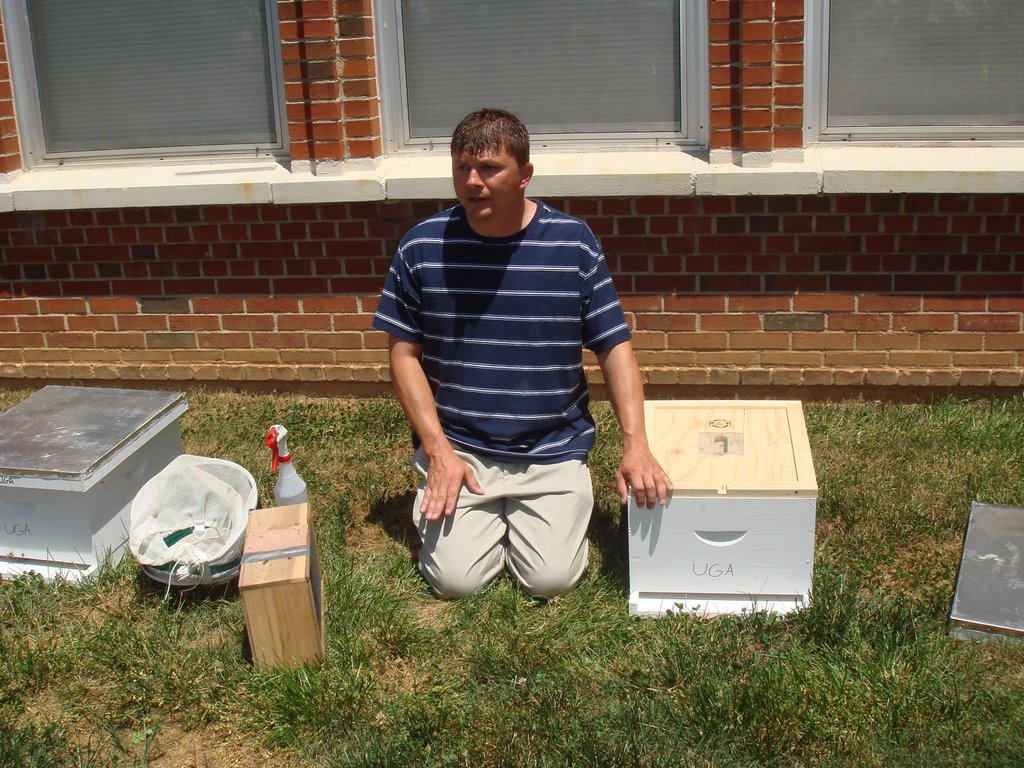
Back in May, 2007 when I was first learning about beekeeping (I started in 2006), I watched Bill Owens install a package at Young Harris and took photos (didn't have movie capability back then on my camera). Since people are receiving packages now and needing to install them, I thought it might be helpful to see this demo. Now Blogger won't let me edit a post that old, and the slides/photos from that post have disappeared (along with Picasa). If you want to read the post, click here.
The photos are resurrected here:


The photos are resurrected here:


Subscribe to:
Posts (Atom)
Pin this post

LinkWithin
