This is the tale that began in 2006 in my first year of beekeeping in Atlanta, GA. ...there's still so much to learn.
Welcome - Explore my Blog
I've been keeping this blog for all of my beekeeping years and I am beginning my 19th year of beekeeping in April 2024. Now there are more than 1300posts on this blog. Please use the search bar below to search the blog for other posts on a subject in which you are interested. You can also click on the "label" at the end of a post and all posts with that label will show up. At the very bottom of this page is a list of all the labels I've used.
Even if you find one post on the subject, I've posted a lot on basic beekeeping skills like installing bees, harvesting honey, inspecting the hive, etc. so be sure to search for more once you've found a topic of interest to you. And watch the useful videos and slide showson the sidebar. All of them have captions. Please share posts of interest via Facebook, Pinterest, etc.
I began this blog to chronicle my beekeeping experiences. I have read lots of beekeeping books, but nothing takes the place of either hands-on experience with an experienced beekeeper or good pictures of the process. I want people to have a clearer picture of what to expect in their beekeeping so I post pictures and write about my beekeeping saga here.Master Beekeeper Enjoy with me as I learn and grow as a beekeeper.
When a swarm issues from a beehive, the bees gather around the swarming queen on a bush or tree and cluster together. They aren't just resting and they aren't settling in for the long haul. Instead the swarm is sending out scouts every minute to find a new home for the hive. As the scouts return to the swarm, they dance on the surface of the swarm and campaign for the place they think would be a good home.
Tom Seeley explains in Honeybee Democracy that the dancing scouts are trying to convince other bees to go scout out the place they have found. If the convinced bees visit the new home and like it, they return and campaign to get others to go. If the bee doesn't find the place appealing, she returns and doesn't name call or belittle the choice. She doesn't bully the bees who want to move to the new place. She just doesn't campaign for it or try to get any of her sisters to go and visit.
In the end, some new home place will have convinced enough bees in the swarm that it is a good place to resettle. The swarm rises from the tree or bush and flies to the new place and moves in.
But if a beekeeper comes along and captures the swarm, we interfere with honey bee democracy. We have autocratically decided that our hive box is where this hive should live.
Sometimes the bees don't agree.
I have an apiary site in the community garden at Morningside in Atlanta. Like many community gardens, this one is on Georgia Power land and huge power lines run over the hillside apiary site. Georgia Power "maintains" the land because it belongs to them. I put maintains in quotation marks because they do not go near the beehives and the grass grows very tall there.
I don't think the bees like the power lines. I have housed three swarms on that hillside over the years and not a one of them stayed.
Most recently I caught another swarm on April 4. I think it was from my own hive. I have a very large hive that has now swarmed three times. It had some beautiful queen cells in it - huge. One had opened and the others seemed to be left untouched. The first swarm I took to Morningside and they didn't stay.
I think the second queen was in a small swarm about fifty yards from my house. My neighbor who didn't know I would come to get it, promised it to someone else, but I feel pretty sure they were from my beehives. By the time the person she called returned to Atlanta, the bees had left for parts unknown.
As I was driving home from out of town on April 4, my neighbor called me to report that he had seen a huge swarm swirling around in his backyard (just over the fence from my hives) and that it had landed in a shrub across the street. I was about an hour from Atlanta and told him I would rescue them as soon as I returned if they were still there. They were and here is the capture in my new box from Hive Butler:
I decided to house these in a hive in my backyard, about fifty yards from their original hive and this time I put a queen "includer" under the hive between it and the opening to keep the queen in the hive for a day and discourage them from leaving. It then poured rain the entire next day and I couldn't remove the queen includer until Wednesday (almost 48 hours later). I was worried that the bees would still leave, but they did not.
Instead I discovered an odd phenomenon yesterday (April 11). In front of the hive was this ball of bees. I sat down with my veil on and took a tiny stick and tried literally to get to the bottom of it. But the bees were determined to keep this ball going and stung me and wouldn't let me interfere. I noticed that the bees in the hive were continuing to fly in and out with high numbers and regularity. They did not feel pulled to gather with the ball of bees on the ground. Here's what the bee ball looked like:
From the cinder block corner in the upper right, you can see how close they are to the hive. As I disrupted them a bit with the stick, I thought I saw a queen bee but can't be sure. My theory is that like many secondary swarms, this one left its hive with more than one queen. Possibly both queens left to mate and this one was the second one to return. The bees now have a mated queen in the hive and the bees don't want two, so they are balling her to death.
Note: Sometimes hives do have two queens but typically when that happens, it's a mother and a daughter. These two would be sisters. (Need to do more research about this.)
This morning I went out, hoping to find in the grass whatever dead thing they were on top of, and this is what I saw:
The ball is still there - not as active. I expect that some of these bees are dead. Maybe later today I can get to the bottom of it, but I still think what is under the ball is a second queen. I'll know more when I inspect the captured swarm hive in about a week to see if they have a functioning queen.
Bees often ball to death intruders in the hive - like hornets - but I haven't seen hornets yet this year and I'm betting on this being a queen.
Meanwhile, aren't bees the most interesting creatures in the whole world?
At 2 PM the next day (today), the cluster/ball was much smaller. I took a stick and stirred up the bottom and indeed, it was a queen bee. If you have any doubt as you look at the photo (she is curved into a C shape), you can see that her wings end and her abdomen extends about 1/3 longer than her wings.
We'll know for sure next week when I inspect to see a laying queen, but I'll bet I do and this is the second queen in the swarm who managed to leave to go get mated but was balled to death to keep her from becoming the queen of this colony.
From this angle you can see how much longer her abdomen is than her wings.
I brought her inside and she is lying in state on my computer desk. Rest In Peace - she certainly didn't plan for this ending.
Every bee hive tells a story. From the minute you approach the hive for an inspection, the story begins. Watching the bees fly in and out of the hive is the first part of the story. You can read the story of the hive in many ways before you even open the top.
What do you see?
Are the bees regularly and rapidly flying in and out in large numbers?
Does a bee leave almost at the same time as another enters the hive?
Are they bearing pollen?
Do you see any drones?
Is the energy busy and peaceful or is there fighting at the front door?
While this isn't a choose-your-own-adventure story, each observation leads us down a path to the next part of the story.
If the bees are flying in and out in large numbers, you know that your hive is busy and the bees are doing their jobs, whether they are collecting water, pollen, nectar or resin for propolis, they are hard at work. You also know that you have a good number of bees in the hive.
If the bees are leaving and flying in at about the same rate, you still know that the bees are working, but the lack of high level of activity may make me worry about the numbers of bees in the hive and wonder ahead of opening the hive if this means there's a queen problem or that there is another reason the bees haven't built up as fast as the hive with large numbers. (This, BTW, is a reason to have two hives at least so you have grounds for comparison.)
If the bees flying into the hive have pollen on their legs and there are lots of them (a bee with pollen every five bees or so) then you are likely to have a laying queen. It also has to do with the time of day. You'll notice with your own hives when the pollen comes in. My hives are more likely to be bearing a lot of pollen in the morning. However, I have had a queenless hive where bees still bring in pollen to feed the brood still developing after the queen has died.
If you see drones, that tells you two things. If it is early spring, drones flying in and out of the hive means it is time to make splits successfully. Why? Because in order to succeed with a split, the new queen has to get mated. She can only do that if there are drones flying. Later in the year, drones flying is a sign of an ongoing healthy hive which produces workers and drones and all are doing their jobs.
If there is fighting at the front door, it's probably late summer and a robbery may be starting. Bees don't fight with their own sisters, but invaders are a different story. Without even opening the hive, you know you need to take preventive measures - start a sprinkler, put on a robber screen. But many new beekeepers confuse the activity of orientation with robbing and these are two very different events. In orientation, the bees fly out of the hive and turn around to look at it. Then they fly back in and do it again. They are learning how to recognize the hive so that when they are foraging, they can find their way back. The hive looks really busy, but not angry.
Here's a video of orientation flying:
This is an old recording before I had a good camera, but here's what robbing looks like - you'll see it's much more violent than orientation:
These days I am creating monthly crossword puzzles for the GBA newsletter. This month I made one up about installing a nuc or package since many people will be getting their nucs or packages in April. You can work the puzzle online! See how much you know, and good luck - it's not terribly hard in any month, not at all like the New York Times crossword.
Tonight I held a virtual hive inspection for Metro Atlanta Beekeepers. We watched the video below to see three inspections: a Langstroth hive that overwintered from a split in 2021; my top bar hive into which I installed the March 2 swarm I caught in Decatur; the split I made in my own backyard which has finally made queen cells.
If you'd like to see what we watched, minus the ongoing discussion that we had on Zoom as we watched it, the video is below:
Yesterday, as I reported in my last post, while I was building a chicken coop in my backyard, my own hive swarmed. I had been checker boarding for several weeks and they swarmed anyway. But luckily I captured the swarm.
Unluckily, the movie I made on my iPhone required "converting?" That's the first time that has happened to me and it wouldn't download even after converting (from what??). So I shot some screenshots of the movie and then filmed the install which did not require converting for some reason.
Let me know in the comments or by email if you have any questions.
As a responsible beekeeper, I try very hard to pay attention to my hives and make efforts to keep them from swarming. On my largest hive this spring, I have taken a split from it. (I didn't actually split the hive, but took frames of brood and eggs and made a split.) I also have been checker boarding the hive to give them the idea that they had plenty of room.
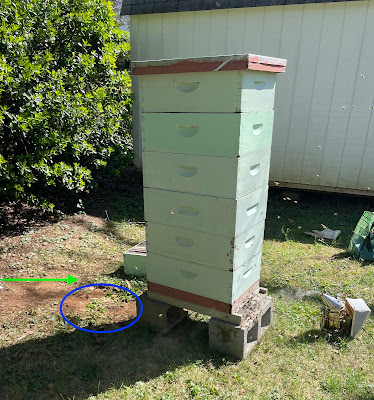
We had heavy rains in Atlanta. I moved in June of last year to a house, new to me. I just discovered in the last month that sometimes in the heavy rains, the back corner of my backyard and the back fence area of my backyard fill with water. The water literally came up to the bottom of the cinder blocks on which my largest hive - the one I've been checkerboarding like mad - sits.
Yesterday I took that entire hive apart all the way down to the cinder blocks and moved the cinder blocks forward the length of a cinder block.
The green arrow indicates where the edge of the water was after the heavy rains (and it stayed there all day and night). The blue oval marks the footprint of the original hive position. Moving the hive forward about a foot didn't seem to bother the bees. They appeared to adapt immediately.
And today, despite three checkerboarded boxes on the top of the hive, they swarmed. My grandson and I were building a chicken coop in the backyard and the bees just wouldn't leave us alone. Then we realized that they were swarming.
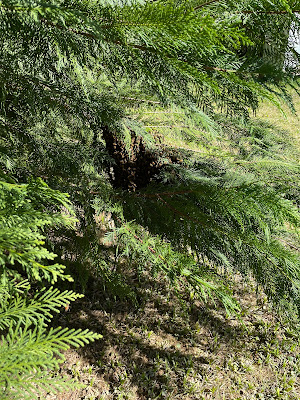
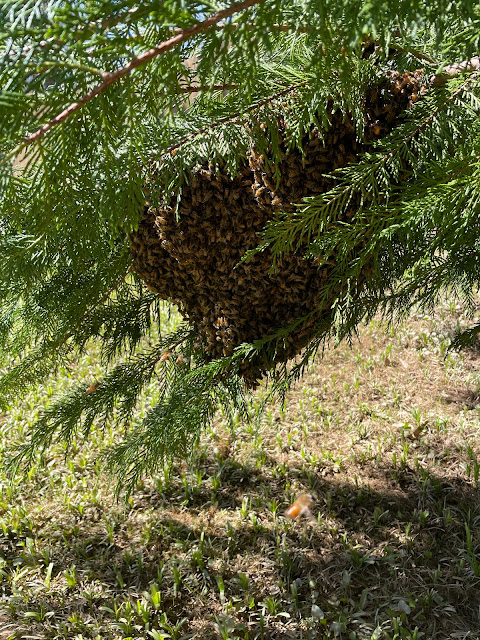
This is a four year old survivor hive and I really didn't want them to swarm, and if they did choose to swarm, I wanted to collect the swarm. These bees flew into an evergreen tree about twenty feet from the hive and about ten feet up. It was 2:30 in the afternoon.
The timing was terrible. Dylan, my grandson, had to go home for soccer practice. As I drove him home, I kept thinking about where I would put this swarm. I didn't plan to climb ladders this year, but I was going to today to get that swarm. Intermittently I reminded myself that you are not supposed to count your chickens before they are hatched.
Sure enough, I ran into my backyard and the swarm wasn't up high in the tree. But bees were still buzzing around and I discovered that the whole swarm had moved down to a much lower branch.
It was a quick and easy (no ladder) swarm capture. I then left the box for about an hour for the bees to settle into their transport container. Then I installed the swarm about 20 minutes away in the Morningside Community Garden.
I'll check on it tomorrow. And when I post the YouTube of the capture and install, I'll put a link here.
Today one of my daughters had a medical procedure so I wanted to take her dinner. I included with her dinner the buttermilk honey rolls that have won so many blue ribbons for me. I realized that I have never posted this video on this blog of how to make the rolls.
Here it is:
Try them - they are easy to make and always a hit!
I got the call at about 3 PM from my local club swarm list. Dave, who manages the list, knew I didn't want to climb ladders this year and said this one was one inch from the ground. And it was only 15 minutes away near downtown Decatur.
The bees belonged to beekeepers, but not beekeepers who are members of my local club. They got bees last year, had not treated them with anything, and the bees lived through the winter. Today they swarmed and it was a HUGE swarm. As swarms go, this was the size of about four cats and when I carried it away, my estimation was that it was about seven pounds of bees.
Here's the photo the homeowner sent:
This enormous swarm was hanging from a hydrangea bush and was also pooled on the ground. It was quite a challenge to collect. Lisa, the homeowner, said the bees began gathering at the base of the hydrangea. My assumption then was that the queen was down at the bottom of this swarm.
The beehive from which the swarm issued was housed in a deep and a medium box - imagine how crowded these bees were since this only represents one half of the hive. I encouraged Lisa to get her husband (the actual beekeeper) to add a box when he got home to give the remaining bees space to grow.
Because of the swarm location I was unable to do a good video of the process. I could barely get to the bees and couldn't place the camera in a way that would work. I'll show you a short bit of what I tried to record. The whole process took an hour because even though I shook a ton of bees into the box, the queen didn't get there until I managed to brush her (I assume - I didn't see her) into a paint container that I had. Then the bees put their bottoms up into the air and began to send out pheromone signals to attract the bees not in the collection box.
Gradually most of the bees were either in the box or on the sheet. A few remained on the tree, but I had hope that they would return to their old hive about twenty feet away by morning.
I took the bees to my empty top bar hive - a great place to put a swarm that large. I am sorry I didn't take any photos of the bees when we dumped them in - they absolutely covered the entire interior of the top bar hive because there were so many of them. There was a basketball size cluster of bees clinging to the ventilated top on the collection box. Even when I dumped those into the hive, there were still at least two cats worth of bees inside the collection box to add.
Here are a few stragglers entering the front door to their new home. The bees on the sheet below are still probably gathered around the pheromone of the queen, left by her after I swept her into the paint container and put her in the collection box.
P.S. My friend David L. and I get our hair cut at the same salon. His stylist is Jon, and David told me that Jon keeps bees. Rachel, another stylist there, cuts my hair. Ever since I learned about his beekeeping, I have always had a short bee conversation with Jon about how his bees are doing every time I visit Rachel for a haircut.
The morning after I caught this swarm, I got a text from Jon that said, "Good morning, Linda. This is Jon from C___ Hair Studio. I heard you had quite the adventure yesterday with my wife and son! Small world. Thank you so much....."
Amazing that in this giant metropolis of the Atlanta area that I would know the person from whom I got the swarm (quite by the coincidence of being on the swarm list for MABA.)
Does your local bee club or extension agent keep a swarm list? It's a great way to get a swarm - put your name on it and you will be called when a swarm is available and it's your turn. I get at least one call a year from MABA and as a retired person who is very available to leave at the drop of a hat, I sometimes get more than one/year.