This is the tale that began in 2006 in my first year of beekeeping in Atlanta, GA. ...there's still so much to learn.
Welcome - Explore my Blog
I've been keeping this blog for all of my beekeeping years and I am beginning my 19th year of beekeeping in April 2024. Now there are more than 1300posts on this blog. Please use the search bar below to search the blog for other posts on a subject in which you are interested. You can also click on the "label" at the end of a post and all posts with that label will show up. At the very bottom of this page is a list of all the labels I've used.
Even if you find one post on the subject, I've posted a lot on basic beekeeping skills like installing bees, harvesting honey, inspecting the hive, etc. so be sure to search for more once you've found a topic of interest to you. And watch the useful videos and slide showson the sidebar. All of them have captions. Please share posts of interest via Facebook, Pinterest, etc.
I began this blog to chronicle my beekeeping experiences. I have read lots of beekeeping books, but nothing takes the place of either hands-on experience with an experienced beekeeper or good pictures of the process. I want people to have a clearer picture of what to expect in their beekeeping so I post pictures and write about my beekeeping saga here.Master Beekeeper Enjoy with me as I learn and grow as a beekeeper.
I got the call at about 3 PM from my local club swarm list. Dave, who manages the list, knew I didn't want to climb ladders this year and said this one was one inch from the ground. And it was only 15 minutes away near downtown Decatur.
The bees belonged to beekeepers, but not beekeepers who are members of my local club. They got bees last year, had not treated them with anything, and the bees lived through the winter. Today they swarmed and it was a HUGE swarm. As swarms go, this was the size of about four cats and when I carried it away, my estimation was that it was about seven pounds of bees.
Here's the photo the homeowner sent:
This enormous swarm was hanging from a hydrangea bush and was also pooled on the ground. It was quite a challenge to collect. Lisa, the homeowner, said the bees began gathering at the base of the hydrangea. My assumption then was that the queen was down at the bottom of this swarm.
The beehive from which the swarm issued was housed in a deep and a medium box - imagine how crowded these bees were since this only represents one half of the hive. I encouraged Lisa to get her husband (the actual beekeeper) to add a box when he got home to give the remaining bees space to grow.
Because of the swarm location I was unable to do a good video of the process. I could barely get to the bees and couldn't place the camera in a way that would work. I'll show you a short bit of what I tried to record. The whole process took an hour because even though I shook a ton of bees into the box, the queen didn't get there until I managed to brush her (I assume - I didn't see her) into a paint container that I had. Then the bees put their bottoms up into the air and began to send out pheromone signals to attract the bees not in the collection box.
Gradually most of the bees were either in the box or on the sheet. A few remained on the tree, but I had hope that they would return to their old hive about twenty feet away by morning.
I took the bees to my empty top bar hive - a great place to put a swarm that large. I am sorry I didn't take any photos of the bees when we dumped them in - they absolutely covered the entire interior of the top bar hive because there were so many of them. There was a basketball size cluster of bees clinging to the ventilated top on the collection box. Even when I dumped those into the hive, there were still at least two cats worth of bees inside the collection box to add.
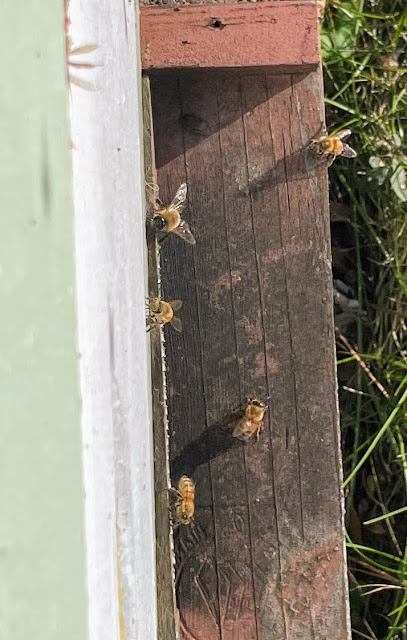
Here are a few stragglers entering the front door to their new home. The bees on the sheet below are still probably gathered around the pheromone of the queen, left by her after I swept her into the paint container and put her in the collection box.
P.S. My friend David L. and I get our hair cut at the same salon. His stylist is Jon, and David told me that Jon keeps bees. Rachel, another stylist there, cuts my hair. Ever since I learned about his beekeeping, I have always had a short bee conversation with Jon about how his bees are doing every time I visit Rachel for a haircut.
The morning after I caught this swarm, I got a text from Jon that said, "Good morning, Linda. This is Jon from C___ Hair Studio. I heard you had quite the adventure yesterday with my wife and son! Small world. Thank you so much....."
Amazing that in this giant metropolis of the Atlanta area that I would know the person from whom I got the swarm (quite by the coincidence of being on the swarm list for MABA.)
Does your local bee club or extension agent keep a swarm list? It's a great way to get a swarm - put your name on it and you will be called when a swarm is available and it's your turn. I get at least one call a year from MABA and as a retired person who is very available to leave at the drop of a hat, I sometimes get more than one/year.
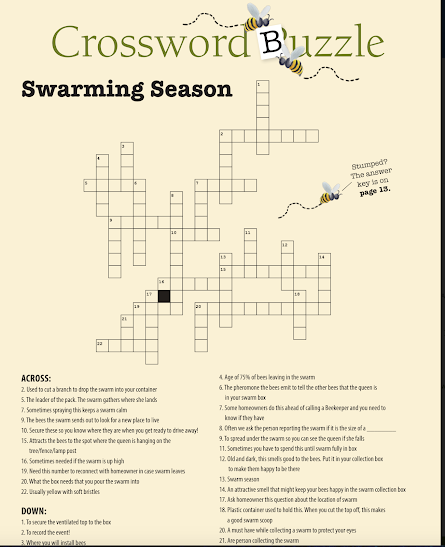
In the south, when March arrives, you know if you are a beekeeper, that swarming sweeps in with the March winds. Being prepared for swarm catching for me means keeping my swarm catching kit in my car at the ready. Here is a crossword "buzzle" that I developed about catching swarms.
If you feel like you need to learn about swarm catching first, visit this post. To see a YouTube video I made of a swarm I caught last year, click here.
Years ago in 2007, an Italian beekeeper shared his swarm lure recipe with me and I have made it every year since. In a good bee year, it's amazingly effective. I have just put it on my empty hives at the community garden and on my top bar hive which is empty of bees.
Next week is March and in Atlanta, that often marks the beginning of swarm season. I have drones flying in all of my hives, so I made swarm lure this week, like a good "be prepared" Girl Scout.
Here's the easy to follow recipe:
1 square inch cube of beeswax
1/4 cup of oil - olive oil was in his recipe but he's in Italy - any relatively no-smell oil will do
12 - 20 drops of lemongrass essential oil
Put the first two ingredients in a glass jar (small jelly jar) and set the jar in a small pan of hot water. Heat until wax is fully melted. I stir with a chop stick and remove the jar from the water. I use a jar lifter which I have for making apple butter.
Let it cool only slightly and then stir in the lemongrass oil.
As the mixture cools, it will become solid but smeary. If your cubes are larger than 1X1 inch, use more oil. You want the concoction to be soft enough to smear. Sometimes I carry a chopstick to scoop out some of the harder versions of my lure before smearing it on the hive.
How to use this fabulous attractant?
Smear it around the center hole in the inner cover.
Smear it on some of the frames in the top box on the hive
Smear it on the underside of the top of the entrance to the hive (if you smear it on the bottom, the bees feet will stick and get goopy so just on the top of the entrance.
For photos and a previous post about this lure, click here.
My bees at the biggest survivor hive have been flying like crazy and I knew I had to either make a split or checkerboard or both as soon as was reasonable. Yesterday it was 65 at 3 PM, so I opened the hive and made a split.
I recorded it with my iPhone and wanted to share it with you. I apologize in advance. I didn't have my microphone on properly. Oh, well! It's the first time this year.
If we were watching this on a virtual hive inspection, I would pause a lot to let you see the frame not in motion. Please do this as you watch so that you can see the queen, etc. BTW, the queen is on the top center of the frame when I show it to the camera.
I created this crossword puzzle for the GBA Newsletter after the MABA Short Course a couple of weeks ago. I thought you might find it fun! I'm doing these for the newsletter and will put them here on the blog after the newsletter has come out.
Have fun with it - pretty easy and should test your basic bee knowledge after a one day short course.
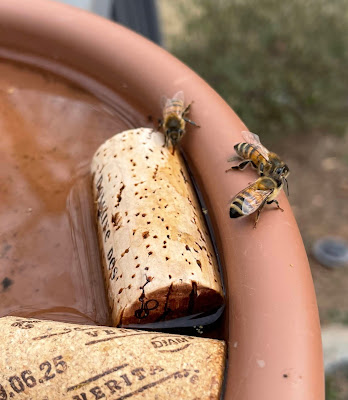
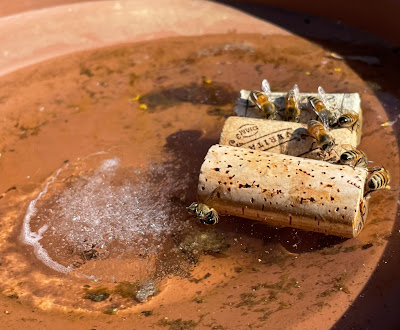
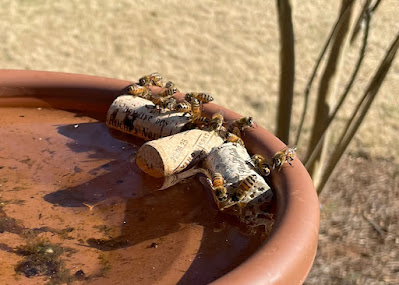
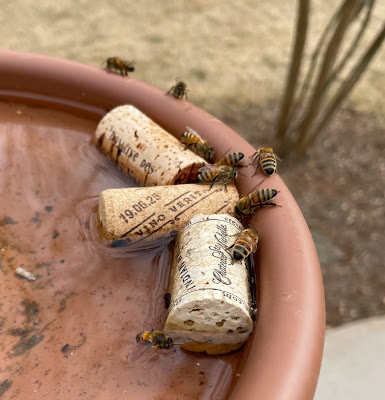
When I set up the bird bath, I wasn't thinking of the bees. There is water in my neighborhood - a nearby creek and feeder streams all over - so plenty of water available. But the first warm day this winter, I noticed bees in my bird bath, struggling to maintain their footing and a couple of dead bees in the water. I immediately added wine corks. Only a couple. I want the birds to use the water AND I wanted to accommodate the bees.
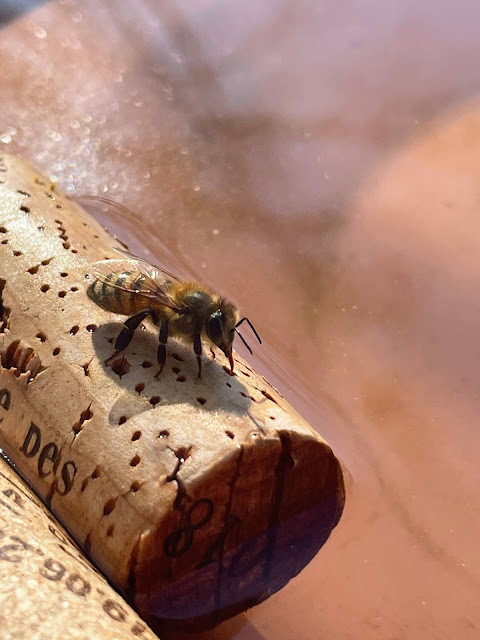
I noticed a very interesting feature of the corks when I was watching the bees in the bird bath yesterday. You'll see too when you look closely at this photo:
Look at the unfocused bee on the cork. Her proboscis is stuck down in the cork. She is using the porous cork to suck up water absorbed into it, rather than risk drowning by balancing her way down to the surface of the water.
At the MABA short course on Saturday, several people asked how long is the bee's proboscis. I believe from watching them on the corks that her proboscis is a little over 1/8". This is why the plant: bee balm (crimson monarda) is not a flower that our honey bee can use as a nectar source. A hummingbird has a long enough tongue to gather from bee balm, but not the honey bee.
Even with the cork, there are bees who drown, but it at least provides a modicum of safety for those searching for water. The bees floating in the water are dead. But the ones on the back cork in the first photo look like they are winning the bee log-rolling contest. They are actually getting water between the two corks which don't move because the ice in the bird bath has glued them together.
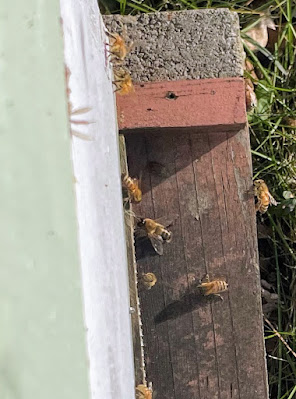
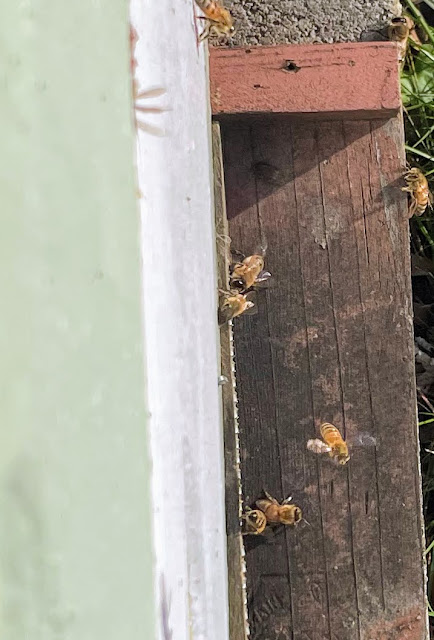
I was looking at the photos from my earlier post today and discovered that there are drones flying in today's 56 degree temperature. I went out to the hives specifically to see the drones in person - not just in a photo that I took. Sure enough, I saw three drones enter each of my hives in a space of less than a minute. Here they are in all their Frida Kahlo glory - with their eyes looking just like her eyebrows:
Below the large bee about to enter the hive is a drone.
In the photo below, the drone is closest to the raised edge of the entry in center of the photo.
In the photo the drone is right in the center of the photo. I believe the bee away from the entrance and near the center of the photo may also be a drone from how his eyes look, but we can't see his body well enough to know.
Two things to note from this:
1. It's a great idea to take photos when you inspect your beehives. You often learn something from the photos that you might not have noticed at the moment. I never saw the queen in the hive in my first few years of beekeeping but I did see her in photos that I took.
2. We may have an early swarm season in Atlanta with mature drones already on the fly! If there is a swarm call list where you live, be sure to put yourself on it and learn how to catch a swarm if you don't already know. Here's a video of a swarm I caught last year on April 19, 2021:
My bees continually defy that rule. Yesterday when it was about 44, they were out flying and having a great time.
When the temperature is in the 50 - 60 range, the bees in the south can fly to gather lots of pollen available to them. As I watched the bees today (Jan 31) there was lots of pollen coming into the hives.