This morning's email contained a forward from my son-in-law, Jeff, from the Smithsonian Magazine. I love the article about Thomas Seeley and his work on Honeybee Democracy.
Here it is, and I invite you all to read it.
Thursday, February 23, 2012
Sunday, February 19, 2012
Happier Bee News on the Old Home Front
Yesterday I taught Hive Manipulation at the Tara Beekeepers' Short Course in the morning. In the afternoon it was warm enough to open my hives at my old house and I have been so anxious to see how they are doing.
Five was ALIVE!
(I loved this movie when my kids were young).
(I loved this movie when my kids were young).
The first sign that Five was alive was this bee with full pollen baskets entering the hive. Bees laden with pollen don't come in to rob out a hive.

I saw another who missed the entrance and was on a stick on the ground.

Inside there were lots of bees. This is the bottom box but the one above had bees as well.

Here we can see signs of a laying queen - brood and eggs. I was so thrilled with this - so much more fun than opening up my dead-outs at home. Oh, and BTW, I saw drones (at least 10 in this small hive) and some drone brood.

Inside the swarm hive I found a different story. Three full boxes of honey, no brood and just a baseball sized group of bees….but there was no sign of a queen. I felt impressed that these girls had made it through the winter and had not been robbed out by a larger hive. I thought I would take a good frame of brood and eggs from both Lenox Pointe or Colony Square and give it to this hive to see how they would do.
Really the smarter decision would be to combine this hive with Five Alive and maybe I'll do that next weekend.
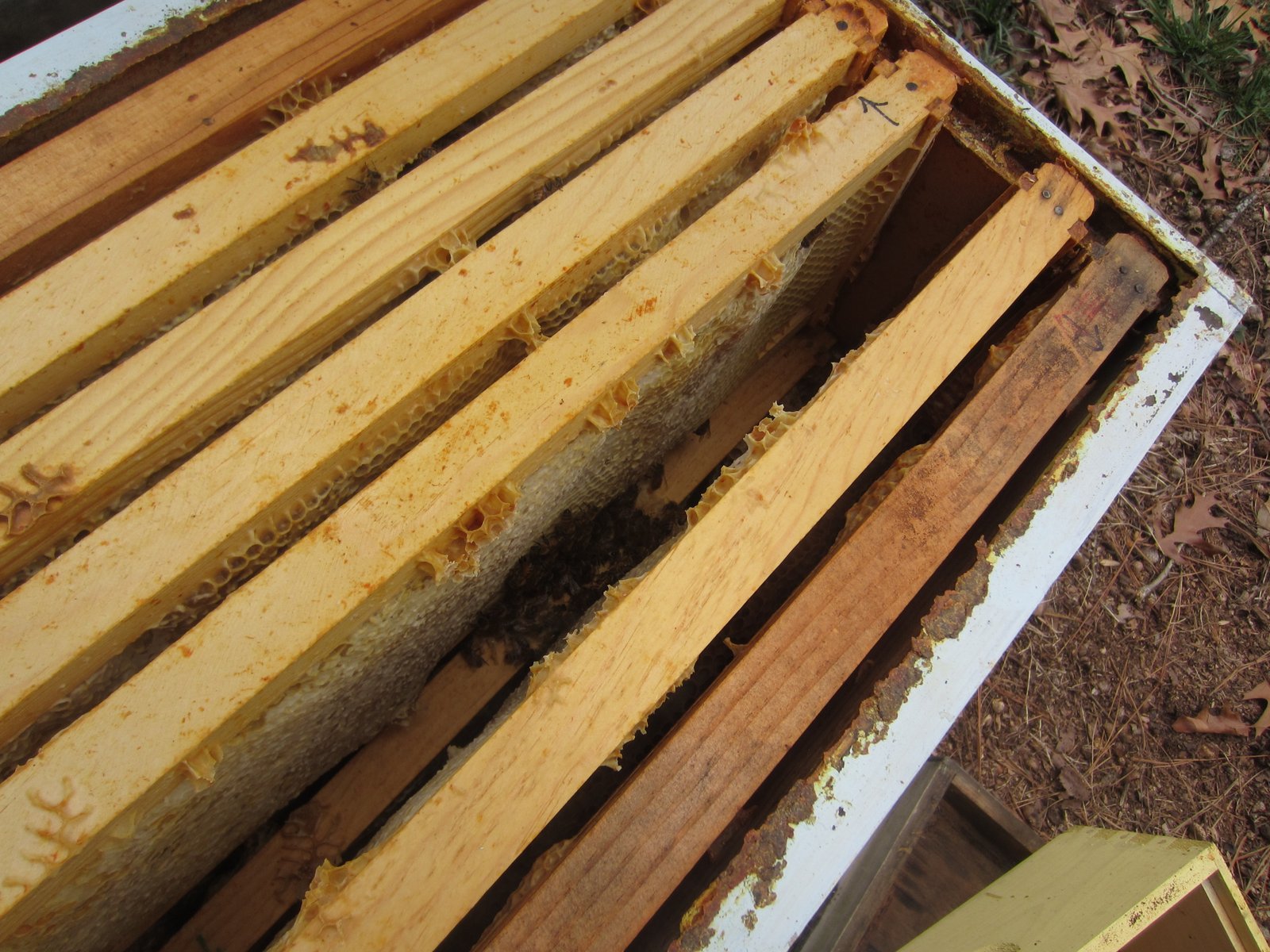
Lenox Pointe has had less bee traffic than I would like to see, but they had brood and eggs in the bottom box. I couldn't move this frame to the Swarm hive because it's a deep and the swarm hive is in all mediums. Here is a strong argument for uniform frame size, but I started Lenox Pointe from a Jennifer Berry nuc last year and it was established in a deep, as a result.
They had good honey stores, as well. This hive is going to be fine. I did take a frame of brood and eggs from their Box #2 and put it into the swarm hive. My plan was also to take one from Colony Square.

Then I opened Colony Square. I didn't take many pictures and the ones I took were blurry. It was filled with bees. There are as many bees in that hive now as in its strongest day last summer and it was a powerful hive then. Jeff was helping me and he called out the pollen colors he saw coming into the hive: red, orange, yellow.
As we lifted the top solidly filled with honey box off of the hive, we uncapped drone brood that they had put between the boxes. The bees were hopping mad.
As we lifted the top solidly filled with honey box off of the hive, we uncapped drone brood that they had put between the boxes. The bees were hopping mad.

I had on a veil and jacket. I also had on gloves because my hands were stung in the swarm hive (queenless and angry with my intrusion). Jeff just had on a jacket and veil as well. He helped me lift off the second box (also heavy but with brood as well as honey), and again we tore up drone brood between the boxes. Jeff had company who came to see the new grand baby, and wasn't expecting to work the bees with me, so I encouraged him to go be with his guests.
Meanwhile I was using hive drapes and smoke but these bees were so unhappy. Suddenly I realized at least three were inside my veil. I walked away from the hive and killed at least one of the bees inside the veil by pinching her, but not before I had been stung three times.
Why didn't I just stop the inspection?
This was a day when I could work the bees, the temperature was finally right, and the drone brood between the frames pointed to a need for space. These bees are going to swarm unless I really work hard to keep them contained and I knew one way would be to checkerboard the brood box to expand the brood space.
So….I put on my Golden Bee suit - just happened to have it in the car. My friend Julia had been using it until she got one of her own and had conveniently just returned it to me. I think I'll keep it in the car on bee visits!
I took a new box with a few drawn frames and some strip frames and went back to Colony Square, waiting for me, draped but angry. The bottom deep had brood in it, but I needed to do this with medium boxes. The next box (#2) had brood as well, so I checkerboarded it with the new box I brought with me.
I completely forgot about the swarm hive and did not pull a frame of brood and eggs for it.
I completely forgot about the swarm hive and did not pull a frame of brood and eggs for it.

Checkerboarding means that in Box #2, frames 1, 3, 5, 7 were left with brood in them and frames 2, 4, 6, and 8 are now empty comb or undrawn frames. In Box #3, frames 2, 4, 6, and 8 are brood frames moved up from Box #2 and frames 1, 3, 5, and 7 are now empty comb or undrawn frames. This expands the brood nest as per Michael Bush (he calls it unlimited brood nest) and gives the queen more room to lay.
You can only do this if the hive has enough nurse bees to keep the brood warm and this hive is bursting at the seams...so no problem there. Next Sunday, if the weather is good, Jeff and I are going to make two nucs from this hive.
You can only do this if the hive has enough nurse bees to keep the brood warm and this hive is bursting at the seams...so no problem there. Next Sunday, if the weather is good, Jeff and I are going to make two nucs from this hive.
This is how the hive looked almost an hour after I was done....and it's February! This hive is bound to swarm unless we do something.


Thursday, February 16, 2012
Bill Owens Speaks to the Metro Bee Club
Last Wednesday, Bill Owens, Georgia's only Master Craftsman Beekeeper (the highest rank you can attain) spoke to our club about his bee removal business. Bill is a great communicator and an entertaining speaker. I enjoyed his talk a lot, although I will not, being constructionally challenged to the max, be doing bee removals from structures.
Bill talked about the importance of customer relations - a job at which I am sure he is spectacular - and the importance of educating the public about the difference between bees and hornets. One thing he said that surprised me is that it is an easier removal if the cutting into the structure takes place inside the house rather than outside. He said bees in the house are much more easily moved into a container than those outside who seem much more upset by the process.

He shared a list of the tools and equipment he carries to a hive removal. He doesn't list it but he also has in his kit a cookie sheet with a long handle attached. He uses that to slide under a mass of bees in narrow spaces!

Bill stayed afterward to answer questions about what's going on in the bee yard. Interestingly he spoke about feeding the bees. Bill doesn't use any chemicals in his 60 or so hives, and he rarely feeds the bees. He said spring feeding is stimulative feeding and who are we to determine when the hive needs to be at its peak. So he sees no point in taking the risk of stimulating the hive to grow rapidly and then finding out that it was wrong timing.
If he feeds a hive going into winter, then something is wrong or the hive would have enough stores. So he works for healthy hives and not for hives that need his assistance through sugar syrup.
Pick myself up, Dust myself off, and Start all over again…..
For days I had been seeing lots of bees flying in and out of my one remaining hive at home. I assumed they were alive and well and given the Atlanta extra warm winter, I should be ready to checkerboard to help expand the brood nest as Michael Bush talks about in his book and on his website.
So last Monday, I went out, bee bag in hand, planning to expand the broodnest.

I took a box of empty frames with foundation strips, ready to do the job.

I opened it up, went through every box, and found that in fact, the hive was dead - no bees, no brood, just stored nectar and a few bodies on the screened bottom board (AGAIN). The bees flying in and out of the hive in great numbers were not residents, but rather either robbers or scouts……I had to go back to the office and was so upset that when I returned to my business clothes and got to my office, I looked down and I had on two different shoes!
Well, who can blame me? This was quite upsetting. I now have no hives alive at home.

The only possible good news is that bees continue to go in and out of that hive in large numbers. They don't appear to be robbing so I am hoping a swarm will move in in a week! Fingers crossed.
I do have five packages ordered from Don K and 2 nucs ordered from Jerry, so I should be OK in the start all over again department.
I do have five packages ordered from Don K and 2 nucs ordered from Jerry, so I should be OK in the start all over again department.
Note: This is my 950th post - that means I'll pass 1000 in 2012!
Monday, February 06, 2012
Richard Taylor, a Lyrical Beekeeper
As spring approaches, I am always drawn back to The Joys of Beekeeping by Richard Taylor. I've quoted him in other places on this blog. He loves the bees and the experience of being with them. His book which is quite short (166 pages) is so nurturing to read and replenishes my spirit about the bees every time I read it.
This is what he writes about his bee yard (I'm going to quote several paragraphs and hope I'm not violating copyright):
"But the bee yard, when not the scene of herculean labors, as at harvest time, is largely a place of quiet where one feels not alone but rather an integral part of the scheme of things. Solitude is not really the word for it. Communion is. One is not separated from company but only from distraction. One's thoughts and feelings are not imposed from without but elicited from within, rising in absorption with the vast surrounding nature.
The hum of bees overhead, which in spring and during a honey flow approaches a roar, is to me what the sound of the surf is to the beachcomber. It is not a menace or warning, but a reassurance, almost a voice speaking. It would instantly carry the thoughts of others, the uninitiated, to the association with stings. The sight of the bee master, placidly standing in the midst of this roar, would give an outsider no reassurance at all. The rare intruder who comes upon me in one of my yards, therefore retreats, and the yard and its master are again as secure as if surrounded by a high wall.
Smaller visitors, feathered and furred, come and go at will, of course, as oblivious to the bees as the bees are to them. The chatter of the birds is unabated, and my appearance produces a squeak from an occasional chipmunk. Off in the meadow a pheasant gives warning to her chicks. But in general all these living things share the peace with me, and I shall always keep it with them. The bees themselves have very few enemies, and I am glad to move about my yard with the understanding that, from the standpoint of nature, this domain is primarily theirs."
Isn't that perfectly lovely? And isn't that your own experience of your own bee yard? It is my experience of mine, though I am not so eloquent. Thank you, Richard Taylor, for expressing it so beautifully.
And on this lovely bee day, my daughter brought me this treasure she and Jeff found in an antique store in Thomaston, GA:

In celebration of the bee, this now sits in my bookcase on the shelf with all the old bee books like AI Root's the ABC and XYZ of Bee Culture.
The skep is on hinges at the back and lifts up, but I have no idea what one would put under it.
This is what he writes about his bee yard (I'm going to quote several paragraphs and hope I'm not violating copyright):
"But the bee yard, when not the scene of herculean labors, as at harvest time, is largely a place of quiet where one feels not alone but rather an integral part of the scheme of things. Solitude is not really the word for it. Communion is. One is not separated from company but only from distraction. One's thoughts and feelings are not imposed from without but elicited from within, rising in absorption with the vast surrounding nature.
The hum of bees overhead, which in spring and during a honey flow approaches a roar, is to me what the sound of the surf is to the beachcomber. It is not a menace or warning, but a reassurance, almost a voice speaking. It would instantly carry the thoughts of others, the uninitiated, to the association with stings. The sight of the bee master, placidly standing in the midst of this roar, would give an outsider no reassurance at all. The rare intruder who comes upon me in one of my yards, therefore retreats, and the yard and its master are again as secure as if surrounded by a high wall.
Smaller visitors, feathered and furred, come and go at will, of course, as oblivious to the bees as the bees are to them. The chatter of the birds is unabated, and my appearance produces a squeak from an occasional chipmunk. Off in the meadow a pheasant gives warning to her chicks. But in general all these living things share the peace with me, and I shall always keep it with them. The bees themselves have very few enemies, and I am glad to move about my yard with the understanding that, from the standpoint of nature, this domain is primarily theirs."
Isn't that perfectly lovely? And isn't that your own experience of your own bee yard? It is my experience of mine, though I am not so eloquent. Thank you, Richard Taylor, for expressing it so beautifully.
And on this lovely bee day, my daughter brought me this treasure she and Jeff found in an antique store in Thomaston, GA:

In celebration of the bee, this now sits in my bookcase on the shelf with all the old bee books like AI Root's the ABC and XYZ of Bee Culture.
The skep is on hinges at the back and lifts up, but I have no idea what one would put under it.
Saturday, February 04, 2012
The Amazing Queen Bee
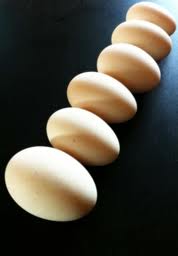
In this morning's email from Naturebee, there is an interesting piece of trivia about the queen bee (assuming a life span of three years). Times have certainly changed - note the length of the chicken egg used for comparison in this 1895 article is 1 1/2 inches - just dawned on me from the photo below (not with the article) that they may have measured the breadth of the egg - I assumed end to end since they referred to the length of the bee egg. There are no eggs in my refrigerator this morning shorter in length than 2 1/4 inches. The queen would still win out by a very long distance:
* A queen will lay a half mile of eggs
in her life time (three years), while a
hen in the same time, allowing 200 eggs
a year and one and one-half inch to the
egg, will only lay seventy-five feet of
eggs. A queen bee's egg is one-fourteenth
of an inch in length.
Source:
Homestead
Friday, March 22, 1895 Des Moines, Iowa
* A queen will lay a half mile of eggs
in her life time (three years), while a
hen in the same time, allowing 200 eggs
a year and one and one-half inch to the
egg, will only lay seventy-five feet of
eggs. A queen bee's egg is one-fourteenth
of an inch in length.
Source:
Homestead
Friday, March 22, 1895 Des Moines, Iowa
Friday, February 03, 2012
Groundhog's Day and Bees
Bee-ing a beekeeper makes one ultra-conscious about the weather. So like many people in the country, I had my eye out for the news about the groundhog yesterday. Apparently Punxsutawney Phil saw his shadow and predicted six more weeks of winter.
However, my bees are in Georgia, so I was more interested in what General Beauregard Lee, our local groundhog prognosticator, had to share on this subject.
I had a video here but removed it because it started automatically and was loud and irritating.
So here's a link that says the General is generally right (not a video).
I had a video here but removed it because it started automatically and was loud and irritating.
So here's a link that says the General is generally right (not a video).
Our local ground hog apparently did not see his shadow on our cloudy February 2nd morning, so he predicted an early spring. I found another link saying that he is right 94% of the time...pretty good record for a varmit like he is.
I could have told him that. We've had the warmest winter I can remember, maybe in all the time I've lived in Atlanta. I only put on my long winter coat one day in the last three months. It is not unusual for us to have a snow storm in March, but I don't expect it this year.
The dandelions are blooming as is the red maple, our first pollen contributor of the spring. Everyone's bulbs are about to burst open and I've seen quite a few blooming crocus plants already.
My bees are flying in and out of the hives that made it through the winter. It's warm in Atlanta.
My bees are flying in and out of the hives that made it through the winter. It's warm in Atlanta.
Wednesday, February 01, 2012
A Local showing of "The Vanishing of the Bees"
Atlanta's Paideia School is showing the "Vanishing of the Bees" on Feb 23rd at 7pm. Ticket price of $10 includes a honey-infused cocktail (or non-alcoholic version) and a honey-caramel praline popcorn ball made by Chef Shaun Doty. You can only buy advance tickets from the school:
https://www.paideiaschool.org/
https://www.paideiaschool.org/


Subscribe to:
Posts (Atom)
Pin this post

LinkWithin
