Welcome - Explore my Blog

I've been keeping this blog for all of my beekeeping years and I am beginning my 19th year of beekeeping in April 2024. Now there are more than 1300 posts on this blog. Please use the search bar below to search the blog for other posts on a subject in which you are interested. You can also click on the "label" at the end of a post and all posts with that label will show up. At the very bottom of this page is a list of all the labels I've used.

Even if you find one post on the subject, I've posted a lot on basic beekeeping skills like installing bees, harvesting honey, inspecting the hive, etc. so be sure to search for more once you've found a topic of interest to you. And watch the useful videos and slide shows on the sidebar. All of them have captions. Please share posts of interest via Facebook, Pinterest, etc.

I began this blog to chronicle my beekeeping experiences. I have read lots of beekeeping books, but nothing takes the place of either hands-on experience with an experienced beekeeper or good pictures of the process. I want people to have a clearer picture of what to expect in their beekeeping so I post pictures and write about my beekeeping saga here.Master Beekeeper Enjoy with me as I learn and grow as a beekeeper.

Need help with an Atlanta area swarm? Visit Found a Swarm? Call a Beekeeper. ‪(404) 482-1848‬

Want to Pin this post?

Thursday, July 25, 2013

So Why Go to Lithuania on a Beekeeping Tour?

One might well ask.

I got an email from Simona Cibirkaite at the Visit Lithuania travel agency in Vilnius.  The trip sounded interesting and I thought it would be neat to meet beekeepers from another country.

When Julia, Noah and I signed up for this, it sounded like a lark and lots of fun.  We've travelled together before - to a beekeeping conference in Massachusetts last summer and every year to Young Harris where although we don't drive up together, we hang out for the whole conference.

My mother was certain I was never coming back home.  My children wanted to know where my will was.  My son-in-law was sure it would be like the tours in Everything is Illuminated.  But despite all of the doubt from others, we had a fabulous experience in Lithuania and I'd love to go back again.  What a gorgeous countryside and what interesting beekeeping traditions were there!

When we got there, we were so pleasantly surprised to find out that beekeeping is a cornerstone of Lithuanian history and culture.  Our wonderful guide, Lukas, explained on the first day that beekeeping has been an important part of Lithuania for hundreds of years (I think he may have said thousands!).  The goddess of beekeeping,  Austėja, is a very common girl's name in Lithuania.

There are actually two gods of beekeeping in that country, Austėja (pronounced ous-stay-uh) who is the goddess of fertility and a protector.  In 2005 Austeja was the fifth most popular girl's name in the country, according to Wikipedia.  
Here is Austeja:
  At Romas' bee museum

 Austeja at the museum of ancient beekeeping on our next to last day.

The other pagan god was Babilas - he was like a drone - a sort of good for nothing consumer, gluttenous and hairy.  
And here is Babilas:


There was reverence for the colony in the hive and they were called in the Lithuanian language the family.  This is still how beekeepers refer to the colony.  The beekeeper at the Nine Honey Apiary that we visited kept talking about the family in each hive.  The queen was called in Lithuanian, the mother - motina or motinella (little mother). 

 In Lithuanian the word for death for bees is the same as the word for death for humans.  They have a different word for death for other animal and insect species.   In other words, in the Lithuanian language, the bee is held in as high esteem as the human, unlike other species. 

Here is a great write-up about how the bee museum guide describes the bee/human relationship.

At our candle-making workshop (photos in another post), the guide told us that the beekeeper was revered in Lithuanian society at the same level as the priest.  People removed their hats when they saw the beekeeper.  In a community, if there was a need, the beekeeper often sat as judge over disputes.  

When the bees would swarm, the beekeepers followed the swarms and made friends with the people on whose land the swarms took up residence.  Sometimes marriages were made through following the swarm.  Even today, although people in Lithuania may not realize the origin of the word, best friends are called bičiulis - which is a derivative of the word for bee: bite - and means dear fellow beekeeper.  Simona, the tour director, wrote us just yesterday with the emails for the beekeepers whom we visited and suggested that we might become “biciuliai” with them.

The Lithuanians sold stones of wax that each weighed 16 kilos all through Europe.  The purchasers needed the wax to make cannons and bells, using the lost wax process.  Lithuania was the biggest producer of wax and honey in all of Europe.  

Side note:  We didn't learn much Lithuanian while we were there, but our guide, Lukas, taught us to count to ten.  We also learned and said a lot, the Lithuanian word for thank you that sounds like "Achoo."  The other person responds, "Brashom," which often to me sounded like "Bless You."  So we went around saying Achoo and receiving Bless You throughout our journey!


Sunday, July 21, 2013

Visit to a Lithuanian Apiary

On our third day in Lithuania we went to visit an apiary of Zilvanus Solys in an area NW of Kaunas, the second largest city in Lithuania.  The countryside in Lithuania is gorgeous, with fields and fields of wild flowers. Solys plants some flowers but most are volunteers.  In this region they make a lot of honey from buckwheat.  Rape is also a possible nectar source but this beekeeper avoids it because of all the poisons used on the rape crop.

It was raining as we arrived which limited our ability to get into the hives and it was late in the afternoon.  He did lift up the tops of many hives to let us see, however.  The traditional Lithuanian hive is a large box surrounding the hive.  It has handles like drawers.  In essence it is a chest to hold the hive.  Inside they have a deep box of frames for the brood.  They put another box on top of it for the honey.  That's it.  They harvest as the bees fill it and do not super in these old time boxes.

We visited his old fashioned apiary with interesting insulated as well as HUGE boxes but those photos are on my camera and I can only post photos from here in Lithuania that are on my iPhone or iPad.  So you'll see those when I'm back in Atlanta.  Now I'm in Atlanta, so click here to see all of the photos.  Some of the boxes we saw before my camera battery ran out were old large boxes.  Inside each had a couch/chair cushion as insulation against the cold.

When we got to the apiary below, I used my cell phone as a camera since my camera battery had lost its charge.


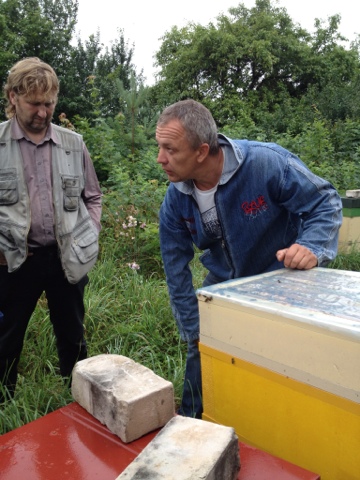
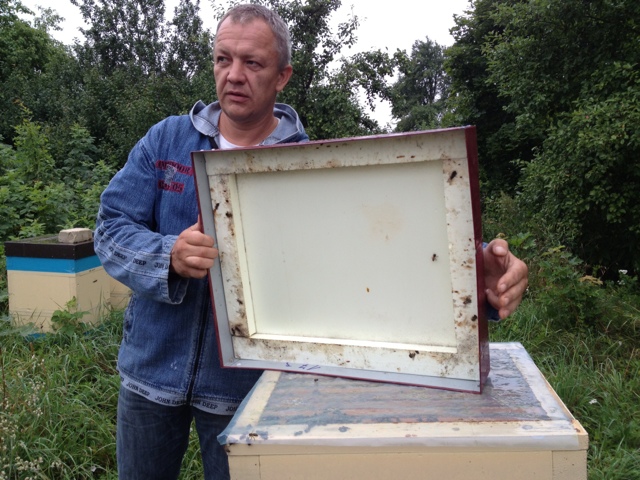
We also went to his friend's apiary who uses Langstroth boxes.  In Lithuania the beekeepers are dealing with cold conditions so they cover the tops of their boxes with food grade plastic.  This helps with warmth but Julia and I wondered about hive ventilation. 


This beekeeper uses screen bottom boards and adds a completely empty box under his hive in winter to add another layer of space between the bees and the cold.  They put foam board under the hive tops and the exterior walls of the hives are thicker.


We laughed when he used his cigarette as his smoker!  I've known that some beekeepers do that but have never seen it in action!  The entrance is a hole drilled through the foam board.


After visiting with them - BTW, they spoke no English and we spoke no Lithuanian, so our guide translated all of the conversations - we went to one of their houses and were treated to beekeeping and Lithuanian delights.


We tasted Linden honey as well as honey that was a mix of Linden and raspberries.  We had their traditional tree cake and tasted Lithuanian cheese with honey.  Julia and I each downed a shot glass of Lithuanian mead which isn't what we call mead at all.  This was 50% alcohol and burned all the way down!  Whoooooo!  


The beekeepers' daughter was named Austeja for the Lithuanian bee goddess!


We don't keep bees the same way. Solys was quite displeased that Julia and I practice treatment free beekeeping.  He is a great proponent of oxalyic acid for Varroa treatment and thinks it is wrong not to use it on your bees.  I don't think oxalyic acid has yet been approved as a treatment in Georgia, but I still think no treatment and splitting the colonies that survive the winter is the way to go.


Created with flickr slideshow.


Thursday, July 18, 2013

Bees in trees. An amazing afternoon!

Today in Lithuania we went to an ancient bee museum in the Dzukija national park.  Near Musteikiai village is this museum where the beekeeper practices natural ancient methods and keeps all his bees in what we would call bee gums or tree trunks as hives.  He has a hand built tool for hollowing out the tree cavity and uses various methods for keeping the chunk of wood that he uses for the entry closure in place.  

He starts his smoker by lighting a dried mushroom with a strike of flint against a handmade metal tool.  He lights his smoker effortlessly.  Here's a video made by someone else of this same beekeeper lighting his smoker.


Notice his hat and veil below.  He wove his hat and added the veil.  In the hive below he showed us how he is hoping that the now small colony will eventually grow to fill the open space above the divider he has made.  Like one does in a top bar hive, he will move the divider up as the hive grows.  He cut some honeycomb from this hive, used a feather to brush off the bees and gave us each a chunk to taste.  


He also demonstrated how he climbs into bee trees to reach his hives.  He has 31 hives in the trees....some are on the ground at his museum and many are in the trees.  He climbed up this tree trunk on protruding branches as steps. He also showed us how he hoists himself up on a rope step that he makes by looping the rope around the tree, making a slip knot, stepping into the slip knot over and over, up the tree.


Then he hooked up a homemade pulley system and slid down the tree.  He gathered his basket and smoker and shinnied back up the tree to inspect the hive.  When all was done the simple rope system was easy to disassemble and he headed for home.


I brought honey from Atlanta to thank him and he gave us all candles that he had made.  What a fabulous day in Lithuania!


Wednesday, July 17, 2013

Ron's Bees and hello from Lithuania

Greetings from Eastern Europe where Julia, Noah, and I have all come on a beekeeping tour!  We arrived yesterday.  We toured the capital city Vilnius yesterday- it's a lovely city.  The entire country only has 3 million people - less than the city of Atlanta - so it's a small city.  Today (Thursday we will begin seeing bee things here). 


 Before I left Atlanta I uploaded these photos so I could post about Ron's bees from Lithuania, but I'm having a bit of a hard time working on this from my iPad, so I'll write a little and you can view what did upload.

The hive was doing well enough with a queen whom I saw.

She had a blue dot on her back which doesn't make sense since that's the color for 2010.  It's a package from Gina that came this year fromWilbanks.  Wonder why they would mark the queen with the wrong color?  Or is she that old?

The hive had small hive beetles in it so I put in two beetle jails, took off the top box because without it they still had plenty of space and with it there was more hiding space for the beetle.

I also put a rapid feeder with honey on it to boost them up.

When I come back from Lithuania I'm going to order nematodes from Southeastern Insectaries  to help the situation.

Apparently all the photos did upload so you can see the blue dot queen.  Also notice the grapes.  Ron has had these vines in his yard for years and this is the first year there are grapes!  He attributes it to the presence of bees.  I know they are on other members of the grape family like porcelain berries so he's probably right!


Monday, July 01, 2013

Beekeeper Error(s)

My commitment to this blog since the beginning has been to write about all of it - my successes, but also all of my failures....Today brought my failures front and center.  As always I have learned a lot, but I should have known better.  I know I should have.

When things go wrong in a beehive managed by a beekeeper, it is almost always due to beekeeper error.  I've made two major ones.

When I installed the Mississippi Queen in the hive at Ron's, I should have put her and the bees in a completely new and much smaller living situation.  I don't know why the bees were not thriving there, but they were originally the queenless half of Lenox Pointe, the thriving hive at my old house.

They never made a queen that was any good and the final queen they had before Mississippi arrived was weak and pitiful.  The comb was old and from last year and the bees were not doing well.  I should have put new frames or at least undrawn ones in a nuc hive, moved some of the honey and all of the bees and installed her there.

Instead I put her in the old hive and she and the bees decided to leave.  So today I found an empty hive.

I came home and was looking out my window and the Sister's Keeper nuc looked forlorn and empty - bees were madly flying out of all of my other hives, but this one had no action going on.  The last time I opened it, I took a frame of brood and eggs to give to the Unintentional Nuc to make sure they grew into a good hive.

Because we are at the end of the nectar flow, I decided to replace the frame I stole with a frame of drawn comb.  I have a few of pretty, unsoiled drawn comb mostly from hives that have died.  When I put that frame into the nuc, I broke some cappings on the adjacent frame of honey.  As I turned away from the hive to go back to my office, I noticed honey flowing out of the bottom of the nuc on the ground.

I had the conscious thought that the honey flow on the ground might draw robbers, but I didn't do anything about it...making the excuse that I needed to hurry back to the office.

Tonight when I opened the nuc and looked into it, there were about five bees.  I didn't explore it because it was getting dark and I didn't have veil or smoker, but the edges of the cells that I could see were ragged as cells look when robbing has occurred.

I was so upset with myself.

I don't know what I should have done - I know be more careful in putting in the new frame.  But should I have watered the ground under the hive to get rid of the honey?  Or scraped it up with a spatula and THEN watered the ground?  I know I should have done something.

I've been telling Jeff for several weeks that we need to get robber screens on all the hives and then not pushing that we get it done.  He's busy, I'm busy.  Now I'm worried about all the hives and that we'll lose more hives because we are not doing what we should be doing - putting robber screens on all the hives ASAP as Billy Davis has suggested.

I have a little #8 hardware cloth here and I know what I'm going to be doing either early tomorrow or after work tomorrow night.

Overview of this Year's Beekeeping Endeavors

At my house:

  • The Patty Swarm Hive - tall and doing well.  I harvested one frame of honey from this hive last week and it was thin.  The top two boxes are honey - the top still has some room in it.
  • The Drone Layer - Now has made their own good queen in their own good time.  They will have one box of honey to harvest (you can see them to the left of Patty
  • The Unintentional Nuc hive with a queen who started out laying multiple eggs but may have the hang of it now.  Maybe it will go through winter or I'll combine it with another hive in fall.


  • The Morningside supply nuc - chugging along with my taking frames out of it at every inspection.  I've seen the queen (easy in a nuc) and she is large and lovely
  • The Don Kuchenmeister package hive - this one hasn't taken off.  I don't know if it's because there is bad energy between Don and me over the bad queen hive at Chastain, or if he just got bad bees this year, but this hive is doing OK but not making honey like the swarm hives at all.  They only have a box for themselves at this point and the nectar flow is about over.

  • The Northlake Swarm hive - going gangbusters.  I added a new box about four days ago.  The bees are tripping all over each other at the entrance.  They are drawing new wax and so happy with whatever nectar source they are working now.  They are all over the front of the hive in the photo because I have just closed it up from working on it and adding a new box.

  • The Atlantic Station Swarm:  This  hive is in the shade all day.  I don't know how much difference that makes but they are only three days later in installation than the Northlake swarm and are not doing as well, although the three swarm hives in my yard are doing better than all the other hives.  The photo below is in the middle of the inspection, so it's all apart and covered with hive drapes, but you can see that it is a three box hive.  On both it and the Northlake hive, I've kept the bottom closed up all season.

At other locations:
Morningside community Garden:
  • My best hive at Morningside garden was the victim of a pesticide kill and has not done well since then - still a big hive with some honey to harvest but is in recovery
  • The second hive at Morningside is a tiny little thing that hasn't gotten off the ground.  They are not using the front entrance of the hive - instead the bees enter the hive through the notch in the inner cover under the back of the telescoping cover.  They are only a two box hive.  If I ever add a box to this hive, the bees will be confused about their back entrance.  I always have to leave the box with the top slid to the back as far as possible to give them entry!
Stonehurst Inn:
  • Two hives are there - one is from last year and is doing OK but will have no honey this year
  • The other - free bees that just showed up and are just getting started
Ron's house near Emory:
  • The Mississippi Queen.  I went to Ron's house after teaching in the Med School at Emory this morning and found that Elvis had left the building.  She was gone and the hive had absconded.  The difference in absconding and swarming is that when a hive absconds, the queen and all the bees leave, taking supplies with them and they leave nothing behind.  I was so sad - both I was excited to have a Mississippi Queen since I grew up in Mississippi and I wanted the hive to succeed.  If the Unintentional Nuc succeeds, maybe I'll take it to Ron's but our hives are just not doing well there, for some reason
  • The Wilbanks Package hive is doing OK.  The queen is laying and bees are flying in and out, but they are not needing a new box - which is disheartening.  But at least they are alive and kicking, for the moment.  There's a community garden within eyesight from the hive and they should be feasting on cucumbers and blueberries but you never know.
Sebastian's
  • We just moved both of those hives so we'll see how they do.  One of them does have a harvestable box of honey on it.  I haven't inspected since the move
Chastain - a hive and a nuc
  • At the last hive inspection on June 15, the Don Kuchenmeister failure of a hive still didn't have a laying queen.  We gave it another frame of brood and eggs from the nuc.  This hive seems hopeless but I keep optimistically thinking it will right itself.  In the end as winter approaches, I may combine the nuc with it.
  • Chastain nuc - feisty bees - I get stung every time I open the hive, but they are productive and busy.  We took a frame of honey from that hive on the 15th and I demonstrated crush and strain harvest for the people at the hive inspection.
Rabun County
  • Last time I checked on that hive was Memorial Day weekend.  I'm going up on Wednesday for the July 4th.  Sourwood honey flow is about to start.  The hive had an extra box on it, but I'll add another box if they are still bee-ing as they should.


Thursday, June 27, 2013

A Funny Thing Happened on the Way to Making a Nuc

When I brought the terrible queen home from Ron's on Memorial Day, May 27, I made a nuc to house her and closed it up so that the bees would have 24 hours without a queen.  Meanwhile the queen who was in a queen clip, slipped out of the clip and was wandering around in the pillow case in which I brought her home.  I left her there over night and the next morning, she was dead.

I added a frame of brood and eggs to the created nuc and decided to see if it would make a go of things.


Now if they made a queen, she should have emerged about the middle of June - and if all went well, she should have been laying by Father's Day.

The little nuc has been looking pretty happy.  Bees are flying in and out.  When I've peeked inside, there seem to be plenty of bees.

So this weekend I thought I'll bet they have a laying queen, so I'll move them out of this box and into a medium hive body.

I opened the hive and found lots of bees and one frame on which there were eggs and brood.

This was quite a funny thing.  On one side of the frame were cells with an obvious laying worker: five and six eggs in the cells.


On the other side were single eggs, tiny larvae and small c-shaped larvae.  - sorry for the blurry photo, but you can see the light biscuit flat-capped worker cells.  What does this mean?


Did a laying worker develop as the queen was getting mated?  A laying worker only results in drone brood and the brood on one side of this frame is flat-capped like worker brood and single eggs.  However, clearly there is a laying worker or maybe the queen just didn't quite get the hang of it at first. I know sometimes they lay multiple eggs in the cells when they are starting out.

At first I set the frame away from the hive, thinking I would see what bees returned to the hive.  But then I thought there clearly is a single egg laying queen....so I returned the frame to the hive.


So here it is in the new configuration.  Bees are again flying in and out.  I gave them a new frame of brood and eggs from the Morningside nuc.

Every time I steal a frame of brood and eggs from that nuc, I think about My Sister's Keeper, that novel about the little girl whose parents had her to provide body parts for her dying sister?  But the nuc, like the little girl, seems to keep on keeping on despite my constantly raiding it for brood and eggs.

I'll leave the new hive for a while and we'll see what develops (or doesn't).

I did add an entrance reducer after I took this photo.

Pin this post

LinkWithin

Related Posts Plugin for WordPress, Blogger...