I subscribe to HistoricalHoneybeeArticles which is a yahoo group. A post today reads:
~~~~~~~~~~~~~~~~~~~~~~~~~~~~~~~~~~~~~
The Mansfield News
Tuesday, August 09, 1904 Mansfield, Ohio
Insane From Bee Stings.
Lima, O., Aug. 9.—Robert Wood, an
apiarist of some renown in northwestern
Ohio, is suffering from the sting
of a bee, and physicians have little
hope of his recovery. While caring
for his bees he was stung a half-dozen
times, about a week ago, and poisoning
has set in. The lip has swollen
so that it almost covers the face, and
lancing had no relieving effect. The
poisoning further extended to the
brain, and he is now a raving maniac.
~~~~~~~~~~~~~~~~~~~~~~~~~~~~~~~~~~~~
Who knew that losing one's mind could be a consequence of bee-ing a beekeeper!
Friday, January 30, 2009
Sunday, January 25, 2009
Hands On Opportunity at the Short Course

The Short Course offered many opportunites for hands on experience in bee stuff. Philippe Audibert hosted a honey tasting table with honey samples from all over Georgia, North Carolina and even from other parts of the world. This was a popular display.

Jerry Wallace demonstrated products of the hive. His table included pollen to taste as well as jars of propolis and his award winning h0ney. He also had his wax blocks to show.

Jason Steidel demonstrated what one might do with a hammer and nail in building bee equipment. He had a very helpful handout for the participants.

PN Williams set up shop at his table and sold bee equipment as well as took orders for nucs to be delivered in the spring.


Metro Atlanta Beekeepers' Short Course
On Saturday, January 24, we held the annual Metro Atlanta Beekeepers' Short Course for beginning beekeepers. We had over 61, I think 64, paid registrants. The course was held at the Atlanta Botanical Garden and you can see all the eager faces below, ready to learn to be beekeepers.

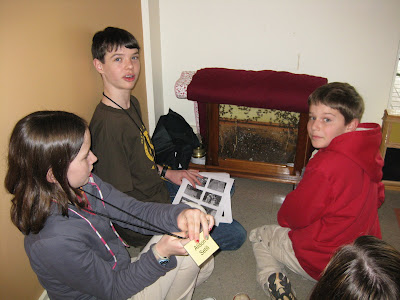
The kids from the Montessori school presented a beginning beekeeper talk for the group. They brought their observation hive for all to see. It was great for the participants both to hear the enthusiasm of these kids and to see real bees at the short course.
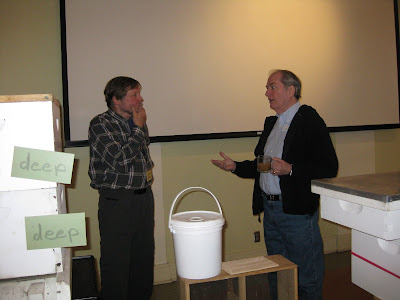
Curtis Gentry, the official beekeeper at the Atlanta Botanical Garden, gave a helpful talk on the components of the hive. Curtis is a great teacher - really good with labels and with providing easy to understand answers. Here he is answering the questions of a participant (Dr. Gentry is on the left).
A regular presenter at our Short Course is Dr. Jamie Ellis, second from the right. He is also helpful, funny, engaging and generally a pleasure to listen to as he imparts his vast knowledge. Before we lost him to Florida, he was at the University of Georgia bee lab working with Keith Delaplane.



The kids from the Montessori school presented a beginning beekeeper talk for the group. They brought their observation hive for all to see. It was great for the participants both to hear the enthusiasm of these kids and to see real bees at the short course.

Curtis Gentry, the official beekeeper at the Atlanta Botanical Garden, gave a helpful talk on the components of the hive. Curtis is a great teacher - really good with labels and with providing easy to understand answers. Here he is answering the questions of a participant (Dr. Gentry is on the left).

A regular presenter at our Short Course is Dr. Jamie Ellis, second from the right. He is also helpful, funny, engaging and generally a pleasure to listen to as he imparts his vast knowledge. Before we lost him to Florida, he was at the University of Georgia bee lab working with Keith Delaplane.

A Christmas Bee
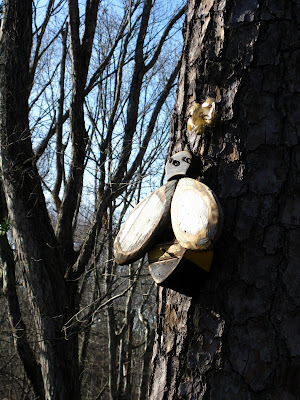
My oldest daughter, her husband and my grandson gave me this fabulous bee bird house for Christmas. I hung it above the bee yard. Since the beeyard is on my deck and already pretty high up, it may be too high for a bird to decide to live there, but it looks like the perfect giant bee to inspire my bees to grow and prosper, so there she hangs!
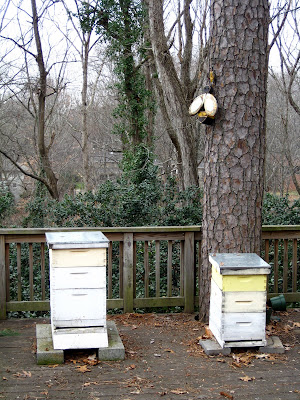
Here's a closer look. The hole for the birds is between the wings and a perch sticks out below - not a great picture, but she's a great addition to my apiary!
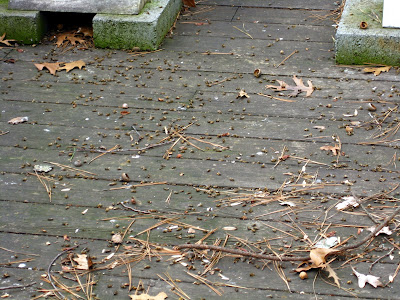
Meanwhile on the deck in front of the hives lie the winter dead. It looks like a calamity has happened but just represents the dead bees that the mortician bees take out of the hive all winter. During the summer, they also carry out the dead but often carry them farther away from the hive's front door. In winter, I imagine they are relieved to be able to get the bodies out of the hive and don't care about the proximity to the hive.

Here's a closer look. The hole for the birds is between the wings and a perch sticks out below - not a great picture, but she's a great addition to my apiary!

Meanwhile on the deck in front of the hives lie the winter dead. It looks like a calamity has happened but just represents the dead bees that the mortician bees take out of the hive all winter. During the summer, they also carry out the dead but often carry them farther away from the hive's front door. In winter, I imagine they are relieved to be able to get the bodies out of the hive and don't care about the proximity to the hive.

Worries about Persephone
Last week we had a couple of over 50 degree days. Bees in my three healthy hives were flying, orienting and bringing in pollen. I saw dead bees on the landing board of Persephone and no activity.
On the first over 50 day, I opened Persephone to see if she needed food. The baggie of sugar syrup left in there still had some syrup in it and I saw only a couple of bees. I felt sad - the hive must be dying. I put in a full baggie anyway in hopes that the bees in Persephone just hadn't gotten the memo that it was OK to fly.
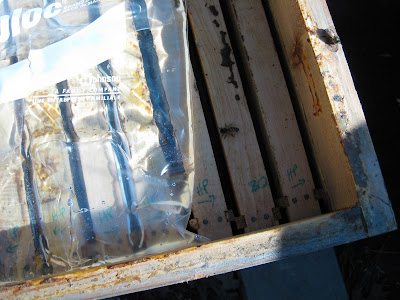
On the second over 50 degree day, there was some activity at Persephone. There wasn't beginning to be as much activity as at the other three hives, but I did see bees entering and leaving the hive. I worried - their approach to the hive wasn't a direct land-and-walk-in event, but involved some indecisive bee movement. I toyed with the idea that these were not hive occupants, but rather robbers from the other hives.
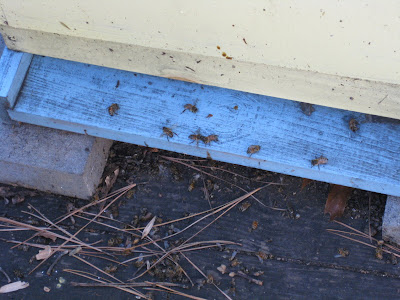
More hope arrived on Friday. I noticed that they had cleaned the dead bodies off of the landing and had apparently removed a roach who had died in the hive - pushed the roach into the pile of the winter dead bodies! Later I saw a couple of bees flying into the hive with pollen baskets filled - so now I am hopeful again.
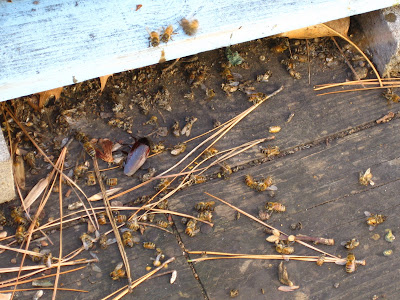
This hive was full of hive beetles as winter began - I attributed that to my feeding the bees (because the SHBs love the sugar syrup), but now with the advent of the dead roach, it's quite clear that the bees have not been alone in their hive this winter. Often the presence of this many critters means that the hive was weak going into winter. If we have another sub-freezing week, this hive may not survive until spring.
Lessons learned: This hive was a combination of a failing swarm hive and a low number hive that was just getting by. I should have made sure they were better set up for winter - added frames of bees, fed them earlier, paid better attention. And I should change the name - as people have pointed out Persephone as a name brings bad karma about winter thriving!
On the first over 50 day, I opened Persephone to see if she needed food. The baggie of sugar syrup left in there still had some syrup in it and I saw only a couple of bees. I felt sad - the hive must be dying. I put in a full baggie anyway in hopes that the bees in Persephone just hadn't gotten the memo that it was OK to fly.

On the second over 50 degree day, there was some activity at Persephone. There wasn't beginning to be as much activity as at the other three hives, but I did see bees entering and leaving the hive. I worried - their approach to the hive wasn't a direct land-and-walk-in event, but involved some indecisive bee movement. I toyed with the idea that these were not hive occupants, but rather robbers from the other hives.

More hope arrived on Friday. I noticed that they had cleaned the dead bodies off of the landing and had apparently removed a roach who had died in the hive - pushed the roach into the pile of the winter dead bodies! Later I saw a couple of bees flying into the hive with pollen baskets filled - so now I am hopeful again.

This hive was full of hive beetles as winter began - I attributed that to my feeding the bees (because the SHBs love the sugar syrup), but now with the advent of the dead roach, it's quite clear that the bees have not been alone in their hive this winter. Often the presence of this many critters means that the hive was weak going into winter. If we have another sub-freezing week, this hive may not survive until spring.
Lessons learned: This hive was a combination of a failing swarm hive and a low number hive that was just getting by. I should have made sure they were better set up for winter - added frames of bees, fed them earlier, paid better attention. And I should change the name - as people have pointed out Persephone as a name brings bad karma about winter thriving!
Tuesday, January 20, 2009
Montessori Beekeepers
This month's program at the Metro Atlanta Beekeepers' meeting was given by Jacqui Miller, a Metro member, who is also a teacher at a Montessori school. She has set up an apiary for the school and her students take beekeeping as a class. In the class they are all learning about how to manage the hives and take care of the bees.

Jacqui described her well-oiled program in which there are student managers of the hives. The school bought bee suits for the program and the students are selling hive products to earn money to pay the school back for the suits! This year they sold honey and wax candles.

The students have had a number of calamities in their hives and have named the calamities accordingly. There was the "Big Bee Scare" when a large number of bees died, along with some yellow jackets. They also experienced the "Great Queen Disappearance." In the last adventure, one of the hives requeened itself. In the second hive they ordered a new queen and learned a lot about requeening in that process.
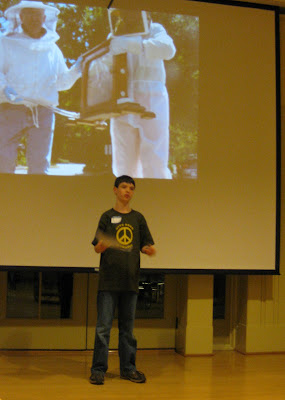
In addition these students acquired an observation hive (actually I think they traded up or down until they finally ended up with the third of three observation hives.) They use this hive to inform the younger students at the school.

These four students each took a turn describing parts of their experience in the beekeeping program. They were lively and entertaining. They were also brave - these four students stood in front of a room of 40 or so beekeepers and told us all about what they had learned in a confident and Power-point supported way.

Jacqui described her well-oiled program in which there are student managers of the hives. The school bought bee suits for the program and the students are selling hive products to earn money to pay the school back for the suits! This year they sold honey and wax candles.

The students have had a number of calamities in their hives and have named the calamities accordingly. There was the "Big Bee Scare" when a large number of bees died, along with some yellow jackets. They also experienced the "Great Queen Disappearance." In the last adventure, one of the hives requeened itself. In the second hive they ordered a new queen and learned a lot about requeening in that process.

In addition these students acquired an observation hive (actually I think they traded up or down until they finally ended up with the third of three observation hives.) They use this hive to inform the younger students at the school.

These four students each took a turn describing parts of their experience in the beekeeping program. They were lively and entertaining. They were also brave - these four students stood in front of a room of 40 or so beekeepers and told us all about what they had learned in a confident and Power-point supported way.
Saturday, January 17, 2009
Shakespeare and Bees
Of course, there's this piece from the Tempest:

Where the bee sucks, there suck I;
In a cowslip's bell I lie;
There I couch when owls do cry.
On the bat's back I do fly
After summer merrily.
 Merrily, merrily shall I live now
 Under the blossom that hangs on the bough.

 -- William Shakespeare

This morning I found this in a Gordon Reader digitized by Google:


The Gordon Readers  By Emma K. Gordon,  Marietta Stockard

Clearly Shakespeare thought, as did most people of his time,
that the bees had a king rather than a queen.

In a New Zealand journal article from 1948, the writer mentions
that Shakespeare very frequently had an entymological bent.

This was a moment of fun distraction while I spend my Saturday
cleaning out my basement!


Saturday, January 10, 2009
Creamed Honey on Toast - YUMMMMM
Over Thanksgiving, I went to Virginia for a week and left my thermostat on 55 degrees to save on my heating costs. Well, my gas bill wasn't so high but there was an unexpected cost.
I left all of my bottled honey on a table and came home to find that the jars that were harvested over Memorial Day last year had all turned into creamed honey. People prize creamed honey - it's less drippy and easier to spread. In truth, though, it is honey that has granulated. Creamed honey isn't a solid mass. Instead it is a thickened honey that tastes great and is just thick instead of clear.
I wondered why the honey from Memorial Day harvest had granulated and not the rest of my jars. I posted on Beemaster to find out what the other beekeepers had to say about this. Apparently this batch of honey had just the right amount of glucose and "seed" material (pollen grains, for example, that didn't filter out) to encourage its turning into creamed honey. And the temperature at which I left my house (55 - 60 degrees) was IDEAL for making creamed honey.
Interestingly, this honey doesn't have a sandy feel on the tongue. Instead it spreads like regular honey and is fabulous, in my opinion. You can tell that I am using the honey from the jar below. Actually you can heat the honey in a water bath and the granulation will go away, but I don't want to heat my honey so I am going to enjoy it as is.
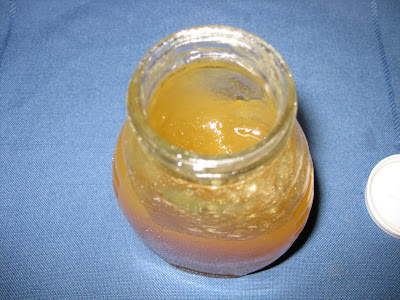
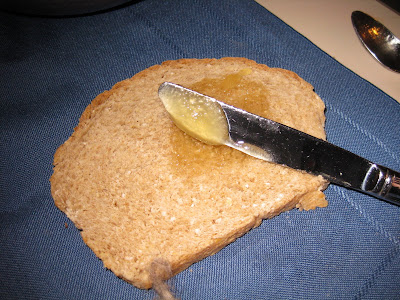
You can see the consistency in the picture below.
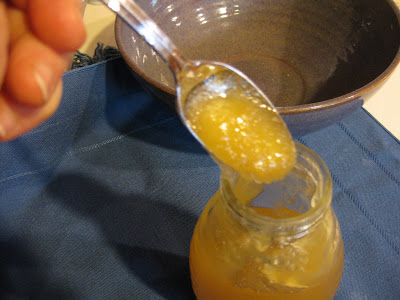
When it is spread on hot toast, it is exactly like non-granulated honey and tastes, as all my honey does, absolutely delicious!
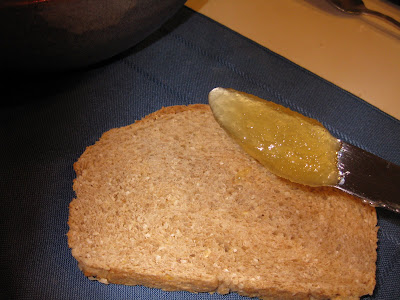
The bread, if you are interested, is a multigrain bread that I made with my grandson.
I left all of my bottled honey on a table and came home to find that the jars that were harvested over Memorial Day last year had all turned into creamed honey. People prize creamed honey - it's less drippy and easier to spread. In truth, though, it is honey that has granulated. Creamed honey isn't a solid mass. Instead it is a thickened honey that tastes great and is just thick instead of clear.
I wondered why the honey from Memorial Day harvest had granulated and not the rest of my jars. I posted on Beemaster to find out what the other beekeepers had to say about this. Apparently this batch of honey had just the right amount of glucose and "seed" material (pollen grains, for example, that didn't filter out) to encourage its turning into creamed honey. And the temperature at which I left my house (55 - 60 degrees) was IDEAL for making creamed honey.
Interestingly, this honey doesn't have a sandy feel on the tongue. Instead it spreads like regular honey and is fabulous, in my opinion. You can tell that I am using the honey from the jar below. Actually you can heat the honey in a water bath and the granulation will go away, but I don't want to heat my honey so I am going to enjoy it as is.

You can see the consistency in the picture below.

When it is spread on hot toast, it is exactly like non-granulated honey and tastes, as all my honey does, absolutely delicious!

The bread, if you are interested, is a multigrain bread that I made with my grandson.

Subscribe to:
Posts (Atom)
Pin this post

LinkWithin
