Welcome - Explore my Blog

I've been keeping this blog for all of my beekeeping years and I am beginning my 19th year of beekeeping in April 2024. Now there are more than 1300 posts on this blog. Please use the search bar below to search the blog for other posts on a subject in which you are interested. You can also click on the "label" at the end of a post and all posts with that label will show up. At the very bottom of this page is a list of all the labels I've used.

Even if you find one post on the subject, I've posted a lot on basic beekeeping skills like installing bees, harvesting honey, inspecting the hive, etc. so be sure to search for more once you've found a topic of interest to you. And watch the useful videos and slide shows on the sidebar. All of them have captions. Please share posts of interest via Facebook, Pinterest, etc.

I began this blog to chronicle my beekeeping experiences. I have read lots of beekeeping books, but nothing takes the place of either hands-on experience with an experienced beekeeper or good pictures of the process. I want people to have a clearer picture of what to expect in their beekeeping so I post pictures and write about my beekeeping saga here.Master Beekeeper Enjoy with me as I learn and grow as a beekeeper.

Need help with an Atlanta area swarm? Visit Found a Swarm? Call a Beekeeper. ‪(404) 482-1848‬

Want to Pin this post?

Wednesday, August 08, 2012

What is Natural Beekeeping?

This Saturday, August 11, I'm going to be in Asheville, NC at the "What is Natural Beekeeping?" day put on by the Center for Honeybee  Research.  Speakers include

Michael Bush (after not meeting him for seven years, I now will see him again within a couple of weeks of the conference in Massachusetts!)


Ed Levi, an Arkansas beekeeper who is very interested in finding uncontaminated wax somewhere in the world (recently searching in Ethiopa!)


and Roger Simonds (couldn't find a good photo of him)  from the USDA National Science Lab in Gastonia, NC where he does testing for Mary Ann Frazier who is at Penn State.
Should be a great day (10 - 5).  Happens at the Warren Wilson College Kittredge Auditorium.

If you want to go too, here is the sign up page.

Tuesday, August 07, 2012

The Cycle of Life

Of course, I'm still thinking about how it was that the hive was chosen to be robbed.  Then I think it was part of the cycle of life.  It's one of the things that happens in nature, part of the bigger picture that I am too small a speck in the universe to see how it fits into the scheme of things.

I grew up in a town that then and still now only held about 16,000 people.  It is daunting to think of an entire community three times that size being wiped out in a day...which is what happened to my bee hive.


So here's another Mary Oliver poem that is right on point for this sad event:

~~~~~~~~~~~~~~~~~~~~~~~


Black Bear in the Orchard

It was a long winter.
But the bees were mostly awake
in their perfect house,
the workers whirling their wings
to make heat.
Then the bear woke,

too hungry not to remember
where the orchard was,
and the hives.
He was not a picklock.
He was a sledge that leaned
into their front wall and came out

the other side.
What could the bees do?
Their stings were as nothing.
They had planned everything
sufficiently
except for this: catastrophe.

They slumped under the bear’s breath.
They vanished into the curl of his tongue.
Some had just enough time
to think of how it might have been --
the cold easing,
the smell of leaves and flowers

floating in,
then the scouts going out,
then their coming back, and their dancing --
nothing different
but what happens in our own village.
What pity for the tiny souls

who are so hopeful, and work so diligently
until time brings, as it does, the slap and the claw.
Someday, of course, the bear himself
will become a bee, a honey bee, in the general mixing.
Nature, under her long green hair,
has such unbendable rules,

and a bee is not a powerful thing, even
when there are many,
as people, in a town or a village.
And what, moreover, is catastrophe?
Is it the sharp sword of God,
or just some other wild body, loving its life?

Not caring a whit, black bear
blinks his horrible, beautiful eyes,
slicks his teeth with his fat and happy tongue,
and saunters on.

Mary Oliver in New and Selected Poems: Vol.2

~~~~~~~~~~~~~~~~~~~~~~~


Sunday, August 05, 2012

Honey at the Table


Mary Oliver's poem about honey at the table comforts me as I am mourning my lost hive from yesterday:

Honey At the Table

It fills you with the soft
essence of vanished flowers, it becomes
a trickle sharp as a hair that you follow
from the honey pot over the table

and out the door and over the ground,
and all the while it thickens,

grows deeper and wilder, edged
with pine boughs and wet boulders,
pawprints of bobcat and bear, until

deep in the forest you
shuffle up some tree, you rip the bark

you float into and swallow the dripping combs,
bits of the tree, crushed bees - a taste 
composed of everything lost, in which everything
lost is found.

(from American Primitive by Mary Oliver)


Today, August 5, is the birthday for two of my daughters, Sarah and Becky, born two years apart on the same day.  We'll have dinner tonight to celebrate Sarah who lives in Atlanta and there will be honey at the table.


I'm making profiteroles with honey lavender ice cream as a "birthday cake" for Sarah tonight and the honey will, of course, come from our bees.:


Becky, my other daughter whose birthday is today, lives in Cumberland, Maryland, or I would have her over for dinner as well.


Saturday, August 04, 2012

The Demise of the Hive

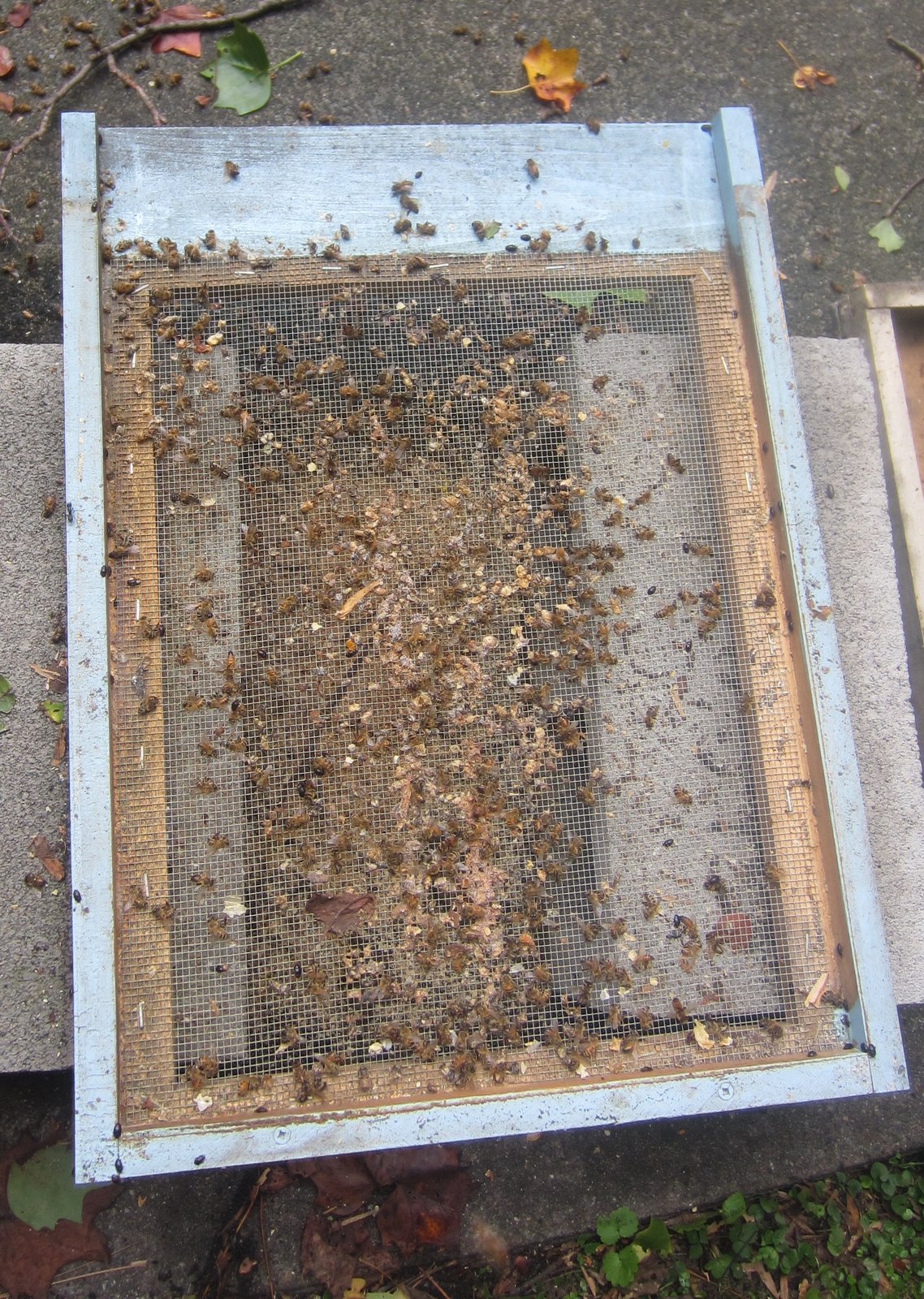
Such a sad feeling to open up a robbed hive.  I avoided it most of the day, but then realized I had to do it - I had to know what the situation was.  I've had robbing before and the hives have made it through but my heart sank when I opened the robbed hive and saw……only dead bees.


I took it down to the bottom.  The bees on the SBB were sad and some were still alive but unable to move to get up and fly.


I looked for the queen in the dead but did not see her.  I did find in one box clustered between the wall and the first frame a handful of bees.  There was still some honey unrobbed but no brood - all those cells which had brood on Thursday - were empty today.

I just feel sick.  I wonder if I did something at the inspection on Thursday to set this off.  Did I open the cappings of honey as I pulled frames from the box?

Then I remembered that the reason I opened the hive on Thursday was because I had seen very little activity and had wondered if something were wrong.  I was surprised to find the hive full of bees.  It wasn't boiling over, but there were bees in every box, new eggs and brood.  I had worried about honey and all of my bees but this hive had plenty of honey (thus the robbery).

I wonder if they had possibly already had problems and the robbing just cinched their fate.

I feel heartsick.  This has been a hard year.  I have had more hives this year than every before, but I have now lost five hives without the winter being the issue.  And most of the losses have been in my own backyard - not in the outyards that I also manage.
Posted by Picasa

Friday, August 03, 2012

Mayhem and Robbery in the Bee Hive

Robbery in the bee hive is disconcerting, to say the least.  It is violent and upsetting to watch.  I am a grandmother on Fridays and after a morning with my grandchildren today at the Atlanta Botanical Garden, came home to find one of my biggest hives being robbed.

Below is a video of the hive.  I usually use a tripod and at the end of the filming with bees head bumping me on all sides, I was not a steady camera holder, so it's jiggly, but I put it up so you can see what robbing actually looks like.

Both Orientation in the afternoons and swarming behavior when the hive is gathering for the swarm are  often confused with robbing.  Both lack the violence.


In the end I soaked a sheet in water and threw it over the hive for a couple of hours.  The robbers desisted and left.


Later in the evening, I removed the sheet and set the robber screen up so that the entry was open for a bit.  The sad bees were carrying out opened larvae.


Under the hive you can see lots of wax shards from the robbers tearing open cells.


I had just inspected this hive yesterday and was pleased to find that they along with the rest of my hives were putting up some nectar and that they had some larvae in the cells.


I don't know what the state of this hive is and if it can recover.  I may open it on Sunday and see what I may need to do to support them, such as add some frames of honey from another hive.


Thursday, August 02, 2012

Lessons from the NE Treatment Free Beekeeping Conference

During the NE Treatment Free Beekeeping Conference (which I am now going to call the NETFB to save typing), the emphasis was on healthy bees.  I learned a lot about balance in the hive, nutrition on every level, and respect for nature and evolution.

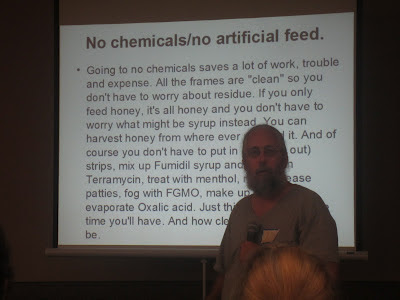
Michael Bush set the tone in his first talk about healthier bees.  He discussed microorganisms in the hive.  There are 30 kinds of mites, 30 kinds of insects and some 8000 microorganisms in the bee hive.  When we treat we affect the hive ecology.  Everything that is put in the hive as a treatment - whether "natural" or not - kills microorganisms.  Dean Stiglitz and Laurie Herboldsheimer (hosts of the conference) have done a small experiment just to show the influence of oxalic acid on yeast in general.  Their point is that whatever we introduce into the hive, we are affecting the ecology of the hive.

If you take the "no treatment" approach, then you are inviting the bees to experience selective pressure to evolve stronger bees who can withstand the varroa mite or whatever the next bee scourge might be.  What happens with treatment is that we strengthen the mite who becomes more virulent and prolific.  If we don't treat, according to Michael, the pressure is where it should be - on the pest/parasite to be in balance with its host.

So Michael advocates (and you can read what he talked about on his website - click on Four Simple Steps to Healthier Bees on the left side column)

  1. No Treatments of any kind
  2. Breed local survivor queens
  3. Only natural food (honey and real pollen)
  4. Use natural comb
To the point of only feeding natural food, Michael pointed out that the Ph of sugar syrup is 6 vs. that of honey which is 3.2  A lower Ph is more acidic and all brood diseases thrive more in sugar syrup than in honey.  

He has a PowerPoint on his website on natural cell size which you can also find in the left column on the linked page.

Dean Stiglitz, seen below, gave a talk on raising local queens.  I own but have only leafed through his book written with Laurie:  The Complete Idiot's Guide to Beekeeping, and this conference and meeting him sent me home to pore over it.  He is the consummate researcher and researches other people's research.  He also gave a talk at the conference on how to read a research study to know if the results are something to rely on or not.

Again, in his queen-raising talk, the emphasis was on bee health.  To be a well-developed queen, the queen must be fed well.  So a hive must have stored food, pollen, and young worker bees to make a good queen.  He encouraged a walk-away split as one way to encourage the bees to make their own queen.  The queenless side of the split will be the cell builder.  If you put that half of the split in the old hive's location, then the foragers will return to it, adding to the food in the colony.


Another interesting talk for me was by Dee Lusby.  Dee and her late husband Ed raise bees in Arizona.  She was a little difficult to understand - I expect one learns more from visiting her at her apiary than hearing her speak, but I learned a lot from her about Housel positioning.

She pronounces it "HOO sul" - I've been calling it "How sul" so I am mending my ways going forward.  What I understood about Housel positioning is that when you put foundation, a foundation strip, or drawn comb into a hive, it's important that the inside of the cell have the "Y" at the bottom of the cell facing up on the frames from the center to the outside of the hive.  In the center it switches and the "Y" should face up going toward the nearest side.

I just thought that for some reason that was better for the bees, but instead there is an explanation that again has to do with balance in the hive.  If the "y" is facing up, then the bees use that upper "v" of the "Y" as a guide for the beginning of their comb.  And for the honey, for example, to stay in the cell, the slant of the cell has to be downward toward the center.

If the cells are not set that way, then it confuses the bees' system and their balance in the hive.  This is also why it is so important to put a frame back into a box in the same orientation in which it was originally.
Jeff and I do all of our hives this way, but only because I thought we were supposed to - now I understand why it is important.


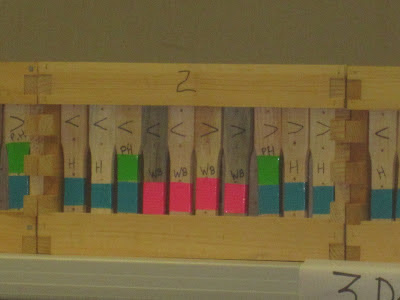
Dee also talked about opening up the brood box in a pyramidal way by placing capped brood in the center of the box with a full frame of honey on either side of the capped brood (for insulation of the brood and for food provision).   She had a complex system of numbered frames to explain this to us.


There were other good speakers - Kirk Webster talked about overwintering nucs, but I'm not going to try to cover that in this post.  And Michael gave another talk on what he calls "Lazy Beekeeping" addressing issues I already talk about in this blog all the time:  8 frame mediums, foundationless frames, etc.  Paul Arnold who anchors the Young Harris Institute was also there, but we missed his talk on Thursday night and on Sunday.  It was fun hanging out with Paul, though, and Julia, Noah, and I ate several meals with him.

BTW, here's a picture of the Atlanta contingent with Michael Bush in front of his table of books that he was selling.  We left a space in our line-up so that his books might show up in the picture, but they don't really.



So I came away resolved to try to succeed at splitting my successful colonies, to forget feeding even bee tea, and to try to emulate my natural beekeeping mentors and heroes.
Posted by Picasa

Tuesday, July 31, 2012

Les Crowder on Using Top Bar Hives

Before the conference in Massachusetts, I didn't know about Les Crowder.  He is a well-known person in the world of permaculture and has been raising bees in top bar hives in New Mexico for years and years.

I love it that his website is called "for the love of bees" which is what we all feel who keep them.

Les has been keeping bees for 40 years.  He likes top bars and natural comb because he thinks we should trust the bees to know what they need to build in the hive and to know how to "run themselves."    He doesn't use any treatments in the hives because he wants "clean honey" on his table with no poison.

Because Les was one of the original teachers of beekeepers in New Mexico, most beekeepers in New Mexico are treatment free and most use top bar hives.  After my challenges with the top bar, I was very interested to hear how he manages his hives.


I always worry about crushing bees in pushing the top bars back together.  Les says as you lower the bar, put your fingers under the ends of the bar and push the bees out of the way before you lower the bar.  I'm certainly going to try that.

He also uses rather shallow top bar hives - his are 10 inches deep, 20 inches across, and 42 inches long.  
The shallow depth helps keep the comb stable.

He doesn't use follower boards (says they stop air circulation) and uses side entrances on his top bars.  He doesn't screen the bottoms of his TBHs because he said it's too much work to add the extra part.  He thinks you need a false bottom under the screen if you use a SBB on a TBH.

To encourage the hive to "stretch" and grow, he opens up the hive by putting an empty bar between two drawn brood combs.  This helps the hive stretch.  He generally in winter moves the honey to the end of the hive for winter.

He said, as all of us who have struggled with top bars know, that top bar hives should be inspected about once every two weeks to manage the comb.

I enjoyed hearing his tales of growing up and working in the bee hives all his life.  I plan to follow his web site and pay attention to what he is saying about these challenging hives.  Maybe I'll try again next year.


Posted by Picasa

Sunday, July 29, 2012

Meeting Michael Bush - I Can't Believe It!

When we arrived in Leominster, Massachusetts, for the NE Treatment Free Beekeeping Conference, here is the sign that greeted us!  It took us until Friday night to find the bar that was "accepting apps," but we were glad for the glass of wine that we bought there when we did finally locate it!


The conference was great in so many ways and I learned a lot, but I thought I'd post a few of the highlights (including the sign) tonight and then I'll post some of the content over the next week.

Sam Comfort talked about Warre hives and I was so entertained and learned a lot.  I knew nothing about Warre hives before I listened to him speak.

I had hoped we would also get some time with Sam in the beehives but it rained every day.  He is a wonder to watch as he works the bees with no protective gear and only a broad-brimmed hat.  I really wanted Noah to get to see Sam in action.  Sam told Noah that he drove his bees down to the conference inside his van - they are top bar and Warre hives - so they were not screened off.  Should have been quite an adventure.


Before we got there, Sam taught a workshop on how to build a skep.  Here is a skep that he built.  Some funny beekeeper equipped the skep with a head covering, sunglasses and a German smoker for a pipe!


But for me the highlight of the meeting was getting to meet Michael Bush in person.  I was so star struck that the first day, the best I could do was to introduce myself and essentially run back to my seat.  But the second day I got to chat with him some and got to eat dinner with him on our last night there - which was a privilege.

When I first started beekeeping, I wanted to be a natural beekeeper and found little support in my local bee club at that time seven years ago.  I went to the Internet for guidance and found Michael on Beemaster and Beesource.  He has been my model for how I'd like to keep bees from the beginning and he has always been willing to answer emails and questions I've posted on Beemaster and Beesource.  I've also learned from reading his website and posts in answer to questions from other people.

It is so rare to get to thank someone like that in person - Michael was every bit as nice in person as he is when he responds on the Internet to questions that he must have been asked 800 times.  I am absolutely thrilled that I got to meet him.

In the photo below, we are standing in front of a table filled with his books that he was selling at the meeting.  In addition to his own book, he has reprinted old beekeeping manuals from classic beekeepers.  I already own his book, so I bought his compendium of queen rearing guides.


Julia, Noah, and I had a great time at the conference and I came home more determined and informed about the importance of no treatment and the importance of raising hives that can fight the varroa mite without my intrusion.
Posted by Picasa

Pin this post

LinkWithin

Related Posts Plugin for WordPress, Blogger...