Welcome - Explore my Blog

I've been keeping this blog for all of my beekeeping years and I am beginning my 19th year of beekeeping in April 2024. Now there are more than 1300 posts on this blog. Please use the search bar below to search the blog for other posts on a subject in which you are interested. You can also click on the "label" at the end of a post and all posts with that label will show up. At the very bottom of this page is a list of all the labels I've used.

Even if you find one post on the subject, I've posted a lot on basic beekeeping skills like installing bees, harvesting honey, inspecting the hive, etc. so be sure to search for more once you've found a topic of interest to you. And watch the useful videos and slide shows on the sidebar. All of them have captions. Please share posts of interest via Facebook, Pinterest, etc.

I began this blog to chronicle my beekeeping experiences. I have read lots of beekeeping books, but nothing takes the place of either hands-on experience with an experienced beekeeper or good pictures of the process. I want people to have a clearer picture of what to expect in their beekeeping so I post pictures and write about my beekeeping saga here.Master Beekeeper Enjoy with me as I learn and grow as a beekeeper.

Need help with an Atlanta area swarm? Visit Found a Swarm? Call a Beekeeper. ‪(404) 482-1848‬

Want to Pin this post?

Saturday, December 08, 2012

Dean Stiglitz on Honey Bee Genetics


ApiNews this week included a link to a video by Dean Stiglitz.  Dean ran the Treatment Free Bee Conference that Julia, Noah and I went to this summer.  He is also the author with his wife Laurie of the Complete Idiot's Guide to Beekeeping - which is a great book (so far--I'm reading it cover to cover this winter and am not through yet.)

Dean gave a version of this talk at the conference in Massachusetts.  The slides in the video that I am sharing in this post are a little off - don't know what was wrong in the YouTube video - but you can make sense of them anyway.

He obviously had a very short amount of time to give this presentation, but he did a good job of explaining how the drone's genetics work in the mating with the queen.

I thought you all might enjoy it:


Friday, December 07, 2012

Alexander and the Red Ribbon Year

I love Alexander and the Terrible, Horrible, No Good, Very Bad Day by Judith Viorst.  Poor Alexander - nothing goes right for him.  He even has to wear his railroad train pajamas and he hates his railroad train pajamas.  When he goes with his brothers to buy shoes, everyone gets cool ones, but they only have boring uncool ones in Alexander's size.

It's a great book to read when things aren't going well.

My honey contest year was a little like Alexander's day.  When I entered my wax block, in each show the winning entry was poured into a design mold instead of a block.  It's much harder to pour a solid block but since most honey contest rules don't designate specifically a solid block with no design, then fancier looking entries always win.

So this was a red ribbon year.  I never won a blue ribbon in any of the many categories I entered.  And I should remember that there were plenty of people who entered honey contests this year who didn't get any ribbon at all, but it was still disheartening.

Usually one wants to improve, not go downhill!


Ordinarily I'd say, "Well, there's always next year," but I'm thinking I might skip entering contests next year and focus on honey production instead.

I'm pretty sure I've entered my last wax block, although I feel so drawn to that effort.  I didn't get to enter the Metro Atlanta Beekeepers' honey contest this year because I was in Ireland, and our honey contest rules do not allow a design mold poured block.   Here are our rules for wax block:
~~~~~~~~~~~~~~

Class 7:  Wax block
1.      The block must be at least one inch thick but not more than two inches thick.
2.      The block must weigh a minimum of two pounds, (but no more than three pounds)
3.      The block should be smooth-surfaced and free of decorations or embellishments.
~~~~~~~~~~~~~~

We worked really hard at Metro to develop a complete and comprehensive set of rules.  If your club needs guidelines for how to write honey contest rules, we ran ours past Robert Brewer (who trains most of our country's Welsh honey judges) and Keith Fielder before completing them.  Here's a link to the MABA honey contest rules.

So, we'll see next year.  Maybe I'll enter the wax block, but probably skip the honey entries for next year.

Thursday, December 06, 2012

GBA Newsletter

At the Georgia Beekeeping Association's fall meeting, Gina, my friend and president of Metro Atlanta Beekeepers, and I volunteered to write the monthly newsletter for the association.  We came up with a basic formula for what we wanted to include and began with our first issue in October this year.

We now have done three issues and are getting good feedback.  The issues are not only sent out to the registered GBA members, but also are posted here, if you'd like to see what we are doing.

Here's our plan for each month:

  • We feature a photo about beekeeping taken by a member at the beginning of each newsletter.
  • We ask the president of the association to make a short statement each month.
  • We try to feature an article of importance. 
    • The first month we featured the Georgia beekeeper of the year;
    • in November we featured an article from a well-known Georgia beekeeper, and 
    • this month we featured an article by Cindy Bee, a nationally known beekeeper who recently left Georgia to move to Maine 
  • We try to come up with a beekeeping tip or a piece of interesting bee information from ApiNews or some other source
  • We feature a funny beekeeping adventure from one of our members
  • We ask one bee club in the state each month to write up what their club is doing, what speakers they've had that they particularly liked, etc.
  • We try to put in about three quotes that are about beekeeping
  • Finally, we beg people to send us articles, photos, and informative items
We figured that if we had a basic plan, then we wouldn't have to reinvent the wheel each month.  We ask everyone only to write a paragraph or two to take the pressure off.  However, most people write us more than that.  

So far, so good....but this is only the third month!  We have gotten pretty good feedback so far and I'm having a great time working with Gina.

I've never done a newsletter before.  It's a lot of work.  Literally, we pushed "Send" today to send out the December issue, and Gina said, "Whew.  Ok, now what are we going to do for January?"  And it will take that long to get enough articles and information to do our next issue.

We're hoping our newsletter will help promote beekeeping in Georgia and maybe up the membership of the state organization (it only costs $15 to be a member of the GBA).  I've noticed that the presidents of the three bee clubs we have featured so far are not members of GBA!  

We're open to ideas or suggestions.  If you go to visit the site and read the newsletter, let me know if you have any feedback or thoughts about how it could be even better.


Wednesday, December 05, 2012

Asters in December

It's December - usually in years before Global Warming, we would actually have cold weather.  The supposed first freeze date in Georgia is generally November 15.  So far this year, as last year and the more recent warm years, we haven't had a freeze yet.

The temperature dipped into the 30s at least two nights, but still was two degrees above freezing.  The problem for bees is that if they fly out of the hive, it is usually to relieve themselves.  There isn't food to be had.

However, walking today I came upon an aster blooming happily and covered with bees!


There are beekeepers all over Virginia Highlands in Atlanta where I live.  I just hope these joyful bees are mine!

For more on Global Warming, here's a TED talk:


Monday, November 05, 2012

Rabun County Marauder

I don't know where the fall went.  It's November and I have no idea what happened to autumn.  Today I'm in Rabun County.  I've missed being up here and have entirely missed the fall leaves.  I haven't done a good job of checking on the bees up here, so I wanted both to check on the bees and turn on the heat at my house so that the pipes won't freeze as the winter arrives.

I arrived at the School House Garden and was shocked with what I found.  As you remember, one of the hives had died.  I left one box on the cinder blocks - a slatted rack, a screened bottom board, one hive box, an inner cover and a telescoping cover.  My hope was that in the spring a hive might move in as a swarm.

Today here's what the empty hive looked like:


I don't  know how to think of this - the cover on the hive box could not have been off for long because the wood is not discolored and I haven't been here in two months.  The slatted rack and screened bottom board are discolored and wrecked.  I don't know if an animal did this or since the weeds had been cut back, if a tractor ran over the whole thing.

At the remaining live hive, I saw an occasional bee enter.  The bees all entered on the same side of the entry, but there were very few of them.  

I had brought an empty 10 frame box to act as a surround for a rapid feeder.  So I set up the rapid feeder over the inner cover and filled it with honey.  It was 62 degrees.  Generally when a hive is in need of stores, when you put on the feeder, at least one or two bees immediately show up in the tube to sample the new honey.  


Not a bee appeared.

I lifted the hive from the bottom hand hold.  It seemed relatively heavy as if they had put on a good amount of stores.  

I get really cautious when I've lost a hive, so I didn't go into the box and just left to go to WalMart.  While I perused the aisles at WalMart, I kept thinking about the bees.  Were those hive bees or were they marauding bees from the nearby hive in the wall of the old school building?  Should I have left all of that good honey on a deadout when there are hives that could use it in Atlanta?  

Needless to say, after I checked out of WalMart, I drove back over to the community garden and opened up the hive box.  

The top box held honey but no bees.  But on the second and bottom box there were bees covering four frames in each box (8 frames of bees in all).  I knew they had clustered there the night before when the temperatures were in the 30s, and I felt relieved to see them.

Still cautious, I didn't check any further to see if there were a queen, but instead closed up the hive with a sigh of relief.  I'll check them again in a few weeks.

I rode home wearing my sunglasses this morning because as probably all of you know, during the fall, leaves look more colorful through sunglasses than they actually are so I could have the illusion that I didn't miss the fall leaves in North Georgia!


Monday, October 15, 2012

Yet Another (two) Wax Block(s)

Well, I'm at it again:  The Great Wax Block Saga.

Last night I poured two wax blocks for the Tara Contest and hoped at least one of them would be good this morning.  When I got ready to pour, I pulled out my piece of silk and found that a wax moth or some other creature had feasted on it:


So I resorted to using panty hose - not as good a filter, but hey, it's what I had.


The panty hose is stretched over a measuring cup with a pouring lip that has been heated in a pan of simmering water so the wax won't solidify as it hits the glass.

I cooled one block in the downstairs oven and the other on the counter top.  I heated the oven to its lowest temperature:  170 and then turned it off before putting in the wax.  Inside the oven while it is heating is a roasting pan filled with hot water and the mold for the block:


I poured one round mold and one in a bread pan.   This morning both were good, but the bread pan had striated lines on the edges of the block:

I polished it while I put the round mold in the freezer - it wouldn't come out of the mold and sometimes the freezer for about 30 minutes will do the trick.  As a last resort, I could use this block but I don't want the striations.

Voila!  The round mold came out just lovely:

I can see a couple of specks in it - result of the use of panty hose instead of silk, but it is a gorgeous wax block.  I've packed it up (after polishing and polishing with panty hose) to go to the show tonight as well.

It rides in its own Tupperware container and sits on a linen napkin - throne for a queen, I guess.

Wish me luck and I'll let you know how it goes.


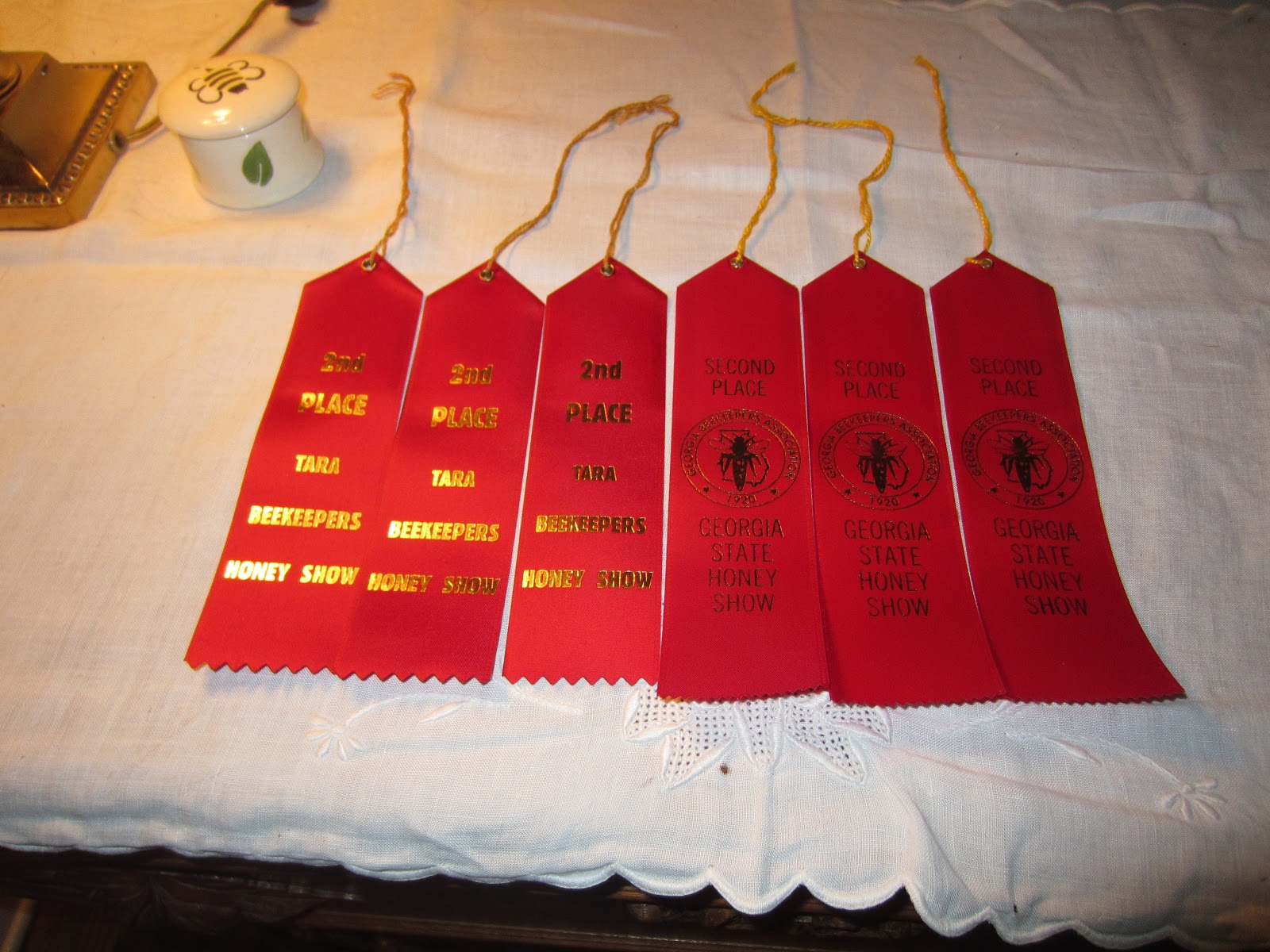
Entries for Tara Honey Show

I belong to a couple of bee clubs.  The Tara Bee Club is having its honey contest tonight.  I have to work until 6:30 and I live 16 miles in going home traffic from the Tara meeting in Forest Park, Georgia.  They are accepting honey entries from 6:45 - 7:15 so I will arrive at best just under the wire.  As a result I had to get everything ready last night so that I only have to take the plastic wrap off of the jars, put on new tops, and hand them to the steward.

Generally to a honey show, I take a leg of panty hose or a piece of silk for polishing, gloves to pick up the jars, a flashlight to look for fingerprints, a squirt jar of water in case something needs cleaning, toothpicks for last minute bubble removal, silver demitasse spoons for equalizing jar fills, and lint free cloths for polishing jars.  I'll probably have all of that with me, but in reality, I won't have time tonight.  So last night I spent hours getting my entries ready for the show.

I poured two wax blocks and crossed my fingers until this morning.

I polished, equalized, and de-bubbled jars (actually only one jar had bubbles).  I put new tops for each jar in plastic Ziplocs.  I put all the finished products in a sectioned box:


So I'm entering (from top of photo to bottom) black jar, creamed honey, light honey, chunk honey (and a wax block - see next post).  You can see the flashlight peeking out of one of the jar lid filled sections and the new tops for the jars in their baggies.  

I only have light honey to enter this year since Jeff and I only really harvested from Five Alive and Stonehurst.  Like last year, the Stonehurst honey has crystallized early - it was kind of medium - so all we have is the light honey from Five Alive.

We'll see if anything places - I've not done great in honey shows this year, but if I say so myself, the creamed honey we are entering into Tara is really fabulous.

Thursday, October 11, 2012

Pests in the Hive - Ants and SHB

One of my hives at Stonehurst is the subject of a UGA study (along with a number of other beekeepers' hives).  The researcher came last week and emailed me that he thought the hives were so infested with SHB that they would not survive the winter.

I went over today with the only small hive beetle trap I could quickly find that didn't need an Imrie shim.  It was an AJ's trap.  I recently won two beetle traps like AJ's from Buster's Bees at a Tara Beekeepers meeting, but I couldn't find them today.

I opened the smallest hive and there were SHB EVERYWHERE on the top cover and in the corners.  I didn't see the SHB in the actual hive, which was comforting.  First I used a funny suction instrument that John Jones gave me.  I tried....I really did, but I only sucked one SHB all the way into the bottle.  The rest were in the suction tube and I had no idea how to manage them.  So I gave up on the method and installed the AJ's.


The good news is that the larger hive (fartherest away in the picture) felt heavy and when I opened it, there was not a single SHB.  In the smaller hive beside the smoker, were the tons of SHB - probably at least 150 on the top cover.

I left the hive with an oil filled AJs and we'll see if it catches any of them.  I also put a surround box with a rapid feeder filled with last year's honey on the small hive.


After that I went to Sebastian's to see if that hive needed food.  I opened it to find that ants had taken up residence:


I wish you would LOOK at all the ants.  Funny thing, they weren't in the rapid feeder and there was still some crystallized honey in it.  I had two jars of last year's honey so I refilled the rapid feeder.

I think I'll go back and sprinkle cinnamon all over the inner cover.

At the bee club meeting this week, the president asked who wasn't feeding their bees.  I didn't know whether to raise my hand or not.  I'm not feeding mine in the way she meant - with sugar syrup.  I am feeding the ones that are light on stores with last year's honey.

After the bee meeting in Massachusetts, I want to raise bees that aren't dependent on my interference and don't need sugar syrup to make it through.  I also was scanty in my harvest this year to make sure that the bees are OK for the winter.


Pin this post

LinkWithin

Related Posts Plugin for WordPress, Blogger...