Last night I spent a fun couple of hours listening and participating in a podcast featuring Jerry Freeman's small hive beetle trap. I've used it on my hives and have been impressed. As I said on the podcast, his trap captures a lot of beetles at once and in that way is very effective.
If you'd like to listen to the podcast in its entirety, here it is.
On the WildlifePro network, there is a scheduled once a month beekeeping podcast. I'll go back - it was fun and informative. People could call in and talk or join in "chat" mode and submit questions for Jerry (and occasionally ---- me!!) that way.
I had thought a lot about all the ways I've tried to combat the small hive beetle and decided to try writing an Ehow article to separate my thoughts on each of the traps I've used. You can read it here.
Such a pest the SHB is. I delight every time I kill one and my usual response to ending the life of any creature is not delight!
Friday, September 11, 2009
Tuesday, September 08, 2009
Revisiting Japanese Knotweed
 This is Cumberland, Maryland where my daughter lives and where I visited the weekend before Labor Day. This bridge goes over the C & O Canal that runs from Washington, DC to Cumberland.
I was so sorry I didn't have my camera with me on my walk on the towpath in Cumberland, MD last weekend. I knew I had seen Japanese knotweed in bloom in the N Georgia mountains in the middle of August. I went there this weekend but the knotweed bloom was completely done. There were no blooms, and no bees.
As I drove away from the lake where I had seen the knotweed in N Georgia, I called my daughter in Maryland and asked her if she would revisit the path we walked and take some pictures of the bees on the knotweed. Here they are. If you look closely at the third picture in the lower half of the picture, you'll see an interesting caterpillar also on the knotweed.
All photos on this page by Rebecca Ramspott.


Monday, September 07, 2009
I'll be on a Podcast About SHB on Thursday
I'm thrilled that I've been invited by "Robo" on Beemaster to be a part of a podcast he will be presenting on Thursday, September 10 at 8 PM Eastern time.
The focus of the podcast is on the small hive beetle and how the various traps work. Jerry Freeman, developer of the Freeman Beetle Trap, will be a guest to talk about his trap and I'm supposed to talk about all the many different traps I've used and the advantages/disadvantages of each.
This should be fun.
The focus of the podcast is on the small hive beetle and how the various traps work. Jerry Freeman, developer of the Freeman Beetle Trap, will be a guest to talk about his trap and I'm supposed to talk about all the many different traps I've used and the advantages/disadvantages of each.
- What: WpN Beekeeping Podcast - Small Hive Beetle Control
- When: Thursday, September 10, 8PM EST
- Where: http://www.talkshoe.com/tc/16456
This should be fun.
Saturday, September 05, 2009
Butterflies, not Bees
In a meadow near the Hambidge Center in North Georgia, I walked a trail where I saw lots of butterflies, but only two bees - one on goldenrod and the other on Joe Pye weed. I decided to take pictures of the butterflies because they were so delicate and beautiful.
(And of course, I took a picture of the bee on the goldenrod!)
This one is probably a yellow tiger swallowtail, at least from pictures on the Internet.

The picture below is probably a meadow fritillary butterfly (what do I know?) but I thought it was pretty anyway, in the fall colors!

This beautiful blue and black butterfly was the prettiest of all and the most difficult to catch in a picture. Here it is on Joe Pye weed. It may be a female Diana butterfly.
Anyway with no bees, I thought I'd share these.

And below is the lone bee on goldenrod!

Tuesday, September 01, 2009
Japanese Knotweed and bees
The bees love it - and it is an invasive plant in most of the world. It's on the list of the top ten invasive plants in Georgia. I saw it all along a trail in Cumberland, Maryland, absolutely covered in bees of all kinds, but particularly honeybees.
Here's a bee on Japanese knotweed
Here are another couple of pictures of knotweed and bees on the plant.
This article says that the plant is often found near water and along railroad tracks. I was walking on the C&O towpath that goes along an old railroad bed along the C & O Canal in Cumberland, Maryland.
I wish I had had my camera with me on the walk, but I did not. I have never seen so many bees on a plant. One of my friends on Beemaster posted that it is related to the buckwheat family, a plant family that always draws bees. It also blooms at a time when nothing else much is supplying nectar, so the bees are delighted to find it.
I'm going to the mountains over Labor Day and since Japanese knotweed is on the list of Georgia's invasive plants, hopefully I'll see an example to photograph myself.
Now that I know what it is, I believe I did see it around the Black Rock Mountain lake the last time I was up there and it was covered with bees, but I didn't know what it was and again, didn't have my camera. Probably down here it will be through with its bloom. We'll see.


Friday, August 28, 2009
Feeding the Bees all over Town!
Because I am off to visit my daughter in Maryland this weekend, I wanted to feed all the hives that need feeding before I left. I opened the nuc with the poorly mated queen from Blue Heron and found that they had not touched the baggie I left there last weekend. I don't really understand why they have not, but I added a couple of slits to the bag and didn't replace it.

I am also feeding Aristaeus2 (the swarm hive from last year on my deck). I gave them a new bag as well. They had drained the bag from the weekend completely dry.

I went over to Blue Heron and opened up the Purvis queen hive. It's hard to put a baggie in without squashing bees. I've learned to lay it down slowly and gradually like a glacier moving over the frames to allow the bees time to move out from under the descending sugar syrup.

Now the baggie is fully down on the frames. I believe a couple of bees may have lost their lives in the process but it isn't as bad as it could be if I had cavalierly put the baggie on top of the frames.

Finally I went to feed the bees at the bee tree but that didn't go so well. The bee tree bees have gotten all possessive of the hive box. This should be a good thing but not for me and my health and well-being!
I climbed up the ladder with my jacket on and well zipped (remembering the last time last week when I got stung in the head under my unzipped veil). I did have my camera around my neck sticking the strap through the opening in the bottom of the veil.
I opened the top of the box and looked at the bees crawling all over the frames under the empty syrup baggie. I pulled off the syrup baggie and the bees came at my veiled head. One came in through the hole for my camera strap. I knew I didn't want to get stung before seeing my daughter for the first time in several months.
I climbed down off the ladder and moved away from the bee tree and zipped off my veil.
Big mistake. Apparently there were bees all over me. Taking off the veil gave them the opportunity they were waiting for and I suddenly had several bees in my hair, a bee in my nose, a bee under my glasses and a stinging bee above my eyebrow. I got the bees off of my face but the ones in my hair all found a way to sting me.
At the end I had about four stings in my head, one on a significant middle finger and one over my eyebrow. So now I headed off for Maryland with a face all swollen on the left side. Thankfully by the time the plane landed 24 hours after the sting, most of the swelling was gone.
Note to self: From here on out, take a smoker to the bee tree. Those girls OWN the hive box.
Thursday, August 27, 2009
Circle Dancing and Festooning at the Bee Tree

In the hot summer in a hive box, the bees gather outside on the landing and do the washboard dance.

AI Root in the ABC and XYZ of Bee Culture says that while the dance looks like the bees are scrubbing and scraping the landing of the hive, there's no evidence that they are doing anything other than exercising.
The bees at the bee tree are washboarding all around the knothole opening. Inside the opening as you can see in the picture above and below, they also appear to be hanging onto each other in a sort of acrobatic festooning in the center of the hole.
In an August day in Atlanta (this was 8 AM) it must be awfully hot inside the tree cavity.

When I climbed the ladder and opened the hive box, there were more bees than usual in the box and on top of the frames. I think they are getting invested in hive box ownership! Or at least I am hoping that they are.

Sunday, August 23, 2009
Bugs in the Beehive
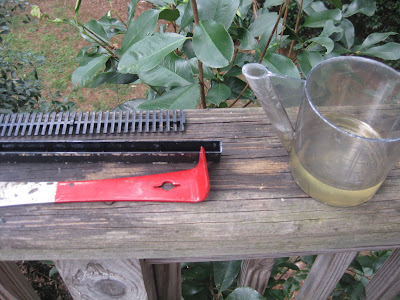
I found a new way to fill the AJ's beetle eater trap. I have this gravy measuring cup that is designed to separate gravy and fat. Since it has a tiny pouring lip, I decided to try to fill the trap with it and it worked beautifully.
But before I put anything back into the hive, I noticed this cockroach in Mellona on the inside of the telescoping cover - gross.

Under Mellona's top cover there were tons of SHBs - see how many there are. I squashed a lot of them with my fingers (gloved!) and with my hive tool.

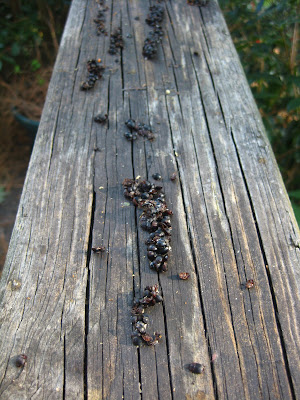
I dumped dead beetles out of the AJs beetle eaters all over my deck railing. Maybe the wren will eat them. There were so many that it looks like piles of seeds gathered on the deck rail.

But before I put anything back into the hive, I noticed this cockroach in Mellona on the inside of the telescoping cover - gross.

Under Mellona's top cover there were tons of SHBs - see how many there are. I squashed a lot of them with my fingers (gloved!) and with my hive tool.

I dumped dead beetles out of the AJs beetle eaters all over my deck railing. Maybe the wren will eat them. There were so many that it looks like piles of seeds gathered on the deck rail.

Subscribe to:
Posts (Atom)
Pin this post

LinkWithin
