Welcome - Explore my Blog

I've been keeping this blog for all of my beekeeping years and I began my 15th year of beekeeping in April 2020. Now there are more than 1300 posts on this blog. Please use the search bar below to search the blog for other posts on a subject in which you are interested. You can also click on the "label" at the end of a post and all posts with that label will show up. At the very bottom of this page is a list of all the labels I've used.

Even if you find one post on the subject, I've posted a lot on basic beekeeping skills like installing bees, harvesting honey, inspecting the hive, etc. so be sure to search for more once you've found a topic of interest to you. And watch the useful videos and slide shows on the sidebar. All of them have captions. Please share posts of interest via Facebook, Pinterest, etc.

I began this blog to chronicle my beekeeping experiences. I have read lots of beekeeping books, but nothing takes the place of either hands-on experience with an experienced beekeeper or good pictures of the process. I want people to have a clearer picture of what to expect in their beekeeping so I post pictures and write about my beekeeping saga here. Along the way, I've passed a number of certification levels and am now a
Master Beekeeper Enjoy with me as I learn and grow as a beekeeper.

Need help with an Atlanta area swarm? Visit Found a Swarm? Call a Beekeeper. (678) 597-8443

Want to Pin this post?

Showing posts with label capped honey. Show all posts

Tuesday, July 17, 2012

Ugli Honey

Jeff and I harvested three frames of honey from the original Lenox Pointe over the weekend.  I crushed and strained the total of 8 frames that we took on Sunday.  Some of the honey was very strange.

Here's what the cappings looked like.  Instead of individual cells being capped, the bees indulged in this stained glass approach.  The honey was a dark orange.


The frame below is what a whole frame looked like - it's all disorganized and the cappings on all three frames had this modern art look.


Inside the cells some of the honey was crystallized!  The grains of the crystals were large and rough against the roof of my mouth.   The honey tasted a little like apricot with a sharp finish at the last minute.  I've never tasted anything like it.  The moisture level on the refractometer was right at 18.6.


Here's a view of the cut side of one of the combs.  See the thickened crystal?


These bees are all overwintered hives so we didn't feed them this year at all.  I wondered if this were honey that was the result of the bees visiting a hummingbird feeder, but with three full frames (and we left the other five in the super because they weren't capped yet), that would be a lot of sugar syrup.

What nectar could these bees have gathered that would crystallize in the comb?  And we've had very hot weather in Atlanta - about a week of days with temperatures over 100 in the last couple of weeks.

Any ideas?


Posted by Picasa

Thursday, July 12, 2012

Bee House Calls

My father was a doctor in Natchez, a small town in Mississippi.  When I was a little girl, he often went on house calls to take care of patients in their homes.  This generally happened at the end of the work day, and he often took us with him.  "Us" at that time consisted of my mother, my brother and me.

While Randy and I mostly bickered in the back seat, I actually remember it as fun.  Often to break up the evening in the car, Daddy would stop at the Dairy Queen, one of two "fast food" establishments in Natchez, the other being the Monmouth, an old-fashioned drive-in with trays that hooked to your car window.  We only went to the Dairy Queen (now the Malt Shop) for dipped cones - Yummmm - nothing better on a hot Natchez night.

Today I made house calls on my bees at other houses.  First I went to the Stonehurst Place Inn where I manage three hives.  In the first hive, there was plenty of honey and on the frame closest to the side of the box, I saw Her Majesty.  You can see her as well - isn't she gorgeous with such a long golden body!


I was both thrilled to see her and to see that the hive was not eating up all of their honey and seemed fine.


The second small (only two medium boxes) hive also had recently drawn comb in the top box.  They were happily storing nectar.  I didn't see the queen, but felt good about this colony.


The third hive was difficult.  It's a mean hive and I put on my gloves before opening it and smoked them both at the entry and at the hole in the inner cover.  I did not get stung today, but that's a first for me when visiting the Stonehurst Place hives.  I didn't go down far enough to see if the queen were laying.  The hive was calm and I wasn't worried about that.

They had plenty of honey - probably we can take another box off of this hive.  However, under the cover I saw plenty of hive beetles.


Between the Stonehurst Place and Sebastian's house (my second house call) in childhood style, I stopped by the King of Pops' stand on the corner of North and Boulevard and bought a blueberry lemongrass popsicle - nothing better (except all the other popsicles he makes which are equally scrumptious).  You should try the chocolate sea salt - WOW.... but I couldn't afford those calories today and blueberry lemongrass was so good that I'll get it again.

Sebastian and Christina have a lovely garden plot just to one side of the hives.  Their cucumbers are healthy and I'm sure the bees are enjoying the blooms!


These bees were in a different state than my bees in Va Highlands.  The hives both had stored honey and brood and eggs, but the yellow hive had no honey in the corners of the brood frames.  I only saw three full frames of honey in that hive.

The blue hive had a ten frame inner cover and hive top, so I replaced those with the appropriate 8 frame sized inner cover and telescoping top.

I told Sebastian we would harvest a frame of honey from one of these hives (probably the blue one since it is hived in a ten frame box and probably has more stores).  But we won't get a box of honey from either of these hives since they aren't gathering nectar like my Va High hives that are only a few miles away.


I left the blue hive with the appropriate top wear!


Posted by Picasa

Tuesday, March 20, 2012

Stonehurst Place Saga

Today I did a deep inspection of the hives at Stonehurst Place Inn.  I knew one hive was dead and wanted to find out why they had died.  I suspected they starved/froze in the cold few days we had when it was 19 degrees here after a warm spell.

I also wanted to check the first hive to see if they appeared to have swarm plans.  I had given them a new box when I was here a couple of weeks ago and discovered that the second hive was dead.

I always get stung a couple of times working these bees.  Today was no exception - three stings - left hand little finger, upper left arm, lower right leg.  These aren't really mean bees compared to Colony Square but aren't bees I want to work on gloveless.
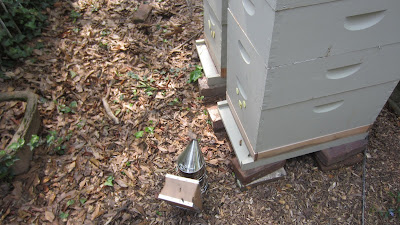


The top box which I had given them at the end of February had three frames of drawn comb, two frames of barely drawn comb and one frame with comb being built from the bottom.  This is because I just threw this box on top of the hive and didn't give them a full frame from the box beneath to act as a ladder.  I moved this bottom drawn comb to the edge of the box.  If they don't fill it out, I'll take it out on my next visit.

The second box was heavy with capped honey and uncapped nectar.
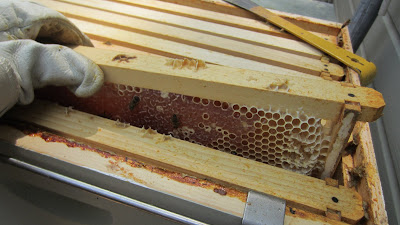


When I lifted off the box to look at the one underneath, I broke open honeycomb they had built between the boxes - they were distressed and immediately began re-gathering the honey because the bees will store this again.  They do not waste something they worked so hard to create.


The capped honey was what is called "wet cappings" because the bees lay the wax cap right on the honey creating a wet look.  I wonder what influences their choice to make wet or dry cappings?  Anyway, this hive is on track to make a lot of honey.  We'll probably need to harvest early and maybe more than once.
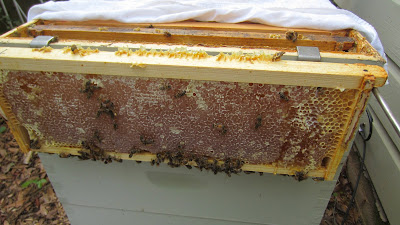


So the top box was empty but newly drawn comb.  The second box was all honey and nectar.  The third box was full of brood - and it was pretty as well.  Here you see what brood looks like on newly drawn comb.
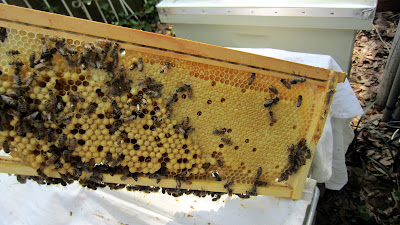

There are both drone cells (the highly rounded tops) and worker cells on this frame.  Some of the drone cells are not fully capped and you can still see the larva through the opening in the top of the cell.
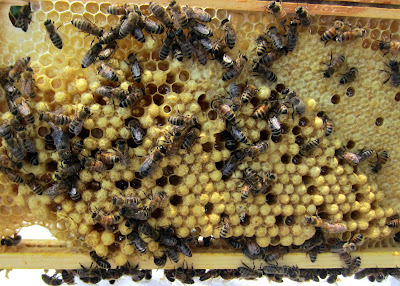


I thought it was interesting that they put drone cells occupying one whole side of this frame.
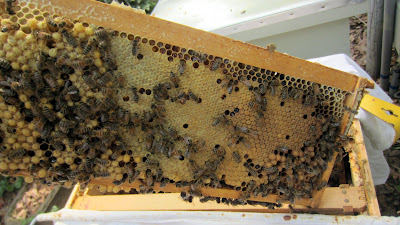


In this comb you can see worker brood capped to the left, and uncapped larvae just to the right of that.  Then in the open cells there are eggs.  You may have a hard time seeing the eggs in the cells with the light behind them, but in the cells with the darker background, you should be able to see a lot of eggs (at about 1:00 in the photo).


I was planning to remove the bottom deep but the bees had drone brood between box 1 and box 2 as well as between box 2 and box 3.  When I pulled up frames from the bottom, it's true that they weren't fully using the frames, but there was brood as well as nectar stored there.  The good news is that I didn't see a single queen cell or even an opened one, so these bees must not be planning to swarm - at least not right now.


When I opened hive #2 it was clear that they had starved.  The bees were flying around in January when I did the powdered sugar shake and the hive looked healthy.  Right after that, though, we had a string of four or five days with weather too cold for the bees to move or fly.  These bees died then.  There was a baseball sized cluster of bees - you can see the top of the cluster in this picture.


The frames were sickening.  They were clustered through three frames.  A sure sign of starvation is to see their little rear ends up in the air, heads down in the cell, getting the final sip of honey before all dying together.


We've ordered two nucs for Stonehurst - a nuc to replace this one and a new nuc to make a third hive.  It's going to be really crowded back there, working the bees, but the Inn will be glad for the opportunity to make more honey this year.

Posted by Picasa

Tuesday, June 15, 2010

Emergency Honey Repair

After being away at a conference for a week, today was my first opportunity to look into my hives.  The Easter hive is doing well, although they only have wax and honey in the first four frames of their top box.  I pulled up one frame to see if the honey were fully capped.  It's a thick honeycomb and I tore some cappings from the other side.


"Waste not, want not," has to be the motto of the bees right now.  The nectar flow was over way too quickly and they can't spare a drop of honey.  Bees in the hive immediately  marshaled forces to retrieve the leaked honey from the frame top.  You can see their tongues (red) pulling the honey into their honey stomachs.


The emergency call went out and more bees circled the potentially dripping honey.  They didn't want any to fall through the hive to the ground.


In the end, all the possible places were taken in the circle as the bees rushed to save their precious product.  I felt bad about tearing the cappings, but loved getting to see this growing bee circle!


Posted by Picasa

Monday, June 09, 2008

Today's Inspection - Beautiful Capped Honey

Today in the 98 degree weather at the hottest part of the day (3 PM) I inspected my hives. I found a couple of interesting anomalies to share on this blog. In Persephone all of the frames were built out, but only in the front 2/3 of the frame. What do you think that is about? I'm going to post on Beemaster and I'll let you know what they say. It was the oddest thing.


When I opened Melissa, I was thrilled to find this pure white capped honey. Isn't that gorgeous? The super wasn't fully capped so I won't harvest it yet, but I was impressed with this new hive. Mellona does have a box of capped honey that I will remove this weekend. Some of it is pretty enough to cut into cut comb honey. The honey below needs a little more time to be fully capped. While the frame in the picture is capped, there were at least four or five that were not fully capped in this super.


I have been giving the bees starter strips of wax in the frames and in each box I put one full sheet of foundation. However, since these are honey supers, I am using thin surplus foundation that I ordered my first year to use in shallow supers. Since this is a medium super, the foundation isn't long enough to fill the frame.

To keep the bees from pushing the foundation sheet (which can't be attached to the bottom because it's too short) out at an angle, I always put a rubber band around the frame to keep the foundation in line. Most of the time after waxing it into the groove, I remove the rubber band before putting the frame into the hive.

I forgot to on this frame. See how the bees indented the comb to accommodate the rubber band!


Finally in inspecting all of my hives today, I only saw one small hive beetle. However, this year for the first time, I have silverfish - yuck. (Whoops! See comment below - it's an earwig.)
Posted by Picasa

Saturday, May 24, 2008

Giant Honeycomb in foundationless frames

In Bermuda I had noticed a huge honeycomb and knew I had to take it out of the hive today. The bees had taken advantage of the foundationless frame and it looked to me as if they had built comb hooking it to two side-by-side frames.

Instead what they did was to build one huge honey comb attached to the first frame and fattened through the second frame. The comb was not attached except in one place at the top to the second frame. Here's the comb hanging on my frame rack on the outside of Bermuda. At the lower right you can see the broken comb at the top where they had attached to the second frame.


The other side of the comb was beautifully capped honey - I wish it had looked like this on the other side. I could have boxed it for cut comb honey. Looking like it does, I can crush and strain or cut it for chunk honey in a wide mouthed jar. I'll probably do the chunk honey so I can remember what this huge comb looked like as I enjoy the honey.


Here's a side view and you can now easily see how the comb was expanded under the second frame but not attaching to it.


There's another comb in this same box with the same configuration (two frames with one very fat honeycomb), but they hadn't capped it enough to take it off of the hive. I'll fill the empty spaces in this box with frames WITH foundation to get these bees back on track.
Posted by Picasa

Tuesday, May 20, 2008

Comb Configurations

When I inspected a hive last week (the smallest swarm hive), I found that I had put shallows in a medium super and the bees had built burr comb below the shallow frames in the space above their bottom box. I scraped off most of it and put the comb filled with nectar on top of the inner cover for the bees to save the nectar.


In place of the shallow frames I put in medium frames. Some of the medium frames had popsicle sticks for starter strips and some had wax starter strips. I put a frame with a full sheet of foundation in the center. This week there was more burr comb and instead of building comb from the top of the frames, the largest comb they had drawn out was the one below which they built on the bottom of the frame.

Again there was burr comb on the edges of most of the bottoms of the frames on one side of the box. I don't usually smoke the bees after an initial puff at the door. To get them out of the area with the burr comb, I did smoke them and they disappeared down into the hive.

This time I carefully scraped all of the burr comb off of the tops of the frames and off of the frames below. I have to train these girls to draw their comb straight and pretty. You can see below the amount of burr comb I scraped off - it will be nice for the solar wax melter, but what a waste of energy for the bees in this hive.


Thankfully, Bermuda has some beautiful capped honey in her next to the top box. I will take it off this weekend before the bees can track pollen and dirt over the gorgeous white comb. Isn't it pretty? There's a whole box of this. It does have a problem that I'll have to address. In frames 4 and 5, which were put in the hive without foundation, the bees have built one very wide comb. The comb is straight and goes the right direction, but instead of filling one frame's depth, they used two.

I both have no idea how I'll get the bees off of that particular duo comb and don't know what to do with it. If I can get it out of the hive in one piece, I'll take pictures. Then I'll probably crush and strain it.

Posted by Picasa

Tuesday, July 17, 2007

"Wet" honey cappings and "dry" honey cappings


When I opened Mellona today, I found some honey that had "wet" cappings. Most of the honey in my hives has "dry" cappings. According to Kim Flottum in The Backyard Beekeeper on page 97:

"You'll find frames that have what are called "wet" cappings,.....and "dry" cappings. When bees place the wax covering over the cell filled with ripe honey, they either place the wax capping directly on the honey, giving the cap a wet appearance, or they leave a tiny airspace between the wax and the surface of the honey, giving the cap a dry appearance. Comb honey producers prefer the dry look, but neither wet nor dry caps have any effect on the quality or flavor of the honey."
The upper picture illustrates "wet" cappings. The lower picture illustrates "dry" cappings.

The only remaining super that I have to harvest is on Mellona and the honey is mostly capped with "wet" cappings.
Posted by Picasa

Saturday, July 07, 2007

Today's Inspection

The small swarm hive was doing fine. Signs were there that the queen was laying well. There are plenty of bees. They are still ignoring the last three frames on the hive, but that's fine. They've only been in the medium 8-frame box for a week.

Proteus Bee is quite a different story. There is no sign there of a laying queen although I gave them brood and egg frames and had seen two queen cells in production on June 23. I didn't see a queen, and felt rather discouraged, but left them in their hive and gave them two more frames of brood and eggs from Bermuda in case they need to make yet another queen. I saw one open queen cell but no evidence of laying.

We've had really stormy weather over the early part of July and if she left on her mating flight she may not have returned. I want to give them a chance. Interestingly this hive was using the upper entrance when they were above Proteus A and I have noticed that the bees in this hive rarely enter through the front door - more often through the upper entrance!

In Bermuda, I found tons of bees and a super of honey with beautiful capped honey for cut comb. I learned a lesson in Bermuda. I found a frame that I had used rubber bands to hold in comb that broke. I had put that frame on the side of the hive box. The bees had fastened the comb to the side of the box. I won't put a repaired comb with rubber bands against the side of the box again. I took this out and will melt the wax - not put it back in the hive.

Today I went on the inspection with several medium frames constructed and with starter strips or full sheets of foundation waxed in. I am so glad because there were a number of frames I either moved or changed and was so glad to have the extras. I'll do that on every inspection going forward.


In Mellona I had tried to open the brood box by taking out the honey filled frames in positions 3, 5, and 7 and substituting starter strip frames. The bees had built comb in the starter strip frames and were filling it with honey.

However, in 2, 4 and 6, they had cleared out the honey in the traditional football shaped pattern and although the queen wasn't laying there, the groundwork was all done. I felt good about opening up the brood nest. Look how shiny the cells are now that they are empty of honey.
Posted by Picasa

Pin this post

LinkWithin

Related Posts Plugin for WordPress, Blogger...