Welcome - Explore my Blog

I've been keeping this blog for all of my beekeeping years and I began my 15th year of beekeeping in April 2020. Now there are more than 1300 posts on this blog. Please use the search bar below to search the blog for other posts on a subject in which you are interested. You can also click on the "label" at the end of a post and all posts with that label will show up. At the very bottom of this page is a list of all the labels I've used.

Even if you find one post on the subject, I've posted a lot on basic beekeeping skills like installing bees, harvesting honey, inspecting the hive, etc. so be sure to search for more once you've found a topic of interest to you. And watch the useful videos and slide shows on the sidebar. All of them have captions. Please share posts of interest via Facebook, Pinterest, etc.

I began this blog to chronicle my beekeeping experiences. I have read lots of beekeeping books, but nothing takes the place of either hands-on experience with an experienced beekeeper or good pictures of the process. I want people to have a clearer picture of what to expect in their beekeeping so I post pictures and write about my beekeeping saga here. Along the way, I've passed a number of certification levels and am now a
Master Beekeeper Enjoy with me as I learn and grow as a beekeeper.

Need help with an Atlanta area swarm? Visit Found a Swarm? Call a Beekeeper. (678) 597-8443

Want to Pin this post?

Showing posts with label Billy Davis. Show all posts

Monday, August 22, 2016

The Value of a Beekeeping Mentor

When I first started beekeeping, I had many mentors. An Atlanta beekeeper came over pretty close to the arrival of my first hives and walked me through my first inspection. I went on hive inspections through my local bee club at the Atlanta Botanical Garden where there were beehives. Most of my local bee club believed in feeding the bees all the time and treating the bees for everything, so I couldn't find many/any like-minded beekeepers there. I relied for mentorship on people at Beemaster and Beesource online and felt wonderfully mentored.

Now that I've been keeping bees for eleven years, I have the opportunity to give back and I do a lot of mentoring new beekeepers. Beekeeper-wanna-bees, as well as new beekeepers, show up to spend time with me in my bee yard and I am glad both for the company and for the chance to teach someone something new.

I was contacted by a man in north Atlanta when he first got his bees. He came to our Meetup in Atlanta and had met me and wanted some hands-on help with his new hives. He lives about 25 minutes from me (Atlanta is really big!) but I went and was glad to go.

He had read a lot online and really wanted to be a natural beekeeper. He had regularly read Beesource and Beemaster and knew a lot, but was uncertain about his hives. The first time I visited, it was about reassuring him about his hives and helping him to know how to conduct a hive inspection.

He has a beautiful organic garden.


He requested a second visit because he was worried that he had a queenless hive. The closest hive in the photo below looked less active and he had opened it and hadn't seen any brood, any sign of a queen.
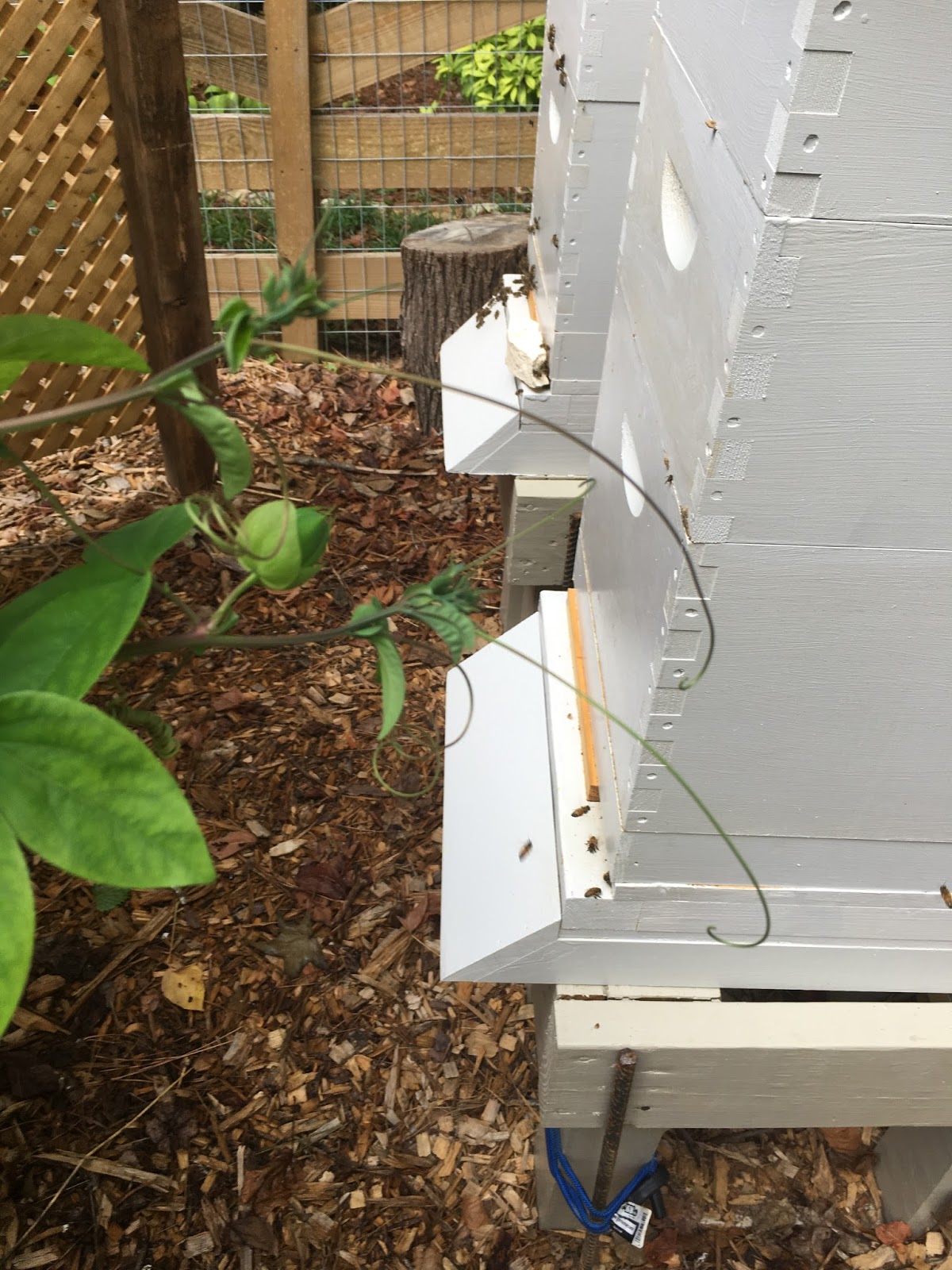


You can see less activity in the closest hive in the photo above. So we opened the hives and went through them. We started in the less active hive. We took off the medium boxes and got to his deep bottom box. I pulled out the next to last frame and there was dark biscuit brood in the center in a pretty good pattern. According to Billy Davis, that means the brood was about to emerge so it was about three weeks old. Also in that frame I could see brood and larvae at all ages and eggs. I showed him how to put the sun over your shoulder the better to see the larvae and eggs.

Every time I go, he comments on how patient I am. I am so not a patient person, but that was nice for me to hear because I think one of the benefits of beekeeping for me is that it slows me down and makes me behave patiently.

Turns out that he was panicked when he had read on Beesource that many people were finding that they had lost their queens here at the end of bee season. He had not looked through the entire brood box (must have started on the other side of the box) and assumed he didn't have a queen.

However, the hive was actually thriving and had a healthy, laying queen. The other hive was in equally good shape with a little more stores than the first hive. I asked him if he would like to take a frame of honey out of the hive so they could at least taste what his bees could do? He loved the idea so we took out a frame (giving me the opportunity to show him how to shake and brush off the bees).

I told him how to scrape it off of the foundation and crush it. He emailed me later in the day to say, "Oh boy, it is awesome!"

It's great to ask for help and guidance at any point, but especially when you are starting out beekeeping. I think the next time he is worried, he will look more carefully through the hive and maybe take reading glasses or a magnifying lens to help him see the eggs and larvae.

As I backed down his driveway, I could hear him literally giving a whoop of joy that his hives were OK.

Friday, March 13, 2015

Moving Day for Polar Bees

This past Sunday was moving day for the Polar Bees in the overwintered nuc.  I was hesitant to get into swarm season with this highly enthusiastic hive in a nuc.  I was cautious about moving them because last year every time I fooled with this hive, I got stung several times, but I accomplished the move with no gloves and no stings.

I used hive drapes the whole time.  First I took the hive down to the bottom box and covered each of the nuc boxes with hive drapes.


My excuse for the next part of this is that last year was the year of my injured leg so I didn't do much of a good beekeeping job.  This nuc was a split from one of my Bill Owens' hives in Tom's yard.  At the time I took the nuc box to serve as a Billy Davis quiet box during the inspection of the hive.  

So if you look at this bottom deep nuc box, the first thing I notice is that the two stapled frames are not my frames and must have come from Bill Owens when I picked up my hive from him.  The other three with the arrows on them are my frames.

I am sorry to report that I don't have a photo of this but will take one in my next inspection of this hive.  I pulled  up the second to the side frame on the left and found that in fact it was a medium frame.  The bees had added free comb to the bottom to fill up the box so that it is the depth of a deep but the wood stops at medium.  This was true of all three of my frames - all were medium frames that the bees had converted to deeps.  Here's a photo of a frame in another hive where this happened.

I think I had intended to take this "quiet box" home and put it into a full box but must have had trouble with my leg and didn't follow through.  Then time went by and I never did it.  I do remember looking at it, thinking it would be nice to have a nuc in my bee yard.  Then the bees were mean in the hive so I wasn't anxious to open it and totally forgot that there were medium frames in there.  When I did open it, I mainly did so to see if they needed another box or more room and didn't do a deep inspection.


I've read various places that if the bees extend the comb like that, they will draw drone comb in the free comb area.  Not true for me in any hive where this has happened.  They always just replicate whatever they were doing in the upper framed comb.  In this hive, it was brood comb and instead of a football pattern, the queen had a full deep circle of "dark biscuit" (another Billy Davis reference) brood comb.  

The dark biscuit comb means the brood is about 21 days old and ready to emerge so my move took place none too soon.

On one of the stapled frames I saw the lovely, majestic queen, moving slowly over her brood.  You can see her below.


At this time of year, often our Atlanta bees are on the verge of starvation because of the late winter freezes.  Not this hive.  The second box was full of frames of fully capped untouched honey like the one below.  No danger for the Polar Bees to starve.


I did see some small hive beetles who had overwintered with the bees.  I saw about five of them.  Below is an out of focus photo of an oil trap with absolutely NO SHB in the trap although there were live ones in the hive.  I guess I need to mix up the banana peel concoction to tempt the beetles into the trap instead of using oil.


So before moving day clean-up, here's how it all looked:

I put the hive in three boxes because after I filled out the bottom box with three empty deep frames, I had full frames plus drawn comb from the other two boxes enough to fill the second box.  It was almost full of honey (five full frames and two partial ones).  So I went ahead and put a third box on this hive to give them some growing room with new brood about to emerge.


I put on an entrance reducer as I do on all my hives and closed off the screened bottom since they had been living in a solid bottom nuc box.  The bees tumbled all over each other as they vied for entry.  In the next week or so, I'll put on one of Billy Davis' robber screens to leave on for the season.

Sunday, February 16, 2014

Winter Bee Deaths - and Still a Strong Hive

The bees that go into winter are not the same as the bees who live in the summer.  The summer bee has her work cut out for her.  She progresses through jobs in the hive, beginning with housecleaner and nursemaid and ending with forager.  Each job prepares her for her next assignment and each wears her out a little more.  Old summer bees have ragged wings and if you see one who looks like that, she is close to death.

Winter bees are different.  First there are no drones in the wintering hives (sometimes one or two) because they are a drain on the hive resources; contribute nothing during the winter; and  the queen can create them from unfertilized eggs as spring approaches.

Winter bees live longer.  Summer bees live about six extremely active weeks.  Winter bees in cold temperate climates may live for 150 days (Winston, p. 215).  In an area like Atlanta where we typically are not a cold temperate climate, the winter bees may live a slightly shorter amount of time.  In the hive during the winter, bees do die and their bodies are cleaned out when the temperatures are warm enough to fly.

Here's what it looks like around my surviving colony in my backyard:


 As you can see around the base of the hive, it looks like an enormous bee graveyard.  The ground has been littered with bodies like this every time we have a cold snap.  In the interim, the yard guys show up and blow them off so this pile is purely from the ice storm last week.

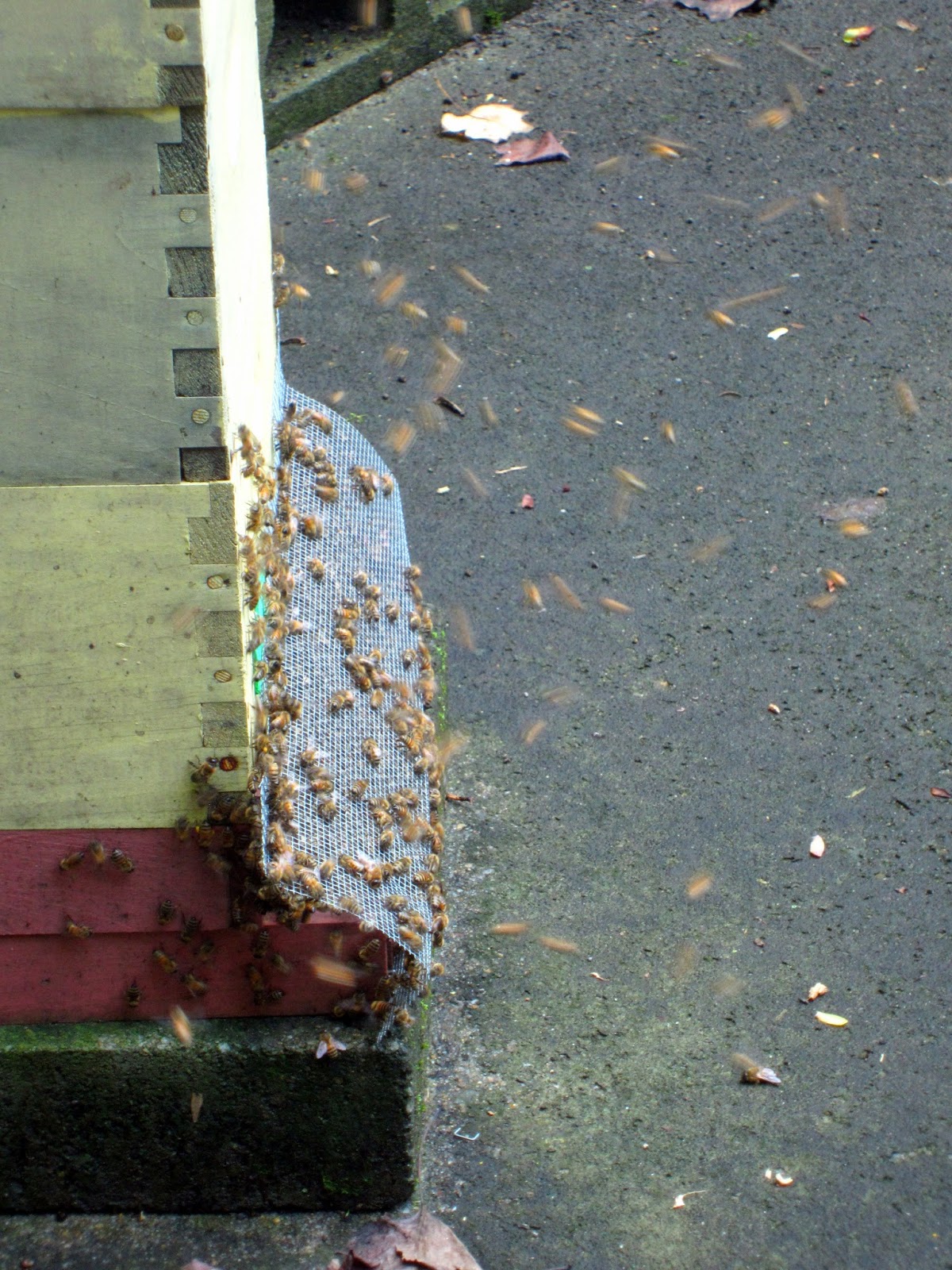
Yet there are still thousands of bees in this hive.  I have a "Billy Davis" robber screen on the hive and there are bees massed under the screened wire, just enjoying the sunshine.  


Here's a closer view or two of the dead, lying en masse outside the hive.


The bees who are flying into the hive have packed pollen baskets.  You might notice that some of the dead bees also have packed pollen baskets.  

I am amazed at the strength of this hive and the numbers of bees who have lived here through our extremely cold winter.  In Atlanta we often have a week of snow in March, so it's not over yet.

Sunday, August 11, 2013

Billy Davis' Robber Screen

What a strange honey year!  After two years of drought, now we have so much rain in Atlanta that it has hurt the bees.  Many hives were unable to put up enough stores for winter and it's prime time for robbing.

Jeff and I keep saying we needed to put the robber screens that Billy Davis uses on our hives.  We put it off and put it off (I am deathly afraid of the staple gun).

While I was in Lithuania, my last hive from the Fatbeeman was robbed out and died.  I think his supplier in south Georgia didn't do well by him this year - one of my packages was the one that had a virgin queen at our Chastain site and the package I installed at home never did well.  They were just limping along, and were easy victims for robbers.  The ground under the hive was covered with wax shards and dead bees on the bottom board.  In a way, if robbers were going to pick one of my hives to destroy, that was the best one.

So Jeff and I put Billy Davis robber screens on almost all of our hives last weekend.  The hive below is the Northlake Mall Swarm.  Billy says for the screen to be effective the hive entrance must be about four inches from the edge of the screen.  This hive has an entrance reducer on it (as do all my hives this year) and the opening is under the bees clustered on the screen.


At first the bees are really confused.  How to get to Mama?  They aim for the entrance but that isn't working so they try the upper part of the hive to see if an entrance has materialized up there.


But after a week, the bees have gotten it figured out.  They've been going in the side and bearding under the robber screen (and on top of it!)

Today at 4:30 - typical time for orientation - there was a frantic energy around this particular hive.  I'm not usually home at this time.  I do have breaks in my day, but my busiest time at the office is from about 2 - 7 at night, so I miss orientation.  Consequently I haven't really seen bees orient since we put the robber screens on the hives.

The other hives in my backyard were orienting at 4:30 and they didn't look as frantic as the Northlake hive.  The bees outside the hive were buzzing angrily.  Now, I've seen robbing and it's frantic, but you also see bees actively fighting with each other and falling to the ground; you see dead bees in front of the hive; and a growing pile of wax accumulates under the hive from wax cappings.  

But this hive has a closed screened bottom board, so I couldn't see wax cappings.  And although there were not dead bees, the buzz was angry and loud.  


The area under the screen is PACKED with bees and bees were actively guarding the available entry.  You can kind of see the bees under the screen in the photo above.

So just to be safe, I threw a wet sheet over the hive, covering the side entrances and waited it out.  I left the front open since there was no entry there and I could monitor the bee population and activity. 


Of course, if this were orientation and not robbing, now the hive bees also don't have access to the hive.

Around 6:30, the activity was back to normal.

In robbing the robber bees keep trying to access the entry of the hive because they smell the honey.  The hive bees go for the pheromone of the queen so they will search different ways to get to the queen.  But typically robber bees just focus on the entrance.

So was this robbing and Billy Davis' robbery screen as well as my wet sheet stopped the action?  Or was this robbing and the screen effectively kept the robbers out?  Or was this just orientation of a strong hive?

I don't know but I felt good about having the robber screen on the hive.   Thanks, Billy.

Maybe tomorrow I'll pull the block to the screened bottom board out and see if there are tons of wax shards there.


Thursday, March 14, 2013

Billy Davis' Quiet Box


Billy Davis respects his bees, his "critters," as he calls them.  I learn so much from him every time I hear him speak.  The first time I heard him was at EAS in Boone, NC.  From him I learned about the reason to use hive drapes and have used them ever since.  We employ hive drapes in our inspections at Chastain Conservancy and the bees are so much calmer.  We light the smoker and rarely use it.


 Billy Davis spoke to the Metro Atlanta Beekeepers last night about his nuc sustainability program in Round Hill, Virginia. Billy said that a beginner can learn more from raising bees in a nuc than any other way.  He said something like, "Anyone can find a queen in a five frame nuc!"  He also emphasized the importance of taking notes and said people in his apiary have to prove they can take notes before they can manipulate any hives.

Billy has been keeping bees since he was a kid - over 50 years.  He stressed the importance of having a mentor as well as the importance of using nucs.  He does not like the idea of buying a commercial nuc but rather creating a nuc from your own splits.  A nuc is
  • a great learning tool, 
  • a generator of drawn comb, 
  • a generator of honey, 
  • a source of brood queens.  
  • Splitting colonies into nucs is a way to increase your apiary.  
  • Nucs are also a way to practice swarm control.  If you take the queen and enough bees to support her, the colony thinks they have swarmed and you have stopped the swarm.
Billy's approach is that we need to help the bees survive by promoting hygienic queens and raising local queens.  He has an extensive program in Virginia in which he runs nucs and raises queens.  He went through his methods for the nuc program in explicit detail, more complicated than I can repeat here, but essentially he is making nucs over and over; overwintering the nucs; culling out queens who are not certifiable breeder queens.  And then he does it all over again.

He railed against artificial insemination and said that it had ruined many aspects of farming - breeding cattle, breeding hogs, breeding all kinds of animals.  He thinks the bees should raise their own queens.  He selects for hygienic queens by systematically killing capped larvae and seeing if the bees remove it within 24 hours.  If so, he uses that queen as a breeder.  As a result he does no varroa treatment and said the most number of mites he has seen this year is THREE.

He is a wood-working guy (in his non-bee life, he works at Home Depot) and makes his own equipment so that he can keep these nucs on a common base.  He has entrances on opposite sides and faces his nucs so that the prevailing winds are not blowing toward the entrance.  You might notice that he uses all medium equipment - no deeps or shallows for him.


He keeps a robber screen and an entrance reducer on every hive.  I was interested in his robber screen - not complicated like mine, but rather a simple screened wire, looks like #8 hardware cloth or maybe a little smaller.  He says it needs to extend 4 inches on either side of the entry to be effective.  He simply staple-guns it to the hive body and the landing.  It's folded into a squared edged to create a tunnel to the entry hole.  Boy, I plan to do this on every hive after my terrible robbery at two different great hives last year.

We have used hive drapes at Chastain Conservancy since I heard him speak about them at EAS.  Now I'd like to try the other item he uses during an inspection: his "Quiet Box."  The Quiet Box is the green box in the photo below.

Billy said that anyone in his apiary who took out a frame and leaned it against the hive would be in big trouble with him.   In our inspections, we typically use a frame rack that may or may not be under the hive drape.  It is his contention (and he's obviously right) that being out in the sun like that is very disturbing to the bees.  

I often find a clump of bees on the outside wall of the hive box when I remove the frame from the rack to return it to the hive.  They left the frame and crowd together on the hive box, probably trying to get into protected space where it isn't very light.

Instead of this disruption, Billy uses a quiet box - the green box in the photo.  It is equipped with a built-in hive drape.  He puts the first frame removed from the hive into this box where there are a couple of other frames.  If the frame is alone in the box, he might also put in the frame on which he finds the queen.  These frames remain in the "Quiet Box" until he is finished with his inspection and then he returns them.

If he chooses not to return them to the hive, with those two frames, he has the beginning of a nuc.  He just needs to add frames of honey and pollen, capped brood and bees.

We could easily take an empty nuc box to our inspections at Chastain (and at my private hives) and use that as the "Quiet Box."  I am anxious to try this and see how we do with it.  Our first inspection there is on the 23rd, so I'll let you know how it works for us.

Billy feeds all of his bees sugar syrup all the time.  He says that they will quit taking the syrup when there is nectar available.  He uses the rapid feeder from Bee Works in Canada that I also use.


He likes this feeder because it is inside the hive and because the bees are protected from drowning when using it.

Billy employes nematodes to control the SHB.  He says the first year you need to do three applications (Julia and I only did one the year we did the nematodes) and thereafter you need to do two applications.  I need to get back in touch with SE Insectaries and order some more to do that again.
At the end of this wonderful talk, Billy was surrounded by members of the Metro Atlanta Club who wanted to ask him questions and thank him for all the information.  I went up afterward to thank him personally and had such a lovely surprise.  He looked at me and said, "I'm so glad you came.  I was hoping you would be here.  I do go to visit your web site sometime, you know!"  I was bowled over and honored - who knew that he even knew who I was?  

Pin this post

LinkWithin

Related Posts Plugin for WordPress, Blogger...