Welcome - Explore my Blog

I've been keeping this blog for all of my beekeeping years and I began my 15th year of beekeeping in April 2020. Now there are more than 1300 posts on this blog. Please use the search bar below to search the blog for other posts on a subject in which you are interested. You can also click on the "label" at the end of a post and all posts with that label will show up. At the very bottom of this page is a list of all the labels I've used.

Even if you find one post on the subject, I've posted a lot on basic beekeeping skills like installing bees, harvesting honey, inspecting the hive, etc. so be sure to search for more once you've found a topic of interest to you. And watch the useful videos and slide shows on the sidebar. All of them have captions. Please share posts of interest via Facebook, Pinterest, etc.

I began this blog to chronicle my beekeeping experiences. I have read lots of beekeeping books, but nothing takes the place of either hands-on experience with an experienced beekeeper or good pictures of the process. I want people to have a clearer picture of what to expect in their beekeeping so I post pictures and write about my beekeeping saga here. Along the way, I've passed a number of certification levels and am now a
Master Beekeeper Enjoy with me as I learn and grow as a beekeeper.

Need help with an Atlanta area swarm? Visit Found a Swarm? Call a Beekeeper. (678) 597-8443

Want to Pin this post?

Showing posts with label collecting a swarm. Show all posts

Friday, April 14, 2017

The Hive Drape as a Swarm Kit Asset

One of Jeff's friends had found a swarm in her compost bin and told Jeff he could have the bees if he'd like to get them. He texted me yesterday but I was too busy. "No problem," he told me. "They are already building comb and have moved in. We can go tomorrow."

I had just heard Bobby Chaisson talk about doing cut-outs at my local bee meeting. So I packed the car this morning to cut the bees out of the compost bin - big, big rubber bands, two nuc boxes with totally empty frames, a spray bottle of syrup, in addition to my hive kit which has everything. I asked Jeff to bring a sharp knife and a flashlight.

Here's what we found when we arrived at a beautiful Garden Hills home in Atlanta:


You can see the comb that has been drawn through the clutching bees.

The bees were using the air holes in the compost bin as entrance into the compost bin. The holes just fit a bee.


I truly didn't know how we would get them. My first inclination was to spread a hive drape under the bees to help us see the ones that fell. Turns out that was the best thing we did. I started by spreading two hive drapes.

If you don't know/remember, I regularly use flour sacking towels as hive drapes when I inspect bee hives. I cover the exposed top of a box and only uncover the frame I am taking out of the box. The bees stay calmer. So here are Jeff's hands and the hive drapes inside the composter.


My guess is that this is a secondary swarm who left their hive with a virgin queen. Then we had cold weather and the queen couldn't fly nor could the scouts. They decided to remain in the composter and started drawing comb. It's not much different than top bars in Africa inside split barrels. I expect they've only been in the composter for a couple of weeks.

We cut the tiny teardrops of honeycomb one layer at a time and rubber-banded the pieces into empty frames. This piece has pollen in it and we saw bees flying into the composter with pollen on their legs:


Even after we had cut and rubber-banded all of the comb, there were still tons of bees left in to composter. The bees were indicating that the queen was still in the composter.


We tried using the bee brush and brushing the bees into a plant saucer, then dumping them into the cardboard nuc we had brought, but that only yielded a few bees each time. Then we figured out how to use the hive drapes. We added a few drapes so that we had about four stacked up. Then we brushed the bees off of the inside of the composter and onto the hive drapes.

Instead of picking up the drape, I folded the edges into the center, picked up the drape which was full of bees and put the cloth, bees and all, into the cardboard nuc. We did this until we ran out of both bees and hive drapes!

Finally the bees let us know the queen was in the hive box. We must have gotten her in one of the drape carries. 


We waited about 20 minutes until most of the bees were in the hive and then put the nuc in the back of my car.


After lunch, I installed them into a hive in my backyard. First I dumped the drape covered bees into the open space in the hive and then moved in the rubberbanded frames. 


This afternoon the bees were all in the hive and doing orientation flying.


Tuesday, April 19, 2016

A Thorny Third Atlanta Swarm

And so for my third act, I went into Buckhead to get a swarm out of a holly bush. It was about the size of a basketball and on the side of a very slanted backyard. It was a little hard to get to, but the homeowner said it was fine to clip back the holly. I took him at his word and cut off the branches that were anxious to prick my hands as I worked with the swarm.

You can see the challenge the holly imposes in its thorns. Before dealing with this swarm, I clipped all the branches between myself and the bees (or why it's a good idea to carry pruning snips in your bee bag).
I spread out a sheet on the hillside, sprayed the swarm with sugar syrup and tried to cut the branches to get the swarm into the banker's box (my standard for carrying a swarm home). I couldn't get photos and keep my balance, but it went rather smoothly.


In this photo above you can see the bees with their rear ends raised to send the nasonov signal that the queen is here!


I left an opening in between the ventilated cover and the box to allow the bees to join their queen. Hundreds of them did. I then, as in the last swarm, covered the whole box up with the sheet, draping it over the bees who had not entered the box, and carried them to the Morningside community garden.

I had a waiting eight frame hive there. I used a third box as a funnel to help me pour the bees into the hive. It works well this way with no frames in it.

Then I added the eight frames back into the box.


I closed up the box and left the bees to adjust to their new life as community garden bees. Pickings should be bountiful!


I stopped by yesterday to check on how they are doing and they are flying well. 

Second Atlanta swarm on I-Beam in Forest Park

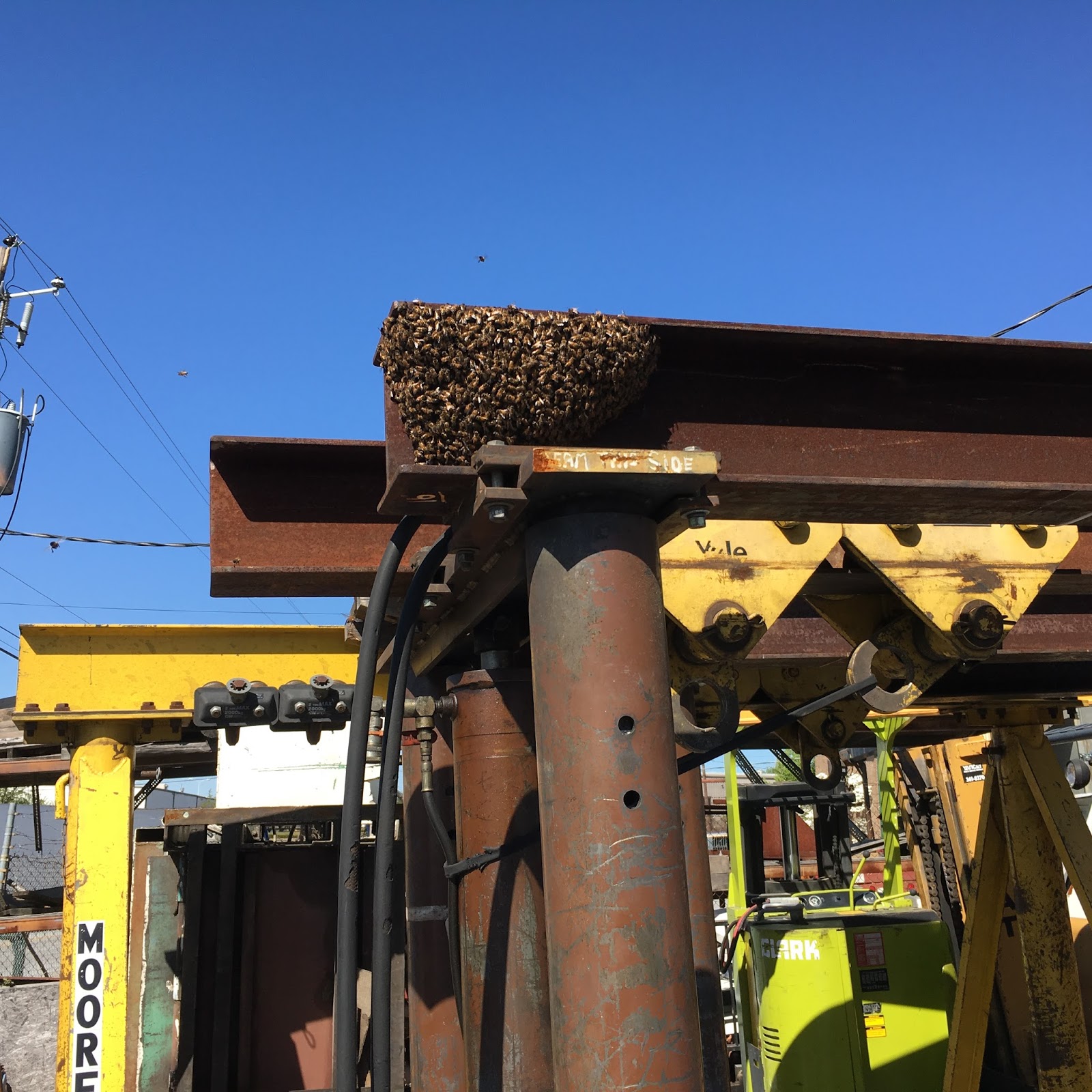
My second swarm call of the year came just a couple of days after the first one. I was told the bees were on rebar at a construction company. When I arrived I found the bees tucked into the squared corners of an I-Beam!

So I did the swarm catching prep while I decided how to get these bees that I couldn't shake and didn't want to make angry.
I set up a sheet under the swarm, got my ladder, my plastic banker's box, a spray bottle of sugar water, and my bee brush. I climbed up the ladder.

I held the box and brushed the majority of bees into it, but huge numbers flew back to the I-Beam. The bees in the box were not tail-up and were not sending out nasonov. The queen must still be on the I-Beam.....


I felt discouraged after several brushing attempts and angry bees in response. So I took a round Ziploc 16 oz container and scraped the bees into it by running it along the interior of the I-Beam. Then I dumped them into the box and repeated, dumped, repeated, etc.

I decided to leave them for lunch and see if the queen was in the box after lunch. Forest Park is 30 minutes from my house so I drove back the 30 minutes, had lunch with Julia, and returned to the scene.

The bees were in the box and had left the I-Beam. I must have gotten the queen in one of my Ziploc container sweeps.


Because there were lots of bees outside the box on top of the ventilated cover, I decided to bring them home just like that. I secured the cover with the bungee cord and then gently wrapped the box, exterior bees and all, in the sheet. I carried it to the car and set them in the back. Now I'm driving with hundreds of bees outside the travel container!


I installed this swarm at Stonehurst Place Inn on Piedmont. Their bees died over the winter and they were glad to see me. I hope they will do well in the hive at the bed and breakfast.


Tuesday, April 12, 2016

Atlanta Bee Swarm - My First of the Season

I got a call to go to a house near Chastain Park to collect a swarm. The man who owned the house is a beekeeper and these were his bees. He understood that if we came to help him, he would be giving the bees away. I assured him that I would install them in the community garden near my house.

Bee swarms are always their own unique challenge. He had reported that these bees were 20 feet up in a tree but that he was fine going up a tall ladder. So I arrived to find the bees high up in the tree, as he had said:


I spread my sheet twenty feet below, under the swarm. There was a deep, deep hole directly under the swarm and I kept forgetting about it and stepping into it as I walked on the sheet.

First Peter climbed his yellow ladder and jabbed the swarm with my swarm catcher on a pole. Many  bees fell into it.


We dumped the bees into the box and covered them with the ventilated cover. It was clear that we hadn't gotten the queen because a huge ball of bees flew back to the branch and the bees in the box were not sending the nasonov signal.


So now Peter gets his largest ladder and climbs even higher in the tree, preparing to cut the limb on which the bees are gathered. I am not thinking this through well. Peter cuts the limb and it falls onto the sheet - bad plan - I should have been on the other ladder with the swarm catcher. Still no queen or at least the bees are not indicating that she is in the box.


So we tried one more time (and there's not a photo because this time I held the swarm catcher right under the branch as he cut it.)


This time we got the queen and the bees are signalling. All seems well with the world of this swarm.

There were still many bees on the sheet (from the falling branch), so I wrapped the box which also had a lot of bees on the outside in the sheet; put the whole contraption in my car and took the swarm off to their new home.

Good job, Peter. I'm hoping he becomes more involved with the local beekeepers. 

I put all of the photos on Google + (they are doing away with Picasa where all my photo albums and slideshows are).


Pin this post

LinkWithin

Related Posts Plugin for WordPress, Blogger...