Welcome - Explore my Blog

I've been keeping this blog for all of my beekeeping years and I began my 15th year of beekeeping in April 2020. Now there are more than 1300 posts on this blog. Please use the search bar below to search the blog for other posts on a subject in which you are interested. You can also click on the "label" at the end of a post and all posts with that label will show up. At the very bottom of this page is a list of all the labels I've used.

Even if you find one post on the subject, I've posted a lot on basic beekeeping skills like installing bees, harvesting honey, inspecting the hive, etc. so be sure to search for more once you've found a topic of interest to you. And watch the useful videos and slide shows on the sidebar. All of them have captions. Please share posts of interest via Facebook, Pinterest, etc.

I began this blog to chronicle my beekeeping experiences. I have read lots of beekeeping books, but nothing takes the place of either hands-on experience with an experienced beekeeper or good pictures of the process. I want people to have a clearer picture of what to expect in their beekeeping so I post pictures and write about my beekeeping saga here. Along the way, I've passed a number of certification levels and am now a
Master Beekeeper Enjoy with me as I learn and grow as a beekeeper.

Need help with an Atlanta area swarm? Visit Found a Swarm? Call a Beekeeper. (678) 597-8443

Want to Pin this post?

Showing posts with label chunk honey. Show all posts

Tuesday, September 20, 2011

Happy Blues for the Honey Contest

Well, my jarred honey - light and medium - did not place at the honey contest this year. While that honey may not have placed no matter what because there were a lot of great entries, I have to confess that I used all old jars and one should never do that, so next year, it's new jars for me. Much of honey judging has to do with presentation and mine, sad to say, were all in old jars (which show their wear or have smudges from the dishwasher, etc.) , but I got several blue ribbons and one red one.

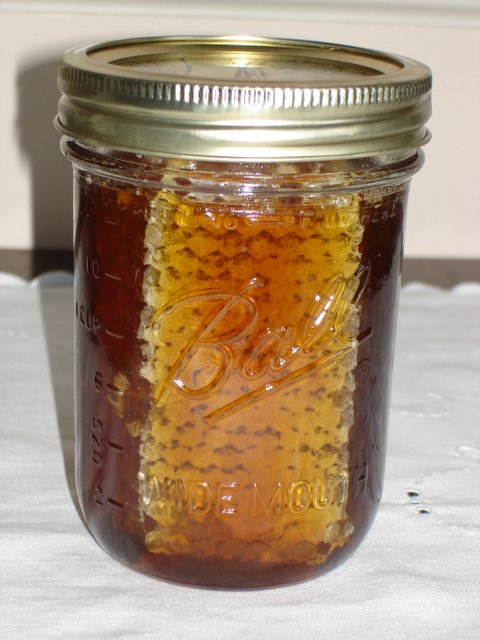
My chunk honey came in with a blue ribbon. This is the first time I've used these jars that are designed specifically for chunk honey. I loved them and will use them again.


You know the wax block saga and this is pour # 6. I marked the pan that I used for this one, but likely it will not be used again for wax blocks, but rather for bar cookies or some other such cooking use.


And I got a blue ribbon for crafts - this was a quilted bag that I made - all original. I made up the pattern. The bee skep is on a pocket. It has pockets on the inside of the bag (six of them).


I got the idea for these handles from a book and really was pleased with how they turned out as well.


My beekeeping buddy, Noah, won the blue ribbon in cut comb honey and mine came in second with the red.  Mine had lots of problems - wet cappings, some honey on the bottom of the container, but what the judge said was the midline was not straight!  I laughed - it's the bees fault, then!

When you go foundationless, the bees determine where they want the midline rather than the beekeeper who has more control with wax foundation.  So I guess if I keep entering cut comb, I'm going to have to be more selective about my creative bees!

Noah also uses foundationless frames - I think his cut comb came from his top bar hive - and the judge essentially said it was a perfect entry.  I know he's not my kid, but I was so proud of him for getting that blue ribbon as a teenager.

My friend Scotti Bozeman won many ribbons including best in show!  This was only her second honey show.  She's in the center with the two Welsh honey judges, Evelyn and Marcy on either side.


Posted by Picasa

Friday, August 19, 2011

Harvesting the Stonehurst Honey

I had a great time harvesting the Stonehurst Place honey.  Caroline, the innkeeper, took some photos at the beginning (so I am in the photo for a change!) and then I took some pictures of the frames and the rest of the process.  We got about 80 pounds of honey from the two hives (from the two harvest visits) which is remarkable since the hives just got started this year at Stonehurst.

Click on the slideshow to see it full screen and with captions.


Thursday, June 23, 2011

Preparing Honey and Wax for Competition

Because it is harvest time, many beekeepers are bottling honey and preparing bottles to enter into honey contests.  We are hoping to have record numbers of entries at the MABA honey contest in September.  We have recently rewritten and much improved the honey contest rules for our club.

I gave a talk at the June meeting of the Metro Atlanta Beekeepers on the topic of preparing honey and wax for competition and have uploaded it as a YouTube movie so that if you weren't at the meeting, you can learn about what to do.

It's a video, but if you want to pause it to read a slide better, it's easily done with a click on the pause icon (the two parallel lines) at the lower left..


Monday, March 23, 2009

Crystallized Honey (Creamed Honey)

Honey lasts a long time. It's been found in tombs, still in good shape. However, under certain conditions honey will crystallize. My understanding is that the crystallization happens when there are tiny particles in the honey that act as seeds for the formation of the crystals and when the temperature is around 57 degrees F.

All honey doesn't crystallize but some of my favorite harvest bottles from this year did just that. I went out of town for a week and left my thermostat on 55 to save on heating. When I returned my favorite honey had become creamed honey.

When people make creamed honey on purpose their goal is to have a very smooth creamed product. The seed grains in this honey must have been perfect because the honey was smooth and perfectly creamy. Or, as my bias would lean, my method of harvest without an extractor may result in only the tiniest grains coming through the filter.

However, at this point in the year, most of my harvest from 2008 is gone and we love honey at my house. This morning I decided to take one of the last non-chunk jars of honey and reliquify it. To do this, you have to heat the honey.

Part of what I value in my harvest methods is that the honey is never heated - the hottest it has ever been is the interior temperature of the hive. But to re-liquify the honey you have to get it to 160 degrees and keep it there for a minute or so before turning off the heat.

I put the creamed honey in a pan of boiling water. I put a candy thermometer in the honey so I could monitor the temperature.


As the temperature rose, the honey became clearer.


At the end of the process, the entire bottle was again liquid honey. Because I got it to 160 degrees, it won't recrystallize. What we lost in flavor from heating the honey is worth it to me to have the liquid again.


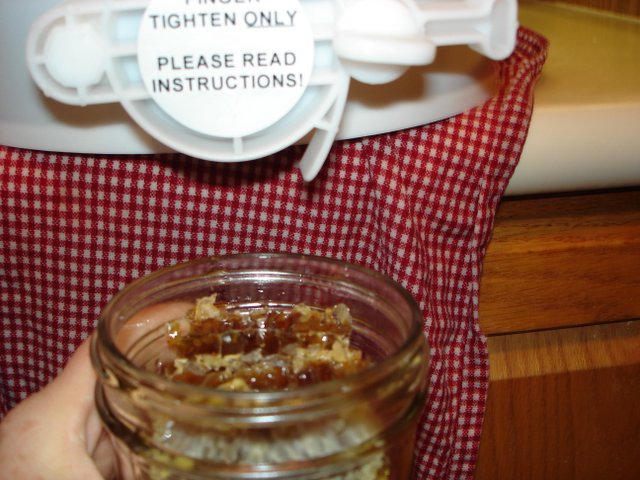
I also have some jars of chunk honey (comb in a jar filled with liquid honey) where the liquid part of the honey has crystallized. I can't imagine that this process would work for the chunk honey because the wax would melt.
Posted by Picasa

Monday, October 13, 2008

Honey Judging and Entering Honey Contests

Robert Brewer, Welsh honey judge from Young Harris, Georgia

I know I haven't posted in a while. I had to miss the last Metro Beekeeper's meeting because I was leaving town on the day after the meeting and had to pack and get organized. I'm sorry I missed it - Keith Delaplane spoke on the thermodynamics of bees and I know I would have learned something new.

Sometimes, however, being a grandmother trumps being a beekeeper!

I did go to a talk at GBA by Robert Brewer, well-respected Welsh honey judge, on preparing honey for a show while I was at the GBA meeting a couple of weekends ago. I found my notes, so I want to share them with you.

In preparing honey jars for a show, Robert strongly urged that one always use new containers and new lids. Most people take their honey to the show with plastic wrap between the jarred honey and the lid so that no honey gets on the top of the jar. He suggested carrying new lids with you to the show to put on the jars when you remove the plastic wrap.

The first order of business is the cleanliness of the jars. He suggested that denatured alcohol will remove smudges from the jar. He also suggested polishing your jar with nylon or silk. I saw a number of people entering jars in the GBA show who came with special cloth for polishing the jar.

I used knee-high panty hose, but next year I'm going for silk!

After the judge determines if the jar is clean and without smudges, he or she will look at the fill level. On a queen-line jar, the honey should be just high enough in the jar that there is no air line between the honey and the jar lid when viewed from the side of the jar.

He said that honey is judged on clarity and cleanliness. If you see something in the jar or want to clear bubbles from the top of the honey in the jar, Robert said that a silver spoon will for an unknown reason do this better than a stainless steel spoon (who knew?). The judges take a flashlight and really look at the jar, both to see possible smudges on the jar and to pick up anything floating in the honey, so strain your honey very, very well.

For chunk honey (a cut of honey comb sitting in a jar of liquid honey), the comb should fit the length of the jar. As I've written about earlier, the comb needs to go in the jar the way it is in the hive, right side up. Judges prefer that the comb sit on the bottom of the jar.

Although my chunk honey won a blue ribbon in the state show, the judge (Robert Brewer) wrote that he would have preferred to see the chunk on the bottom of the jar. Since the wax wants to float, the only way to accomplish this wish is to somehow stick the honey comb to the jar bottom. Robert said that some people set the wide-mouthed jar in hot water so that when you put the chunk in the jar it melts slightly to the bottom of the jar and sticks there.

"Cut comb" is the comb in the clear plastic 4 inch square box. Robert said that judges look for clean cuts of the comb, no honey drips in the box, and for dry cappings. Bees can cap honey in two ways: wet cappings and dry cappings. The wet cappings look somewhat transparent as if the honey is touching the wax and sort of soaking into it. Dry cappings look white and lovely and the honey is not apparently touching the wax.

Robert also talked about pouring wax blocks (remember my 18 pours??). He noted that pouring a good wax block is particularly hard to do. Wax is affected by air currents and vibrations in the room. He suggested doing what I have done - pour the block and go to bed, leaving the block in a quiet room to cool. He said that some people put the block in the oven to cool with a piece of glass over it to keep the air currents from affecting the block. Even the air conditioner turning on or the vibrations of the refrigerator can cause wave marks on the top of the wax.

I've always liked the wavy surface when the wax cools. This year is the first year that I've learned that wavy surfaces count off, so I bought a pane of glass and have tried to minimize the waves.

While I knew the importance of even, slow cooling and the importance of avoiding the wavy look from the air currents, he also said that the edges of the wax block needed to be smoothed so that they are not sharp. Mine are always sharp so I am going to try what he said next year during my 18 or 19 pours. He said to take the ball of your thumb and rub it on the sharp edge to round it off.

Wax block pouring for judging is one of the hardest things to accomplish. This year my wax block won a red ribbon in the state show, but with all these helpful hints, maybe I can do even better next year.

I'm hoping to try all of Robert's techniques described in his talk "Preparing Honey and Hive Products for Show." There are other good hints about honey show success on the Metro Atlanta Beekeeping Association web site as well.

Monday, September 15, 2008

The Metro Atlanta Beekeepers' Honey Contest


Tonight was the annual Metro Atlanta Beekeepers Association honey contest and party. The food was great. I took a beehive cake like I'd made for my book club last year. The little jelly bean bees with almond wings turned out better than the previous cake I baked.

I'm so grateful that my daughter Valerie gave me this cake pan - what fun I've had with it!


We had an auction of donated items from a garden hive top and an observation hive to baskets of honey goodies, baked goods, etc. I bought a candle holder, a basket of homemade honey lotions, balms, and other body indulgences, a pair of bee earrings and a necklace, and a bee hand towel.

We did all of this while the honey contest was being judged.

Our honey contest has grown - there were about 60 entries this year. Some of us entered in more than one category, but it is still a phenomenal number. Our Welsh honey judge, Evelyn Williams, declared that next year we need to have more than one judge or more time. I think she worked like a Trojan for several hours.

I am so excited! I won six ribbons - four blue first place ribbons and two red second place ribbons.

The blue ribbons were for:

1. The wax block that I poured in the end 18 times!!!!!
2. My boxed cut comb honey
3. My jarred chunk honey
4. My entry into the black jar contest - the honey is poured into a black jar and is judged purely on the taste and consistency. I wasn't planning to enter the black jar but did at the last minute. So I was particularly pleased about winning that because it was so last minute! My bees make delicious honey and I think it helps not to use an extractor in terms of the richness and thickness of the honey.

The red ribbons were for:

1. My light amber honey
2. My dark amber honey

Now I'll re-pour the wax block for the Georgia Beekeepers' meeting in a couple of weeks and I'll re-clean all of my jars and the cases for the cut comb honey and start all over again!


Posted by Picasa

Thursday, July 17, 2008

Four Ways to Harvest Honey without an Extractor

Last Wednesday I was part of a panel on ways to harvest honey. I talked about harvesting without an extractor. Below is the slideshow of slides I used for my part of this. Each type of harvest has been more extensively talked about on this blog previously and most can be found in the video/slideshow bar on the side.

Here are my slides illustrating four ways to harvest honey without an extractor:


Click on the slideshow to see captions for each picture.

I have detailed slide shows and videos on all of these ways on the sidebar on the right.

Crush and Strain Honey Harvest
Cut Comb Honey
Chunk Honey
Jar to Jar several links: one, two, three

Wednesday, July 09, 2008

Talk at Metro Atlanta Beekeepers' Association

Tonight I was part of a panel called "Everything Honey." Jerry Wallace and I were to talk about harvesting honey. We went together well since he uses an extractor and I do not. I talked about four honey harvest methods: Jar to Jar, Crush and Strain, Chunk Honey and Cut Comb Honey. Jerry talked about extracting and how different honeys come at different times of the year.


I had four slideshows - one on each topic above and I showed my video on Crush and Strain.
I'll try to post the slides in a single group later.
Posted by Picasa

Sunday, October 07, 2007

More from the History Center


The kids who came to the talk (see previous post below) were interested as much in the wax as in the honey that I had for them to taste. This young man wanted to smell the wax block. I can understand how he feels - the smell is heavenly and it is as if you are standing in between the hives on a warm day to smell a wax block.

Everyone was interested in the chunk honey so I opened the jar so they could taste it with popsicle sticks.

For the last of my three talks, my sweet angel grandson showed up to help me. I am holding him and answering questions in the last picture!

Posted by Picasa

Saturday, June 16, 2007

Harvesting Chunk Honey


I love honey comb. I love to melt it in my tea and drink it that way. I love spreading it on a biscuit and having the melted wax be part of the feast. I've done a video on how to harvest honey as chunk honey.

I previously did a post and video on how to do crush and strain to harvest liquid honey. You can see it here.

Please leave any comments or questions you have in the comment section. Here it is:

Sunday, September 17, 2006

Beekeeper's Picnic


Last night was the Metro Beekeeper's Association Picnic. Many items were donated for the auction, held to benefit the club's projects.

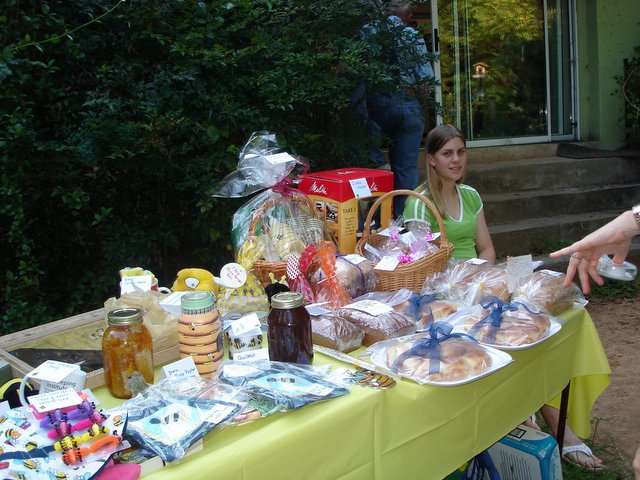
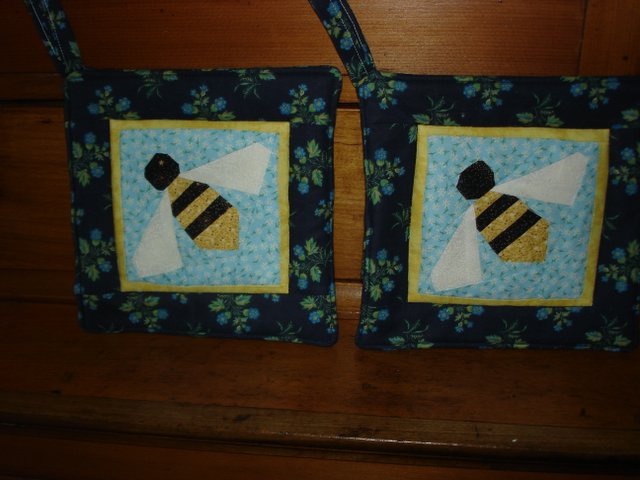
The three plates of rolls tied with blue ribbons are Canadian Honey Buttermilk rolls that I baked and donated. I also made two honeybee potholders sitting on the front edge of the table. I was pleased that all were sold. I bought a couple of things, but really wanted a solar wax melter - not offered for auction. Guess I'll have to build my own.


There was a honey contest. I decided to be brave and enter it. I entered my chunk honey in the contest and also entered the "black jar contest" in which honey is judged only for taste.

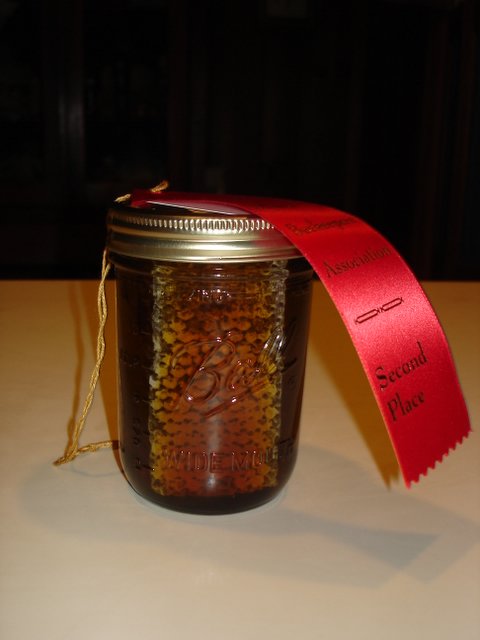
The chunk honey was entered in three jars as per the rules. My chunk honey won second place! I was so excited. Most of the winners were seasoned beekeepers. I think I may have been the only first year beekeeper to win a prize - I was thrilled with my red ribbon and my cash prize! Posted by Picasa

Saturday, August 19, 2006

Chunk Honey - Phase Two


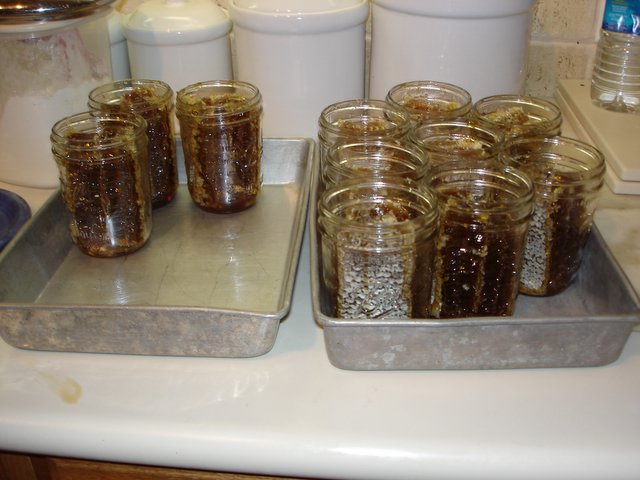
The crushed honey sat on the edge of my garden for several hours and most of the honey strained through the filter by then. I took the bucket in to my kitchen and began filling the wide-mouthed jars filled with honeycomb.

I had 22 jars and just enough honey to fill all of them - which says to me that to do chunk honey, I'll always need to allot about half of the frames to crush and strain to provide the honey to fill the jars.

So at the end of the day of honey bottling, I have:

1. From Bermuda, all done in crush and strain, I emptied one 10 frame shallow super and got about 21 pounds of bottled honey.

2. From Destin, I emptied one 10 frame shallow super and made 22 pint jars of chunk honey, including comb and filler honey.


Posted by Picasa


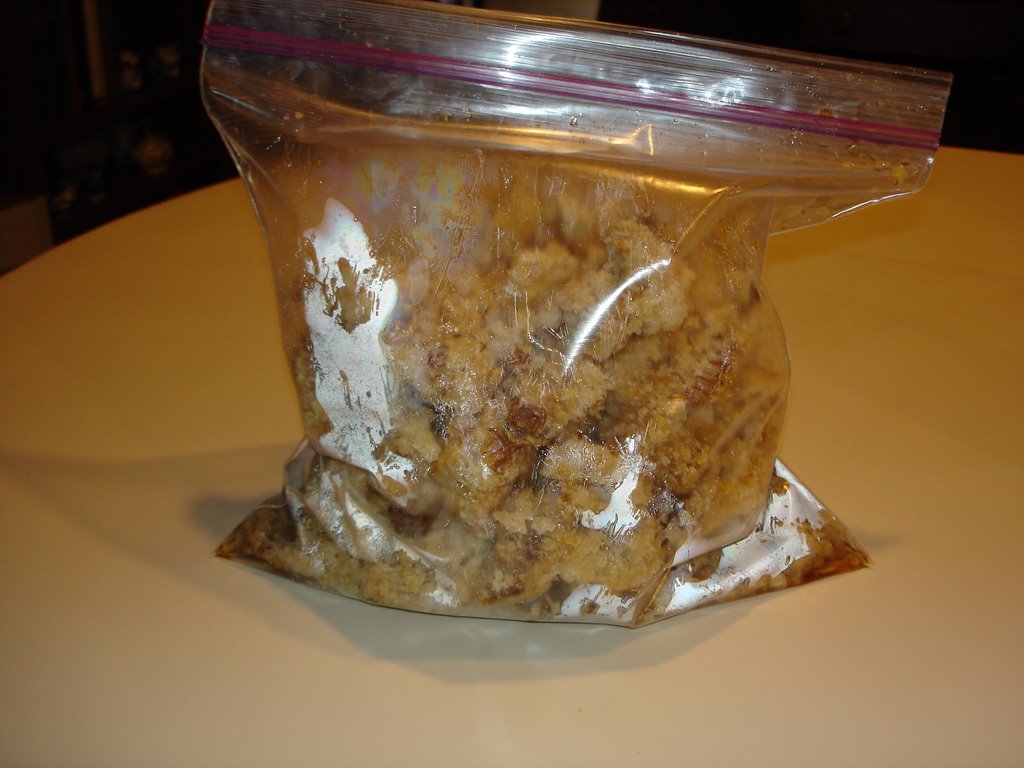
3. I also ended up with 2 gallon ziploc bags filled with washed wax cappings and crushed comb


At the end of the honey bottling day, I put the empty frames, each with honey dripping from them, back on the hive from which they came. I put the frames in Bermuda back in the empty super below the inner cover. I put the frames in Destin above the inner cover, as suggested in Hive Management.

I'm not sure that was a good idea in that there has been a frenzy of bee activity around the super in Destin with the honey dripping from the frames - I'm not sure if robbing from Bermuda is happening or what.

I left the wax from the chunk honey in the filter over the 5 gallon bucket to continue to filter overnight. Whew!!!! What a day!

Bermuda still has three honey supers on the hive - one is pretty empty; one has honey and brood and is closest to the brood boxes, so I'll leave it on the hive for the bees; one more is full and capped. So I still have at least one super to harvest from that hive.

Destin still has two honey supers on the hive. One is pretty empty and the other is full of beautifully capped honey. I will harvest at least that one super from the Destin hive in a week or two.

Bottling Chunk Honey - Phase one


Chunk honey is often called comb-in honey. Chunk honey includes a chunk or chunks of honeycomb in a jar with honey filling the jar.

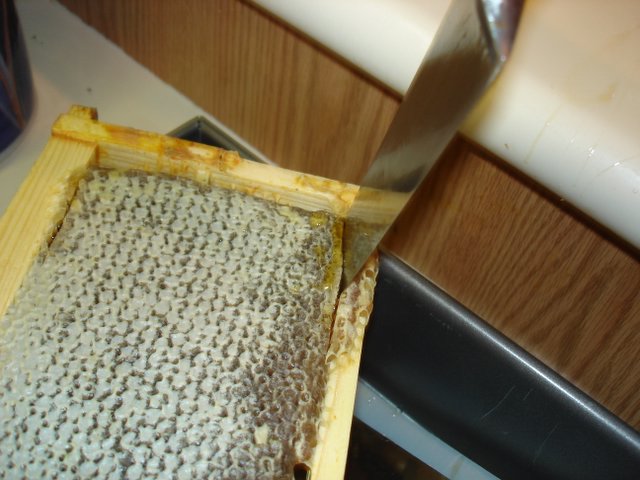
I had a frame of beautiful comb from Destin, so I decided to cut chunk honey from it. I cut chunks from 5 1/2 frames of the 10 and crushed the other 4 1/2 frames to make the honey to fill the jars around the comb.

I used a sharp knife to cut a chunk of comb the size of the frame and the width of a wide mouthed canning jar. I balanced the frame over the wonderful 12X17 Calphalon pan I bought at my local Super Target. I held a spatula under the frame as I made my last cut to catch the chunk.

I then transferred the chunk to the wide-mouthed jar. Each jar held 2 chunks. Each frame yielded four jars and a small chunk to be included in the crushed and strained honey at the end of the process.

When I was done I had filled 22 wide mouthed jars. I crushed the rest of the honey into a strainer over a 5 gallon bucket, covered it with the top, and put it out on my front sidewalk near my garden. The heat of the day should make the honey run through the strainer so that I can finish filling the jars before the day ends.
Posted by Picasa

Pin this post

LinkWithin

Related Posts Plugin for WordPress, Blogger...