Welcome - Explore my Blog

I've been keeping this blog for all of my beekeeping years and I am beginning my 19th year of beekeeping in April 2024. Now there are more than 1300 posts on this blog. Please use the search bar below to search the blog for other posts on a subject in which you are interested. You can also click on the "label" at the end of a post and all posts with that label will show up. At the very bottom of this page is a list of all the labels I've used.

Even if you find one post on the subject, I've posted a lot on basic beekeeping skills like installing bees, harvesting honey, inspecting the hive, etc. so be sure to search for more once you've found a topic of interest to you. And watch the useful videos and slide shows on the sidebar. All of them have captions. Please share posts of interest via Facebook, Pinterest, etc.

I began this blog to chronicle my beekeeping experiences. I have read lots of beekeeping books, but nothing takes the place of either hands-on experience with an experienced beekeeper or good pictures of the process. I want people to have a clearer picture of what to expect in their beekeeping so I post pictures and write about my beekeeping saga here.Master Beekeeper Enjoy with me as I learn and grow as a beekeeper.

Need help with an Atlanta area swarm? Visit Found a Swarm? Call a Beekeeper. ‪(404) 482-1848‬

Want to Pin this post?

Showing posts with label sourwood. Show all posts

Tuesday, July 07, 2015

Rabun County Bee Status Report

Since I am up here for the Fourth of July holiday, I went over to check on the bees at Robin's house. The sourwood is blooming up here.  It started early this year and is about in the middle of its bloom.  I fully expected the bees to be bringing in tons of nectar.

We are not planning to harvest from this hive this year. Starting so late, our best hope is that the bees can collect enough honey to make it through the winter.

There were plenty of bees coming in and out of the hive, but also asparagus greenery in front of the hive so it's hard to see any bees in this photo - trust me, they were there!


The first thing I did was to kill a black widow spider who had built her web and laid eggs inside the top cover.  I frequently have found black widows in the inside of the top cover - this is at least the fifth one in the last two years. (You can't see her in the photo but can see the remnants of her web.

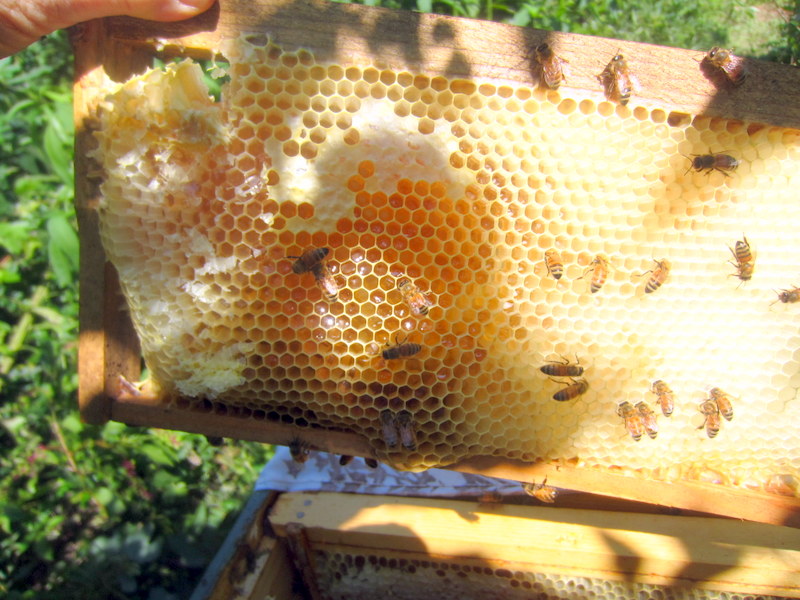
Upon opening the hive, I found beautiful straight comb and the bees were making good use of what they had. In this comb they were storing nectar:


In these two shots the honeycomb is full of eggs - just look at how active this good queen is!


Since I live over 100 miles from this hive, I decided to leave them with a fourth box even though they had barely started using the third box. It is the height of the sourwood flow and if they don't use the box for nectar, it will help with ventilation. I did not put a ladder frame into the hive because there wasn't one available in the box below, so we'll just hope for the best.

Truly my car was not parked on top of the hive, but it does look rather strange!  I'll be back in a few weeks to check on this hive and probably to steal one frame of sourwood honey!

As I drove back to the mountain house, I was struck by the beauty of the roadside blooming weeds that serve the bees so well in the country.  There was an abundance of Queen Anne's lace, bright orange butterfly weed (a member of the milkweed family which bees love), and black-eyed Susans.


Aren't they lovely? The sad thing for bees today is that when you aren't in the country as I am now, the sides of the road are not full of flowering weeds. 


Thursday, August 30, 2012

Rabun County Bees

A couple of weeks ago when I went to Asheville for the Natural Beekeeping meeting, I stayed at my house in Rabun County.  On the way up I saw the bear in the misty rain at Black Rock Mountain Lake.    The day after the conference, the lake was sunny and beautiful and while I didn't see a bear again, I did see Joe Pye weed and goldenrod, evidence of the fall flow (for what it's worth).


Before I drove back to Atlanta, I checked on the Rabun bees.  The last time I was up at the mountain house, I discovered that one of the hives was almost dead and had small hive beetles all through it.

I didn't really check out the cause of the problem when I was there before because I was so upset, so I opened the hive on this visit and brought the boxes back home.  Clearly the hive had been robbed out, and left so weakened that the small hive beetle took advantage of the opportunity.


Two things are evident in this picture.  The edges of the cells are ragged, indicating a robbery.  There were dead bees littering the ground in front of the hive.  And you can see the slime of the small hive beetle.  I brought four boxes back to Atlanta and could hardly stand the sicky sweet smell in the car of the SHB's destruction.

The other hive was almost completely covered with weeds.  It was totally in the shade and had kudzu and other brambles all over the entry.  I didn't take a before picture, but I wish I had.  The bees were still flying happily in and out of the hive.  I knew this vegetation situation was likely so I brought my hedge clippers with me.  I went to work and freed the hive from most of the vegetation.


When I opened it, I was shocked (in all the previous shade) to find that I only saw one small hive beetle in the hive.  Perhaps they were all satiated on the frames from the other hive?

This hive has honey in all three boxes and brood in the bottom box.  I really wanted to taste their honey.  The top box is likely sourwood, but they had not completely capped the honey in those frames, so I brought back a frame from the middle box.


I didn't come prepared for harvest transport, so after brushing off the bees, I put the frame into a pillow case (I'm now using them for hive drapes like Julia taught me), and brought it back to Atlanta.  I crushed and strained it and now have three pounds of luscious grape-flavored honey, likely from the kudzu all around the creek bed where the hive is located!


(The HIDDEN honey frame).

Sunday, July 08, 2012

Gosh, I'm Feeling Like a Bad Beekeeper

I went up to the mountains for the Fourth of July to see the fireworks and to check on the bees.  I love the Rabun County fireworks - we go and sit on a blanket in a field near the Rabun Gap Nacoochee School.  We wait eagerly for dark (which doesn't come until 9:30) and by then the grandkids are sleepy.  But the fireworks are grand and glorious - (and don't include Atlanta traffic jams) - so we have a great time and are back at the house by 10:05.

Since the Fourth was on a Wednesday, all of us needed to go back to Atlanta the next day.  Before I left I went to check on the bees.  Sad news:  The over-wintered hive was almost completely dead - all of the honey was covered in small hive beetles and the whole hive smelled of orange crush (a sure sign of being slimed by the small hive beetle).

I was so upset that I didn't want to look at the evidence and determine the reason the hive failed, allowing the rise of the SHB.

When I was last up there about three weeks ago, there was no nectar and although I saw brood and eggs, the hive had no evident stores (although the slime would indicate otherwise).  I imagine that I may have killed the queen in that inspection.  When I put on one of the boxes, a roar went up from the hive, but I discounted the possibility.  If the queen died in that inspection and stores were so low, the hive may have not been able to make a new queen.

The frame of bees below is all that were left.  Since I didn't know what caused the end of the hive, I didn't shake them into the other hive for fear of contaminating them, if the hive were diseased.

I regreted not having enough supplies - I couldn't move the bees into a nuc because I didn't have one.  I had brought boxes to add but not solutions to problems.


On the good side of things, the other hive, which was a swarm that took up residence there this year, was busting out all over with bees.  In spite of encroaching kudzu, hundreds of bees were coming and going.  Afraid and feeling like a bad beekeeper, I didn't inspect this hive - didn't want to kill another queen.

I looked in the top box which was completely empty on my last visit.  They had filled five frames, drawn new wax and were filling it.  Sourwood is blooming up there now and this looks like nectar that ends up as sourwood honey.  We'll see.

I won't go back until the 22nd and by then the surviving hive may be covered up with kudzu.

Posted by Picasa

Thursday, July 22, 2010

Bees in Rabun County Putting up Honey

This past weekend I went to Rabun County and checked on my hive there. The greenery had really grown up around it and I think the people who weed whack around the community garden don't want to disturb the bees. I had a clipper in my car and clipped the area in front of the hive entry before I left.


I used smoke on this hive just at tne entry because it was about to storm and I didn't want angry bees (as often happens when it rains).


I last opened this hive two weeks ago and they had barely begun building wax and filling it in the second box. Today every frame was drawn out in the second box and bees were festooning in the third. Last weekend was about the last weekend of the sourwood bloom so maybe they were trying to take advantage of the last of it.

Below is a frame of honey that the bees are beginning to cap from the second box.


I was pleased and put the hive back together, clipped the grass and weeds from in front of the entrance and left it until I return on August 7. This hive won't have honey I can harvest, but I plan to rob out one frame just to see what Rabun County honey tastes like! Maybe I can get some of those small hexagon bottles and give the gardeners each a taste of the honey.


Posted by Picasa

Saturday, June 26, 2010

The Rabun County Bees are Hard at Work

Today was my first visit to the Rabun County bees since Memorial Day weekend. So many nice things have happened at the garden. They have the lovely sign below, designating the community garden as "The Old School Garden." The garden is located on an old school ground, thus the name.


As I walked back to the bee hive, I was struck by the lush garden. I didn't take a picture of it as a whole (wish I had), but here are some cucumbers that I am sure the bees are enjoying pollinating!


Then to my surprise in front of the bee yard, they have erected this bright orange caution sign. What a hoot - I love it!


The bees were doing well. I installed them as a 2 pound package from Don Kuchenmeister (fatbeeman) on April 24 2010. By Memorial Day weekend, it was clear that they were doing well, but they had only used about 6 frames of the bottom box. Now they have completely filled the bottom box with drawn frames, brood, pollen and honey. They are into the second box where they have built out a little over 1/3 of the box, all on the right side.

They have beautiful mostly uncapped honey.


The sourwood is in full bloom all over the county and the bees are drawing wax and filling it, trying to take advantage of the flow.  (After posting this, I looked more closely at the comb below which is full of eggs(!) not sourwood honey).


I was also pleased to pull the second frame from the bottom box and see lots of eggs and brood. This is a good queen and a good hive.  Click on the picture to see a larger view of the eggs in the center bottom of the frame.


Posted by Picasa

Saturday, July 08, 2006

I have sourwood trees!


I'm thrilled to find out that I have sourwood trees on my property in the North Georgia mountains. Sourwood is treasured honey for those who know the difference.

Here is a close-up of a sourwood flower. You can see why it is commonly called the lily of the valley tree. In North Georgia the sourwood is peaking right now. The bloom started at the end of June.

I don't have beehives at my mountain house right now because of the bears. There are five bears that live on the mountain - three adults and two cubs. Others who live up here see them regularly.

Jamie Ellis, PhD, bee expert from UGA, told me that I would need an electric fence to keep the bears out. He suggested that I set up the fence and drape bacon on the wires. Then when the bears went for the bacon, they would be shocked and learn not to go into the fence to get the hives.

With all of this blooming sourwood (these pictures are all taken on my property), I feel determined to find out how to put hives up here next year. I have the perfect spot for two or three hives with a southern exposure looking down the mountain toward many sourwood trees and with forest behind as well.

I've gotten so accustomed to looking at my hives every day at home - it will be odd to set up hives that I only see every three weeks or so. The problems will certainly be different, more global. I'll probably have to deal with swarms, hungry bees, no close-by water source.....hmmmm......among other problems yet to be discovered.

Posted by Picasa

Wednesday, July 05, 2006

Beekeeping in North Carolina


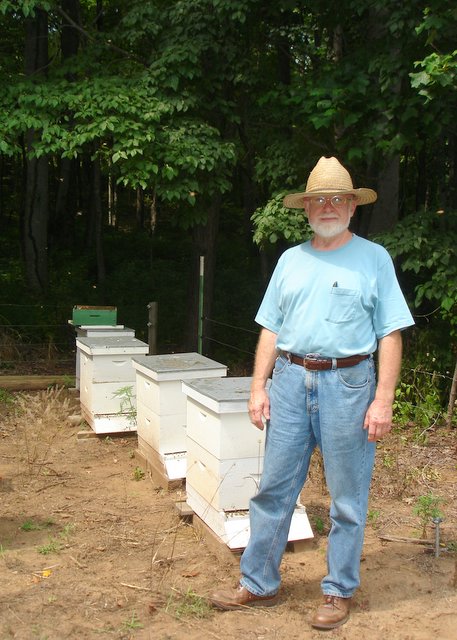
I'm in North Georgia for the July 4th week. While here I went to visit my new friend Ed to see his bees. Ed has four beehives in North Carolina just over the Georgia line. His hives are in a beeyard protected from bears by an electric fence with a solar powered battery. He shares his beeyard with about 30 hives belonging to Bob Binnie, a well-known N Georgia beekeeper from Lakemont, Georgia.

Bob unexpectedly arrived at Ed's house just before I did so I was lucky to get a free lesson about bees from someone who really knows his bees. Bob is one of the speakers at EAS(Eastern Apiculture Society) in Young Harris, Georgia in August this year. His topic is "Breaking in to New Markets." Bob sells his honey all over this area.

Ed and Bob wait until the sourwood is in bloom to put honey supers on their hives. I wondered why the bees didn't swarm if they had to wait this long before getting space to expand. Bob (in my wonderful private bee lesson) explained that the hives at Ed's place were mostly new splits, started in May, so in fact were just now at production strength.

I have to confess that I have never seen the queen in either of my hives or in any hive. Bob showed me the queen in one of the hives and I was thrilled to see her. He also showed me a queen cell and many examples from Ed's hives of great brood patterns.

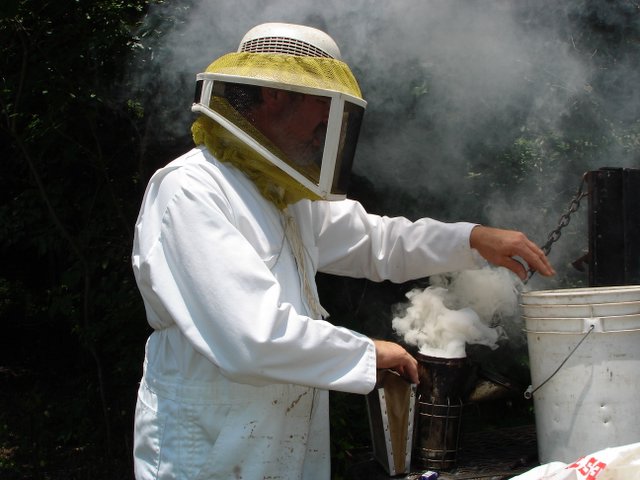
I also learned from Bob how he lights his smoker. Everyone seems to have a different trick. Bob's (and as a result Ed does this too) is to use a paper towel. He fills the smoker with thick twine and a paper towel and then lights the towel. Unlike mine, which I can spend a minimum of 15 minutes trying to light, his went up in thick smoke right away. He keeps it running with pellets he gets from Dadant.

So for smokers so far:
--Virginia Webb uses wood chips and puts some in the bottom, lights them and keeps feeding the chips.
--My friend and mentor, Nickie, in Atlanta uses hamster cedar chips and pine needles
--Bob Binnie and Ed use paper towels to start the action and then feed Dadant pellets
--I, who take forever to get mine lit, use dryer lint, cedar chips and anything I can find that will burn......hmmm, I think it will be paper towels for me going forward!

It was certainly a privilege to see Bob in action. I asked him about his hives in the Rabun Gap area where my house is and it happens that he supplies the observation hive bees at Osage produce market where I buy local produce daily when I am up here. His hives line the highway beside Osage as well. After my afternoon at Ed's, I went back to Osage and found the queen in Bob's observation hive there!

When I was a little girl, we had a housekeeper who would also say, "We live and learn and dies and forgets it all." Goodness, I hope I remember all I observed while watching Bob.
Posted by Picasa

Pin this post

LinkWithin

Related Posts Plugin for WordPress, Blogger...