Today I checked the hives at Stonehurst Place (doing fabulously well) and my backyard hives. The Stonehurst hives each needed a new box - we've had great weather throughout May after the wettest April in years and years.
The bees are having a great opportunity to bring in nectar.
When I checked my backyard hives, I was particularly interested in the nuc split I had made several weeks ago. They appear to be doing fine, but I didn't want to go into their bottom box in case I might destroy a queen cell about to emerge.
Michael Bush says it never hurts to add a frame of brood and eggs to a hive when you have any question about the queen. So I have taken that approach with this nuc. I made the nuc because it's good to have a nuc in your bee yard as a resource - it can provide bees or eggs or a boost to any hive in your yard once it is established.
I am trying to be conscious of genetics. So this year I have only added frames of brood and eggs from hives that survived the winter and did not bow to the dreaded varroa vectored diseases. So I took a frame of brood and eggs from my survivor neighborhood swarm hive from last year and added it to the nuc hive. This is the second frame of brood and eggs I've added to the nuc. The first frame came from the nuc hive that overwintered (now in a full sized hive).
The nuc hive is a medium nuc, currently consisting of two boxes. I added the frame to the upper box so as not to disturb any event in the bottom box. I think the added work force will help the nuc and the eggs on the frame will give them the ability to make a queen if they have not yet been successful with that endeavor.
Whatever queen they make, she will come from survivor stock since both hives where I have pulled frames of eggs survived the winter.
Showing posts with label adding frame to queenless hive. Show all posts
Showing posts with label adding frame to queenless hive. Show all posts
Saturday, May 09, 2015


Saturday, March 28, 2015
Ground Control to Major Tom......
I went over to Tom's on Monday morning to see how the hive was doing. I knew it had made it through the winter because Tom and his family reported seeing flying bees (and I had stopped by earlier), but I had not yet been inside the hive.
Monday was the day. As I popped the top, an angry queenless roar began and I felt worried. I took the hive down to the bottom box. Some honey in the second box and in the bottom box. In the bottom box, I found tons of dark brown capped brood (dark biscuit), meaning the bees were about to emerge.
I searched on both sides of every frame and could find no uncapped brood and no eggs, despite there being plenty of room.
It's early in Atlanta for a swarm, but there have been some. All I could determine was that Tom's hive had looked out and said, "Take your protein pills and put your helmet on....The stars look very different today," and swarmed last week while he and his family were on vacation.
The only explanation for this hive bursting at the seam with bees and only capped brood is that they had swarmed; the queen had emerged and had gotten rid of any other competing queens; and she was off on her mating flight. Perhaps she was unsuccessful - got eaten by a bird or didn't find any available drones aloft.
Thus the queenless roar.
I put the hive (which I had intended to split) back together and left to think. As I drove home I decided to get a frame of eggs and brood from the daughter hive that is in my backyard and bring it over to Tom's on Thursday (my next free day). On Thursday I made a split from the daughter hive to put in Tom's second hive (a 2014 Buster's Bees hive that did not make it through the winter).
My office got busy on Thursday, so Jeff decided to help me do this on Friday. Atlanta was cold and windy on Friday morning, so instead we put the nuc box with the split and an extra frame of brood for the queenless hive on top of its new quarters. I planned to return when the temperatures rose in the afternoon.
Around 3:30 I arrived at Tom's and opened the "queenless" hive. Now they were calm. No roar; no angry bees head bumping me. I looked through the bottom box and there they were, right in my face: eggs, newly laid, and young, young brood. In the five days since I had been there, the queen must have successfully returned and began her new job.
HOORAY!
And I installed the nuc in the other hive. So we have had two very cold nights, last night and tonight, so the new nuc may not make it. I'll give it more bees next week.
Sorry about the lack of photos - left my camera at my house......
Monday was the day. As I popped the top, an angry queenless roar began and I felt worried. I took the hive down to the bottom box. Some honey in the second box and in the bottom box. In the bottom box, I found tons of dark brown capped brood (dark biscuit), meaning the bees were about to emerge.
I searched on both sides of every frame and could find no uncapped brood and no eggs, despite there being plenty of room.
It's early in Atlanta for a swarm, but there have been some. All I could determine was that Tom's hive had looked out and said, "Take your protein pills and put your helmet on....The stars look very different today," and swarmed last week while he and his family were on vacation.
The only explanation for this hive bursting at the seam with bees and only capped brood is that they had swarmed; the queen had emerged and had gotten rid of any other competing queens; and she was off on her mating flight. Perhaps she was unsuccessful - got eaten by a bird or didn't find any available drones aloft.
Thus the queenless roar.
I put the hive (which I had intended to split) back together and left to think. As I drove home I decided to get a frame of eggs and brood from the daughter hive that is in my backyard and bring it over to Tom's on Thursday (my next free day). On Thursday I made a split from the daughter hive to put in Tom's second hive (a 2014 Buster's Bees hive that did not make it through the winter).
My office got busy on Thursday, so Jeff decided to help me do this on Friday. Atlanta was cold and windy on Friday morning, so instead we put the nuc box with the split and an extra frame of brood for the queenless hive on top of its new quarters. I planned to return when the temperatures rose in the afternoon.
Around 3:30 I arrived at Tom's and opened the "queenless" hive. Now they were calm. No roar; no angry bees head bumping me. I looked through the bottom box and there they were, right in my face: eggs, newly laid, and young, young brood. In the five days since I had been there, the queen must have successfully returned and began her new job.
HOORAY!
And I installed the nuc in the other hive. So we have had two very cold nights, last night and tonight, so the new nuc may not make it. I'll give it more bees next week.
Sorry about the lack of photos - left my camera at my house......
Sunday, February 22, 2015
Analytical Thinking about the New Dead Hive
So the hive that appears dead today (it rained and was too cold to open it today) needs some careful thought and I have not been able to get it out of my mind today.
First it originally was my Northlake swarm hive - a swarm from a hive of bees that had been living "for years" in a column in a business condominium complex. So potentially these were feral survival bees. They lived through the winter of 2013 and I was thrilled to have a survivor hive.
But this year, as my son-in-law called it, was the Year of the Foot. I dealt all through bee season with my injured leg (now all better after a YEAR) and it really hampered my beekeeping attentiveness. I have to acknowledge that my hives were neglected more than they were cared for in bee season 2014.
So the Northlake Swarm hive went queenless some time midsummer. Because I was not in my hives every week with a cast on my leg, I missed the queenless situation until it had probably gone on a while - not long enough to develop a laying worker problem, but still long enough.
When I recognized the queenless problem in the hive, I didn't have any swarm survival hives, so I gave them a frame of brood and eggs from the Sebastian hive (the one that we moved from the yard of the GSU professor in spring 2014). I did that three times before they made a queen. Two frames came from Sebastian and one from my Morningside hive in the community garden.
So the queen that developed in the Northlake hive was no longer a survivor queen. She had been made from eggs with a less clear history.
I just grabbed a frame of brood and eggs from a hive that seemed to have a lot and didn't give the genetics much thought.
This year if either my nuc that has overwintered or my neighborhood swarm hive that has overwintered go queenless, I'm using each of them to provide brood and eggs for the other. That way they will still get survivor genetics. I am resolved to be a much more involved and careful beekeeper in this year of NON-INJURY - crossed fingers that that remains true.
Tomorrow I'll check on Stonehurst and see if it survived - it's not a feral hive - it came from Mountain Sweet Honey last year, but it may have made it.
My ongoing goal should be to use survivors to make queens for any queenless hives. If Tom's hive which came from Bill Owens and also appears to be a survivor hive made it through this cold period, I will split it in late March for the same reason - it's a survivor. The nuc currently alive in my backyard came from that hive as a split in 2014.
First it originally was my Northlake swarm hive - a swarm from a hive of bees that had been living "for years" in a column in a business condominium complex. So potentially these were feral survival bees. They lived through the winter of 2013 and I was thrilled to have a survivor hive.
But this year, as my son-in-law called it, was the Year of the Foot. I dealt all through bee season with my injured leg (now all better after a YEAR) and it really hampered my beekeeping attentiveness. I have to acknowledge that my hives were neglected more than they were cared for in bee season 2014.
So the Northlake Swarm hive went queenless some time midsummer. Because I was not in my hives every week with a cast on my leg, I missed the queenless situation until it had probably gone on a while - not long enough to develop a laying worker problem, but still long enough.
When I recognized the queenless problem in the hive, I didn't have any swarm survival hives, so I gave them a frame of brood and eggs from the Sebastian hive (the one that we moved from the yard of the GSU professor in spring 2014). I did that three times before they made a queen. Two frames came from Sebastian and one from my Morningside hive in the community garden.
So the queen that developed in the Northlake hive was no longer a survivor queen. She had been made from eggs with a less clear history.
I just grabbed a frame of brood and eggs from a hive that seemed to have a lot and didn't give the genetics much thought.
This year if either my nuc that has overwintered or my neighborhood swarm hive that has overwintered go queenless, I'm using each of them to provide brood and eggs for the other. That way they will still get survivor genetics. I am resolved to be a much more involved and careful beekeeper in this year of NON-INJURY - crossed fingers that that remains true.
Tomorrow I'll check on Stonehurst and see if it survived - it's not a feral hive - it came from Mountain Sweet Honey last year, but it may have made it.
My ongoing goal should be to use survivors to make queens for any queenless hives. If Tom's hive which came from Bill Owens and also appears to be a survivor hive made it through this cold period, I will split it in late March for the same reason - it's a survivor. The nuc currently alive in my backyard came from that hive as a split in 2014.
Friday, July 25, 2014
Queenless Hive - How to Move a Frame of Brood and Eggs Without Accidentally Including the Queen
Julia and I inspected our hives at Chastain a week ago. We discovered to our dismay that my hive was queenless. There was no sign of queen cells and the bees, while there was no queenless roar, were diminshing in population. We added a frame of brood and eggs from Julia's hive at Chastain and crossed our fingers.
For best results in adding a frame of brood and eggs, the beekeeper should add a frame weekly until the hive has established a new queen. Michael Bush talks about this in the queenless hive that has resulted in laying workers, but it holds for any queenless hive: adding a frame of brood and eggs weekly allows the best possibility of the hive being able to become queenright.
So this weekend I need to move a frame of brood and eggs from one of my hives at home to my Chastain hive about 25 minutes away from here.
As you know, I edit the Georgia Beekeepers Association newsletter with my friend, Gina. We asked Noah to suggest a question for Aunt Bee, our Dear Abby of the Georgia bee world. Noah suggested a question about how to transport a frame of brood and eggs to a queenless hive.
I also asked him to answer the question. He said he had always heard to wrap the frame in a towel soaked in warm water and put it in a cooler to maintain its warmth. I thought that sounded good. What I typically do is drop the open brood frame into a pillow case and drive like mad to the far away location.
That is, of course, not the safest plan!
So to confirm Noah's suggestion, I went online "googling."
I found the suggestion on Beemaster forum to wrap the frame in a warm damp towel for transport. As I explored I found a post from one of my favorite posters on all the bee forum places. This was from Indypartridge who posts on Beemaster but I found his advice on Homesteader.
Generally the best way to move brood is with the nurse bees to keep them warm. Most people removing an open brood frame are afraid that they might accidentally take the queen.
This is what Indypartridge said:
"I can understand being nervous about accidentally transferring the queen along with a frame of brood from the strong hive to the weak. ........you can simply shake off the bees and give the weak hive a frame of eggs & open brood. If you want to give the weak hive an even better boost, you should transfer nurse bees along with the frame of brood. Do it this way so you don't transfer the queen:
1) Take a frame of eggs/larva from the strong hive. Shake off all the bees.
2) Put a queen excluder on top of the strong colony.
3) Add an empty box on top of the excluder. Put the single frame in the box.
4) Cover up the hive, leave for an hour or two.
5) Come back, the frame will be covered with nurse bees (and no queen).
6) Put the frame of eggs/larva & nurse bees in the weak hive.
I use this method for making nucs and splits when I don't want to spend time looking for a queen."
You could then put the brood frame with the nurse bees into a nuc box for transport. Typically a hive will pretty readily accept nurse bees from another hive.
For best results in adding a frame of brood and eggs, the beekeeper should add a frame weekly until the hive has established a new queen. Michael Bush talks about this in the queenless hive that has resulted in laying workers, but it holds for any queenless hive: adding a frame of brood and eggs weekly allows the best possibility of the hive being able to become queenright.
So this weekend I need to move a frame of brood and eggs from one of my hives at home to my Chastain hive about 25 minutes away from here.
As you know, I edit the Georgia Beekeepers Association newsletter with my friend, Gina. We asked Noah to suggest a question for Aunt Bee, our Dear Abby of the Georgia bee world. Noah suggested a question about how to transport a frame of brood and eggs to a queenless hive.
I also asked him to answer the question. He said he had always heard to wrap the frame in a towel soaked in warm water and put it in a cooler to maintain its warmth. I thought that sounded good. What I typically do is drop the open brood frame into a pillow case and drive like mad to the far away location.
That is, of course, not the safest plan!
So to confirm Noah's suggestion, I went online "googling."
I found the suggestion on Beemaster forum to wrap the frame in a warm damp towel for transport. As I explored I found a post from one of my favorite posters on all the bee forum places. This was from Indypartridge who posts on Beemaster but I found his advice on Homesteader.
Generally the best way to move brood is with the nurse bees to keep them warm. Most people removing an open brood frame are afraid that they might accidentally take the queen.
This is what Indypartridge said:
"I can understand being nervous about accidentally transferring the queen along with a frame of brood from the strong hive to the weak. ........you can simply shake off the bees and give the weak hive a frame of eggs & open brood. If you want to give the weak hive an even better boost, you should transfer nurse bees along with the frame of brood. Do it this way so you don't transfer the queen:
1) Take a frame of eggs/larva from the strong hive. Shake off all the bees.
2) Put a queen excluder on top of the strong colony.
3) Add an empty box on top of the excluder. Put the single frame in the box.
4) Cover up the hive, leave for an hour or two.
5) Come back, the frame will be covered with nurse bees (and no queen).
6) Put the frame of eggs/larva & nurse bees in the weak hive.
I use this method for making nucs and splits when I don't want to spend time looking for a queen."
You could then put the brood frame with the nurse bees into a nuc box for transport. Typically a hive will pretty readily accept nurse bees from another hive.
Saturday, July 19, 2014
The Power of the Sting
Now that I am in my ninth year of beekeeping, stings are relative in their impact on me. Often I get stung on my hands since I don't usually wear gloves, but most of the time within a half hour, I have no idea where I was stung or how many times.
Don't get me wrong - I often inspect hives and don't get stung at all, but probably do get stung about once a week during bee season.
Julia and I went to Chastain to check on the hives there. We have had three hives there, but she took the swarm hive she collected and took it to her mountain house to gather sourwood honey. So there are two hives now at Chastain: her hive which overwintered there and my hive which was a swarm collected by a beekeeper who wanted to donate it to Chastain for teaching purposes.
First we opened her hive. It was doing well, but not busting at the seam with bees. There were plenty of bees in the hive. We saw a lot of larvae being pulled out of their cells by other bees. This larvae was white and all the way to the stage where their eyes are developing. We wondered if this were a particularly hygienic queen or if the bees had been affected by pesticide.


I love the last photo where there was old comb and the bees added to it this year with new.
We have been told that the city doesn't use pesticides on the golf course. Apparently they can't afford it so they just keep the course well cut. (The hives are in the center of one of Atlanta's biggest parks and golf courses). However we noticed an area right by the hives that had been sprayed with Round-up and when we spoke to the directory of the Chastain Conservancy, he told us that they use a good bit of Round-up in the area of the quonset hut where the hives are.
Julia's hive did have eggs, an obviously thriving queen and stored honey.
In the process of the inspection, she went to her car to get a frame. Her ten frame boxes included one box that only had 9 in it and she had an extra frame in her car. We had draped the hive with pillow cases to keep the bees calm, but when Julia returned, she rapidly pulled off the pillow case and as I reached for a frame, I got nailed in the third finger of my left hand.
I walked away and flicked (I thought) the stinger out. A few minutes later I realized I had not gotten the stinger so I used my fingernail to get it out for good. My finger felt tight and swollen. It has continued to feel like that all day. A couple of hours after the incident, I noticed another stinger in the joint of my finger. No wonder it continued to hurt so much. It is now hours after the incident and my finger is still swollen and hurts.
We opened my hive to bad news - no queen. The hive had requeened itself recently and we had noticed at the last inspection that the queen appeared to have gone off to get mated. But she clearly did not succeed and I did not bring over a frame of brood and eggs every week as I should have until I clearly had a laying new queen.

Don't get me wrong - I often inspect hives and don't get stung at all, but probably do get stung about once a week during bee season.
Julia and I went to Chastain to check on the hives there. We have had three hives there, but she took the swarm hive she collected and took it to her mountain house to gather sourwood honey. So there are two hives now at Chastain: her hive which overwintered there and my hive which was a swarm collected by a beekeeper who wanted to donate it to Chastain for teaching purposes.
First we opened her hive. It was doing well, but not busting at the seam with bees. There were plenty of bees in the hive. We saw a lot of larvae being pulled out of their cells by other bees. This larvae was white and all the way to the stage where their eyes are developing. We wondered if this were a particularly hygienic queen or if the bees had been affected by pesticide.
We have been told that the city doesn't use pesticides on the golf course. Apparently they can't afford it so they just keep the course well cut. (The hives are in the center of one of Atlanta's biggest parks and golf courses). However we noticed an area right by the hives that had been sprayed with Round-up and when we spoke to the directory of the Chastain Conservancy, he told us that they use a good bit of Round-up in the area of the quonset hut where the hives are.
Julia's hive did have eggs, an obviously thriving queen and stored honey.
In the process of the inspection, she went to her car to get a frame. Her ten frame boxes included one box that only had 9 in it and she had an extra frame in her car. We had draped the hive with pillow cases to keep the bees calm, but when Julia returned, she rapidly pulled off the pillow case and as I reached for a frame, I got nailed in the third finger of my left hand.
I walked away and flicked (I thought) the stinger out. A few minutes later I realized I had not gotten the stinger so I used my fingernail to get it out for good. My finger felt tight and swollen. It has continued to feel like that all day. A couple of hours after the incident, I noticed another stinger in the joint of my finger. No wonder it continued to hurt so much. It is now hours after the incident and my finger is still swollen and hurts.
We opened my hive to bad news - no queen. The hive had requeened itself recently and we had noticed at the last inspection that the queen appeared to have gone off to get mated. But she clearly did not succeed and I did not bring over a frame of brood and eggs every week as I should have until I clearly had a laying new queen.
We went through frame and frame and there was no sign of a queen. Julia very generously gave me a frame of eggs from her hive and we put it into the queenless hive. Hopefully they will make themselves queenright before winter. I'll try to do a better job of paying attention to their status and add more brood and eggs if necessary.
You may notice the air-cast on my right foot. I've had to wear it now for almost a month for a torn ligament. It really has hampered my beekeeping. I was so grateful for Julia who could bend her leg and pick up things, etc. in a way that I cannot with this air-cast on my leg.
Monday, May 26, 2014
Robbing Peter to Pay Paul and the Taste of Honey
The front hive at Tom's house is desperately queenless, so on Thursday I went over to Stonehurst Place to steal a frame of brood and eggs from one of the deep boxes over there. The new Ray Civitts hive was looking good and needed a new box. I checkerboarded them top box into the new box and then went into the lower box.
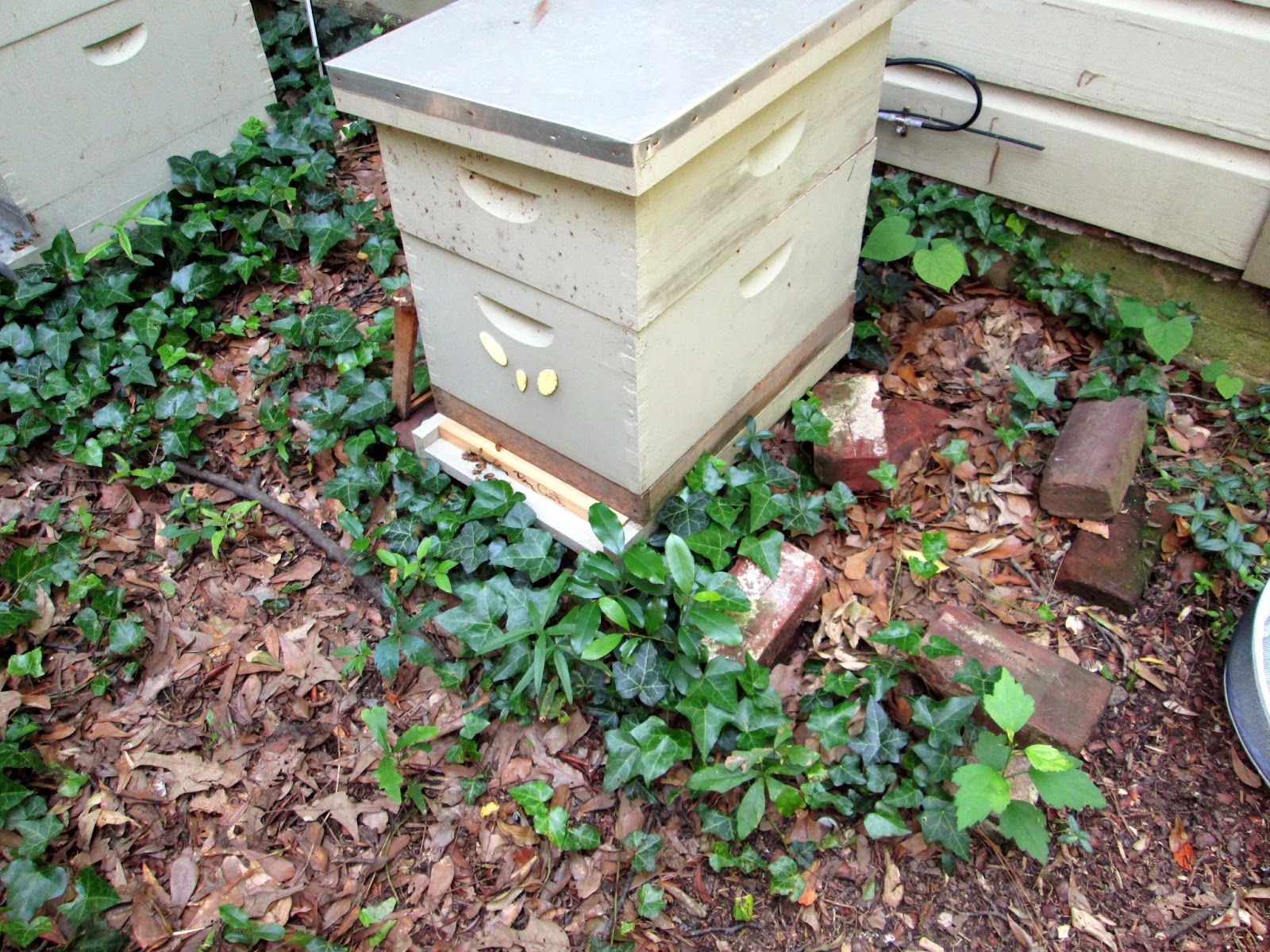
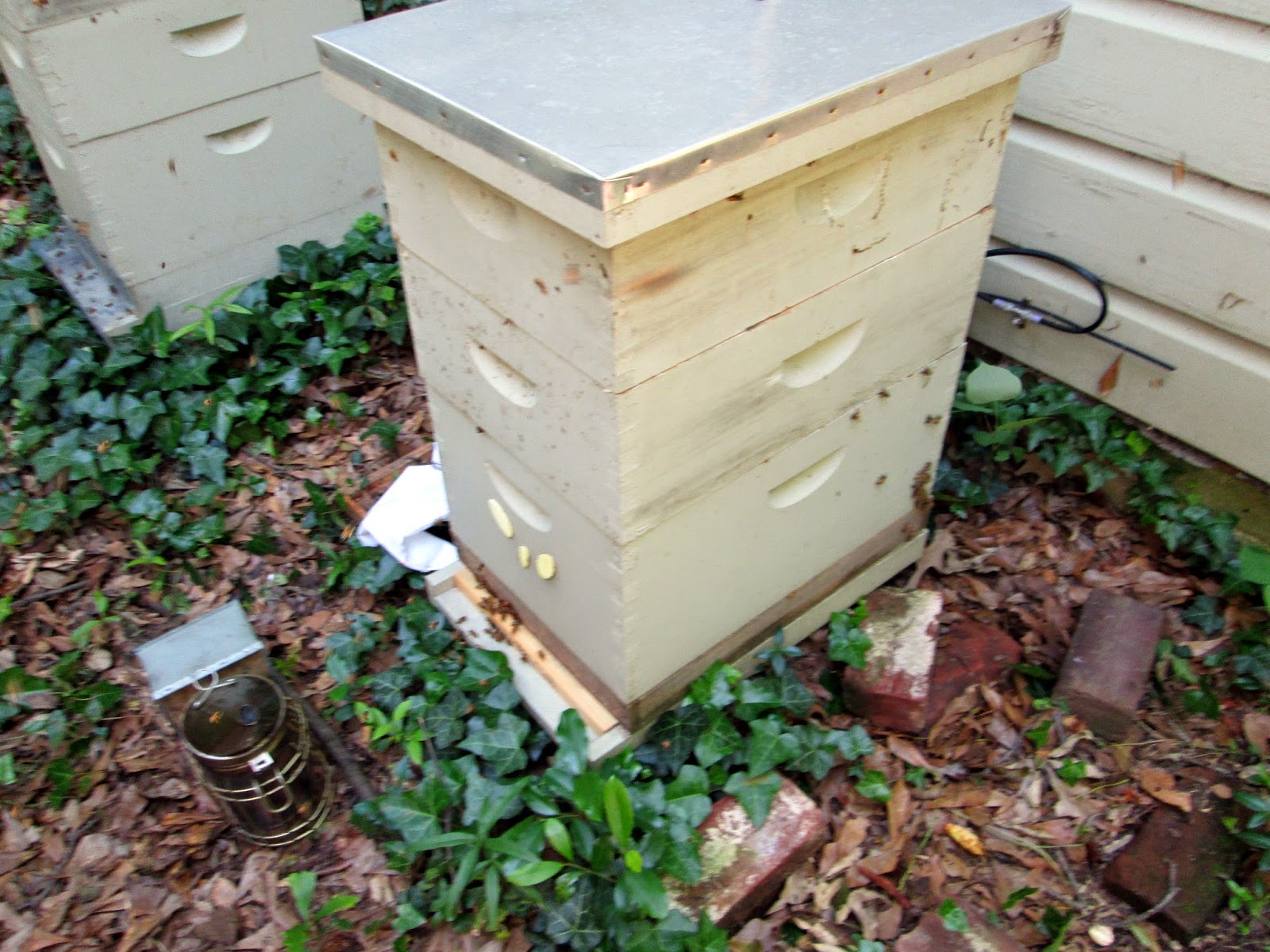
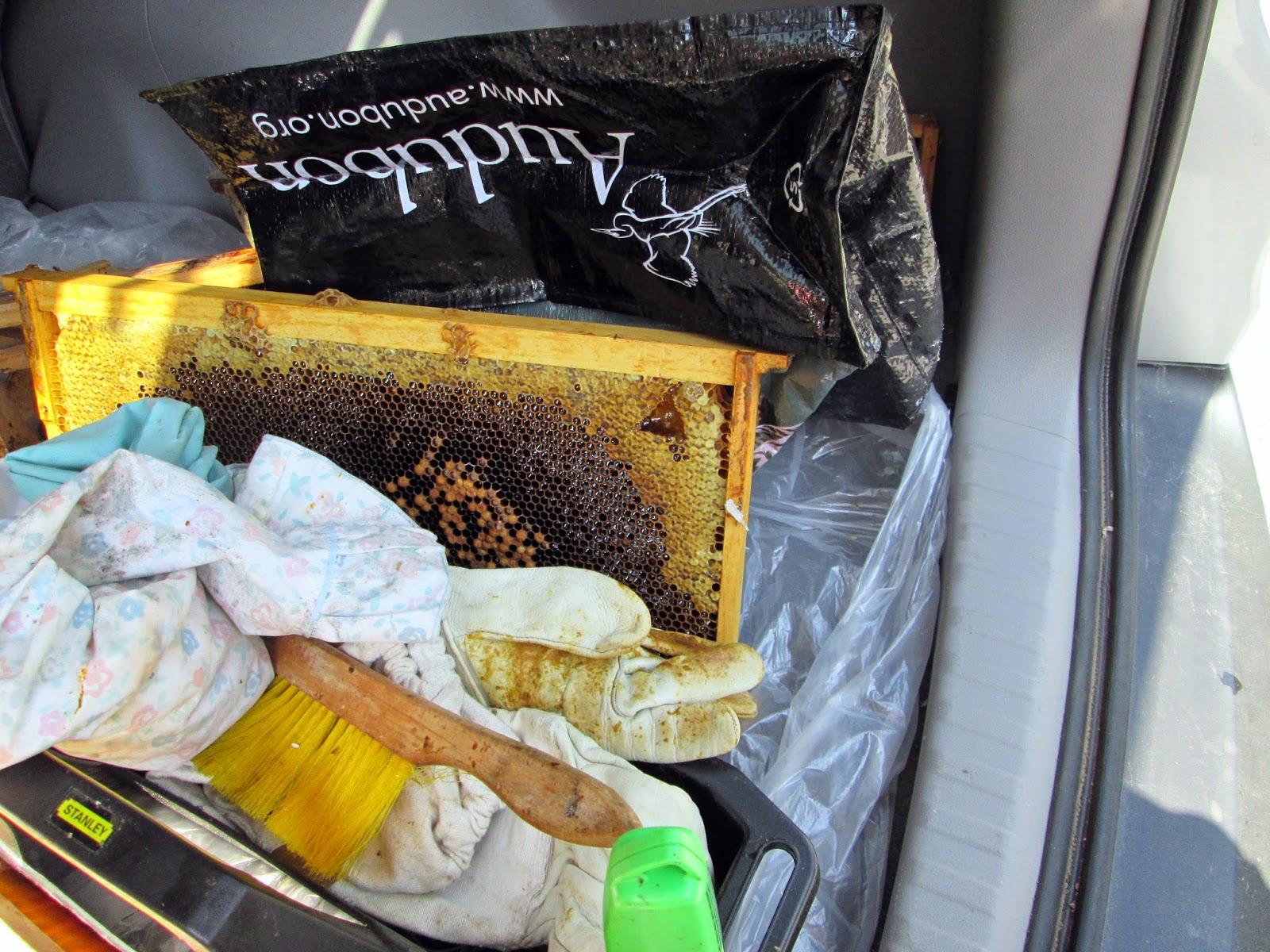


I put the beautiful frame of mostly eggs and young brood into a pillow case and put it in the back of my warm car (it was 87 in Atlanta that day). I drove to Jeff's office and picked him up to go to Tom's. We opened the hive.
Inside the hive, the frames had some brood but it was all drone. I think after the swarm the queen must have either been short bred (a Keith Fielder term meaning that she only mated with a couple of drones - not enough to allow her to function as a good layer). Anyway we pulled a frame from the bottom box that had a baseball sized circle of drone brood in the center. The rest of the frame had all the worker cells back-filled with nectar and there was honey at the corners, as is typical in a brood frame.
We added the beautiful Stonehurst brood/egg frame to the hive. I am crossing my fingers that they will now be able to make a successful queen.
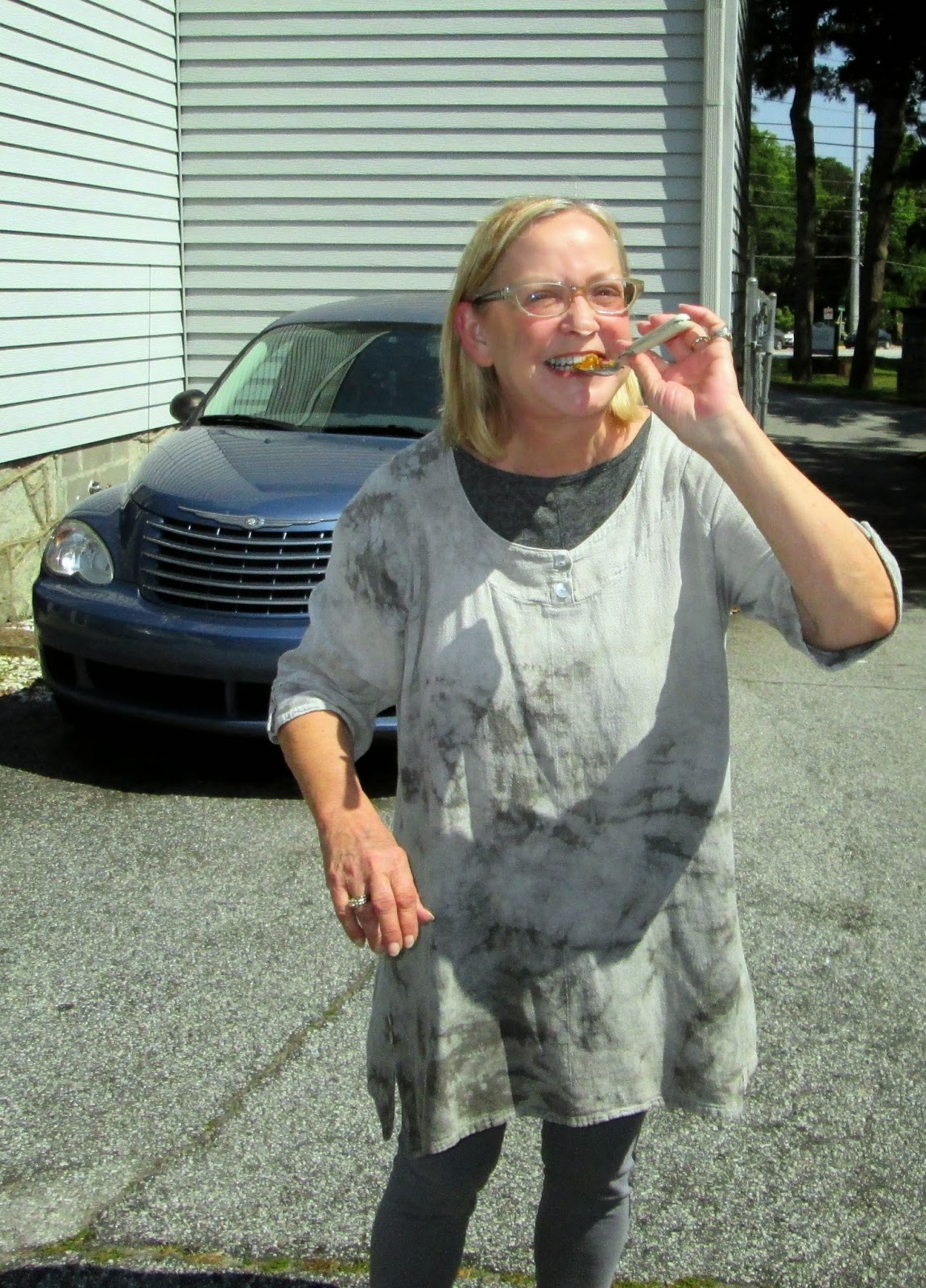
Jeff and I couldn't resist sticking our finger hive tool into the corner of the frame to taste the honey. Yum - it had a sweetness followed by a spicy end note - delicious. We didn't have anywhere else to put the frame, so I put it in the back of the car to take home.
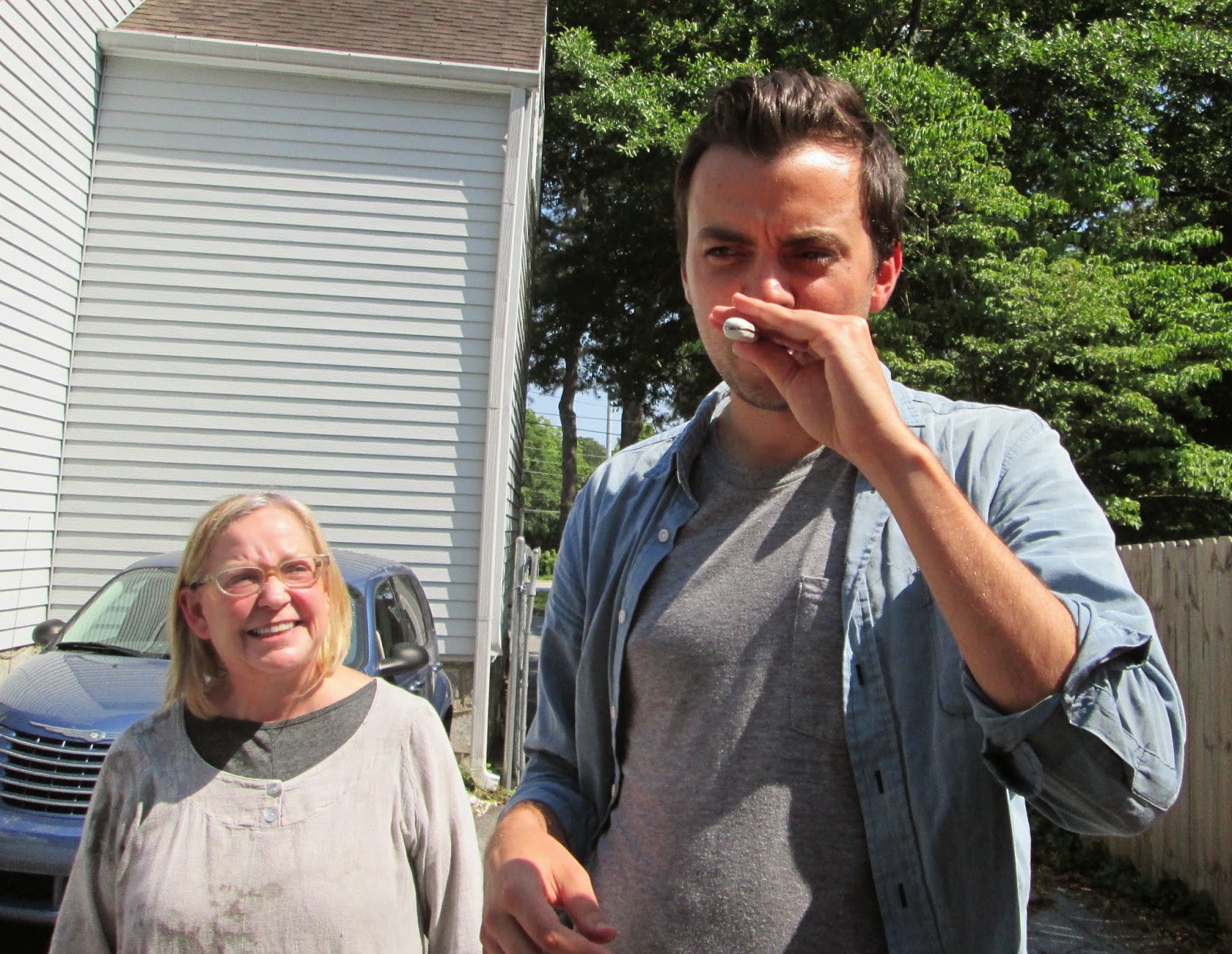
I let Jeff out at his office and he went in to tell the staff that we had a taste of honey in the car. At least six people came running out of the building brandishing spoons! I didn't get the camera up and running fast enough.
All six of them had a taste. Jeff works at a casting agency and they know how to have fun! All of them enjoyed the honey adventure, I think. And I had a great time sharing our honey moment with them as well.
Thursday, May 30, 2013
Queenly is as Queenly Does
So today was the day to check on the red dot Mississippi queen in Ron's hive. First I went to check on Sebastian's hives. The first split hive was doing well. The queen was laying. I saw one frame that was almost 100% eggs! They were also storing honey but not going gangbusters so they didn't need another box. I gave them a powdered sugar shake and moved to the survivor hive.
The survivor hive over there was also doing really well. They had completely filled the top box and were putting honey in odd comb formations between the boxes so even though there was one unused frame in the top box, I thought they needed a new box.
I am using the ventilated hive cover to help do powdered sugar dusting:


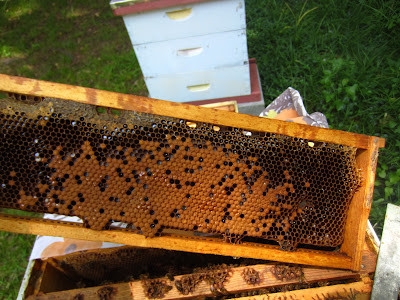
The survivor hive over there was also doing really well. They had completely filled the top box and were putting honey in odd comb formations between the boxes so even though there was one unused frame in the top box, I thought they needed a new box.
I am using the ventilated hive cover to help do powdered sugar dusting:


It's much simpler and faster than using a sifter. I put one Sierra cup's worth of sugar on each hive on top of the frames in the brood box.

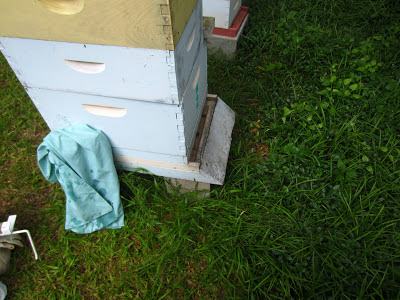
I took a frame of brood and young larvae from Sebastian's large hive to give to the hive at Ron's. I put it in a green pillow case to keep it relatively warm; closed up the hive; and drove to Ron's.
At Ron's my first concern was the Mississippi Queen. Had she been released now that I removed the old queen on Monday? I opened the hive and found her still in her queen cage. The bees were acting eager and friendly around the cage and had eaten all but the last sugar barrier. There were dead workers in the queen cage. I opened the queen cage and direct released her. She moved rapidly into the hive box and I cheered her on her journey and her life.

I also added the frame of brood and young larvae to the same box in the position where the queen cage had been. That should give a little boost to the hive and keep them busy. I marked that frame as Sebastian's R's Hive so that I wouldn't give the Mississippi Queen credit where credit wasn't due and left, hoping that the next time I visit, there will be new eggs on a different frame laid by her.
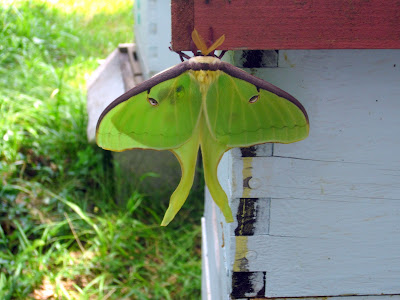
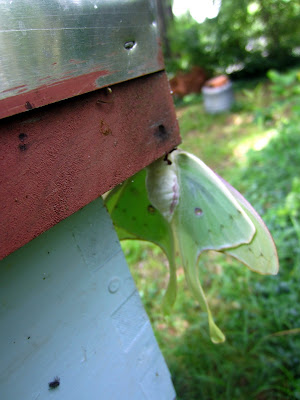
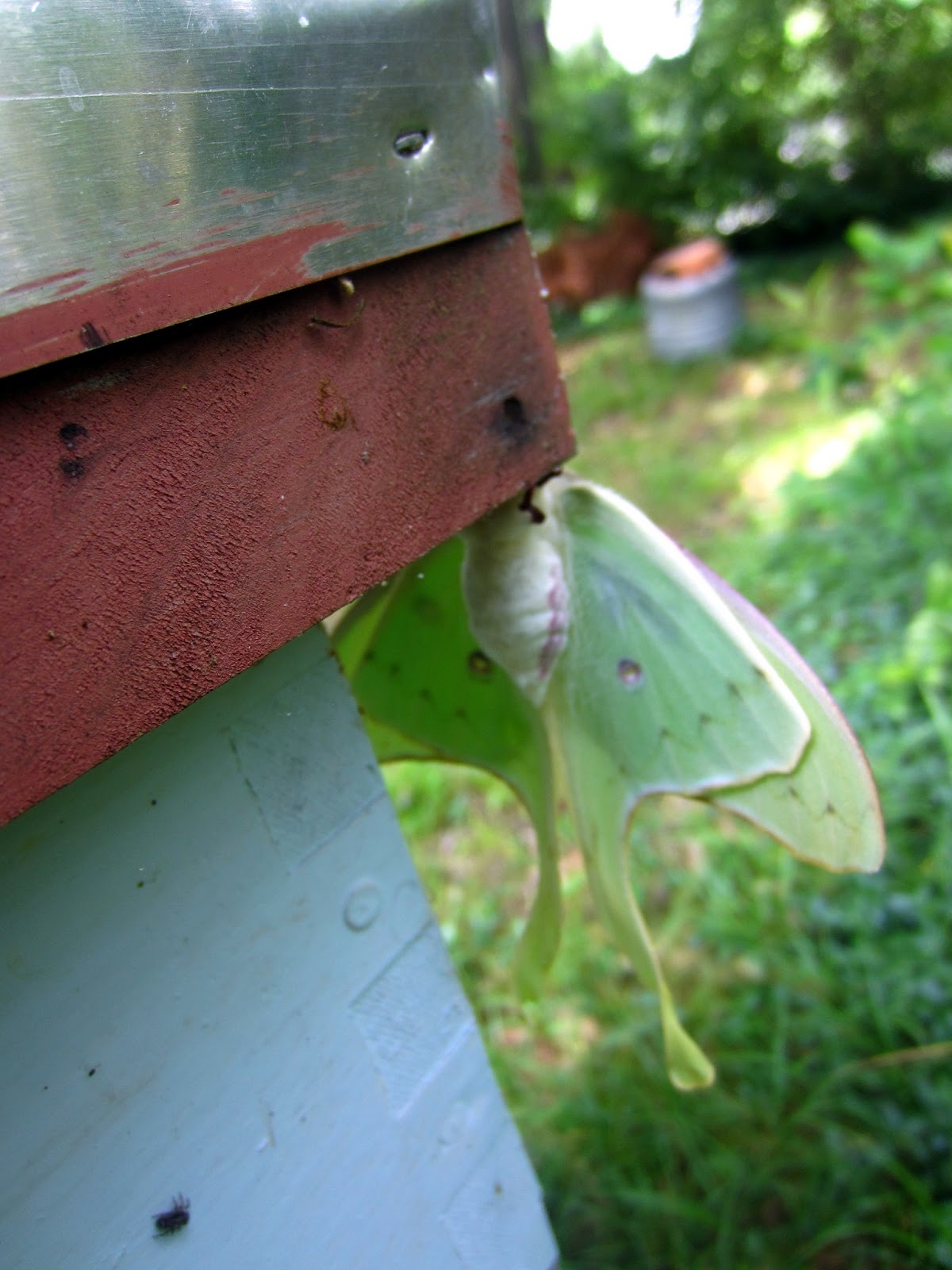
Before I walked away I glanced at the hive box (no bees in it) next to the Mississippi Queen hive. There on the side of the hive was a newly hatched luna moth. So GORGEOUS. She probably had her cocoon on the side of the hive just under the top cover. They have to dry for two hours before they can fly. Here she is in her regal glory:

Friday, May 10, 2013
Dave Tarpy on Good Queens
At Young Harris this morning I heard a talk by Dave Tarpy on how good queens = good colonies. A study by Dennis vonEngelsdorp found that of hive deaths over the winter, 31% of the deaths were attributed to poor queens.
 Dave Tarpy is on the left, Tom Seeley on the right (weren't we lucky to hear both of them!)
Tarpy pointed out that the queen serves many more functions in the hive than simply being a good egg laying machine. When the queen is a virgin, her QMP (queen mandibular pheromone) is low but after mating her QMP is high and stays high during her lifetime. Her emission of this pheromone does many things for the hive.

Tarpy pointed out that the queen serves many more functions in the hive than simply being a good egg laying machine. When the queen is a virgin, her QMP (queen mandibular pheromone) is low but after mating her QMP is high and stays high during her lifetime. Her emission of this pheromone does many things for the hive.
- The presence of QMP in the hive suppresses laying worker tendencies
- Workers are instantly attracted to QMP and want to touch the queen and disperse the QMP throughout the hive
- QMP is a great attractor for drones - drones even have a special segment on their antennae just for smelling QMP
- QMP includes 9-ODA as well as 9-HDA. The 9-HDA is needed to encourage the clustering of a swarm when the hive swarms
- The queen also has a footprint pheromone which is emitted with each footfall. This pheromone inhibits queen cell production. The queen spreads this herself as she walks throughout the hive
- If laying worker eggs are present, QMP influences the workers to cannibalize those worker-laid eggs.
It's crucial in the life of a hive that the hive have a really good queen. In the hives we run where we let the hives requeen themselves, there is a possibility that the bees will not make a good queen. I've always heard this but never understood why until today.
If the hive is queenless and desperate for a queen, then the beekeeper gives them a frame of brood and eggs to help them make a queen. The pheromone emitted by the eggs and young larvae is helpful in making the bees react as if they have a queen. But they are still desperate for a new queen as quickly as possible.
In the general development of a queen, the bees feed the egg and larvae only royal jelly until the cell is capped. If the egg is to be a worker, then after the third day, the bees feed the larvae bee bread and other things - not just royal jelly. With their goal being to replace the queen as quickly as possible, they may very well pick an egg or larvae that is older than 3 days and start feeding it royal jelly. In the interim, it may have had a couple of days of being fed like a worker, meaning that it has a lesser quality developmental start and will be less of a great queen.
Not only that, but a queen cell made from a four or five day larvae is going to emerge in 11 or 12 days rather than 16 (as in a one day egg). The bees may pick for speed of emergence rather than quality so that they get the new queen sooner than later. The newly emerged less-than queen will then kill the other queens in their cells and you the beekeeper are stuck with a less than wonderful queen.
To prevent this Dave says to check the hive five days after installing the brood and egg frame. If you find any capped queen cell at that time, remove that cell, leaving any still uncapped queen cells which were of course started with younger larvae and thus more likely to be successful queens.
That last paragraph was worth going to the conference to learn - thanks, Dave Tarpy.
Monday, May 06, 2013
Drone Layer Hive
Yesterday we had about a 2 hour break of sunshine and blue sky - followed, of course, by grey sky, clouds and, you guessed it, more rain. It's raining now.
It was like the eye of the storm that I remember from hurricanes, growing up on the Mississippi river. We would take a breath during the eye as it passed over, but the hurricane would start again. I know it dates me, but the one I really remember was Hurricane Audrey in 1957. I remember the eye because of the startling contrast to what was going on just minutes before - I was little and this fierce weather really scared me. Hurricanes would devastate south Louisiana and then would come up the river to Natchez, MS where I lived. By then they would be weakened and still wreaked havoc.
In our small calm of sunny weather, I opened the split to see if the new queen were laying and I opened the drone layer hive to see if their new queen had succeeded. The split was doing great and had wall to wall cells of eggs and tiny c-shaped larvae.
The split was made on April 13, so the queen should have emerged around the 29th. So checking on the 5th might have been pushing it. We've had bad weather and I was concerned she might not have been able to go on a mating flight but she had and was working hard.
In the drone layer colony, I didn't find a laying queen. I did find a queen cell on the frame I had given them that had been ripped open from the side, indicating that a queen had emerged, and I found a queen cell opened appropriately at the tip. The last frame of brood and eggs I gave them was on April 15. Doing the math, at the longest, the queen should have emerged on May 1 and this was just May 5. We've had terrible weather for most of those days. So either she hasn't mated; she was lost in a storm; she has mated but hadn't started laying.

So as a panacea, as per Michael Bush, I took a frame of brood and eggs out of the Patty swarm hive and gave it to the drone layers.
I'm leaving for Young Harris on Thursday and this way they'll have a chance if they need it.
I'm stopping by Chastain tomorrow and taking a frame of brood and eggs out of our nuc there to put in the Don Kuchenmeister drone laying hive tomorrow if I have enough time.
It was like the eye of the storm that I remember from hurricanes, growing up on the Mississippi river. We would take a breath during the eye as it passed over, but the hurricane would start again. I know it dates me, but the one I really remember was Hurricane Audrey in 1957. I remember the eye because of the startling contrast to what was going on just minutes before - I was little and this fierce weather really scared me. Hurricanes would devastate south Louisiana and then would come up the river to Natchez, MS where I lived. By then they would be weakened and still wreaked havoc.
In our small calm of sunny weather, I opened the split to see if the new queen were laying and I opened the drone layer hive to see if their new queen had succeeded. The split was doing great and had wall to wall cells of eggs and tiny c-shaped larvae.
The split was made on April 13, so the queen should have emerged around the 29th. So checking on the 5th might have been pushing it. We've had bad weather and I was concerned she might not have been able to go on a mating flight but she had and was working hard.
In the drone layer colony, I didn't find a laying queen. I did find a queen cell on the frame I had given them that had been ripped open from the side, indicating that a queen had emerged, and I found a queen cell opened appropriately at the tip. The last frame of brood and eggs I gave them was on April 15. Doing the math, at the longest, the queen should have emerged on May 1 and this was just May 5. We've had terrible weather for most of those days. So either she hasn't mated; she was lost in a storm; she has mated but hadn't started laying.

So as a panacea, as per Michael Bush, I took a frame of brood and eggs out of the Patty swarm hive and gave it to the drone layers.
I'm leaving for Young Harris on Thursday and this way they'll have a chance if they need it.
I'm stopping by Chastain tomorrow and taking a frame of brood and eggs out of our nuc there to put in the Don Kuchenmeister drone laying hive tomorrow if I have enough time.
Saturday, April 27, 2013
Hope and the Honey Bee
This bee season I have learned something about hope and the honey bee through having two drone laying queens. The first drone layer was in a hive I purchased as a nuc last year whose queen was obviously not mated well enough to last beyond one year. The second drone layer was the package I bought from Don Kuchenmeister this year whose queen wasn't mated or was barely mated. She was never released (she wasn't sending out queen pheromone so the bees weren't interested) and when she was directly released, only laid drones.
In each hive I followed the standard recommendation that I put a frame of brood and eggs into the hive weekly until they successfully requeened themselves.
It may be unfair to attribute hope to the honey bee. After all, they are incredibly efficient creatures. Every bee has a job to do every day. When a different need arises, she moves to the next job. Each job she takes prepares her for the next until she becomes a forager and wears herself out (and dies) in the service of perpetuating the life of the hive as an organism.
For the honey bee, it is inefficient to use the resources of the hive taking care of drone brood once enough drones have been raised by the hive to contribute to the general environmental needs for mating with a queen in the general drone congregation area.
In The Wisdom of the Hive by Tom Seeley, he says that "the pheromones that provide the proximate stimulus for workers to refrain from laying eggs come mainly from the brood, not from the queen."(reviewed in Seeley 1985; see also Willis, Winston, and Slessor 1990).
So giving the hive a frame of brood and eggs brings a pheromone into the hive emitted from the brood that helps the hive know that there is the possibility of a queen or at least the perpetuation of the hive through new workers - even if there is not a current queen or if there is a queen that they don't like. In both of my drone laying hives, shortly after the first frame of brood and eggs was added to the hive, they began casting out the drone brood, ripping them out of their cells and throwing them in front of the hive for the birds to eat.
Here's what it looked like in my backyard. And here's what Noah and Julia photographed on a visit about a week after April 16 when I gave the Chastain drone-layer hive a frame of brood and eggs.
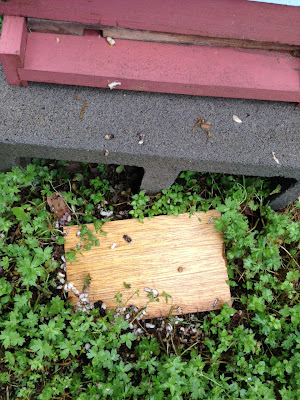
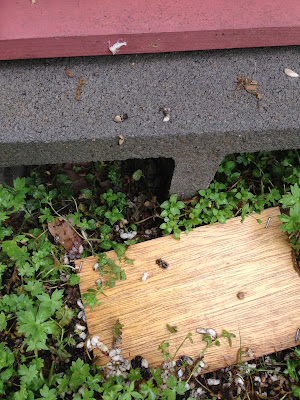
At the point of these photos both in my home apiary and at Chastain, each hive had either killed the drone-layer or appeared to be planning to cast her out. The drone laying hive at my house had chewed off the wings of the drone laying queen in preparation for pushing her out of the hive. With the frame of brood and eggs, they know a good queen is now possible even though neither hive made a queen cell from the first frame of brood and eggs given to them.
Today at Chastain, there was some capped worker brood from the frame of brood and eggs that I gave them on the 16th. That brood will probably emerge in three or four days to help the hive, but they did not make a queen cell from those eggs. I had to transport the frame for 30 minutes. I put it in a nuc box but didn't really have an appropriate way to keep it warm and probably none of the eggs were good enough when they were finally in the hive about 45 minutes after they were removed from their home hive.
In my hive at home with the third added frame of brood and eggs, they now have four or five queen cells on the frame I most recently added and are probably now home free (assuming the emerging queen survives her mating flight). The hive at Chastain today got a good frame and I'll give them another next week and the next, if that is what it takes.
Michael Bush says it takes several weeks of weekly addition to make it work. He is a great fan of adding brood and eggs. Here's what he says:
I've now added brood and eggs several times to these hives - twice to the Chastain hive and three times to my hive at home.
I love thinking that they are hopeful for their future and trust that they will be able to make a functioning queen.
Despite that romantic thought, in fact what probably is happening is that they recognize that there is healthy brood now and they need enough energy to manage the healthy brood well, so to that end they get rid of the energy sucking drone brood that is way more than they need.
But I like the sentimental thinking better.
.JPG)
In each hive I followed the standard recommendation that I put a frame of brood and eggs into the hive weekly until they successfully requeened themselves.
It may be unfair to attribute hope to the honey bee. After all, they are incredibly efficient creatures. Every bee has a job to do every day. When a different need arises, she moves to the next job. Each job she takes prepares her for the next until she becomes a forager and wears herself out (and dies) in the service of perpetuating the life of the hive as an organism.
For the honey bee, it is inefficient to use the resources of the hive taking care of drone brood once enough drones have been raised by the hive to contribute to the general environmental needs for mating with a queen in the general drone congregation area.
In The Wisdom of the Hive by Tom Seeley, he says that "the pheromones that provide the proximate stimulus for workers to refrain from laying eggs come mainly from the brood, not from the queen."(reviewed in Seeley 1985; see also Willis, Winston, and Slessor 1990).
So giving the hive a frame of brood and eggs brings a pheromone into the hive emitted from the brood that helps the hive know that there is the possibility of a queen or at least the perpetuation of the hive through new workers - even if there is not a current queen or if there is a queen that they don't like. In both of my drone laying hives, shortly after the first frame of brood and eggs was added to the hive, they began casting out the drone brood, ripping them out of their cells and throwing them in front of the hive for the birds to eat.
Here's what it looked like in my backyard. And here's what Noah and Julia photographed on a visit about a week after April 16 when I gave the Chastain drone-layer hive a frame of brood and eggs.

Look at all the dead drones in the grass at the front of the hive at Chastain!

At the point of these photos both in my home apiary and at Chastain, each hive had either killed the drone-layer or appeared to be planning to cast her out. The drone laying hive at my house had chewed off the wings of the drone laying queen in preparation for pushing her out of the hive. With the frame of brood and eggs, they know a good queen is now possible even though neither hive made a queen cell from the first frame of brood and eggs given to them.
Today at Chastain, there was some capped worker brood from the frame of brood and eggs that I gave them on the 16th. That brood will probably emerge in three or four days to help the hive, but they did not make a queen cell from those eggs. I had to transport the frame for 30 minutes. I put it in a nuc box but didn't really have an appropriate way to keep it warm and probably none of the eggs were good enough when they were finally in the hive about 45 minutes after they were removed from their home hive.
In my hive at home with the third added frame of brood and eggs, they now have four or five queen cells on the frame I most recently added and are probably now home free (assuming the emerging queen survives her mating flight). The hive at Chastain today got a good frame and I'll give them another next week and the next, if that is what it takes.
Michael Bush says it takes several weeks of weekly addition to make it work. He is a great fan of adding brood and eggs. Here's what he says:
"There are few solutions as universal in their application and their success than adding a frame of open brood every week for three weeks. It is a virtual panacea for any queen issues. It gives the bees the pheromones to suppress laying workers. It gives them more workers coming in during a period where there is no laying queen. It does not interfere if there is a virgin queen. It gives them the resources to rear a queen. It is virtually foolproof and does not require finding a queen or seeing eggs. If you have any issue with queenrightness, no brood, worried that there is no queen, this is the simple solution that requires no worrying, no waiting, no hoping. You just give them what they need to resolve the situation. If you have any doubts about the queenrightness of a hive, give them some open brood and sleep well. Repeat once a week for two more weeks if you still aren't sure. By then things will be fine.
If you are afraid of transferring the queen from the queenright hive, because you are not good at finding queens, then shake or brush all the bees off before you give it to them.
If you are concerned about taking eggs from another new package or small colony, keep in mind that bees have little invested in eggs and the queen can lay far more eggs than a small colony can warm, feed and raise. Taking a frame of eggs from a small struggling new hive and swapping it for an empty comb or any drawn comb will have little impact on the donor colony and may save the recipient if they are indeed queenless. If the recipient didn't need a queen it will fill in the gap while the new queen gets mated and not interfere with things."
I've now added brood and eggs several times to these hives - twice to the Chastain hive and three times to my hive at home.
I love thinking that they are hopeful for their future and trust that they will be able to make a functioning queen.
Despite that romantic thought, in fact what probably is happening is that they recognize that there is healthy brood now and they need enough energy to manage the healthy brood well, so to that end they get rid of the energy sucking drone brood that is way more than they need.
But I like the sentimental thinking better.
.JPG)
Monday, April 22, 2013
News from Drone Layer Queen
The bees are rid of the queen. I've added weekly a frame of brood and eggs for the past three weeks.
Today I saw queen cells - at least FOUR of them - on a frame of brood and eggs I left them last week. The best looking one is below. The second photo is blurry but there is another queen cell. I saw two others - all on this same frame from the nuc Julia gave me the queen cell to use to start it.
Michael Bush says that with a drone layer, you need to give them brood and eggs three times and then they will probably make a successful queen. I hope this time, they get a good one.
I'm so glad I got to see this process so close up - watched them remove the drone brood in a good housecleaning; saw the old queen with her wings chewed almost off; now see they are making a queen cell. From just watching the front of the hive, you'd have no idea this was going on!
The brood you see is capped brood from the frame of eggs I gave them last week. It was a good testament to why a beekeeper should have a nuc or two going all the time. I took a frame out of a nuc. It was two large tear drops of newly drawn wax, covering about 2/3 of the frame. Almost every cell had an egg in it. There was no honey or capped brood.
These bees managed to make four queen cells from the eggs. So by the middle of May the hive should be queenright again.
They are not missing the nectar flow which is currently going. They have really been storing up honey.
Note: Each time I have opened this hive, I've had to squash at least 30 small hive beetles. Today I only saw five small hive beetles the whole time I was fooling around with the hive. I need to order nematodes which I have not done yet.
Today I saw queen cells - at least FOUR of them - on a frame of brood and eggs I left them last week. The best looking one is below. The second photo is blurry but there is another queen cell. I saw two others - all on this same frame from the nuc Julia gave me the queen cell to use to start it.


Michael Bush says that with a drone layer, you need to give them brood and eggs three times and then they will probably make a successful queen. I hope this time, they get a good one.
I'm so glad I got to see this process so close up - watched them remove the drone brood in a good housecleaning; saw the old queen with her wings chewed almost off; now see they are making a queen cell. From just watching the front of the hive, you'd have no idea this was going on!
The brood you see is capped brood from the frame of eggs I gave them last week. It was a good testament to why a beekeeper should have a nuc or two going all the time. I took a frame out of a nuc. It was two large tear drops of newly drawn wax, covering about 2/3 of the frame. Almost every cell had an egg in it. There was no honey or capped brood.
These bees managed to make four queen cells from the eggs. So by the middle of May the hive should be queenright again.
They are not missing the nectar flow which is currently going. They have really been storing up honey.
Note: Each time I have opened this hive, I've had to squash at least 30 small hive beetles. Today I only saw five small hive beetles the whole time I was fooling around with the hive. I need to order nematodes which I have not done yet.
Saturday, April 06, 2013
Follow-up on the Queenless Half of the Even Split
Today my grandkids and I stopped by Ron's house to see how the two queenless hives were doing. Colony Square had a queen cell when we moved it, so now three weeks later, the queen should have emerged, mated, and started laying. The other hive at Ron's is the queenless half of Lenox Pointe. (The half with the queen went to Sebastian's house.)
I only had fifteen minutes, grandkids and Hannah, my dog, with me so I couldn't do an inspection. I went and observed both hives and took the top off of both hives but didn't take out any frames.

The hive on the left is Colony Square - you'll remember it as my most productive hive. It's three years old and was moved from my old house. When we moved it, we planned to split it but there was absolutely no brood as if the hive had swarmed or had some other problem. We did find a queen cell - several of them - in the yellow box, so we moved the hive as a whole without splitting it. The hive on the right is the queenless half of the even split of Lenox Pointe. Both hives had bees flying in and out of them.
I didn't even take the time to light the smoker since I was not planning to pull any frames. I took off the telescoping top and found what I found in both hives: earwigs under the cover.

I lifted the inner cover of Colony Square and found that, true to form for this hive even in a new location, the top box had evidence of new wax (look at the second frame)
and appeared to be full. So I added a new box. The nectar flow is beginning and I don't want to dampen their enthusiasm for making honey.


I peeked into Lenox Pointe as well, but saw limited numbers of bees and it was clear that they had not used the top box at all. There were less bees flying in and out as well, as you might expect from a queenless hive as its population dwindles, awaiting the emergence of a new queen. If I had had my smoker and time, I would want to look into this hive although for a queenless hive, it's really about a week too early to look in and see if there's a queen evident yet.


Both hives had bees bringing in pollen. Since pollen is used for bee bread to feed larvae, it is often seen as evidence that the queen is laying, but I'm not sure of that in the second hive.
Next week I'll take the time to open Lenox Pointe and see if there's evidence that a queen emerged and is mated. And when I do come to see this hive, I'll bring a frame of brood and eggs from one of my hives at home - perhaps the newly installed package - to add to this hive just in case.
I only had fifteen minutes, grandkids and Hannah, my dog, with me so I couldn't do an inspection. I went and observed both hives and took the top off of both hives but didn't take out any frames.

The hive on the left is Colony Square - you'll remember it as my most productive hive. It's three years old and was moved from my old house. When we moved it, we planned to split it but there was absolutely no brood as if the hive had swarmed or had some other problem. We did find a queen cell - several of them - in the yellow box, so we moved the hive as a whole without splitting it. The hive on the right is the queenless half of the even split of Lenox Pointe. Both hives had bees flying in and out of them.
I didn't even take the time to light the smoker since I was not planning to pull any frames. I took off the telescoping top and found what I found in both hives: earwigs under the cover.

I lifted the inner cover of Colony Square and found that, true to form for this hive even in a new location, the top box had evidence of new wax (look at the second frame)
and appeared to be full. So I added a new box. The nectar flow is beginning and I don't want to dampen their enthusiasm for making honey.


I peeked into Lenox Pointe as well, but saw limited numbers of bees and it was clear that they had not used the top box at all. There were less bees flying in and out as well, as you might expect from a queenless hive as its population dwindles, awaiting the emergence of a new queen. If I had had my smoker and time, I would want to look into this hive although for a queenless hive, it's really about a week too early to look in and see if there's a queen evident yet.


Both hives had bees bringing in pollen. Since pollen is used for bee bread to feed larvae, it is often seen as evidence that the queen is laying, but I'm not sure of that in the second hive.
Next week I'll take the time to open Lenox Pointe and see if there's evidence that a queen emerged and is mated. And when I do come to see this hive, I'll bring a frame of brood and eggs from one of my hives at home - perhaps the newly installed package - to add to this hive just in case.
Monday, April 01, 2013
The Impending Death of a Queen
This morning it's finally both warm and I'm in town AND I am off on Monday mornings, so Hive Inspection time. I was very anxious to get into the drone layer hive and see what's going on.
I got out to the backyard to find that the bees in the Drone Layer hive were carrying out the bodies of drones, ripped out of their cells:

So now I'm thinking something is going on and the drones are either ill or perhaps they have a new hygienic queen.
I wanted to open the hive, but when I took the top off, I found a ton of hive beetles. Those of you who have heard/seen my hive inspection talk/slideshow (on right sidebar under Pages), know that my cure for the small hive beetle is SMASH THEM WITH YOUR HIVE TOOL. So that's what I did. The first photo shows the shiny little !!#$!@#$ and the second shows the smashed dead bodies.


But then I opened the hive. I started in the bottom box where there was pollen stored but no brood. The last time I was in the hive, I saw (or thought I saw) eggs in the bottom box. I worked my way up.
In the second box, I found the old queen. She had a yellow dot on her thorax which means she is the original queen from the hive that was purchased as a nuc last year. The yellow dot means she is a 2012 queen (yellow is the color for years ending in a "2") - the drone cells mean that she was indeed "short bred" and did not get mated well enough to justify selling her with the nuc that I bought.
The bees do not like her and are setting her up for her impending death. I'm putting up several photos of her so you can see that they have chewed her wings. I think they are about to push her out of the hive and with her wings destroyed, she will die. I don't think they would do this or pull out the drone brood if they didn't have a new queen.


There was no brood in the hive. But I found an opened queen cell, probably made from the frame that I put in the hive from Morningside. So I think they have a new queen who is either out getting mated or is back from getting mated and isn't quite ready to start laying.

Since there was no worker brood, just for safety's sake, about 30 minutes after I closed up the hive the first time, I opened it up again and I added another frame of eggs into the hive from Morningside .
I think this hive feels hopeful as a group. There hasn't been a good queen for quite a while but there were still a ton of workers in the hive as well as drones.
I got out to the backyard to find that the bees in the Drone Layer hive were carrying out the bodies of drones, ripped out of their cells:

So now I'm thinking something is going on and the drones are either ill or perhaps they have a new hygienic queen.
I wanted to open the hive, but when I took the top off, I found a ton of hive beetles. Those of you who have heard/seen my hive inspection talk/slideshow (on right sidebar under Pages), know that my cure for the small hive beetle is SMASH THEM WITH YOUR HIVE TOOL. So that's what I did. The first photo shows the shiny little !!#$!@#$ and the second shows the smashed dead bodies.


But then I opened the hive. I started in the bottom box where there was pollen stored but no brood. The last time I was in the hive, I saw (or thought I saw) eggs in the bottom box. I worked my way up.
In the second box, I found the old queen. She had a yellow dot on her thorax which means she is the original queen from the hive that was purchased as a nuc last year. The yellow dot means she is a 2012 queen (yellow is the color for years ending in a "2") - the drone cells mean that she was indeed "short bred" and did not get mated well enough to justify selling her with the nuc that I bought.
The bees do not like her and are setting her up for her impending death. I'm putting up several photos of her so you can see that they have chewed her wings. I think they are about to push her out of the hive and with her wings destroyed, she will die. I don't think they would do this or pull out the drone brood if they didn't have a new queen.


I know it's a lot of photos, but I thought this was fascinating....the impending murder of the queen....and it's by slow torture. First they chew the wings, then they will cast her out to die in the elements - and she has been taken care of all her life. What thanks does she get???
There was no brood in the hive. But I found an opened queen cell, probably made from the frame that I put in the hive from Morningside. So I think they have a new queen who is either out getting mated or is back from getting mated and isn't quite ready to start laying.

Since there was no worker brood, just for safety's sake, about 30 minutes after I closed up the hive the first time, I opened it up again and I added another frame of eggs into the hive from Morningside .
I think this hive feels hopeful as a group. There hasn't been a good queen for quite a while but there were still a ton of workers in the hive as well as drones.
Sunday, February 24, 2013
First Hive Openings of 2013
Today I came home from a mountain site visit for a professional conference, immediately donned my bee gear and headed for the bee hives. We've had such rain in Atlanta and finally today was sunny and a temperature when I could open the hives. It was a mixed experience.

In my own backyard, I opened the first hive which was small going into winter. It was housed in two boxes but really only needed one. There was still a little honey on the hive.

This is a small group of bees but the queen is laying. At first I only found spotty brood so she may have some problems. I did find further frames with more solid brood on them, though.
I decided to treat this hive more like a nuc and left it in a single box. I'll check next week and maybe either combine it with another or give it more resources from another hive.
Originally my plan was to give this hive some frames of brood and eggs from the very strong hive next to it (the only other hive in my own yard).
I opened the hive next to it and found it boiling over with bees:

When I looked through the hive, I found it to be full of honey and I found frames where they are obviously bringing in new nectar (I saw this in several hives today). I don't know where they are getting it at this February date, but they are finding nectar somewhere.
But then my heart sank when I pulled the first frame with brood on it. Only drone brood and tons of it - three frames that looked like this:


I looked through the entire hive and did not find ANY worker brood. This probably means the queen who was new last year was probably "short-bred" to use a Keith Fielder term. That means that she didn't get enough mating before she was placed in the nuc and thus couldn't make more worker brood.
Queens need to fly out several times sometimes to get fully mated or when they are in the air, they need to mate with up to 17 or so drones. This one may not have gotten that opportunity.
The bees are everywhere in this hive. I don't know how to make sense of this unless 21 days ago, her sperm ran out. It's also possible that I couldn't see eggs in other frames since it was about 4:00 and the sun was not in a position to allow me to get a good view, but this was my strongest looking hive at this point, so I was really upset by what I found.
Originally I had planned to take a frame of what I thought would be plentiful brood and eggs from this hive to put in the small hive next door, but that was not to be.

Then I went to Sebastian's house where I found a lovely surprise. This hive was doing well. I didn't spend a lot of time in the hive because as soon as I knew it was OK, my instinct was to close it up. I saw the queen and was happy. She still had her yellow paint dot, though quite worn, on her thorax.
As you can see, this frame is full of nectar. I was so pleased to see this.
I left Sebastian's and rushed down Piedmont to the Stonehurst Place Inn to check on those hives.
There are three hives there, although one box is empty and has been since right before harvest when the largest hive was robbed out and died. I left one box there as a swarm lure. The two that are left include one strong hive and one that doesn't look too great.
I opened up the weak one first. I found only two deep frames of bees (these hives were purchased nucs last year). The hive appeared queenless. Oddly there was a full super of honey on the top and more honey in the second box although it wasn't full. The bottom box was full of equal amounts of hive beetles and bees. (Odd that the beetles weren't in the honey). The bees looked pitiful. The brood I didn't get pictures of, but it was scattered and looked old. I think the hive is queenless. I took a frame of brood and eggs from the stronger hive and put it into this hive to give them a chance to make a queen, but I really have my doubts.
The strong hive looked great. Good brood, lots of it and frames of pollen and nectar. This hive is a keeper. I took a frame of honey out of the weak hive to put in a frame of brood and eggs from the strong hive. Since I don't know if those bees are just weak from queenlessness or because they are ill, I brought the honey home rather than giving it to another hive. I replaced the empty space with a drawn comb.

Last but definitely not least I went to the Morningside Garden hives. There is one hive that is dead there. I did an autopsy on it and found absolutely no bees in the hive. There were dead bees on the screened bottom board - I believe they went queenless into winter and died in the first cold snap. Clearly they didn't starve. I took the hive apart and left one box on the hive stand as a swarm lure.


Then I opened the live hive and found the best hive of the day. This hive was thriving. Under the cover, I found lots of ants and of all things, ladybugs. Julia told me she found ladybugs in one of her hives. This is a first for me in eight years.
But inside the hive were frames and frames of beautiful brood patterns. I didn't see any swarm cells but I didn't look into the bottom box. By the time I got here the sun was setting and I had my answer - the hive was doing well.

BTW, I worked on six hives today, lit my smoker and left it at the hive entry, wore no gloves, moved very slowly and did not get stung once even though these bees have not been disturbed all winter. One of the best parts of wearing no gloves is I could really feel the heat of the hives. In summer, Atlanta deserves its moniker: Hotlanta and there is no difference between the outside air temp and the temp inside the hive. But today it was 60 outside but 90 in the hive around the bees and I could really feel it by going gloveless.
I also didn't brush off any bees. If a bee landed on my hands, as many did, I continued to move slowly and trusted that they weren't after me but rather were landing on my hand because it was there. I loved the way it all felt.
So I still need to visit the hives at Timber Trail. I hope the two there are doing better than some of the ones I observed today. I have time tomorrow, but I think the weather is going to be cold and not good for opening the hives.

In my own backyard, I opened the first hive which was small going into winter. It was housed in two boxes but really only needed one. There was still a little honey on the hive.

This is a small group of bees but the queen is laying. At first I only found spotty brood so she may have some problems. I did find further frames with more solid brood on them, though.
I decided to treat this hive more like a nuc and left it in a single box. I'll check next week and maybe either combine it with another or give it more resources from another hive.
Originally my plan was to give this hive some frames of brood and eggs from the very strong hive next to it (the only other hive in my own yard).
I opened the hive next to it and found it boiling over with bees:

When I looked through the hive, I found it to be full of honey and I found frames where they are obviously bringing in new nectar (I saw this in several hives today). I don't know where they are getting it at this February date, but they are finding nectar somewhere.
But then my heart sank when I pulled the first frame with brood on it. Only drone brood and tons of it - three frames that looked like this:


I looked through the entire hive and did not find ANY worker brood. This probably means the queen who was new last year was probably "short-bred" to use a Keith Fielder term. That means that she didn't get enough mating before she was placed in the nuc and thus couldn't make more worker brood.
Queens need to fly out several times sometimes to get fully mated or when they are in the air, they need to mate with up to 17 or so drones. This one may not have gotten that opportunity.
The bees are everywhere in this hive. I don't know how to make sense of this unless 21 days ago, her sperm ran out. It's also possible that I couldn't see eggs in other frames since it was about 4:00 and the sun was not in a position to allow me to get a good view, but this was my strongest looking hive at this point, so I was really upset by what I found.
Originally I had planned to take a frame of what I thought would be plentiful brood and eggs from this hive to put in the small hive next door, but that was not to be.

Then I went to Sebastian's house where I found a lovely surprise. This hive was doing well. I didn't spend a lot of time in the hive because as soon as I knew it was OK, my instinct was to close it up. I saw the queen and was happy. She still had her yellow paint dot, though quite worn, on her thorax.
As you can see, this frame is full of nectar. I was so pleased to see this.
I left Sebastian's and rushed down Piedmont to the Stonehurst Place Inn to check on those hives.
There are three hives there, although one box is empty and has been since right before harvest when the largest hive was robbed out and died. I left one box there as a swarm lure. The two that are left include one strong hive and one that doesn't look too great.
I opened up the weak one first. I found only two deep frames of bees (these hives were purchased nucs last year). The hive appeared queenless. Oddly there was a full super of honey on the top and more honey in the second box although it wasn't full. The bottom box was full of equal amounts of hive beetles and bees. (Odd that the beetles weren't in the honey). The bees looked pitiful. The brood I didn't get pictures of, but it was scattered and looked old. I think the hive is queenless. I took a frame of brood and eggs from the stronger hive and put it into this hive to give them a chance to make a queen, but I really have my doubts.
The strong hive looked great. Good brood, lots of it and frames of pollen and nectar. This hive is a keeper. I took a frame of honey out of the weak hive to put in a frame of brood and eggs from the strong hive. Since I don't know if those bees are just weak from queenlessness or because they are ill, I brought the honey home rather than giving it to another hive. I replaced the empty space with a drawn comb.

Last but definitely not least I went to the Morningside Garden hives. There is one hive that is dead there. I did an autopsy on it and found absolutely no bees in the hive. There were dead bees on the screened bottom board - I believe they went queenless into winter and died in the first cold snap. Clearly they didn't starve. I took the hive apart and left one box on the hive stand as a swarm lure.


Then I opened the live hive and found the best hive of the day. This hive was thriving. Under the cover, I found lots of ants and of all things, ladybugs. Julia told me she found ladybugs in one of her hives. This is a first for me in eight years.
But inside the hive were frames and frames of beautiful brood patterns. I didn't see any swarm cells but I didn't look into the bottom box. By the time I got here the sun was setting and I had my answer - the hive was doing well.

BTW, I worked on six hives today, lit my smoker and left it at the hive entry, wore no gloves, moved very slowly and did not get stung once even though these bees have not been disturbed all winter. One of the best parts of wearing no gloves is I could really feel the heat of the hives. In summer, Atlanta deserves its moniker: Hotlanta and there is no difference between the outside air temp and the temp inside the hive. But today it was 60 outside but 90 in the hive around the bees and I could really feel it by going gloveless.
I also didn't brush off any bees. If a bee landed on my hands, as many did, I continued to move slowly and trusted that they weren't after me but rather were landing on my hand because it was there. I loved the way it all felt.
So I still need to visit the hives at Timber Trail. I hope the two there are doing better than some of the ones I observed today. I have time tomorrow, but I think the weather is going to be cold and not good for opening the hives.
Wednesday, May 23, 2012
Hives at Jeff and Valerie's House
Jeff and I have thought that Colony Square is queenless. They have not stored much honey in a few weeks and we haven't seen brood/eggs. However, it's a rather vigorous hive and we haven't gone into the lower boxes. We decided this past Sunday to explore until we found evidence of a queen or lack of one.
The hive is one deep (this hive began as a Jennifer Berry nuc last year) and five medium boxes.

These hives are Jeff's responsibility, so I am just there to satisfy the question: is there a queen? He wanted to do the work (and the lifting, thankfully!)

We went down to box four where we found brood frames that only had a few scattered capped drone cells. There were many empty uncapped worker cells. This means that the queen last laid eggs more than three weeks ago. The drones, which take 24 days to emerge, would be the last capped cells left.
However, the hive was pretty calm and there was no queenless roar. More than likely they have already taken care of the problem and made a queen who either hasn't emerged, hasn't gone on her mating flight or hasn't started laying yet. We went all the way down to the deep box and didn't see capped brood other than drone cells.

We decided for insurance sake to add a couple of frames of brood and eggs to Colony Square to give them a way to make a queen if they are still in need. Although they have not collected much nectar in the past few weeks, there are three boxes on the hive for us to harvest - and the disruption of the brood cycle will be good for any varroa problems. It takes a hive 42 days to get back to full production when they make a queen.

We decided to go into Lenox Pointe to get frames of brood and eggs. We found lots of capped honey and some beautiful wax (see below).

In taking out the frames, some comb was opened. The bees below are trying to repair the damage as quickly as possible.

We found brood - but most of it was in honey frames so we decided to get our transfer frames from Five Alive - our most vigorous hive.
We opened Five and took two frames of brood and eggs and put them into Colony Square. We put CS back together.
Meanwhile, Five Alive which had eight medium boxes on it, was desperate for a new box. Jeff added the new box (the blue one) below the top box and we moved honey frames from the box below up to the new box to serve as a ladder.
The top box was completely full of capped honey. It took all his muscles to get the box onto the top of the now nine-box Five Alive hive! Jeff posed to show his muscles after the event!

The hive is now almost as tall as Jeff who is six feet! We must harvest from this hive. Our plan is to harvest on June 2 from Five Alive, weather permitting. This is my seventh year as a beekeeper and the best year ever as far as productivity is concerned.
FWIW, this hive began as a package from Don in Lula, Georgia; survived the move from the south Georgia farm almost exactly a year ago; and survived the winter, although there was only a tiny number of bees as February arrived this year. We actually thought it was dead (thus its name: Five Alive).


The hive is one deep (this hive began as a Jennifer Berry nuc last year) and five medium boxes.

These hives are Jeff's responsibility, so I am just there to satisfy the question: is there a queen? He wanted to do the work (and the lifting, thankfully!)

We went down to box four where we found brood frames that only had a few scattered capped drone cells. There were many empty uncapped worker cells. This means that the queen last laid eggs more than three weeks ago. The drones, which take 24 days to emerge, would be the last capped cells left.
However, the hive was pretty calm and there was no queenless roar. More than likely they have already taken care of the problem and made a queen who either hasn't emerged, hasn't gone on her mating flight or hasn't started laying yet. We went all the way down to the deep box and didn't see capped brood other than drone cells.

We decided for insurance sake to add a couple of frames of brood and eggs to Colony Square to give them a way to make a queen if they are still in need. Although they have not collected much nectar in the past few weeks, there are three boxes on the hive for us to harvest - and the disruption of the brood cycle will be good for any varroa problems. It takes a hive 42 days to get back to full production when they make a queen.

We decided to go into Lenox Pointe to get frames of brood and eggs. We found lots of capped honey and some beautiful wax (see below).

In taking out the frames, some comb was opened. The bees below are trying to repair the damage as quickly as possible.

We found brood - but most of it was in honey frames so we decided to get our transfer frames from Five Alive - our most vigorous hive.
We opened Five and took two frames of brood and eggs and put them into Colony Square. We put CS back together.
Meanwhile, Five Alive which had eight medium boxes on it, was desperate for a new box. Jeff added the new box (the blue one) below the top box and we moved honey frames from the box below up to the new box to serve as a ladder.
The top box was completely full of capped honey. It took all his muscles to get the box onto the top of the now nine-box Five Alive hive! Jeff posed to show his muscles after the event!

The hive is now almost as tall as Jeff who is six feet! We must harvest from this hive. Our plan is to harvest on June 2 from Five Alive, weather permitting. This is my seventh year as a beekeeper and the best year ever as far as productivity is concerned.
FWIW, this hive began as a package from Don in Lula, Georgia; survived the move from the south Georgia farm almost exactly a year ago; and survived the winter, although there was only a tiny number of bees as February arrived this year. We actually thought it was dead (thus its name: Five Alive).

Subscribe to:
Posts (Atom)
Pin this post

LinkWithin
