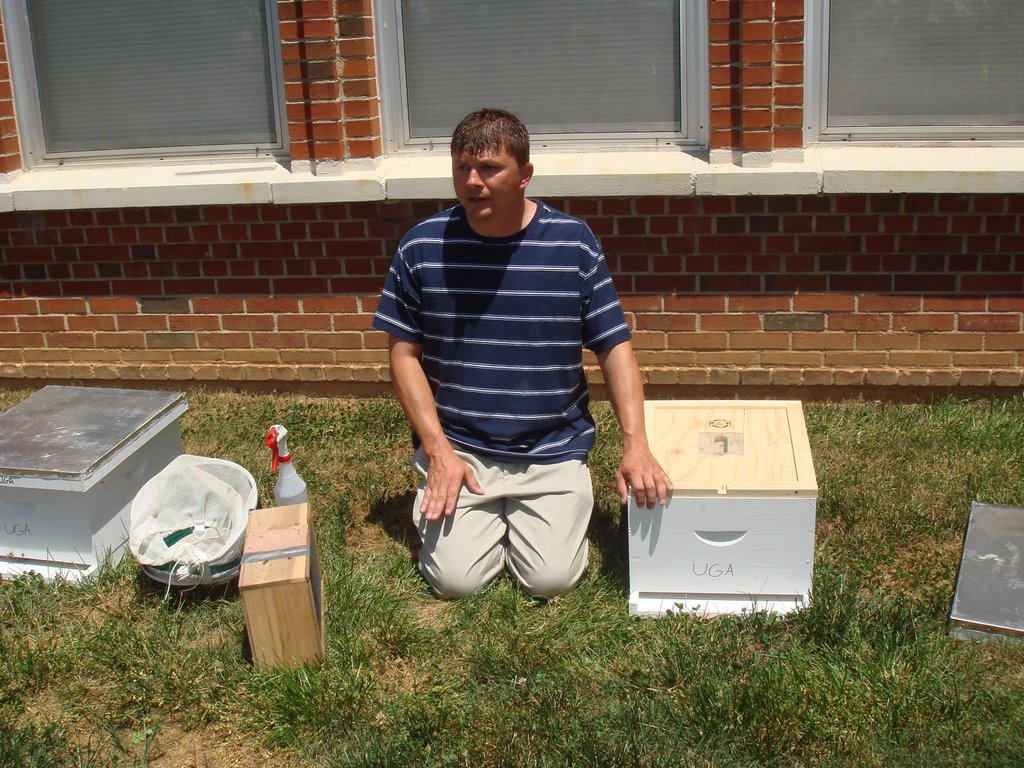
This is the tale that began in 2006 in my first year of beekeeping in Atlanta, GA. ...there's still so much to learn.
Welcome - Explore my Blog
I've been keeping this blog for all of my beekeeping years and I am beginning my 19th year of beekeeping in April 2024. Now there are more than 1300posts on this blog. Please use the search bar below to search the blog for other posts on a subject in which you are interested. You can also click on the "label" at the end of a post and all posts with that label will show up. At the very bottom of this page is a list of all the labels I've used.
Even if you find one post on the subject, I've posted a lot on basic beekeeping skills like installing bees, harvesting honey, inspecting the hive, etc. so be sure to search for more once you've found a topic of interest to you. And watch the useful videos and slide showson the sidebar. All of them have captions. Please share posts of interest via Facebook, Pinterest, etc.
I began this blog to chronicle my beekeeping experiences. I have read lots of beekeeping books, but nothing takes the place of either hands-on experience with an experienced beekeeper or good pictures of the process. I want people to have a clearer picture of what to expect in their beekeeping so I post pictures and write about my beekeeping saga here.Master Beekeeper Enjoy with me as I learn and grow as a beekeeper.
I didn't talk about this on this blog but I have been the president of the Georgia Beekeepers Association from September 2016 until September 2020. I loved the job and enjoyed giving as much as I could of my time and energy to the organization. I have been on the GBA conference committee since 2014, at least.
In September 2020 which was GBA's 100th anniversary, we had to hold our conference online. It was supposed to be our big birthday blowout. Instead we had what turned out to be a wonderful online conference. Jonathan Hayes, who did a lot of the technical parts of the meeting, and I as president wrote up how we achieved this successful conference and our article was published in American Bee Journal in this month's issue (December 2020). If you subscribe to the magazine, our article is on page 1333.
Since COVID does not make it possible for us to meet in person for our spring conference, we are again holding it on Zoom. That means that people from all over the country can register and participate. It's only $15 for GBA members and $20 for nonmembers. Our keynote speakers are Jay Evans, Jennifer Berry and Jack Rowe (just a coincidence that all of their names start with "J"!). We have great breakout as well.
In addition to coming to the conference on February 20, 2021, through the miracle of Zoom, we also will present all of the talks from the meeting online to registered participants for two weeks. Conceivably you could watch every single one of the eight breakouts and all of the six keynotes.
We have a wonderful conference committee: Gina Gallucci, Julia Mahood, Derrick Fowler, Marilynn Parker, Jonathan Hayes and me. Again we will all be planning the actual day and Jonathan and I will make it happen.
In September we had people from 22 states outside of Georgia as well as our large Georgia contingent. Come - you'll have a good time. We know how to make a Zoom meeting both fun AND educational! Here's where to register.
The Bee Informed Partnership is a resource for all beekeepers. They provide a lot of material that is educational and helpful to beekeepers. You can see what is available on their site by clicking here.
As you explore their site, you'll find lots of helpful information. They even offer a webinar series and all of the webinar recordings are on their site for you to watch and learn from great speakers.
To support the site, they are having an auction. There are about 48 items in the auction, including a cloth bag that I made!
To visit the auction and bid for something, click here.
The auction started today and ends on November 23, 2020.
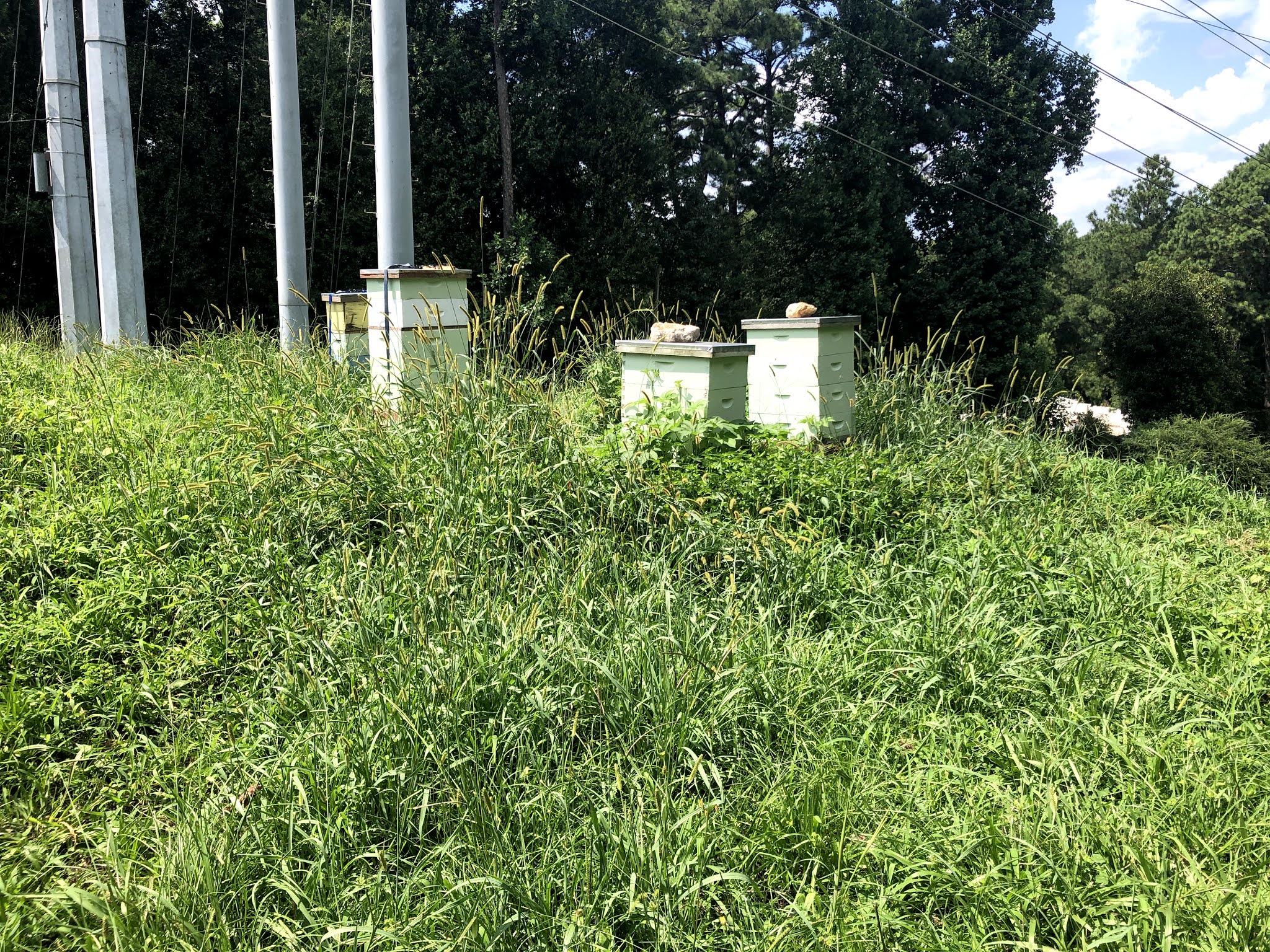
These hives are at a community garden. Like many community gardens in Atlanta, this one is under Georgia Power lines. The workfolk for Georgia Power don't come anywhere near the bees so the area around the community garden gets mowed, but not this place where the apiary is.
I had a weed whacker in the mountains and now I've hired a guy who is cutting my place up there, so I brought the week whacker home. It's battery powered and should be perfect for this hillside apiary. Small catch - I've only used it twice before today and I don't really understand it. Took me a few minutes to remember how to turn it on and in the middle of using it on this tall grass, the protector device came off. Luckily the screw was still hanging onto the device and I rescued it.
It looks a bit like the hives are drowning in the grass and you can't even see the entries except on the strapped hive which is the absconding hive which I've just moved here.
And here are the after shots:
The nuc hive where the bees came out to see what the heck was going on:
The absconding hive whose view of the hill is much better now:
The pesticide hive - again coming out to see what is going on. Also it was very hot, and they may have been out anyway - just hidden under the grass!:
Here are both of the original hives - the hive on the left was split about two weeks ago. I saw a bee flying in with pollen so maybe the queen is in this half of the split. I'm inspecting tomorrow so we'll see.
My weed whacking leaves a lot to be desired but in the process my cell phone fell out of my pocket somewhere in the cut grass. I spent about 30 minutes looking for it and finally found it (Whew!) but it did distract me from doing more with the weeds. And the protector had come off. I wasn't sure what it was protecting me from, but I didn't really want to find out the hard way.
I'm checking all of these hives tomorrow and it will be so much easier without the tall grass and kudzu.
I am cautiously optimistic. I walked to the community garden and this is what the hive looked like:
New hive facing away from the community garden in opposite direction of the nuc hive next to it.
The tall hive (tall because of the two medium boxes used to surround the Boardman feeders) is the absconding hive that I moved yesterday.
The bees were calmly flying in and out. I lifted the top and they were taking honey but there was plenty left in the largest jar. I think I am going to leave them alone until tomorrow and then consider adding a frame of brood and eggs. I hope they will stay and they looked like they were making this their home, but clearly I am not in the bees' heads, so tomorrow they may leave again.
In search of information about absconding, I went to my favorite source: Mark Winston's The Biology of the Honey Bee. I have had bees abscond before in my fifteen years of beekeeping. I had a colony, overrun by small hive beetles, with all of their honey slimed, abscond a few years ago. I had another colony abscond in the face of approaching forest fires in N. Georgia in 2016. I've had them leave for unknown reasons in 2013. Although in 2013, someone had been doing electrical work with a jack hammer just feet from the hive for several days in a row.
On two occasions, the one at my house yesterday and in 2013, I saw the bees making preparation to abscond, carrying out white larvae, and attributed it to their being hygienic about varroa.
But here's what Mark Winston says about it:
"Absconding can be defined as the abandoning of a nest by a colony which forms a swarm and presumably reestablishes itself elsewhere. Absconding swarms differ from reproductive swarms in that few or no workers and no adult or viable immature queens are left behind in the original colony. Absconding from feral nests is generally either disturbance induced or resource induced." (Winston, Mark, The Biology of the Honey Bee, p. 218)
Absconding is not the same as putting a swarm in a colony and having the entire swarm leave. For example, once I hived a swarm in a top bar hive with a screened bottom board. They left and gathered on the ground rather than be in that hive. I put them back in the hive and they left again. Then I put boards under the screened bottom board, closing out the space and light. This time they stayed. They were not involved in planning absconding.
Resource-induced absconding, according to Winston, happens during the dearth when nectar and other resources are scarce. We are in a dearth in Atlanta right now. When absconding happens because of a disturbance like the forest fire in the mountains in 2016, the bees don't prepare as well. So those bees left behind frames and frames of what turned out to be prize-winning honey. But for absconding like my bees were planning yesterday, lots of preparation is involved.
Winston says that sometimes for weeks ahead of time, bees prepare for absconding due to a resource shortage. They reduce brood-rearing about 25 days before they leave and "rear no new larvae in the 10 - 15 days preceding absconding." (Winston, p. 219) If the queen lays a few eggs during this time, the workers eat them. They appear to time their absconding to happen just after the last brood has emerged so the result is that they leave with lots of new, young bees to help start the new colony.
Just before going, they engorge with honey (way more than if a hive is preparing to swarm) so that all that they leave in the hive box are wax combs. Winston suggests that they consume the pollen which then stores protein in their fat bodies and hypopharyngeal glands. He also says that unlike swarms, the bees don't send out scouts ahead of leaving. Instead they fly long distances (as much as 100 miles) before scouting for a new place. They will fly through areas of poor forage to find somewhere with a source of food for them before settling down. And they often settle in what Winston calls "interim locations" in their search for a better living situation.
So this doesn't bode well for my moved almost-absconding colony, although the community garden has vast resources for them and it is very close to the Atlanta Botanical Garden. And maybe my jars of honey in the interior Boardman feeders will suggest that food is available. I am going to walk the dog to the community garden and see how they seem to be doing. They were orienting yesterday, but they would have to orient to any interim spot as well.
Thank you, Mark Winston. Whenever I have a question about how the bees function, his Biology of the Honey Bee has the answer. Every beekeeper should own and read this book:
While that poem is obviously location-related, in Atlanta, it applies well although most of our swarms which are definitely worth a silver spoon (or much more - after all, they are free bees) usually occur in March and April. Definitely we don't typically have swarms in July.
So imagine my surprise when I looked out of my window at 6 PM on a Friday night to see my survivor beehive swirling by the thousands up in the air. I was too panicked to think to video the event, but I thought is this robbing? I didn't think so because there were no attacks as you usually see in robbing. But it is JULY. So I picked up the hose and set it on shower and sent water straight up into the air and disrupted the swarm.
I called my friend Julia who gave me the hive. She said that the man whose survivor bees she split to create this hive has swarming all season long. I do know that Russian bees often swarm throughout bee season.
I just did a split to control the varroa mites at the community garden, so I wanted a queen cell. Great, I thought, I'll go in this hive in the morning and get a queen cell. Even if I lose these bees, I'll have a queen with their genetics.
Eventually the bees settled down on the side of the hive. And as night fell, they all were back inside the hive.
First thing this morning I went outside, lit my smoker and proceeded to open the hive. I made a video below.
As the video notes, there is absolutely nothing in any of the honeycomb - no brood, no honey, no nothing. And there are thousands of bees in the hive. These bees were absconding, not swarming.
Bees abscond when they think something is wrong with their home - sometimes it is that there are too many small hive beetles, sometimes they don't have enough food and have no hope for forage or feeding, sometimes their hive is damaged and they don't feel safe. Who can know the mind of the bee? But all beekeepers - inexperienced and experienced - have dealt with absconding, even if they didn't define it as such. A beekeeper may tell me, "I went to the hive and all the bees were gone. I have no idea what happened." If there is nothing left in the hive, the bees absconded. When they leave, they take all of their supplies, all of the honey.
I had noticed that a new box I put on this hive had a broken corner and the bees were forced to guard the broken corner as if it were an entrance. Maybe they didn't feel safe in the hive. The hive was in shade much of the afternoon and maybe there were too many small hive beetles. The hive had lots of honey when I last inspected but we are in a dearth and maybe they saw no hope for enough food for the future.
When I replaced the new box with one that wasn't broken, I noticed that the bees were carrying out larvae. At the time, I thought how great that they were such good survivor bees, carrying out defective or infected larvae. But that wasn't what they were doing. They were carrying out larvae because they were leaving/absconding and wouldn't be in the hive to care for their young - so they got rid of them.
When I recognized what was going on, I thought they are looking for a new home. What if I move them and give them a new home? Maybe that will keep them in my apiary. I love these survivor bees and the sister hive of this hive is at the community garden. I could move them there. While I began preparations to move this hive all by myself, I put a Boardman feeder inside the hive with a jar of honey to feed them, if that was the motivator.
I started at 8:30 and it was 12:30 before I was completely finished with this project. I took two plastic nuc boxes that I have and filled both of them with bees. I did this by shaking each frame off into the boxes. Then I had to shake each box. I looked for the queen but I never saw her and I never saw the bees with their rear ends in the air sending out nasonov....but I was VERY busy. Still, I don't know if I had the queen or if she were in the grass somewhere.
Bees do give tale-tell signs - like if the queen is in a corner, all the bees will start moving toward that corner or if she is in a box, they will easily go into the box. This whole process was like catching a swarm except that I was moving a hive as if they were a swarm. But I never saw any of those signs. So I thought I would get a frame of brood and eggs out of one of the community garden hives when I got there to help them make a queen if she didn't make the journey or was injured in the process.
I was by myself and had to make six or seven trips to and from the car, carrying equipment, cinder blocks, and/or bees each time. By the time I got to the last step of putting on the feeder and the surrounding boxes, I felt light-headed and faint. It was hot as blue blazes, as my mother used to say. I didn't get a frame of brood and eggs from another hive and just hoped for the best. I may go up there tomorrow and add a frame of brood and eggs. Doing that will make it OK even if the queen didn't make the trip or survive the trip. The frame of brood and eggs will inspire the bees to stay in the box. And will give them the resources to make a new queen.
At the end of the move, this is how the hive looked:
The entrance is actually on the other side of the hive, but I didn't think of that and kept treating the hive as if it were facing this way. You can see bees all over the hive and the area. You can see the community garden nuc hive to the far side of the new hive.
At around 3 PM at the end of the afternoon, I went back to the community garden and found the bees doing orientation flying and acting like they were comfortably home. I realized that the notch in the inner cover provided a door for robbers to enter where the bees are feeding on honey, so I stuff grass into it before I left.
Hopefully they will live well and prosper, but after all that work, they may still abscond tomorrow! But I will go in the morning and add a frame of brood and eggs from the sister hive next door to them.
As a side note, because I did this move in the day time, there were at least a thousand bees left behind who were circling in the area where their home used to be. I finished at 12:30 and at 1:30 this afternoon, there was a fierce thunderstorm. When I drove back into my driveway, the thousand bees were clinging to the hive to the left of where there hive had been and as the rain fell, they moved in with their neighbors!
Riding in my father's car when I was young was like inhabiting a library of information. An unabridged dictionary was always in the car to settle any word identification discussions. He was a bird watcher, so there were stacks of field guides with Peterson's Field Guide to the Birds on the top of the pile. He was also interested in mushrooms, so there were books about mushrooms. My mother loved and could identify any wildflower or tree, so for her the car contained tree identification books, Gray's Manual of Botany and the three books that comprised Britton and Brown's Illustrated Flora.
Britton and Brown's three books were a botanical key so you could identify an unknown plant. I vaguely remember that you had to determine if the plant had leaves that were opposite or alternate and whichever answer you gave led to the next question and the next until you finally determined the identity of the plant.
If you had the answers to each question, you could get closer and closer to its actual identity.
Wouldn't it be helpful to have something like that to figure out what might be wrong with your bees?
Jamie Ellis and others (Dewey Caron, Debbie Delaney are among the authorities who contributed) have created TheBEEMD - now on the web. What it intends to be, as I understand from listening to the latest edition of Two Bees in a Podcast, is like WebMD for bees. I think it's like my mother's botanical books - a key for identifying bee troubles by following a set of questions and answer choices which lead you to possible solutions. On the podcast they suggested that we go online and put in a common situation and see where it takes us. I tried but unfortunately used two situations that maybe they didn't see as problematic enough to put in the database.
I am often asked at this time of year about bearding and if it means something is wrong or that the bees are about to swarm, etc. So I put that in and it didn't go anywhere, but maybe they didn't consider that a problem. Then I looked for the difference in robbing and orientation - another question I am asked a lot -and that isn't there either. The answer that leads you to robbing says seeing wax crumbs on the landing in cool weather, but we see wax crumbs in extremely hot August here when robbing has occurred. The BeeMD answer helps you understand what evidence indicates that robbing has already occurred, but doesn't clarify what robbing looks like. I would like it to have both.
So here's how the experience goes. First I have to decide what part of the bees/beehive is the area of my concern:
So for the purposes of exploration, I chose Internal Hive.
Then I saw:
So I chose unidentified worm. I was hoping to see how they determine the difference between a wax moth larva and a small hive beetle larva. Here is what I got:
Now, you'll notice they don't have a photo of the small hive beetle larva. On the podcast, they said they had a hard time getting enough/the appropriate photos. There are tons of photos on the Internet of small hive beetle larvae and there are ways to distinguish them from the wax moth larvae, but I imagine there were issues of a proprietary nature. Also some of the areas are incomplete. When I chose "Honey" as my area of concern, there were no questions, no answers, and no diagnoses. I wanted to see if they addressed a box of honey as a barrier to the queen or if they addressed wet-capped vs. dry-capped honey.
I think BEEMD is a work in progress but a really helpful tool if you want to understand how wax moths take over when a hive has died or if you are worried about being queenless, for example. It provides pretty good descriptions of bee diseases. And they want feedback so if you can't get the answer to the problem you are observing in your hive, click on Contact us and fill out their feedback form.
BeeMD feels like a project in its infancy with miles to go to be the comprehensive tool that it has the potential to become.
Here's the edition of Two Bees in a Podcast where they discuss TheBeeMD:
Here is the inspection that I did with my grandson Dylan, who was the videographer. I have had so much fun incorporating him into the bee stuff. When he was little, he really didn't want to be around the bees and these days, he is fearless and moves in close to video them. I am so proud of him!
The other day my grandson and I were filming the hive inspection for the virtual inspection on Saturday on Zoom (here in the time of the coronavirus). So we thought we would look at the top bar hive while the camera was running just so we could share how well it is doing.
The top bar hive was moved from my backyard to my daughter's backyard in late February. The queen was killed during the process of the move and the hive was gone toward the end of March. I cleaned out the hive, harvested all of the honey that was left, and straightened up any messy toppers on a Saturday. On Wednesday, a swarm, a huge swarm, moved in and they have been thriving.
I've shared a little of the top bar in some of my hive inspection videos, but never with someone else holding the camera so Dylan gave me a huge present to do this:
My grandchildren helped me do this hive inspection. Dylan who is 14 did the video and Lark who is a rising fifth grader helped in many ways. It is sharply shot and shows up great on Quicktime, but uploaded to YouTube kind of fuzzy. Here it is:
We had so much fun that Dylan came back the next week to film my inspection again!
My walks with my dog, Hannah, have become more entertaining times because of Jamie Ellis and his sidekick, Amy. The University of Florida beekeeping institute has introduced a podcast titled: "Two Bees in a Podcast." Every episode is delightful as Jamie discusses huge range of topics about honey bees with well-informed guests.
The podcast includes funny interactions between Jamie and Amy who obviously enjoy their back and forth. They have produced at least nineteen episodes at the time of this writing.
And when Jamie has a guest who wanders into language that might be a little on the too-scientific side, Jamie easily and disarmingly makes it understandable for the lay listener. I listened to an episode on invasive species and the honey bee. His guest was discussing ways to intervene to get rid of invasive species in rather scientific terms. Jamie interjected gently that when he teaches he usually says that there are mechanical means, biological means, and chemical means for getting rid of invasive species. That simple clarification made the rest of the conversation flow in a much more user-friendly way.
His episode on the Asian Murder Hornet was fascinating and there is an episode on ants in the hive that is really interesting. Each episode is thoroughly documented with show notes on each topic covered with references galore.
At the end of each episode that I have listened to, there is a Q&A section (which Jamie sometimes calls, "Stump the Chump") in which Jamie addresses questions that have been sent in by listeners in his usual entertaining style.
If you haven't heard Jamie Ellis speak, he will be a featured speaker at the GBA Virtual Fall Conference on September 25 and 26. People love his talks because he is so easily able to connect with his audience. I'm sure there are lots of YouTube videos of his talks as well.
During the coronavirus consciousness about social distancing and not gathering in groups, we are not having in-person hive inspections for MABA, my local bee club. I'm the chair of the hive inspection committee and have felt a great responsibility to figure out a way for the newer beekeepers in the club to have the opportunity to see inside a hive.
Zoom call hive inspection
My solution, albeit not at all professional, has been to video my hive inspections with my iPhone. I dutifully bought a light tripod from Amazon which is easily added to my kit that I carry to the hive. I put the phone in the mount on the tripod, push the "video" button, step in front of the camera and start my hive inspection.
I've run into numerous issues. I always seem to go to the hive when someone in the area is weed-whacking - either in the yard next door or Georgia Power has sent their yard guys to weed-whack the community garden. The wind up on the hill is always blowing like it's March every single time, making loud whooshing sounds as it goes over the mic on the phone. And sometimes someone, urging commands, walks their dog right past my hives.
And then there's my iPhone itself. It has a mind of its own.
I'll go through a whole hive and then find that right in the middle of my inspection, the phone simply turns itself off. Once it was because my memory was full, but I've deleted everything so that doesn't happen but even now, it just turns itself off with no obvious cause. Bees often fly into the phone screen while I am filming, but that shouldn't turn off the video unless they perfectly head bump the round circle with the little red square in it. I would think that would knock them unconscious and maybe I am missing their tiny bodies, lying unmoving on the ground at the base of the tripod.
I prefer to blame it on the iPhone having a mind of its own.
So this Thursday, it's a miracle - no wind, no weed-whackers! I set up the iPhone in the tripod and like Santa Claus, checked it twice, and it appeared to be running in video mode. Blissfully chatting about what I am seeing in the hive, suddenly I hear a voice from the phone: "What's the emergency?"
I ran to the tripod to find that the iPhone had called 911 and the operator was patiently waiting for me to describe whatever tragedy I was enduring. "I'm sorry, M'am," I said. "I'm a beekeeper filming a hive I am inspecting with my iPhone. I guess the phone called you by mistake. I'm fine. Please don't send anyone!"
Thankfully, she believed me and the fire truck, the ambulance and the police did not appear at the community garden!
PS: If you push one of the volume buttons and the button on the opposite side of the iPhone at the same time, your phone will call 911. #nowIknow That's what was happening as the tripod gripped the iPhone horizontally.
Similar questions come up every time I do a virtual inspection. Since you all are not on my virtual inspections, I thought I'd address some of the FAQs that are asked every time:
1. What are those white cloths and why do you use them?
They are hive drapes. I learned about them from Billy Davis. He used oilcloth. I have used these for years. I use either pillow cases or flour sacking kitchen towels. You need something that the bees won't get tangled in (nothing with a nap) and both pillow cases and flour sacking cloth fits that bill.
When the hive is covered with a hive drape, it really cuts down the need for smoking the hive. I typically smoke the front door to knock on it (learned that from Michael Bush) and then set my smoker down and rarely pick it back up.
Like a surgeon, you can use two drapes to allow yourself only to expose the one frame you are about to remove from the hive. I keep one of them draped over the frame on my frame rack as well.
2. Why don't you use a queen excluder?
The queen excluder was developed for commercial beekeepers to use when they are harvesting honey. They can drive their trucks through the bee yards and take off the top boxes, blow the bees out of the boxes and load the box on the truck without worrying that they are taking the queen. All harvested honey in a commercial hive is above the queen excluder.
Bees don't want to be separated from their mother and the queen does better when she can lay wherever she wishes, so there is really no reason for a backyard beekeeper to use a queen excluder when there is no good reason to do so.
---As a drain rack for cut comb honey. The bars on the queen excluder are close enough together to distribute the weight of a square of cut comb honey without causing indentations in the cut comb.
---To prove your theory that there are two queens in a hive. Put the queen excluder between where you think the two queens are living in the hive. In seven days, look at the top box. If there are new eggs and brood, you have a queen in that box. Look below the queen excluder and if there are new eggs and brood, you also have a queen in that box.
---If you want to make a split and are scared you will take the queen. Take an empty box and put into it the frames of brood, eggs, honey and pollen that you want in the split. Shake every single bee off of these frames as you remove them from the hive. Put a queen excluder on the top of the top box and put your box of frames but no bees above the excluder. Put on the inner cover and top. In the morning, nurse bees will be in your new box to take care of the brood. Remove that new box and you have a split without a queen in it but resources to make one.
---As a queen includer when you catch a swarm. To make sure the swarm stays in the box where you hived them, put a queen excluder below the bottom box on top of the entrance. The only bees who can leave the hive are workers. The queen will stay put. After no more than two days, remove the "includer" and the hive will have established itself.
3. How do you make a robber screen?
Billy Davis also taught me this. With his robber screens on your hives all year long, robbery never happens. It's made of #8 hardware cloth and I have also used window screen. The secret is to keep an entrance reducer on your hives all year long. The entrance of the robber screen has to be four inches minimum away from the entrance of the hive.
4. Should you start feeding your bees as soon as the nectar flow is over?
The nectar flow is over in Atlanta, but we are not in a dearth yet. Here the nectar flow is defined by the bloom of the tulip poplar. When it is over, the bees no longer stumble over each other in their rush to enter the hive and leave again to get more. But the end of the flow does not mean there is no nectar. Many nectar bearing plants bloom in early summer in Atlanta. As long as there is nectar, there is no reason to feed your bees. Since honey is the bees natural food, why not let them eat what they have brought in? If I see that my bees are eating all of their stores, then I should feed my bees and I will. But then if I have it, I will feed honey and if I don't, I will feed bee tea.
Now is a good time to check your hives for weight so you'll know how heavy your hive is at the height of the season. Then if it is really light in August, you should feed!.
In this inspection, my plan was to take a frame of bees from one of the strong hives and give it to the smaller nuc hive to help it build up its numbers. However, we found that the tall hive had a new queen who had not laid in the medium boxes - so we couldn't take a frame. However, we made an entrance reducer for the nuc hive out of wine corks. I'll try to visit that hive and take a frame of brood and eggs from my strongest hive at home to help the nuc hive build up.
Meanwhile, here's the inspection. There are instructions and video on how to make a solar wax melter from a styrofoam beer cooler (I first posted about this in 2006) at the end of the inspection movie.
Yesterday my main goal in the hive inspection was to see if the pesticide kill hive were surviving OK. I also looked at the taller hive and at the small hive housed in a nuc tower. Please enjoy the inspection and send any questions you have to me.
I knew what had happened as I walked up the hill to the community garden. The smell was overwhelming and meant only one thing. I was going to find a pile of dead bees in front of one or all of my hives.
The article suggests that either the hive will survive on its own without the beekeeper's help, or that I should take out the combs of pollen and wash them all out. I wouldn't begin to attempt that since most of my pollen is on brood frames and the hive is decimated as it is. So I will cross my fingers and hope for the first possibility to happen. If the poison is stored in pollen on the frames, the brood and bees will continue to die.
I videoed a drone, affected by the poison, trying to walk on my hand and trembling and unsure of himself:
The video ends abruptly when one of the men who comes to my virtual hive inspections drove up and we had a six-foot-apart discussion of the hive poisoning.
The article states that bees are affected by pesticides in several ways. If a bee were in the path of the spraying of mosquito poison that occurs all over Atlanta, she would die right there and not return to the hive. If the bee brings the pesticide back in the pollen or nectar she transports, then many, many bees will die. Some will die from contact with the pesticide brought back by the original ill-fated bee. More will die because she (the unintentional poison carrier) will tell her sisters where this marvelous source of nectar or pollen is and they will then go and be affected in the same way.
The effect of taking in all of this poison is seen/smelled by the shocked arriving beekeeper (me) because there will be a pile of thousands of dead bees in front of the hive:
The second photo is around the side of the hive.
And the stench is unforgettable. It smells like very rotten garbage. I found this on Thursday, one week after my last visit to the garden on the previous Thursday. The only saving grace may have been the weather. The hive was fine at the last visit. We had good weather over some of that weekend. But then on Sunday night, Monday and all day Tuesday we had rain. The way these dead bees smelled meant to me that they had been in front of the hive for a few days.
I expect that the rain interrupted the visits to the poisoned source and the rain may have also diluted the poison over the several days of it.
There were still lots of bees in the hive. I barely opened it because they were suffering and I didn't want to make it worse, but in opening the hive, many of the bees were trembling and looking confused. The systemic damage is such that they are disoriented and palsied. I just wanted to cry.
I've only had pesticide kills in two hives - both at the community garden - separated by about four years. I did go back to this hive the next day and bees were still writhing on the ground, but there were lots of bees hanging on the robber screen who didn't appear palsied, and I saw a bee go into the hive with pollen on her legs which may mean the queen is still in there and laying. Cross your fingers! I certainly am.
However the UGA article does say that if the poison is in the pollen, nurse bees and brood will continue to die. This is a wait and see situation.
P.S. Today is Sunday, three days since I found the dead hive. I have just walked up to the hive. The smell is almost gone; the pile of bees does not appear to have grown. There are not as many bees on the front of the hive as in the photo I took (above) on Friday, but there were active bees and they didn't look like they were dying. I forgot my phone so don't have a photo.
At my next inspection of this colony, we will go down into the brood box to see how the growth of the hive is going, given the poison/pesticide event.
Here's the video from the latest inspection for the MABA beekeepers in this time of coronavirus. Zoom is helping us to connect and to learn about bees virtually if not in person! In this video, we inspect the three hives at the garden, rob the bees of two frames of capped honey, and I demonstrate how to harvest via crush and strain in the last twenty minutes of the video.
I took a week off for Mother's Day and skipped last weekend, but really made up for it this week. On Monday, the 11th, I moved the little queen castle hive that was only four frames in a two-medium box hive into a nuc. We are going to let it grow in the nuc this season.
On Friday, the 15th, I inspected the two established hives at the garden and gave a quick check to the now-nuc hive. To add a little interest to it all, I did an inspection of my top bar hive which is boiling over with happy bees and honey.
The whole pieced-together inspection (it starts on Monday and ends on Friday!) is below:
While I was checking on my own hives, I discovered that one needed a new box. I decided to video the process of checkerboarding.
There are two ways to employ checkerboarding to open up space in your hive. First is in the early spring when you checkerboard an overwintered hive to fool the bees into thinking they don't need to swarm because there is plenty of space. In this instance, you move every other frame in the top box of the hive into an empty box and replace their previous space in the old box with empty frames. You do this with the honey box that is typically above the brood nest. This gives the bees more space to use and may interrupt their desire to swarm for more space.
Michael Bush wrote this on Beemaster to explain the basics of checkerboarding:
"For a bee colony: o Survival is the primary motivation - Survival of the existing colony takes priority. - Bees will not do a reproductive swarm if they perceive it to jeopardize survival of the existing colony. o Survival of the species runs a close second. - Generation of a reproductive swarm is the secondary objective of every over-wintered colony. - The over-wintered colony expands the brood volume during the build-up by consumption of honey. - When the colony has expanded the brood nest to the amount of reserve that they consider appropriate, they are now able to move into the swarm preparation phase. - The first activity of swarm preparation is to reduce the brood volume by providing additional stores. As brood emerges, selected cells are filled with nectar or pollen. - Alternating empty drawn combs above the brood nest "fools" the bees into thinking they don't have enough stores yet for swarming and causes them to expand the brood nest, giving both a bigger field force and avoiding reproductive swarming.
During honey production, checkerboarding can help open up room for honey production. In fact the bees will not draw wax or store nectar when there is no nectar flow. I've found during the nectar flow, though, that employing checkerboarding in honey boxes increases the storage of honey. I did this in my hive today (we are still in an ongoing nectar flow).
I use foundationless frames and it is essential to provide checkerboarding when you add a box of foundationless frames. The full frames moved up to a new box provide a "ladder" for the bees to get to the tops of the frames to draw wax.
We can't gather in groups and I continue to offer virtual hive inspections to members of my local bee club, including the people who took our short course this year. Every virtual inspection has about 15 people in attendance and while some people come more than once, I also have new people each time.
In this inspection one of the key things was to notice the difference in honey production between the over-wintered nuc, the swarm I installed on March 11, and the tiny new hive from a three frame nuc in a queen castle. My biggest conclusion after I made this video is that the three frame nuc hive needs to be in a nuc and not in a hive. The space is just too big for them. I will move the hive into a stacked nuc hive before the next inspection.
My friend and beekeeping buddy, Julia Mahood, is a multi-talented woman. Among other things, she designed the license plate now sported by lots of Georgia cars; she was beekeeper of the year for GBA in 2018; and she is a Master Beekeeper. She, her son Noah, and I went together to Lithuania on a beekeeping tour back in 2013.
Always up for becoming an even better beekeeper, she is working on her Master Craftsman level of certification. The focus of her research for this is the drone bee. She has developed a citizen science website for mapping where the drone congregation areas are throughout the world. If you know where one is or are just interested in drones and their behavior, you'd enjoy her website.
So imagine my delight when wallowing in the middle of the depression of social isolation and never seeing anyone I care about in person, Julia suggested that I meet her in a field where she is catching and marking drones. It would be easy to do that and stay six feet apart!
I believe the way it works is she is interested in how often drones who don't "get lucky" return to the same DCA. She catches drones, marks them in a color representing this DCA, releases them and returns another day to see how many of her painted drones she catches a second time.
On this day, she was using a helium weather balloon for catching the drones.
The helium weather balloon is about a yard in diameter if not a little larger and flies high above the trees. If you look at the photo of Julia holding the balloon down at a lower height, you can see the trap hanging about ten feet below the balloon. The trap has a velcro part at the top where the drones can't escape.
Julia told me that drones only have enough fuel to fly for thirty minutes before they need to be back in the hive for more honey (fuel). So she flies her balloon for about five minutes at a time and takes three minutes or so to mark the drones before releasing them and sending them on their way.
In the photo below, if you look closely, you can see lots of little black dots, all of which are the comet of drones trailing the trap. The trap is baited with queen lure hanging in it (which entices the drones). I am sure the little black dots are all drones - Atlanta air in the pandemic is remarkably clean because there are no cars on the road since everyone is staying home!
Once back on the ground, Julia takes the drones out of the trap one at a time; marks their backs with a permanent red marker and releases them. At another nearby DCA, she uses a yellow marker. So if she sees her red-marked drones in the yellow district, she knows that the red-painted drone frequents more than one DCA.
It was interesting to look closely at the netting of the trap - it's a wide netting and very soft, unlike what I have seen in fabric stores.
At the end of the whole process (Julia has found that she catches the most drones in the 4PM - 5PM time slot), she puts the balloon in her car and drives home very carefully because the balloon is so BIG that the hatchback will not fully close!
Julia's project has made me much more interested in the drones in my hive and more curious about their behavior in general.
On April 24, I videoed an inspection of the three hives at the community garden. In this time of COVID-19, we can't do gathering around the hives to inspect and this is a way to share how an inspection might go with new and old beekeepers.
I have bad timing for these videos. Most of the time, it's windy on the hill, but this time we were plagued with yard guys - incredibly noisy yard guys! First Jeff and I went to the garden to put on the robber screens and the Georgia Power people were weed whacking the garden. They stood to get their photos with us doing our bee work in the background.
Then several days later, I went to the garden to video the actual inspection. This time the yard guys from the house next door began loud leaf blowers or weed whackers as soon as I opened the hive. ARGHHH.
When I show these videos to the Metro Atlanta Beekeepers, we do it in a Zoom meeting with lots of questions and interaction. So far I haven't recorded the meetings. Maybe I should but for now,
here's the video:
For four years, I have been the beekeeper at SPARK Elementary School in Atlanta. It's a public school with an amazing para-pro, Meghan M, who has a beautiful organic garden and teaches the children all about nature. She helps them grow plants, teaches them about the bees, and is very creative in the ways she explains nature to them in active, hands-on ways.
Over the past winter, we lost both beehives and I was really upset because the bees had survived treatment free for so long and the hives were about seven years old. We set the hives up with swarm lure and crossed our fingers while we waited for two nucs that we ordered.
Then before time to pick up the nucs, the coronavirus arrived. Luckily our swarm lure worked and a swarm moved into one of the hives. We were ecstatic. But then the schools closed for the year and we couldn't access the building to check on the swarm. On the first Monday after the schools closed, a day when the teachers were allowed in, we met in the morning and checked on the hive, which looked good. We set it up with an extra box, just in case, and barely looked at it because of time constraints, planning to come back the next week.
As the nation became aware of the severity of the virus, access to the school was no longer allowed. I was worried about the hive and didn't feel like it would be OK without our getting to look at it and add a nectar/honey box. But last week, the principal was going to be there and we could go check on our hive!
Meghan and I opened the hive and pulled out frame after frame of honey and nectar. There was no brood anywhere, not anywhere. The hive would have died in a matter of a couple of weeks without a queen.
"I have to go pull a frame of brood and eggs from one of my hives," I told Meghan. "I can be back in 30 minutes." With a frame of brood and eggs, the bees in the hive could make a new queen.
I rushed home, opened one of my hives and pulled a frame of brood and eggs. "HURRY," Meghan texted me. The security guard had announced that only the principal and the cleaning staff could be in the building, but since we were saving the life of the hive (Meghan must have been really convincing), we could stay only long enough to insert the frame of brood and eggs.
Back up to the rooftop garden we rushed, and I took off the top and inserted the frame of brood and eggs into the middle box. I removed a frame of honey to make room for the frame and gave it to Meghan to take home and harvest. With the top back on the hive, I looked down at the entry to see how things looked and something amazing happened.
The bees were standing at attention, frozen and all facing the same way. I'm almost 100% sure I saw a queen bee enter the hive. I thought of how we rise for royalty and this must be the bees' version!
Then Meghan told me and I read in Mark Winston that the bees often freeze on the front landing and emit nasonov to help a queen on her mating flight find her way home.
Sometimes swarms, once they are settled, get rid of the old queen who came with them to get them started and make a new queen. This must be what had happened in the six weeks since the school closed. Meghan grabbed her phone and made a wonderful movie to share with the school students, now studying at home, on this Earth Day. And she gave me permission to share it with you. Video made by Meghan McCloskey for SPARK Elementary and shared here with permission. Watch to see the bees standing at attention.
Today we had a virtual hive inspection since we can't gather in groups to do an in-person hive inspection in Atlanta for quite some time to come. Here is the video of the inspection. I didn't know that my iPhone can film video on landscape because my old iPhone couldn't, so going forward I will put the phone in landscape orientation which should be better!
This inspection includes the installation of a nuc as well as the usual inspection of the two community garden bee hives.
This is the fourth hive inspection (third video) done virtually to help those beekeepers who want to be a part of a group hive inspection and are staying at home because of the coronavirus. I am posting a video after each virtual hive inspection. I offer these inspections in my role as hive inspection chair for 2020 for MABA. The advantage of being a MABA member is that you can come to the virtual inspections and be a part of the QandA as well as the discussion, but even without belonging to MABA (MetroAtlanta Beekeepers Association), you can see these videos after the fact.
I thought my video was recording when I opened the first hive and didn't discover that it was not until halfway through the inspection. To make up for it, I added a short inspection of my top bar hive to the end of this video. My hands shake all the time, but they were really shaky during this video because I was so stressed that the video had not been running.
In the middle of the video I put in a slide about how to checkerboard and at the end of one section some photos illustrating how you rubberband crooked comb since you can't see me do the repair in the video.
This one wasn't my best, but I am putting it up for continuity of the record.
Back in May, 2007 when I was first learning about beekeeping (I started in 2006), I watched Bill Owens install a package at Young Harris and took photos (didn't have movie capability back then on my camera). Since people are receiving packages now and needing to install them, I thought it might be helpful to see this demo. Now Blogger won't let me edit a post that old, and the slides/photos from that post have disappeared (along with Picasa). If you want to read the post, click here.