Welcome - Explore my Blog

I've been keeping this blog for all of my beekeeping years and I am beginning my 19th year of beekeeping in April 2024. Now there are more than 1300 posts on this blog. Please use the search bar below to search the blog for other posts on a subject in which you are interested. You can also click on the "label" at the end of a post and all posts with that label will show up. At the very bottom of this page is a list of all the labels I've used.

Even if you find one post on the subject, I've posted a lot on basic beekeeping skills like installing bees, harvesting honey, inspecting the hive, etc. so be sure to search for more once you've found a topic of interest to you. And watch the useful videos and slide shows on the sidebar. All of them have captions. Please share posts of interest via Facebook, Pinterest, etc.

I began this blog to chronicle my beekeeping experiences. I have read lots of beekeeping books, but nothing takes the place of either hands-on experience with an experienced beekeeper or good pictures of the process. I want people to have a clearer picture of what to expect in their beekeeping so I post pictures and write about my beekeeping saga here.Master Beekeeper Enjoy with me as I learn and grow as a beekeeper.

Need help with an Atlanta area swarm? Visit Found a Swarm? Call a Beekeeper. ‪(404) 482-1848‬

Want to Pin this post?

Friday, June 17, 2011

A Little More Blue Heron Help

We really have needed three hives at Blue Heron as a teaching spot for the Metro Atlanta Beekeepers Association. Another member, Cindy Hodges, offered to help us in an interesting way.

She offered a nuc that she had put together and in exchange, she wants her five frames back in August, leaving the queen with us. That way we get a start on a colony and she gets back what she originally had - five frames from one of her hives.

She wants, since she's not getting her queen back, to get a good frame of brood and eggs back in August with her frames.

I picked the bees up between some of the worst storms we've had in Atlanta in a month. I could hardly see through my windshield driving back and just hoped, hoped, hoped that a tree wouldn't fall on my car. As I arrived home, I put my key in the lock, turned it and at that very moment the power went out at my house for the rest of the night.

I took the bees out of the car and set them in my carport where they would be cool. I went into my dark house where I felt around until I found the box I had packed (because I'm moving soon) with all the candles! I just hoped the bees would be OK in the carport for the night.

I got up at the crack of dawn and took the nuc to the Blue Heron, setting the nuc on top of its hive box and removing the screen from the entry at 7:15 AM.


I returned to Blue Heron with Julia and Noah to install the nuc that afternoon.


The brood frames barely had any brood on them as you can see in the two photos below. I didn't look, but hopefully the empty cells had new eggs in them. I have my fingers crossed.


Another of the two brood frames with, as you can see, very little capped brood.


Noah is putting in the last frame in this photo below. It wasn't fully drawn out on the plastic foundation and had a little pollen on it.


Since there were still bees in the nuc box, Julia picked it up and shook it over the hive box. We then left the nuc box on its side to allow the bees to make their way into the hive.


I don't know how this new hive will do because it came with so few resources. We may need to reinforce it with frames of brood and eggs from other hives at our houses to get it to succeed.

But we are grateful that someone stepped up and offered us bees since we have both been on the swarm call list for our club all season and neither of us has gotten a call.


Below you can see the new hive with the nuc box beside it.


Posted by Picasa

Thursday, June 16, 2011

Two Hours from Email to Requeening

At 6:15 this evening I got an email forwarded from the president of our bee club to let me know that one of our members had a queen he did not need. I immediately called Scott, the generous beekeeper, got directions to his lovely home in Marietta, and drove up there in the less-than-lovely Atlanta traffic (a drive of 50 minutes) to get this queen.

Our Blue Heron hive has been queenless for weeks now and we needed to do something rather desperately. So far they have not developed laying workers, but I think it's just a matter of time. So Scott's gift is a real potential hive-rescue for Julia and me.

Scott's apiary is high up on a deck originally built for sunbathing at his house in a beautiful woodsy area. Here he is with his three thriving hives. He had gotten this queen to requeen a failing hive, but the hive was too weak and discouraged and didn't manage to accept this queen but instead just died and gave itself over to wax moths.


He had the queen in a quiet spot in his house ready for me to take her to the Blue Heron.


The queen cage was interestingly small and there were no attendants with her. It's an 8 frame medium hive so I slid the frames apart enough to wedge the box in.


At 8:30 (it only took me 25 minutes to drive home), a little over 2 hours since I found out about this queen, she is installed in the hive.


I'll check on Sunday to see if she has been released. I do hope this works and the bees accept her! We are in bad shape at the Blue Heron with this particular hive.


Posted by Picasa

Tuesday, June 14, 2011

Bees in Atlanta Still Going Strong, Gathering Nectar


Side note: This is my 880th post on this blog!

Monday, June 13, 2011

Trouble....Right Here at Blue Heron


We haven't looked at the Blue Heron hives in over a month and we were scheduled to do an inspection there on Saturday.   Julia, Noah and I went over on Sunday to see how things were going.

When we last looked in on them on May 8, we had lots of trouble:  Julia's hive was moving slow as molasses and hadn't showed signs of thriving in any way.  My hive had been split, but the split occurred after a swarm from the hive and neither side of the split successfully raised a queen.

At that time we recombined the split into one hive and gave them two frames of brood and eggs from Lenox Pointe to see if they would get themselves back together and raise a queen.  We purposefully left the hive alone for a month to allow them to calmly and successfully raise a queen.

Beekeeping is often a gamble - just like the trouble in River City in the video - only we are gambling that the bees will function the way we hope they will.

Since an inspection is scheduled for this coming Saturday, Julia and I thought we should see what's what at Blue Heron.  And we found out:

We got Trouble, right here at Blue Heron.....with a capital T and that rhymes with BEE - so there you have it, trouble, trouble, trouble.........

Julia's hive as you will see in the slide show below was full of honey.  As a matter of fact, they had run out of room and had back-filled all the empty cells in the brood box.with nectar,  The hive didn't have any larvae or eggs because the queen couldn't find space.  And we discovered this problem because of the rest of the Trouble.

We opened my hive at Blue Heron to find that once again they had failed to make a queen.  This hive has had no queen for two months now, but amazingly has not developed a laying worker - probably because they did make a queen but she didn't successfully mate or return from her mating flight.

We decided to get frames of brood from Julia's hive to give them - which is how we discovered her back-fill nectar Trouble.

So Noah and Julia went home (after Noah sampled a hive tool section of delicious honey from their hive).  I went home too to find brood and eggs in one of my home hives.

OK, you'll remember that Colony Square is now six boxes high and Lenox Pointe is doing well also.  I went into Lenox Pointe because it is smaller.  I went into the top three boxes and found lovely honey, but no brood or eggs.  I determined that the hive desperately needed another box so I put one on, but didn't find a frame to take to Blue Heron.

There's no way I would be willing to take all the boxes off of Colony Square to find brood and eggs so I turned to the small swarm hive.  In it I found that two of the brood combs were built in cross comb fashion, connecting the comb from one frame to a second frame.....more trouble.

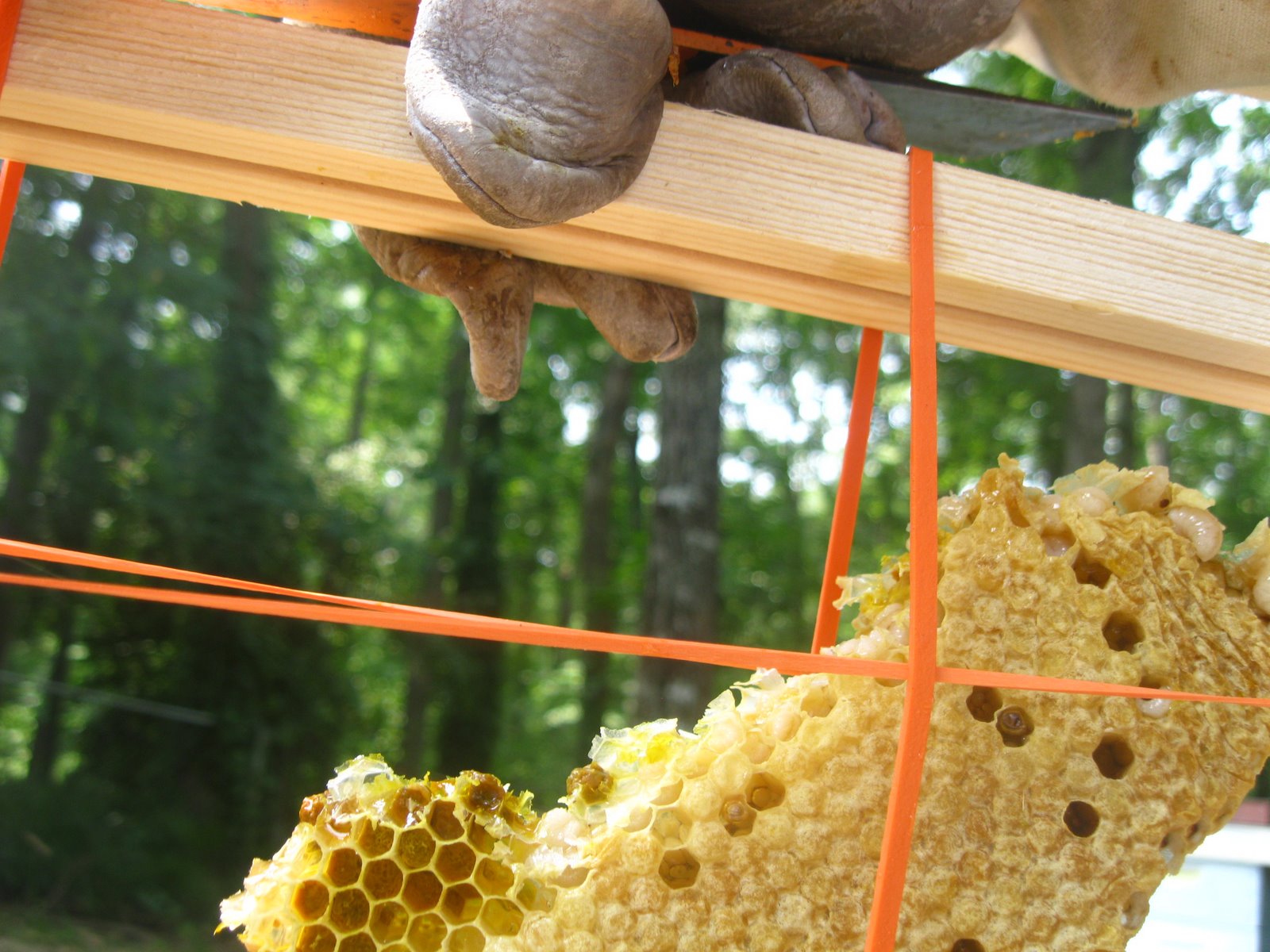
I cut out the bad comb and rubber banded it back into a frame that I gave back to the swarm hive.  I took the half frame of comb (which held lots of eggs and very young brood) and gave it plus one more frame to Blue Heron (drove back over there and installed these frames).

We cancelled the inspection for this Saturday.  We made such disturbance of Julia's hive that we didn't want to disturb it again on Saturday.  In my hive, the bees need peace and quiet to develop a new queen.  I'm driving to Rabun County on Sunday and if Don has a queen, I'll stop and buy one from him.


Saturday, June 11, 2011

Topsy Turvy Curvy - Decisions to be Made

The new top on Topsy is lifted off of the top bars by two sections of 1X6 nailed to the bottom of the cover. This creates space for ventilation beneath the cover. So in Topsy instead of bearding off of the front of the hive, the bees collect under the cover where I found them on Thursday when I visited the hive.


My first task was to remove the comb we left in front of the follower board from trying to un-attach the comb several weeks ago. It helps to clear out the hive not to have old comb on the floor of the hive.


The hive has built out to about the last ten bars, so they have used about 25 - 30 of the top bars available to them.


Looking in, I could see that the last two combs curved forward, occupying the space under at least two top bars. Instead of trying to look at the comb or any further into the hive, I backed up and decided to make a different plan about this hive.


I don't think there's a way at this point to straighten out the mess that is Topsy. There are several problems:

First, I don't have Topsy at my own house so I don't see what's going on there on a regular basis. If I am to work on a top bar hive, I need it to be at my own house.

Second, I haven't addressed the comb problems in an appropriate way yet - causing the comb to drop off of the top bar is what has continued to happen and that doesn't work. I have a new hive tool for the top bar and understand now that I need to cut up with the hive tool if a comb is attached to the side of the hive, rather than cut down.

So I plan to leave Topsy alone until after I move to my new house in July. At that point, I am going to treat the hive like a cut out and move the comb into probably two hives in a split.

I have recently watched several of JP and Schawee's videos on Beemaster of how they do cut outs and I think I now understand better how to cut comb to fit it into frames. Thus far the only time I have rubber-banded comb is when I am trying to repair an accident, not when I've made an intentional cut.

I think I could treat Topsy as a cut out and following JP and Schawee's lead, I could cut the comb out well.  I'll move the two created hives to my house. At that point, I will move the empty Topsy box to my new house as well, leaving it empty until Spring 2012 when I'll start over with better management.
Posted by Picasa

Tuesday, June 07, 2011

What a Honey Harvest We Will Have in Atlanta!

I'm not going to be able to get the top box off of Colony Square without a ladder! And the nectar keeps coming. The tulip poplar flow is long over but the bees are finding other sources - probably sourwood, sumac, mimosa, and garden flowers. It's amazing. The golden flow of bee bodies flying up into the air from the hives is going on when I wake up and still going on when I come home just before dark. Amazing year!

After two years of no honey harvest, this looks like a really good year.


In Lenox Pointe, the bees had not moved up into the empty top box although the box below it is full of burgeoning honey comb as you can glimpse in this picture.


So I moved two of the fat combs from the box above into positions 2 and 3 in the empty box below and put the box on the hive below a full box. We'll see if that works.


In the moving some honey leaked onto the inner cover. Who sends out the alarm, I wonder? Before you know it, there's a line of bees sucking it back up to return it to the hive. At the lower left of the picture, one bee is transferring what she just lapped up to the mouth of another bee! How do they get the message?


Meanwhile I also went over to Stonehurst and here's what the gorgeous honey looks like over there.


Posted by Picasa

Monday, June 06, 2011

Inspecting the Swarm Hive


Here it sits, in the yellow paint of our farm hives, with markings on the front to help with orientation.  I haven't really checked on this hive.  So today I decided to see how they are doing.


Inside I was treated to views of beautiful comb and happy bees.  Did not see the queen, but did see eggs in almost every cell.


Some of the comb was cross-combed and broke off as I separated the frames.  I used rubber bands to hold it in place so that the bees can do repair work.


Made me sick that some of the broken off comb was larvae.  I carefully rubber-banded it back in also.


While in the yard, I checked on Colony Square which is now so tall that I will have to use a ladder to add another box, and they need one.

Below is Lenox Pointe.  They haven't finished working their empty box, but comb was being built quite well.  They don't need another box yet, but at the rate they are going, another box should grace their top by the weekend.

This is quite a honey summer in Atlanta.


Beautiful comb being built in Lenox Pointe.


And a closer view of the clear nectar being put up in this hive.


Posted by Picasa

Wednesday, June 01, 2011

Foundationless Frames Need a Ladder!

Thanks to blog reader, Tom, in southeast Pennsylvania, I've learned why sometimes my bees start the comb in a foundationless frame at the bottom.

I opened Lenox Pointe the other day and found no comb in the newest box that has been on the hive for a week. In one frame the bees had built small attempts at comb from the bottom up on the bottom bar of the frame.  We had a frame like this at Blue Heron in a box last year that the bees never touched beyond the small attempt on the frame bottom bar.


Many people have written on Beesource and other places that the bees actually build down, not up, as we have all been told.

deknow from Beeuntoothers writes:"the common beekeeping wisdom is that the bees, if they can, like to work their way upwards....adding brood boxes and supers is generally done above what is already established, so that the bees can "work up".

but....

think of what a swarm will do when the occupy a cavity. the START at the top, and WORK DOWN. it would take very specific circumstances for a colony to build a bunch of comb, and then build comb ABOVE it.

bees (when working without foundation), cluster at the top and build all the comb down. if you place a box of foundationless above the existing comb (with no bait comb or foundation), the cluster tends to stay on the established combs, and starts to build upwards from the bottom bars of the new box. the results are fairly predictable....a big mess (as far as the beekeeper is concerned).

when i bait the bees up, i try to use 3 frames of bait comb (with brood) so that the bees not only have comb to be on, but beespace between the combs to be in. three combs can hold a goodly number of bees, and can make expanding outwards into the rest of the box much easier (for the beekeeper, and presumably, the bees as well).

it may be that adding the new box on the BOTTOM is a better plan, and might not require bait comb. certainly, it more closely replicates what the bees do, which is to START at the top, and work their way down."


Another poster Jt9610  wrote: "Don't put a whole frame of foundationless on top of a whole frame of drawn foundation. Set the two boxes side by side, pull roughly half the drawn brood from the old box into the new box, set them in groups of two, and back-fill both boxes with foundationless. Be sure to keep at least two brood frames together (no singles) for thermal efficiency, but other than that try to surround each foundationless frame with drawn frames. This will encourage the bees to work the foundationless and help them draw straight combs. As foundationless gets drawn out, move the newly drawn frame to surround other foundationless frames that haven't been drawn (i.e., at the sides) thus helping to guide them in turn. 

Also think in terms of a pyramid: you want brood toward the center and more in the bottom box than in the top box, but some in each."

So we need to be sure the bees have a ladder to climb up and work in the new box.
Deknow also says:
"if you place an EMPTY box (all foundationless frames) on top of an established hive, the cluster will stay on the established comb (below) where their brood and foodstores are.

as they want to expand (and fill the empty space), they do not want to move away from the established nest, and they do not want to split into two clusters.

so, they will start building comb "up" from the established comb...which will end up as a mess.

the "ladder" need not be more than a frame with foundation or comb (i like to use 3 combs...this gives more space "between combs" for the bees to populate). this gives the bees a way to "move up" without drawing crazy comb, and eventually, they will use the ladder comb (or build out the "ladder foundation"), and then start building comb on the foundationless frames from the top (as it should be)."


And Michael Bush says:
"If you put a package or a swarm in a box on foundationless they will draw from the top down. If you put a box of foundationless on top of a hive they may go from the bottom up or the top down. If you put in a ladder (a drawn comb) in the box of foundationless (take from below and put one of the foundationless in it's place) they are more likely to go from the top down."


I've always known to put a frame with a full sheet of foundation in it or a drawn comb in each box of foundationless frames but I thought I was doing that to help the bees know how to draw the comb straight.  While it may help the bees to have a model for building straight comb, the bees appear to find it easier to BEGIN drawing comb in the box with the help of a ladder to get them started at the top of the frame.


Giving the bees a ladder eases their comb building from the top down.


Some of my recent new boxes on hives do not have that ladder.  I may have given them a frame of drawn comb but not the ladder, the continuation of the work of the hive, by moving frames of brood or honey from a filled box into the new box of foundationless frames.

Today I set out to do just that.  Here you can see a frame I moved into the empty top box on Colony Square.


With a ladder the bees are glad to fill the frames with comb, but without it, they may not move into the new box.


I want them to build comb like the comb below, so I'm focused on giving bees ladders going forward.


Posted by Picasa

Pin this post

LinkWithin

Related Posts Plugin for WordPress, Blogger...