Bee Gum is a hollow tree log in which a beehive resides. It's a term more common to the Southeast. It originated because often gum trees were hollow, making it a natural place to hive bees.
The bees at Odd Job could be called bees in a bee gum, although the tree is an oak.
Beegum Gap is a part of the trail up to Rabun Bald, the second highest point in Georgia and I have been to Beegum Gap.
There's an interesting write-up in the Old Settlers Gazette about bees and beegums - it's only a couple of pages and worth reading - especially for the picture on the second page.
Here's a section of Bees in America that describes the bee gum.
Michael Bush on a post on Beesource says about moving the bees out of the bee gum into a box:
"If you can get them through to spring, THEN you can put a frame of brood and some empty drawn comb in the super and then drum and smoke them up into that box and then put an excluder in, you might trap the queen up in the super and the brood there may anchor the bees to take care of her. About a month later pull the log and split it open and steal the honey."
So I am going to say a mantra every time I drive over to Odd Job: "Move up, move up, move up." Who knows, maybe it will work!
Thursday, August 06, 2009


Bee Tree Gets a New Second Story
First I put the hive box on so that it slanted side to side. This seemed like a problem. I called Wally (Iddee on Beemaster and Beesource) and asked him what to do.
He responded that the hive box in your own bee yard would normally be slanted back to front, but side to side was a problem. You can imagine - the bees would draw comb up and down as per gravity, but up and down would not be in the frames - a big future mess, assuming they move up.
Then I realized (DUH) that all I had to do was turn the box and then it would slant front to back, making the back lower than the front by about 3/4 inch. Easy to do that so I immediately turned the box, problem solved!

I laid the bag of 2:1 syrup that I had brought with me on top of the frames and slit it with my knife.

Then I put an empty hive box around the baggie, put the bottom board on for a top and left it with lots of hope that the bees will move up.
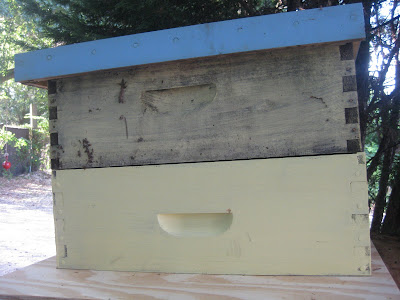
Here it is in its final resting place. I'll check back on Saturday to see if the bees are eating the syrup. I wonder if I should prop the top to allow them to continue to use the top "entrance." Seems like that would encourage them to move up into the box as well.
I'll ask about that on Beemaster and then let you all know what I will do about that.
Looking at this picture, I'm a little embarrassed that I didn't bring a newly painted box for the surround for the sugar syrup. Maybe I'll replace it so it can look pretty in this public location.


He responded that the hive box in your own bee yard would normally be slanted back to front, but side to side was a problem. You can imagine - the bees would draw comb up and down as per gravity, but up and down would not be in the frames - a big future mess, assuming they move up.
Then I realized (DUH) that all I had to do was turn the box and then it would slant front to back, making the back lower than the front by about 3/4 inch. Easy to do that so I immediately turned the box, problem solved!

I laid the bag of 2:1 syrup that I had brought with me on top of the frames and slit it with my knife.

Then I put an empty hive box around the baggie, put the bottom board on for a top and left it with lots of hope that the bees will move up.

Here it is in its final resting place. I'll check back on Saturday to see if the bees are eating the syrup. I wonder if I should prop the top to allow them to continue to use the top "entrance." Seems like that would encourage them to move up into the box as well.
I'll ask about that on Beemaster and then let you all know what I will do about that.
Looking at this picture, I'm a little embarrassed that I didn't bring a newly painted box for the surround for the sugar syrup. Maybe I'll replace it so it can look pretty in this public location.

Setting the Hive Box on the Bee Tree

Here are the bees peeking up from the top of the exposed comb in the tree. The bees had already started using the opening as a top entrance. I am a little worried about putting the hive box over the hole because they are using it as a top entrance.

Here's the silicone caulk beaded around the hole to keep out ants and other critters.

I nailed the board to the tree top. Tony, a New Zealander working of Odd Job, took this picture.

So here's the plywood board all caulked and nailed to the tree top, just waiting for the box.
Wednesday, August 05, 2009
Bee Tree Hive Preparation for a Hive Box
I can't get over how much beekeeping adds to my construction challenges! I went to Home Depot and bought a 24" X 24" piece of plywood to put on the top of the tree. I don't own and didn't want to purchase a sawsall ($199) and I don't have a mandrill (?) or whatever adaptor you have to have to attach a large hole saw to a drill and a 4" hole saw was about $15 without whatever adaptor I would need to attach it to the drill.
The guy in Home Depot suggested that instead of buying something I didn't really need, that I take my drill with a large bit and make a connect the dots circle since it doesn't have to be pretty for the bees. So that's what I did (see below)

Then I had to get the piece out and this required using this thin saw that I have (I had to change the saw blade - first time in the 15 years I've owned the saw) to put the small ended saw blade on - I'm sure it has its own special name. Anyway it worked perfectly to cut the little bits of wood between the dots.
Note: Research tonight yields that this is a "compass saw" and here's how it is described:
"A handsaw with a narrow triangular blade for cutting circles and curves in wood. Compass saws have longer, coarser blades than keyhole saws. They are designed for slightly heavier work such as cutting holes in subflooring for plumbing or electrical wiring."
So even though I didn't know what it was, I actually used it for the purpose for which it is designed: cutting circles!

Only one piece of wood still joined the circle to the larger block.

It's done. Tomorrow I'll nail this board to the tree section top. Iddee on Beemaster also suggested that I run a bead of caulk around the hole to keep the bees from making an entrance below the plywood and to keep out intruders like ants and such. I do have caulk and a way to do that (a caulking gun) so I'm all equipped for my morning event.
I have the car loaded with an extra super, a baggie of 2:1 sugar syrup, the board with the center cut out, my hammer and nails, my caulking gun, my bee jacket and veil, my gloves. A box with frames is already over there. Oh, and I loaded the ladder I'll need to have any height to work on this.

More to come on the bee tree adventure.
Preview of coming attractions:
- Pictures of the installed hive box from tomorrow's installation;
- Information about bee gums;
- An inspection at Blue Heron on Saturday morning.....
Tuesday, August 04, 2009
The Bee Tree - Huge Success
Beekeeping is the best adventure I have ever had - every day there is a new wrinkle, something new and exciting to figure out or to learn. I never knew I would be dealing with bees in trees.
Yesterday Eddie, a tree man, cut down a tree near Emory and found that it was full of bees. Being a good person, he preserved the 12 foot part of the tree with the bees and brought it back to his office. He called his friend Roy, who called his friend Wade, who is a Blue Heron Beekeeper. Wade suggested that he call me and that is where this story begins. (It's all in who you know ultimately, isn't it!)
Today I went over to visit the bee tree (see earlier post) and in a panic came home to talk to Wally (Iddee on Beesource and Beemaster) and Cindy Bee, my Atlanta mentor. They both said that the best plan would be to upright the tree and keep the bees in it. It's illegal to keep bees in a tree, but the plan includes putting a hive box on top of the tree section and lure the bees up into it with food and frames and a box that hasn't been through an earthquake!
OK, I went to Eddie's Odd Job Tree removal company and conferred with Annette, who is in charge when the guys are out on jobs. I told her the options:
When I brought the bee veils, the men were there and wanted to get started right away. This was an AMAZING process - the slide show speaks for itself. The pictures are a combination of photos taken by me, Julia, and her son Sam.
BTW, I stopped by this evening on my way home from work and the bees were orientation flying around the entrance to their hive!
I'll put a hive box on top of the tree on Thursday morning so the process of moving out of the tree and into a hive box can take place over the fall and winter months.
Let me also put in a plug for Eddie at Odd Job - what a process he went through to save these bees. He's a good person to know - the number for his company is in the first picture on the slide show.
Yesterday Eddie, a tree man, cut down a tree near Emory and found that it was full of bees. Being a good person, he preserved the 12 foot part of the tree with the bees and brought it back to his office. He called his friend Roy, who called his friend Wade, who is a Blue Heron Beekeeper. Wade suggested that he call me and that is where this story begins. (It's all in who you know ultimately, isn't it!)
Today I went over to visit the bee tree (see earlier post) and in a panic came home to talk to Wally (Iddee on Beesource and Beemaster) and Cindy Bee, my Atlanta mentor. They both said that the best plan would be to upright the tree and keep the bees in it. It's illegal to keep bees in a tree, but the plan includes putting a hive box on top of the tree section and lure the bees up into it with food and frames and a box that hasn't been through an earthquake!
OK, I went to Eddie's Odd Job Tree removal company and conferred with Annette, who is in charge when the guys are out on jobs. I told her the options:
- Cut the tree open and remove the hive and hope that the queen survives and that there isn't too much damage to the brood, etc.
- Save the section and either:
- Leave it at Odd Job as their own hive (which I would manage for them) - they are very near to my house,
- Take it to my house or to Julia's house,
- Take it to Blue Heron.
When I brought the bee veils, the men were there and wanted to get started right away. This was an AMAZING process - the slide show speaks for itself. The pictures are a combination of photos taken by me, Julia, and her son Sam.
BTW, I stopped by this evening on my way home from work and the bees were orientation flying around the entrance to their hive!
I'll put a hive box on top of the tree on Thursday morning so the process of moving out of the tree and into a hive box can take place over the fall and winter months.
Let me also put in a plug for Eddie at Odd Job - what a process he went through to save these bees. He's a good person to know - the number for his company is in the first picture on the slide show.
Here's the Bee Tree Challenge
OMG, I don't know if I can accomplish this. The bees are in a huge piece of tree on the back of a truck. You can see the open knothole that they are using for their entrance to the hive.

I wish there were a way to move this tree to my yard but it is way too big

There are thousands of bees in the tree.
I talked to Wally ("Iddee" on Beemaster and Beesource) and he said that they probably occupy anywhere from three to five feet of the tree. He was so helpful to talk me through how to determine where the hive is.
He said to cut about a firewood's length piece from the bottom of the tree and if there's solid wood there, to do the same thing again. When you reach the rotten wood, then you cut about 6" until you reach the comb. Once you reach the comb, you start at the other end of the tree and do the same thing. If Ed's guys are going to do this, I've promised to let them wear bee veils that I have!
My Blue Heron partner, Julia, borrowed a stethoscope and is going over the listen to the tree to see if she can locate the hive that way. I told her to take something to mark it with if she could determine where it is! located.
Here's a close-up of the bee's entry way.

And here I am optimistically putting a lure box beside the opening in hopes that the bees would just move in (fat chance!). And notice that this is in no way a pick-up truck but a big flat bed! They put a ladder by it so I could get into the back.

Monday, August 03, 2009
Preview of Coming Attractions
Today I got a call from a man whose friend is in the tree cutting business. Ed, the tree cutter, had cut a tree that had a beehive in it. He kept the section with the hive in it because he didn't want to condemn the bees to the shredder. It's in the back of his pickup.
He called to see if I wanted to come to get the bees. I am without a clue.
I posted on Beemaster and the people there who are always helpful, led me to a slideshow of how to remove bees from a tree, but to do it, I'll need to get the tree cut open. My friend Derrick said he could do it this weekend, but I may have to get this accomplished before then.
I also called my mentor, Cindy Bee. She called me back from EAS (I am so envious - I'd love to be there) and she suggested that I ask the guy if he would bring the cut tree trunk to my backyard. She then gave me great directions as to what to do once the trunk is in my yard. It involves a plywood base to set the trunk on, more plywood at the top to serve to hold a hive box and then an enticing hive box for the bees to move up into over the winter.
This sounds like fun. I hope I can talk him into driving it over to my house *(about 2 blocks from where the truck with the bees is parked). I have an extra veil, gloves and a bee suit, so we'll see and I'll report back with pictures tomorrow.
Beeyard Mayhem
At 8 PM on Saturday night I was moving a wheelbarrow through my backyard to the shed when I realized there were bees buzzing and swirling all around my yard and rising from my deck. I put on my bee jacket and veil and went out to see. Bees were everywhere. It was organized like a swarm and it wasn't apparent that any particular hive was being robbed.
The bees were all over the deck - they head-butted me no matter where I walked. Hundreds were flying in circles near my sun porch door. It was almost dark - what was this about? I assume because of the nectar dearth and the relatively low supplies for this time of year, that probably robbing was going on. I approached the two weakest hives and both, while not looking like robbing I've seen in other years, did appear to have some attacking happening on the front landings.
I immediately dropped the propped tops on all three hives and planned to get out robber screens for the two front entries of the hives that looked violated. By the way, opportunists were just waiting. I saw two bald-faced hornets get into the act of violating the hives as well as a couple of yellow jackets.
I went into the house to get the robber screens and angry bees went in with me. Usually they abandon the cause at the door, but not this time. I got the screens and put them on Mellona and Aristaeus2 since both seemed somewhat in distress. I posted on Beemaster to see if someone had an idea about what might be going on, but most of the wise people I depend on were at the Northeast Treatment Free Beekeeping Conference in the northeast and nobody answered for more than 24 hours.

On Sunday the center hive, Mellona, looks OK, but I was worried about the robber screen on Aristaeus 2. When I took it off, there were lots of dead bees behind the screen. By this afternoon (Monday), they had removed the dead and everything appeared to be back to normal. I will open the hive tomorrow and know more about what happened - if they were robbed and what is the state of the hive.
Meanwhile I had a wedding shower at my house on Sunday morning and didn't have the time to rescue with the glass and postcard all the bees that were on my porch. I carried about 20 of them outside that way. But then I am ashamed to say that I vacuumed up the 102 others that were still on the sunporch. I was afraid of having them there with all the people coming to the shower and I didn't have enough time to remove them one by one. So I was part of the hive devastation that happened on Saturday night.


If you click on the picture below to enlarge it, you'll notice in the lower part of the picture a bald-faced hornet attacking a bee.

Subscribe to:
Posts (Atom)
Pin this post

LinkWithin
