Welcome - Explore my Blog

I've been keeping this blog for all of my beekeeping years and I am beginning my 19th year of beekeeping in April 2024. Now there are more than 1300 posts on this blog. Please use the search bar below to search the blog for other posts on a subject in which you are interested. You can also click on the "label" at the end of a post and all posts with that label will show up. At the very bottom of this page is a list of all the labels I've used.

Even if you find one post on the subject, I've posted a lot on basic beekeeping skills like installing bees, harvesting honey, inspecting the hive, etc. so be sure to search for more once you've found a topic of interest to you. And watch the useful videos and slide shows on the sidebar. All of them have captions. Please share posts of interest via Facebook, Pinterest, etc.

I began this blog to chronicle my beekeeping experiences. I have read lots of beekeeping books, but nothing takes the place of either hands-on experience with an experienced beekeeper or good pictures of the process. I want people to have a clearer picture of what to expect in their beekeeping so I post pictures and write about my beekeeping saga here.Master Beekeeper Enjoy with me as I learn and grow as a beekeeper.

Need help with an Atlanta area swarm? Visit Found a Swarm? Call a Beekeeper. ‪(404) 482-1848‬

Want to Pin this post?

Saturday, June 30, 2012

Atlanta Temperature Today Will be 106!

We have a dearth of nectar, supposedly, in Atlanta and it's hot as H____.  The high today is supposed to be 106 and I think it must be close right now.  My dog Hannah, whose preference on summer days is to be outside in pursuit of squirrels, is camped out by the air conditioner duct.  (I know it's the return duct but for some reason, it's a very cool spot on the floor)


I did worry about the bees, though, and checked my hives at home on Thursday.  After all, if the Top Bar absconded, could the others be far behind?  My goal was to see if they were eating up all their stored honey and if I might need to consider feeding them.

In every hive I found stored honey and uncapped nectar.  The bees have been working the porcelain berry really hard lately and maybe it is a nectar source.  I don't see them with pollen on those vines, but they are all over the flowers.  The bloom is almost over, though.


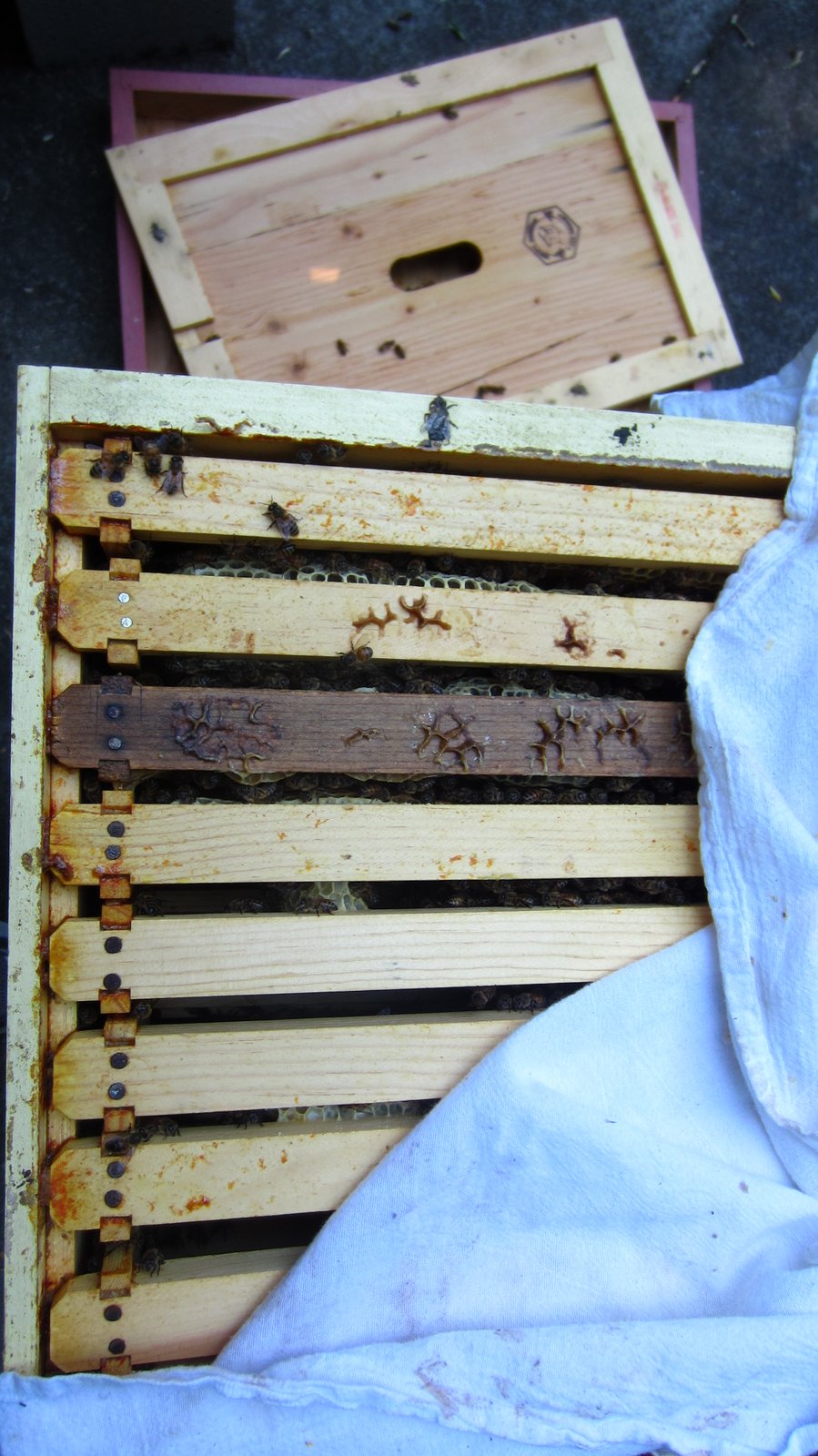
I found frames like the one above in every hive.  I also found boxes full of capped honey like the one below.


I even found some newly drawn wax....


By way of management, I removed one box from the hive below because it is a small hive and they were not using the space.  I am most worried about this hive.  They do have a queen who is laying, and they have some stored honey, but this is the weakest hive in my apiary.  This was a split off of Colony Square and has not done well - they've had two queens since the split that they made from frames of brood and eggs.  I should move some frames of brood and eggs into this hive to bring up the numbers, if nothing else.  This hive will never make it through the winter at this rate.


Other management tasks:  I put bottle caps under most of the top covers to help with ventilation in this heat.  Also if the bees were not using their newest box addition, I moved it to the top of the hive so its empty space could also help with ventilation.


The little kitten swarm is living still in nuc boxes (three of them).  I wondered how they were doing.  I looked and easily found the queen - she's in both photos below.  I was so relieved and she looks like the queen who ate the honey off of my fingertip, so I am going to believe that she is the actual queen of the hive.


If you don't see her right away, she's near the bottom of the frame just to the right of center.


So for now, I'm not worrying about the strength of my hives' stores - they all seem OK for the moment.
Although if the nectar is done for the year,  I'll probably feed going into September....it's funny because my general stance is that I want survivor bees and don't want to feed them if they can't manage on their own, but with this many hives, I feel a lot of responsibility not to lose my investment in addition to not wanting to lose the bees.

Temperature record set in Atlanta today at 106.8!
Posted by Picasa

Friday, June 29, 2012

And at Morningside...

Two weeks ago I checked on the Morningside Hives.  I found them surrounded by ever-encroaching kudzu but doing fine.  Neither hive has honey to spare but they do have honey and uncapped nectar.


The blue hive was desperate for space so I gave them another box.


Now both hives are four boxes tall.  They did have brood and eggs and were surviving this Atlanta weather just fine.


This week I went back to look at the hives.  Two weeks later, the hives look about the same but the kudzu has continued to grow.  Vines were between and under both hives.  Since I remember last year when the Rabun hive got completely inundated by kudzu, I don't want that to happen here.


I pulled out my garden shears that are always in my bee bag and snipped and pulled kudzu.  Now at least the yellow hive has front door access!

And the secondary gain is that the whole hillside of kudzu behind the hives may bloom, yielding delicious grape-flavored honey.

Posted by Picasa

Monday, June 25, 2012

Top Bar Hive Troubles

I've pretty much been gone for the last two weeks.  First I went to Key West with my youngest daughter and her family for the second week of June.  I was home for two days and then left last Wednesday to go to Norfolk, Virginia for a psychology conference that lasted until Sunday.  So my bees have not had attention for two weeks.

Before I left I checked all of the hives, somewhat giving them each a quick once-over, but not a deep inspection.  I didn't look at the top bar beyond watching to see if bees were flying in and out….which they were.

Today all the hives had bees flying, but not the Top Bar.  I flipped off the top and found absolutely no bees…..no bodies, no larvae, no bees at all.  Every cell was empty and the wax moths were already going to work.  I pulled out all the bars and set them in the sunlight so the wax moths would not thrive.


This hive was tiny.  It started from a small swarm I captured in Decatur and then recaptured in my front yard.  I installed it into the top bar on March 25.  By March 25, the nectar flow here was almost over and they never built up well.  These combs are all they had built.


In the photo above I can see a few left capped cells so I'll look at them tomorrow.  What I imagine happened was that the hive failed to put up enough supplies and absconded out of desperation as bees sometimes do here in Atlanta in August….but this year August has come sooner.

I am currently teaching communication skills to the doctoral PT students at the Emory Med School.  Every year I tell them that it's important to be aware of whatever biases or judgmental thoughts they may bring to their relationship with patients because it will affect how they care for the patient.  I tell them that if they have a negative sense of who the patient is, maybe they'll realize it because they'll find that they are giving less good care to that patient or attending to that patient less than patients whom they like/respect more.

I should listen to my own lesson.

I have had a bad feeling about the top bar hive.  Once again the bees built crooked comb and I felt a little angry and betrayed that here, my second attempt to have a successful top bar hive, I was failing again.   I had said that if I had only had the hive in my own yard last year instead of at Jeff's, perhaps the hive would have done better.

Well, this hive was in my own backyard, but I treated it neglectfully.  I hadn't really opened it in about a month and didn't enjoy working on it, so it often took a back seat to the other hives.


How would I have managed it better had I inspected to see about the state of the hive?  Maybe if they were without stores, I would have fed them.  Beyond that with only one top bar hive, I really didn't have many other choices.  I couldn't move a frame of brood and eggs into the hive to increase the worker force without another top bar from which to borrow; I couldn't share honey from another hive since the rest are all Langstroths.

I do hope they didn't leave and die somewhere (which is highly likely), and all I can do is vow to try to be a better beekeeper for the rest of my tiny charges.
Posted by Picasa

Sunday, June 17, 2012

Rabun Hives are Honey-Less

Before going on vacation this past week, I went up to Rabun County to check on the bees on June 6.  Both hives had bees but both were WITHOUT honey.  They didn't even have honey on the corners of the brood frames.

I had read in the The Macon Beekeeper (the monthly newsletter of the bee group in Franklin, NC) that there was little nectar in the area - here's the quote:

"Reports from all over indicate that at this point the honey crop is a failure. With one exception beekeepers report that their honey supers are, essentially, empty. A few are feeding their bees to hold off starvation.
It’s no different here. The tulip poplar did bloom. I do see some dark nectar in a few colonies. However, in reality, the nectar flow did not happen. My bees continue to work, and they are not starving. But there is no excess honey. It’s hard to take, but that’s agriculture."

My bees are about 10 miles south of Otto, NC, which is the area referenced in the above quote, so I'm not surprised, but sad to find that they had eaten through earlier honey stores.  That's just the way it is.

Here are the bees from the surprise move-in swarm hive happily (or not) entering their hive.


Note the corner of this frame by my thumb - NO honey for the brood.


I did see nectar on a few frames.  The sourwood was just starting to bloom when I was up there on the 6th.  My house up there is on a mountain of sourwood and the trees each had a few blooms.  My bees are at the Rabun County Civic center and not at my house, but they may have found some blooming sourwood to put the nectar in these frames.


This hive with five boxes on it had two full boxes of capped honey when I was here at the beginning of May.  Now they are empty.


Another sign that they may be finding a little nectar now is that they had begun building beautiful wax on this frame.  Just a little, but it takes nectar to do that.


The hive seemed listless, though, and the population was down although I saw eggs in both hives so I know the queens are OK.  The queen won't lay more eggs than the bees can support, though so she may have slowed down.


There are eggs and young larvae in the frame below.


Again, here's a little capped honey and some nectar being stored now.  Since the sourwood flow is starting, I took one box off of the tall hive and left them with room to store sourwood.  I didn't change the configuration of the surprise swarm hive, so their house is like it was the day they moved into it.


Posted by Picasa

Friday, June 08, 2012

Inspection at the new Chastain Conservancy Site

This year we are holding inspections at the Chastain Conservancy.  We still have hives at the Blue Heron, but with vandalism, critters, and floods, we needed a new site for teaching new beekeepers.  We now are grateful to have use of the land at the Chastain Conservancy.

It's a great site - Noah, Julia and I each have a hive there and hold teaching inspections about monthly during bee season.  It's a sunny spot, near water, the hives face east - only one drawback - it's directly in the middle of the Chastain golf course and I've never inspected the hive there without an errant golf ball flying into the apiary.

Perhaps we should wear hard hats!!!

Here's a slide show of our most recent inspection.  You'll notice me doing a powdered sugar shake and Noah collecting bees to do a powdered sugar roll to count varroa mites (we only counted ONE).


 Be sure to click on the slide show to see the pictures bigger and to read the captions, once I have gotten them up!

The Chastain Conservancy is located in an old Quonset hut.  You'll see it in the background...

Sunday, May 27, 2012

Musing about Frames: The Importance of the Tenth Nail, Sturdy Waxing, and the Availability of a Handy Toothpick

Lots of people purchase their frames pre-assembled.  I am not one of those people.  However, I am certainly rethinking this - it takes me 50 minutes to nail together 10 frames using a jig - not very fast, although the jig really helps.  The jig is set up for 10 frames, so when I went through the process three times, I've completed enough for three boxes (but since I use 8 frame boxes, I actually almost have enough for four!)  Waxing frames in takes time too.  This morning I spent one hour cutting and waxing strips into about 50 frames.

Constructing a frame takes 10 nails.

Are you listening, those of you who only bothered to use eight nails?

The tenth nail is the hardest to drive in and makes me say, "*#^#$^)%(#$)," almost every time  However, it is by far the most important nail.  That nail and glue make all the difference in frames that can stand up over time.  The tenth nail is the one that takes me the longest.  I can hammer all eight into 10 frames in 30 minutes.  Then it takes me 20 more minutes to hammer in that $(*)@#*$**^ ( tenth nail into either end bar of 10 frames.


If you don't hammer in the tenth nail (or use glue), the sight below is one you might see.  This is a medium box of honey, but I won't be able to harvest the second frame.  The top bar has become unattached from the end bar and I won't be able to get it out of the box.   This is a frame from 2007, so it is in its fifth year of use (new comb every year), but the parts are wearing out and maybe I skipped the 10th nail at least on this end of the frame.


The frames for the hives at Stonehurst don't have the tenth nail.  I am not in charge of constructing the hive parts over there. I picked up the constructed frames the other day and brought them home to wax in strips.  When I noticed the lack of the 10th nail, I suppose I could have nailed it into place.  It's my nemesis however, so instead  I've decided that if one of the frames over there comes apart like the one above, I'm simply skipping it in the harvest.  And if we order any more frames for Stonehurst, I'll do a better job of educating the guy who is building the hive parts.


When I've given talks about using foundation less frames, I've had beekeepers I respect tell me that they have had strips fall out of frames in Hotlanta weather.  That has never happened to me.  I wonder if perhaps those beekeepers are not waxing in the strips well.

When I put a wax strip into a frame, I run the wax tube fastener up one side of the strip.  Then I turn the frame and run the wax tube fastener up the other side.  When I'm done it's well waxed in and I can't imagine it falling out.

Here's where the handy toothpick comes in (you were wondering, weren't you?).  Sometimes the wax tube fastener looks like it is releasing wax when it isn't really.  Then I take a handy toothpick and unplug the hole in the handle.  Wax flows out easily then and I can make sure the wax strip is being secured on both sides.

One thing I've noticed in using frames from previous years when I have cut out the old comb:  If the old comb I cut out was crooked cross comb, then the bees with the now empty frame, follow the old cell lines and build crooked comb again....even with just a one cell depth of wax left on the frame.

Going forward when I cut out cross comb, I am going to use hot water to melt the old crooked lines off of the top bar and insert a new wax strip.  I may have to put such old frames into a boiling water bath so that the bees, in trying to color between the lines, crooked though they may be, won't have the old lines to use.

Note:  There's a video on this site about how to build a frame.

Wednesday, May 23, 2012

Hives at Jeff and Valerie's House

Jeff and I have thought that Colony Square is queenless.  They have not stored much honey in a few weeks and we haven't seen brood/eggs.  However, it's a rather vigorous hive and we haven't gone into the lower boxes.  We decided this past Sunday to explore until we found evidence of a queen or lack of one.

The hive is one deep (this hive began as a Jennifer Berry nuc last year) and five medium boxes.

These hives are Jeff's responsibility, so I am just there to satisfy the question: is there a queen?  He wanted to do the work (and the lifting, thankfully!)


We went down to box four where we found brood frames that only had a few scattered capped drone cells.  There were many empty uncapped worker cells.  This means that the queen last laid eggs more than three weeks ago.  The drones, which take 24 days to emerge, would be the last capped cells left.

However, the hive was pretty calm and there was no queenless roar.  More than likely they have already taken care of the problem and made a queen who either hasn't emerged, hasn't gone on her mating flight or hasn't started laying yet.  We went all the way down to the deep box and didn't see capped brood other than drone cells.


We decided for insurance sake to add a couple of frames of brood and eggs to Colony Square to give them a way to make a queen if they are still in need.  Although they have not collected much nectar in the past few weeks, there are three boxes on the hive for us to harvest - and the disruption of the brood cycle will be good for any varroa problems.  It takes a hive 42 days to get back to full production when they make a queen.


We decided to go into Lenox Pointe to get frames of brood and eggs.  We found lots of capped honey and some beautiful wax (see below).


In taking out the frames, some comb was opened.  The bees below are trying to repair the damage as quickly as possible.


We found brood - but most of it was in honey frames so we decided to get our transfer frames from Five Alive - our most vigorous hive.

We opened Five and took two frames of brood and eggs and put them into Colony Square.  We put CS back together.

Meanwhile, Five Alive which had eight medium boxes on it, was desperate for a new box.  Jeff added the new box (the blue one) below the top box and we moved honey frames from the box below up to the new box to serve as a ladder.

The top box was completely full of capped honey.  It took all his muscles to get the box onto the top of the now nine-box Five Alive hive!  Jeff posed to show his muscles after the event!


The hive is now almost as tall as Jeff who is six feet!  We must harvest from this hive.  Our plan is to harvest on June 2 from Five Alive, weather permitting.  This is my seventh year as a beekeeper and the best year ever as far as productivity is concerned.

FWIW, this hive began as a package from Don in Lula, Georgia; survived the move from the south Georgia farm almost exactly a year ago; and survived the winter, although there was only a tiny number of bees as February arrived this year.  We actually thought it was dead (thus its name: Five Alive).


Posted by Picasa

Monday, May 21, 2012

Tom Seeley Webinar about Swarm Decision Making

Robo on Beemaster posted this link to a webinar by Tom Seeley.  I had a hard time getting the sound and the slides to work at the same time, but when I did, it is well worth watching.

Seeley is a great speaker and a very good teacher.


This picture is from the Cornell University web site.

Pin this post

LinkWithin

Related Posts Plugin for WordPress, Blogger...