Welcome - Explore my Blog

I've been keeping this blog for all of my beekeeping years and I am beginning my 19th year of beekeeping in April 2024. Now there are more than 1300 posts on this blog. Please use the search bar below to search the blog for other posts on a subject in which you are interested. You can also click on the "label" at the end of a post and all posts with that label will show up. At the very bottom of this page is a list of all the labels I've used.

Even if you find one post on the subject, I've posted a lot on basic beekeeping skills like installing bees, harvesting honey, inspecting the hive, etc. so be sure to search for more once you've found a topic of interest to you. And watch the useful videos and slide shows on the sidebar. All of them have captions. Please share posts of interest via Facebook, Pinterest, etc.

I began this blog to chronicle my beekeeping experiences. I have read lots of beekeeping books, but nothing takes the place of either hands-on experience with an experienced beekeeper or good pictures of the process. I want people to have a clearer picture of what to expect in their beekeeping so I post pictures and write about my beekeeping saga here.Master Beekeeper Enjoy with me as I learn and grow as a beekeeper.

Need help with an Atlanta area swarm? Visit Found a Swarm? Call a Beekeeper. ‪(404) 482-1848‬

Want to Pin this post?

Wednesday, September 12, 2012

Carl Chesick and Sustainable Bees

Last weekend was the fall meeting of the Georgia Beekeepers Association.  I went because the speakers look better than in any previous year I remember and because I am on the board.  The most interesting speaker was Carl Chesick, Director of the WNC Center for Honey Bee Research.


Carl was focused on sustaining bees that can outlast the varroa vectored diseases.  He said that in Asheville and the Asheville area, his center was encouraging everyone who has an untreated hive that lives through the winter to split it in early spring.  This is a fabulous plan and one that is in some ways obvious.

I, however, keep hearing that we should be supporting survival stock, and hadn't exactly understood how little ole me would be instrumental in that since I am not a queen breeder. But Carl pointed out that a split and a new queen that results is in fact breeding (a) queen on a very small scale.  Duh! But I hadn't registered this thought.

It's basic math, though.  If I have a hive that lives through the winter, untreated and only fed honey, then in the spring, I split it.  I have doubled the number of hives in my yard that are survivor bees.  The bees in that hive are strong enough to live WITH the varroa and not be defeated by the varroa.  If everyone did that, imagine how quickly treatment for varroa would go away.

Basic split involved in this:

  • 2 frames uncapped brood with attendant nurse bees
  • 1 frame of capped brood (to replace aging nurse bees)
  • 1 frame of honey and pollen
  • 1 frame of drawn empty comb
I rarely succeed with a split because I am always scared to bring enough nurse bees.  But in this split, if I were to take the queen by accident along with enough nurse bees, then the hive that is left becomes the queen breeder!  

In three weeks, the new queen should be emerged and laying.

Carl's talk followed a talk in the morning by Kefyn Carley from WNC University.  Kefyn's main interest is in spiders and mites, but after his talk I wanted to scratch my eyelashes.  He said mites are necessary and EVERYWHERE (even - read that often - in your eyelashes)...


His main point was that we would lose if we try to defeat (read that kill off) the varroa mite.  That approach only breeds a stronger varroa mite.  Instead, we need to accept the varroa mite and try to work with natural selection.

To do that, we have to recognize that if the parasite (the varroa) kills off its host, it will die as well, so it behooves biology for a mite to develop that can co-exist with its host.

It will take from 6 to 12 years to get mites and bees that can co-exist together and neither kill the other off.

So after hearing him talk and then hearing Carl, I am determined to get my bees to live through the winter and then split them!


Friday, September 07, 2012

And.....the Wax Block Pouring Continues

Well, the first pour was cracked in both blocks.  The second pour of two blocks last night resulted in two cracked blocks.  I was so disappointed.  Since the GBA honey contest is Saturday, tonight is really my last opportunity to succeed at this unless I pour a block during the day tomorrow while my grandkids are napping.

Generally a cracked block means that there was uneven cooling, but sometimes there's no explaining it. I had done almost everything I know to do, so I decided today to buy new pans and try with them.  I went to Target and bought two bread (loaf) pans to give that a try.   One is glass....


The other is no-stick metal:


I heated the measuring cup in a pan of hot water and melted the wax in my converted Presto Pot.  I have some silk that I use to filter the wax.  So what happens is:  The wax melts in the Presto Pot.  I rubber band the silk over the large measuring cup (and 8 cup measure).  Then I pour the wax through the filter into the hot measuring cup.

Having the measuring cup hot keeps the wax from solidifying on the bottom of the measuring cup.

When the wax has filtered through the silk,


I carefully remove the rubber band and the silk (so that the filtered debris doesn't fall into the hot wax).  Then I pour the melted wax into the mold.  I put panes of glass on the mold after I've filled it so that the block won't have a wavy surface.


One is cooling in the oven in a pan of very hot water and the other is cooling in the oven downstairs in a pan of very hot water.  Cross your fingers that at least one of these is usable in the morning.

Thursday, September 06, 2012

The Wax Block Pours Again.......

Those of you who have been along for most of this journey remember the year when I poured a wax block for the honey contest 18 times.  This is the first pour when I innocently thought this might be pretty easy.  And this is the 15th.  I did get a blue ribbon, but now I think that was a little (are you laughing yet?) obsessive.

This weekend is the Georgia Beekeepers' Association fall meeting and honey contest.  I am going to miss the Metro honey contest this year because I will be on vacation.  So I am entering the GBA contest this weekend.  For sure I'll enter liquid honey, chunk honey, creamed honey (remember Jeff's and my detailed experience), crafts, and maybe photography, but I don't have a photo that just screams to be entered.  I'd like to enter wax block but I didn't pour my first one until last night.

Well, to be honest, I poured two.  I had enough wax and I figured that one would probably come out OK and I could keep repouring the other to try to attain perfection (or close).

The other aspect of this contest is that I'll be up against Virginia Webb - she wins everything.  Her honey has won Best in the WORLD at Apimondia - TWICE.  And she always wins the wax block.

The last time I went against her at GBA she entered a block that wasn't a classic wax block but was poured into a mold covered with designs. She got the blue ribbon and I won the red.  Our rules for MABA specify that the block has to follow the classic rules - a plain, no design on it, 2 - 3 pound wax block.  But this weekend Virginia is sure to enter a lovely designs all over it block and I will not get the blue ribbon - so I'm trying for the red.

The truth is I may not have an entry at all.

This morning I woke to find that neither block had finished well - both had cracks in them.


The prettiest wax I have poured all the right ways - left in a hot pan of hot water in a 350 oven that I turned off right before I put the wax into it.  I put a window pane over it, closed the door and left it for the night.  Nothing doing, it's a mammoth failure....


The second block I put in a pan of hot water on the work bench with glass over it and it too cracked in cooling.  That usually means uneven cooling but I had it in a hot water bath, with two sheets of glass over it.


It looked pretty good from the top, but underneath:


Undaunted, I repoured both of them tonight - we'll see.  I didn't change much - used a little more release (dishwashing liquid) and added some extra hot water to the pan.

We'll see in the morning.

Saturday, September 01, 2012

Article on Urban Beekeeping in Organic Gardening

Last night I got an email from a friend of mine saying she had seen an article about me in Organic Gardening.  I was interviewed back in the spring and a photographer came and spent the morning at my house.  I knew it was coming out soon, but thought I'd get a copy when it hit the newstands.

The article is online at Organic Gardening magazine,  but there are only two photos from my hives in the online version.  My friend said in her email that she really liked the photo(s).  I decided today to go buy copies at the bookstore so I could see for myself.

I flipped through the magazine at the bookstore to the article and found lots of photos both from my bee yard in my backyard, and the beeyards of two other beekeepers, both men, one in Chicago and the other in Vancouver.  I was so excited, I bought several copies so I could give one to each of my children.

I brought my purchases indoors and opened the magazine's cover for the first time, instead of flipping through as I did before.  The second page held the table of contents and there I was, the background photo for the Table of Contents page!


I'm honored that of all the women beekeepers in the country, Janet Davis, the author picked me for her article.

Thursday, August 30, 2012

Rabun County Bees

A couple of weeks ago when I went to Asheville for the Natural Beekeeping meeting, I stayed at my house in Rabun County.  On the way up I saw the bear in the misty rain at Black Rock Mountain Lake.    The day after the conference, the lake was sunny and beautiful and while I didn't see a bear again, I did see Joe Pye weed and goldenrod, evidence of the fall flow (for what it's worth).


Before I drove back to Atlanta, I checked on the Rabun bees.  The last time I was up at the mountain house, I discovered that one of the hives was almost dead and had small hive beetles all through it.

I didn't really check out the cause of the problem when I was there before because I was so upset, so I opened the hive on this visit and brought the boxes back home.  Clearly the hive had been robbed out, and left so weakened that the small hive beetle took advantage of the opportunity.


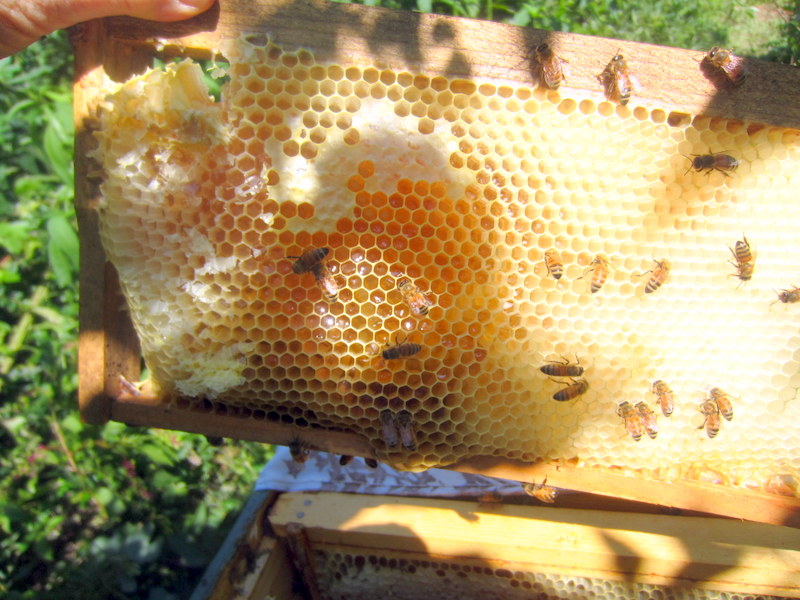
Two things are evident in this picture.  The edges of the cells are ragged, indicating a robbery.  There were dead bees littering the ground in front of the hive.  And you can see the slime of the small hive beetle.  I brought four boxes back to Atlanta and could hardly stand the sicky sweet smell in the car of the SHB's destruction.

The other hive was almost completely covered with weeds.  It was totally in the shade and had kudzu and other brambles all over the entry.  I didn't take a before picture, but I wish I had.  The bees were still flying happily in and out of the hive.  I knew this vegetation situation was likely so I brought my hedge clippers with me.  I went to work and freed the hive from most of the vegetation.


When I opened it, I was shocked (in all the previous shade) to find that I only saw one small hive beetle in the hive.  Perhaps they were all satiated on the frames from the other hive?

This hive has honey in all three boxes and brood in the bottom box.  I really wanted to taste their honey.  The top box is likely sourwood, but they had not completely capped the honey in those frames, so I brought back a frame from the middle box.


I didn't come prepared for harvest transport, so after brushing off the bees, I put the frame into a pillow case (I'm now using them for hive drapes like Julia taught me), and brought it back to Atlanta.  I crushed and strained it and now have three pounds of luscious grape-flavored honey, likely from the kudzu all around the creek bed where the hive is located!


(The HIDDEN honey frame).

Sorry for the Radio Silence

In my real life, I have two jobs in the summer - my usual job and in addition I teach in the Emory Med School, teaching communication skills to the doctoral students in the Department of Rehabilitative Medicine.  I've been drowning in grading final exams and videos, and thus off the air for the last couple of weeks.

I'm going to post some activities from the last month to catch me (and you) up, and now that the semester is over, I'll get back to blogging about my bees.

A couple of weeks ago I went to check on the Morningside hives and found them hidden by tall grass.  The community garden is on land owned by Georgia Power and they usually do the maintenance, but someone apparently dropped the ball and the grass hadn't been cut in forever.


I had recently been up to Rabun County where I had to cut the kudzu off of the hive so I had in my car some hedge clippers.  So I grabbed them and instead of doing bees, I did landscaping.

Now I and the bees can see their front doors.  I have Boardman feeders filled with water on the hives to keep the bees from going to the neighbor's swimming pool.  Who knows?  They probably like the chlorine better, but at least I am demonstrating an effort to keep them away!  The hedge clippers are on top of the closest hive.

Then I went over to Sebastian and Christine's.  I didn't post about it, but one of their two hives was robbed out.  It was sad and I assumed the hive that was beside it, which was also the stronger of the two hives, had done the robbing.

I opened this hive to see the spoils.  Instead I found bees that were doing fine - lots of brood and bees, but very little honey.  I went all the way down to the bottom box to see what I could see and found little nectar.  

That was two weeks ago and the asters and goldenrod have begun to bloom so maybe they will bring in some nectar.  I also have some honey that I can feed them.

You can see in the photo above that there is lots of brood but no honey in the corners.

In the bottom box which is a deep (this hive started from a nuc this year), I found Her Majesty, walking regally over the frame:

I don't usually wear gloves but a bee stung me on my right hand and I threw on a glove so I could finish up.  The queen is marked with a yellow dot and is in the upper left corner of the frame.  So this hive MAY make it through the winter if they can gather some supplies in the fall flow (which in Atlanta is generally minimal).


Tuesday, August 14, 2012

Michael Bush, Man of Many Talents

I arrived in Rabun County on Friday night in a torrent of rain.  I had promised the dogs a walk when we got there, but with the rain, I went to the grocery store and got gas for my car instead.  When I was done with those errands, the rain had stopped, so I decided at 8 PM to go ahead and walk the dogs around Black Rock Mountain lake.

I was the only person there, so I let Hannah, my bearded collie/terrier mix, off leash and we walked the path around the lake.  It was misting but there was still plenty of light.  Hannah bounded down the trail up and back, having a great time.  On the back side of the lake, as I neared the final bridge, I heard crashing in the woods and immediately thought, "Bear!"

Sure enough, a few steps down the trail and I found a bear about 10 feet up a tree with Hannah at the foot of the tree, just looking at the young black bear.  Of course I didn't have my camera.

The tree was only about 12 feet from the trail and as I arrived, the bear was looking at me and then at Hannah.  I called Hannah who finally turned away from the bear.  Just as she did so, the bear leaped off of the tree and ran up Black Rock Mountain!  What an adventure!

On Saturday I drove to Asheville for the the conference exploring natural beekeeping put on by the Center for Honey Bee Research in Asheville.  The three speakers were very different and all were interesting.

From Ed Levi's talk about his world wide beekeeping, I saw interesting photos of bees around the world.  He also spoke on IPM and beekeeping.   Roger Simonds, who is an investigator at the USDA lab in Gastonia, NC, spoke on all of the poisons that end up mostly in wax and the pesticides that end up in honey - his picture of honey health and particularly of wax health, grew grimmer and grimmer the longer he spoke!

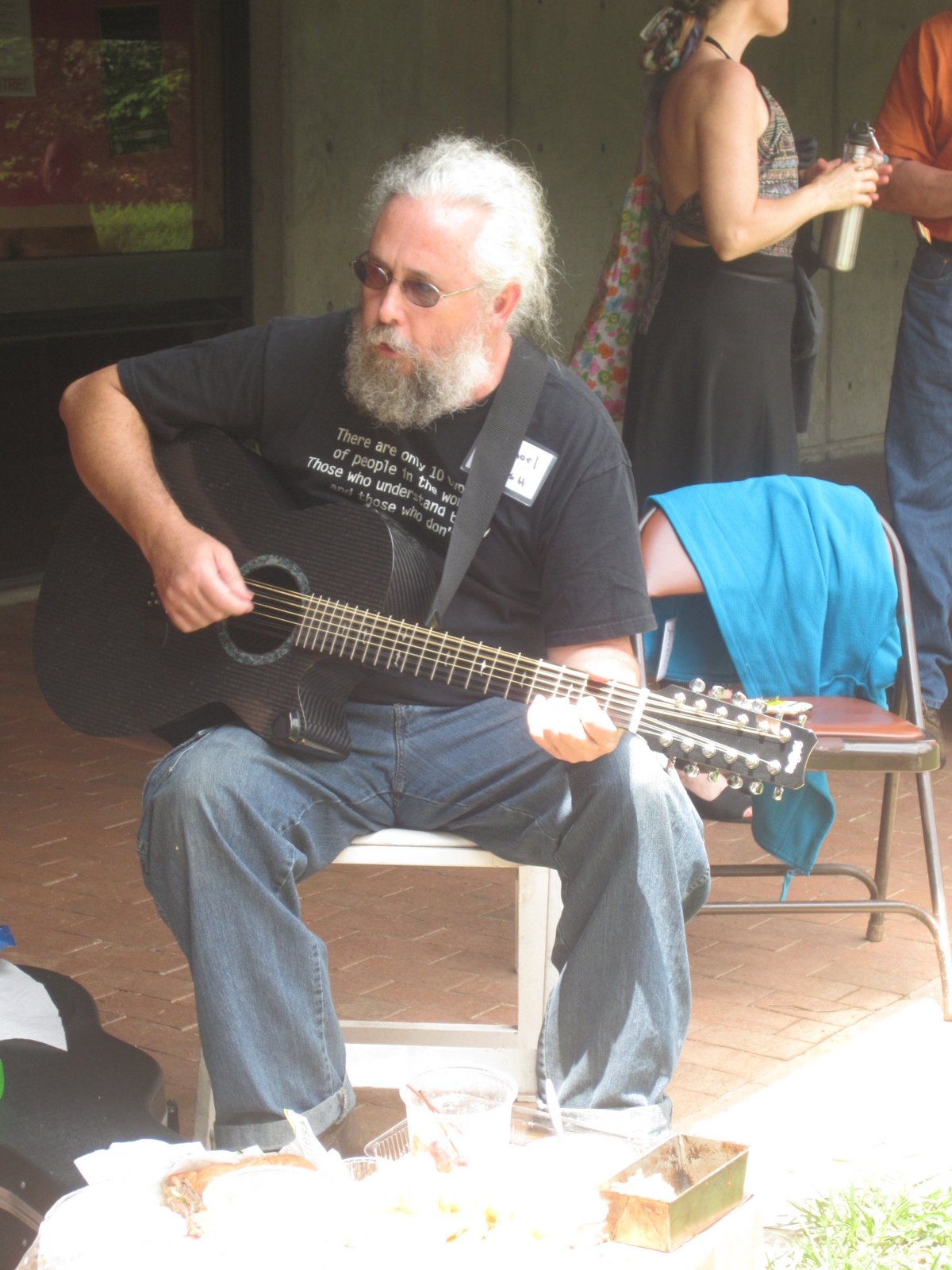
Michael Bush gave both of the talks I had heard in Massachusetts, but it's always fun to hear his perspective and I had fun just chatting with him as well.  At lunch he played and sang with his 12 string guitar - who knew?


The Bunscombe County Beekeepers were quite hospitable, sharing watermelon, fresh pineapple, and home-grown cherry tomatoes with all of us as we listened to Michael play and sing.


It was a great day! And a great weekend in the mountains.

Posted by Picasa

Sunday, August 12, 2012

Survivor Miracle Maybe???

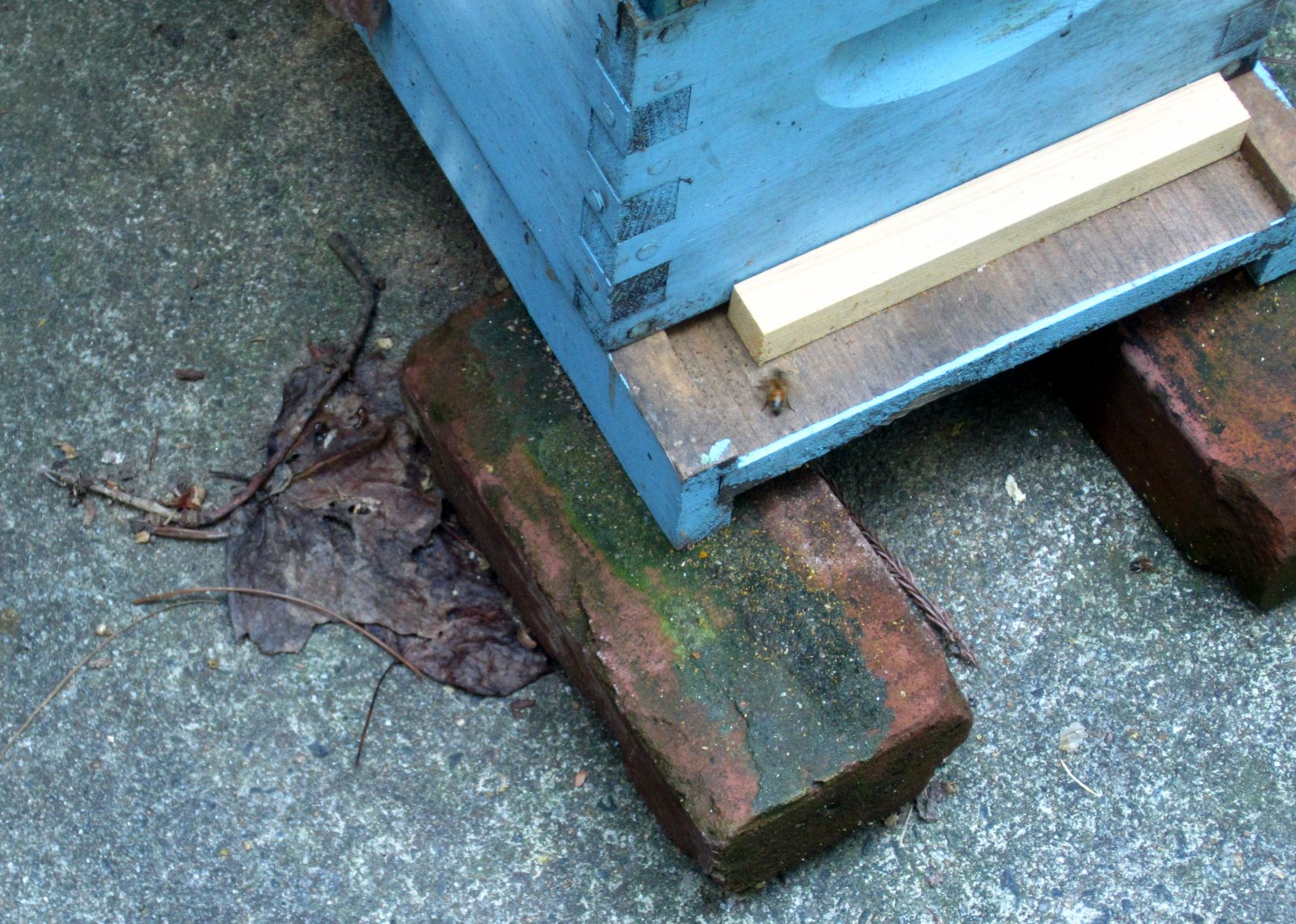
On Sunday after the robbery on Friday, I walked out of my basement door and noticed this nuc, sitting with four empty frames in it.  There were bees!  And no reason for them to be there.

I think these are the survivors from the robbed hive.  The queen is from Don Kuchenmeister and the bees are tough little small cell bees who should be able to make it.


Quick like a rabbit, I put the nuc up on bricks, gave it an inner cover and a top cover and added an empty nuc as a surround with a Boardman feeder full of honey in it.  I replaced the empty frames with drawn frames from what I think was their original hive, the robbed out one.

I also put two frames in the upper nuc with the Boardman (with a pint jar of honey) in between.  I think I should put those two frames side by side and will when I go back to it.


I didn't look for the queen, but the bees acted like a small swarm does.  I'll check for a queen in a couple of days.  Bees were orienting and flying in and out.


I reduced the entrance so that they would be safe while I'm off to the mountains to the Asheville conference.  I hope they'll make it.  I'm inclined to consider keeping them in the nuc for the winter if they can manage to get a hive going.
Posted by Picasa

Pin this post

LinkWithin

Related Posts Plugin for WordPress, Blogger...