Welcome - Explore my Blog

I've been keeping this blog for all of my beekeeping years and I am beginning my 19th year of beekeeping in April 2024. Now there are more than 1300 posts on this blog. Please use the search bar below to search the blog for other posts on a subject in which you are interested. You can also click on the "label" at the end of a post and all posts with that label will show up. At the very bottom of this page is a list of all the labels I've used.

Even if you find one post on the subject, I've posted a lot on basic beekeeping skills like installing bees, harvesting honey, inspecting the hive, etc. so be sure to search for more once you've found a topic of interest to you. And watch the useful videos and slide shows on the sidebar. All of them have captions. Please share posts of interest via Facebook, Pinterest, etc.

I began this blog to chronicle my beekeeping experiences. I have read lots of beekeeping books, but nothing takes the place of either hands-on experience with an experienced beekeeper or good pictures of the process. I want people to have a clearer picture of what to expect in their beekeeping so I post pictures and write about my beekeeping saga here.Master Beekeeper Enjoy with me as I learn and grow as a beekeeper.

Need help with an Atlanta area swarm? Visit Found a Swarm? Call a Beekeeper. ‪(404) 482-1848‬

Want to Pin this post?

Tuesday, July 19, 2022

Harvesting Honey in the Dearth

Since I moved last June, I didn't harvest last year. I was in the process of moving my hives. And this year, I had only one hive out of two from the year before that was still standing when it was time to harvest honey - that was the hive that is at my daughter's house. Generally I try to harvest at the end of May, early June, instead of now in July, when the bees are in the throes of the dearth and really unhappy.

This year I was sitting at a red light and a woman crossed two lanes of traffic turning left into my lane, didn't see that the red light had caused the traffic to stop and slammed into my driver's side door (ARGHH). So given what the pandemic has done to supplies, the accident happened in April; I couldn't even get an estimate until May; the repair couldn't begin until mid June and my car was in the shop until this week. I didn't want to put honey in the trunk of a rental car so I delayed harvest until this week.

Needless to say, the bees were not happy. This was a hive we moved from Sarah's backyard to the front when she had a tree next to it cut down. I haven't opened them since the move on May 16. 

First I observed the hive for a long time from the front of the hive. The bees were very busy and active, coming and going in and out of the hive, quickly but peacefully. There was nothing unusual in their pace or the way it looked on the entry. A lot of bees flew in with honey on their back legs - about every fifth bee. The bees weren't carrying out dead bees or dead larvae. 

From observation of the front of the hive, I decided we did not have to do an inspection. The hive had a bottom box full of brood and the box above it has always been a little brood on the left side and then all honey. But it's the dearth and not a time to go deep into a hive because the bees tend to be "hangry." 

AND because it's the dearth, I put on a zip-on veil and jacket. I meant to put on gloves but forgot and when I opened the hive, I was immediately stung on my hands. The message was quite clear so I put on my gloves! On the top of the hive were about five cockroaches - not unusual in the height of summer in Atlanta. They are kept on the top by the bees and just remain their optimistic that they will get fed, I suppose, but to no avail. Roaches, earwigs, black widow spiders are all often on top of the hive and are no threat to the bees. There were also LOTS of bees. 

The top box (#4) was completely empty with every other frame drawn or partially drawn. None of the comb was being used so I removed that box. The third box had honey in about three of the frames and none of them were full. I decided to take those three frames. 

Typically in a honey harvest, you don't use the smoker because you don't want smoke to infuse your honey. But these bees were in such a bad mood that I decided that the smoker would be a definite feature of this inspection. With the help of my daughter, Sarah, I took the three frames - I actually had to take four because one of the frames was slightly cross-combed with a drawn but empty frame beside it. I took those two together in case breaking the cross comb might open honey cells. I had put this box on the hive right at the very end of the nectar flow and the bees had not been able to fill it. 

I put the three/four frames into a plastic nuc box. Then I filled the spaces we left in the third box with the drawn frames from the top box. I left the top box off of the hive and took the nuc box home to harvest. I have no photos because I recorded the whole thing. I'll have it up on YouTube and add it to this post on July 27 when I am offering my bee club a virtual hive inspection.

July Crossword: Bees and the Summer Dearth

I am having such fun creating these bee-themed crosswords. By the end of the year, we'll have a collection of them, each on the bee theme for that month. Here's the one I did for July:

Saturday, June 04, 2022

Harvesting Your Honey - a new Crossword Bee Buzzle


Friday, May 27, 2022

Surprising Water Source for Bees


This is my first full year in my new house and as spring approached, I planted a raised bed garden. I had too much soil so when my first raised beds were done, I ordered a felt raised bed. Felt pots are the "in thing" these days.

My garden is thriving and I water it about every other day. I've noticed a lot of bees around the felt bed. Imagine my surprise when I saw what they are doing.


Part of my felt raised bed - see the little girls at the fold lower center?


 The bees are clinging to the felt and letting its absorbency and the water in it be a source of water for them to carry back to the hive! Who knew? I thought I was doing a good thing for the plants and the soil and it turns out, I was also helping the bees.


Friday, May 06, 2022

Inspecting a Bee Hive Well - Crossword Buzzle

Test yourself! How much do you know about doing a good hive inspection? Here's the "Buzzle" I created for the monthly GBA newsletter this month:


The answers are in the GBA Newsletter each month (join here for a mere $15) or you can email me for the answers.


Monday, April 25, 2022

A Swarm Moved into an Empty Hive Box in My Yard and Did it Right in Front of Me!

 I got home from helping my friend with bees she tried to rescue from the airport at 5:30 PM today. 

When I left at 3:00 there were bees in my carport all over some stacked hive boxes there to be painted. I thought maybe a swarm was moving into the stacked boxes. My shed where I store all my bee equipment was getting a lot of activity too. I even left the door cracked to the shed because there were so many bees visiting the interior that I didn't want to leave them in there. And an empty hive box was getting lots of visitors. 

It's April and the height of swarm season in Atlanta. If you are a seasoned beekeeper with unoccupied equipment in your bee yard, it's not unusual to see scouts or to get a swarm interested in your empty properties. 

I came home and took my dinner out to the back deck to eat outdoors. I watched the hive while I ate, and noticed that there was still some activity - scouting - going on at the hive. I had almost finished my dinner when I heard a loud whirr and looked up to see a swarm moving into the hive.

The whole process took a mere 15 minutes so I filmed it all - it's kind of calming to watch the bees claim a home for themselves. These are truly free bees. They didn't cost me anything in terms of time, effort, preparation or money. Enjoy the video:


Bee Crisis at the Atlanta Airport

 A fellow MABA beekeeper got a call from a commercial beekeeper in Alaska yesterday. The beekeeper was calling to report that a huge order of packages had been rerouted in error from Sacramento to Atlanta instead of Alaska. Makes you wonder, doesn't it, if the cargo handler could read - the only thing Atlanta and Alaska have in common is that they both start and end with the letter "a." 

So hundreds of packages of bees which should have been in Alaska three or four days ago arrived at the Delta cargo building yesterday. Many were dead. The beekeeper who got the call, Edward Morgan, arrived at the airport and assessed the situation. The bees would not make it until they could leave again at 3:30 on Monday (today) to continue to Alaska and the ones surviving would surely not make it alive to Alaska.

An emergency email went out to the members of the Metro Atlanta Beekeepers that if you could and wanted to try to save these bees, they were yours for the taking. Just come to the airport. My friend and partner in beekeeping at SPARK Elementary, Meghan, took her daughter and went down to the Delta Cargo building. They brought home fifteen packages of mostly dead bees.

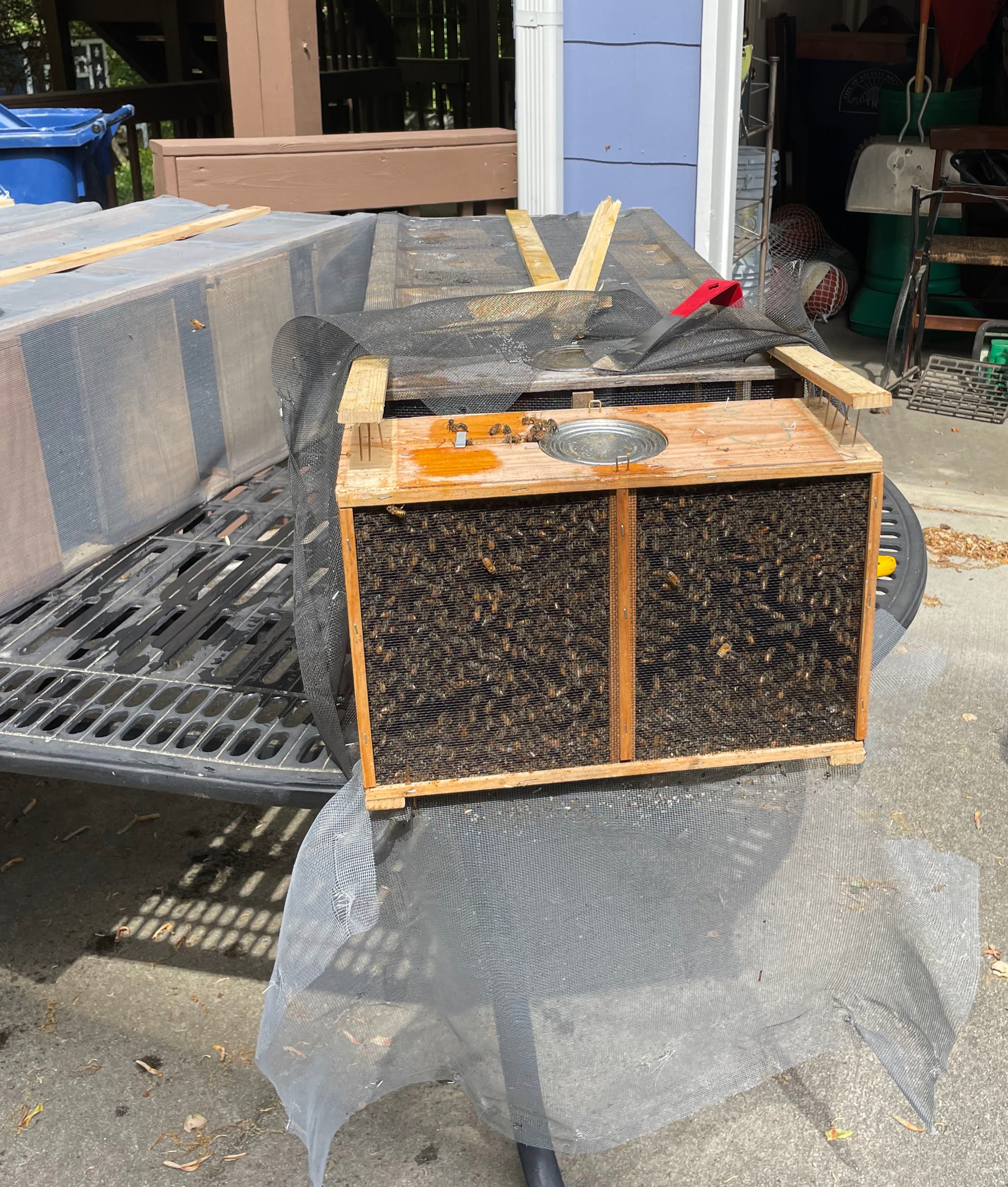
The packages were nailed together in groups of five and wrapped in soft window screen wire. 


It must have been so hot in that cargo container. Only the bees in the end packages showed any signs of life. One difference in Atlanta and Alaska is that it is already pretty hot here and the bees must have died of heat, crammed into that container. 

The package facing us in the photo was the only one of the fifteen with a fully live queen. We checked the queen in every package - all were dead except for one other. That one barely moved. We exchanged the cork in her queen cage for a marshmallow and when she began eating it, she perked up. 

We put the fully live queen in between the frames in a hive box and set up a hive box over a telescoping cover to catch all the dead bees. We poured the live and dead bees out of the package.


The live bees are in the hive and the package box sitting on top of the hive. The bees you see there are all dead - the ones in the telescoping cover and the ones on the ground. It was heartbreaking.

A few of the fifteen packages looked like this with a few live bees clinging to the screen:


And caged queen after caged queen looked like this:


Meghan kept the dead queens to put in alcohol to make swarm lure.

In the end, the bees moved into the large hive with the queen. You can see them moving into the hive.


The marshmallow-feeding queen went into a nuc box. The bees on the nuc box are clustered over the queen cage. Meghan moved the hive down into her yard and left the nuc box open on the driveway near the now all-opened packages. 


We put two opened packages with the most live bees facing each other above the frame with the queen (we added another to the configuration in the above photo). We figured with a live queen maybe most of those bees left in the packages would go down into the nuc box by morning.

This was a terrible loss and tragedy. However, at least twenty beekeepers went to the airport to take bees to rescue. All were not lost, but thousands of bees suffered death in this awful situation.

Footnote: This horrible incident was covered by the New York Times on Sunday, May 1. I didn't know until I read the NYT article that the bees were unable to access their food/liquid because all of the packages were upside down, meaning the syrup in the cans would not be coming through the holes in the bottom of the cans. When Meghan and I went through the packages she brought home I was struck by how full the syrup cans all were.


Hive Inspection - Week of April 15


I still am holding virtual hive inspections and think it is a good value. In person is great, but COVID has taught us that you can learn a lot by asking questions on Zoom as well. This is the hive inspection that I shared last week on Wednesday on Zoom. We start with my top bar hive and then look at my Langstroth hive in my daughter's yard. It ends with a hive that is in the last throes because of a queenless situation and an overtaking by the small hive beetle. I included it so you could see what it's like to lose a hive like that. This hive was fully functioning and doing well three weeks ahead of this inspection.


Pin this post

LinkWithin

Related Posts Plugin for WordPress, Blogger...