I'm at Bald Head Island in North Carolina with my sister, but as we were driving here, my cell rang. It was Annette at Eddie's Odd Job Tree Service where the first bee tree is. She called because they had cut another tree full of bees and had brought it back to the office.
The plan was to section the tree as they did the first one - so when I get back to Atlanta, there should be a second bee tree right next to the first one. I can't believe it!
Of course from here I have no pictures, but will get some when I get back. Annette said this is a smaller tree than the first one. The bees in this tree should be in desperate straits. Their winter supplies will have been destroyed or at least turned into a big mess with the felling of the tree.
When I get back to Atlanta, I'll get a piece of plywood as I did before and cut a center hole. I'll take a hive box over there with drawn comb. Then I'll cross my fingers that this will work!
I'll need to feed them like mad to get them ready for winter as quickly as possible. Lucky for us the first frost in Atlanta is usually around the middle of November....so we have a little bit of time here.
Sunday, October 11, 2009
Thursday, October 08, 2009
The Messy Sugar Syrup Process
When people talk about harvesting honey, there's always some discussion about how messy the process is. When I harvest via crush and strain, I put cardboard under everything, keep the harvesting in a small area of my kitchen and have very little clean-up. I put the cardboard outside on the sidewalk and the bees clean it up. The equipment - a pan, a rubber spatula, a pestle, a sharp knife - is easily cleaned in the sink.
Making sugar syrup is an entirely different matter. I find it very messy and difficult to clean up. Since the process takes place on my gas stove, I can't line the burners with anything and sugar and drippy syrup get all over EVERYTHING.
When I'm done, there are sugar drips on the stove, on the floor, on the counter, on my clothes, on every square inch in the vicinity of the pot.
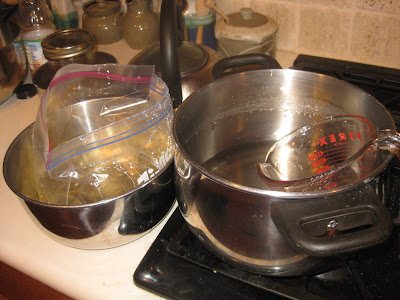
Drips happen in the pouring of the syrup from the pot to the ziploc baggie. The measuring cup drips. The pot is too heavy for me to pour and hold the baggie open at the same time so I start by transferring the syrup from the pot via a glass one cup measure. Drippy, drippy, drippy.
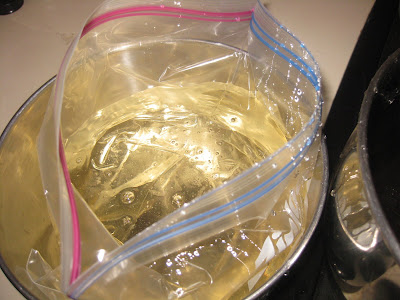
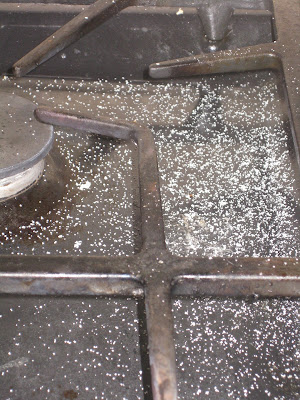
And in pouring the sugar into the boiling water, sugar gets sprinkled all over my burners.
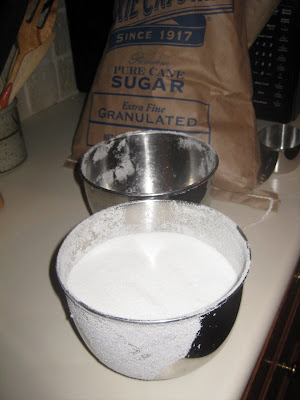
The only discovery that has diminished the mess is that I discovered that two of these one quart mixing bowls (see photo below) filled to this level = eight cups of sugar. I then don't have to make as many transfers from the bag of sugar to the boiling water. That has cut down on the sugar on the counter.
When I'm finished I have to clean at least three or four pots, three or four mixing bowls, an assortment of whisks, a sharp knife, and of course, the kitchen counter, the floor and the stove top.
In addition the bees go through a baggie in about five days so I am feeding at least once a week and often more. So unlike harvesting which takes place a couple of times each summer, this feeding mess and clean up happens weekly or more and has been continuous since the beginning of September.
All in all, I'd say making and using sugar syrup in ziploc baggies is the biggest clean-up challenge I've had so far in beekeeping.

Making sugar syrup is an entirely different matter. I find it very messy and difficult to clean up. Since the process takes place on my gas stove, I can't line the burners with anything and sugar and drippy syrup get all over EVERYTHING.
When I'm done, there are sugar drips on the stove, on the floor, on the counter, on my clothes, on every square inch in the vicinity of the pot.

Drips happen in the pouring of the syrup from the pot to the ziploc baggie. The measuring cup drips. The pot is too heavy for me to pour and hold the baggie open at the same time so I start by transferring the syrup from the pot via a glass one cup measure. Drippy, drippy, drippy.

And in pouring the sugar into the boiling water, sugar gets sprinkled all over my burners.

The only discovery that has diminished the mess is that I discovered that two of these one quart mixing bowls (see photo below) filled to this level = eight cups of sugar. I then don't have to make as many transfers from the bag of sugar to the boiling water. That has cut down on the sugar on the counter.
When I'm finished I have to clean at least three or four pots, three or four mixing bowls, an assortment of whisks, a sharp knife, and of course, the kitchen counter, the floor and the stove top.
In addition the bees go through a baggie in about five days so I am feeding at least once a week and often more. So unlike harvesting which takes place a couple of times each summer, this feeding mess and clean up happens weekly or more and has been continuous since the beginning of September.

All in all, I'd say making and using sugar syrup in ziploc baggies is the biggest clean-up challenge I've had so far in beekeeping.
Wednesday, October 07, 2009
The Newest Baby Bee

I've paused in my beekeeping to welcome the newest baby "bee" to my family....my little granddaughter, Lark, born 10-6-09! I suppose that means she's a bird and not a bee, but nonetheless, I see a bee veil all her own in her future!


Friday, October 02, 2009
Bees Eating Sugar Syrup
These days I am feeding my bees sugar syrup in order to help them prepare for winter. I didn't do this last year, but this year my hives, despite my harvesting very little honey, are too light to go into winter.
The bees in the picture below have just discovered the sugar syrup floating by the slits in the baggie feeder.

The hive from which I took these pictures yielded me no harvest this year and they are very light on stores for the winter. This is the hive that I combined with the nuc from Blue Heron back in August.

In these two pictures (above and below) you can see the bees' tongues out to slurp up the honey.

Below is a frontal view of a syrup slurping bee.

I closed up the hive with one last glance through the hole in the inner cover to see them feeding away!

The bees in the picture below have just discovered the sugar syrup floating by the slits in the baggie feeder.

The hive from which I took these pictures yielded me no harvest this year and they are very light on stores for the winter. This is the hive that I combined with the nuc from Blue Heron back in August.

In these two pictures (above and below) you can see the bees' tongues out to slurp up the honey.

Below is a frontal view of a syrup slurping bee.

I closed up the hive with one last glance through the hole in the inner cover to see them feeding away!

Thursday, October 01, 2009
A View Into the Bee Tree
Even though I don't post about it every time I go, I feed the bees in the bee tree at least once a week. The last time I went was last Thursday, after a visit to see the flood damage at Blue Heron.
Today I took them a baggie feeder full of 2:1 sugar syrup. It was only 59 degrees this morning and the bees weren't clustered around the opening and weren't flying too much. So I took advantage of the opportunity to peek inside their tree home with my camera.
Here's how the entrance looked this morning. The bees are clearly more inside the tree than out.

A view of the inside reveals bees on top of bees.

I couldn't decide if they were clinging to each other or if there is a shard of rotting wood still in the center of the hollow part of the tree.

It looks as if they are clinging to each other as I get closer inside. I so wish I could see their interior combs and how long they are and how they have been repaired after the tree cutting. But for now, this is the view.

When I opened the hive box on top of the bee tree, I found a totally empty baggie and no bees at all. I guess they were all clustered to keep warm - it was about 49 or 50 degrees last night. When I put the baggie on the frames and slit it, one lone bee came up to greet me.

Today I took them a baggie feeder full of 2:1 sugar syrup. It was only 59 degrees this morning and the bees weren't clustered around the opening and weren't flying too much. So I took advantage of the opportunity to peek inside their tree home with my camera.
Here's how the entrance looked this morning. The bees are clearly more inside the tree than out.

A view of the inside reveals bees on top of bees.

I couldn't decide if they were clinging to each other or if there is a shard of rotting wood still in the center of the hollow part of the tree.

It looks as if they are clinging to each other as I get closer inside. I so wish I could see their interior combs and how long they are and how they have been repaired after the tree cutting. But for now, this is the view.

When I opened the hive box on top of the bee tree, I found a totally empty baggie and no bees at all. I guess they were all clustered to keep warm - it was about 49 or 50 degrees last night. When I put the baggie on the frames and slit it, one lone bee came up to greet me.

Wednesday, September 30, 2009
Podcast about Beekeeping and Beekeepers' Clubs
I was interviewed for a podcast by Darcy, a northern Kentucky beekeeper, back in August. He has recently posted the podcast.
We had fun talking about bee clubs, beekeeping and my blog for about 40 minutes.
Here's the link, if you'd like to listen.
There's a bar at the end of the post where you can click to listen to my conversation with Darcy.
We had fun talking about bee clubs, beekeeping and my blog for about 40 minutes.
Here's the link, if you'd like to listen.
There's a bar at the end of the post where you can click to listen to my conversation with Darcy.
Urban Beekeeping - Bees in the City
The Daily Green and Bee Culture teamed up to gather data and photos from urban beekeepers. Today the first pictures that were sent in response to Dan Shapely's request to hear from city beekeepers came out.
Here's the link.
I sent a picture of a hive inspection at the (now lost until next year) Blue Heron hives and sent them a story about my beekeeping adventures.
My picture and story are located at picture #36 in the slideshow. It's fun to look at all the pictures and see how many different ways people keep bees in the city.
Here's the link.
I sent a picture of a hive inspection at the (now lost until next year) Blue Heron hives and sent them a story about my beekeeping adventures.
My picture and story are located at picture #36 in the slideshow. It's fun to look at all the pictures and see how many different ways people keep bees in the city.
Monday, September 28, 2009
Loss ..... and Gain
We had wondered about the hive with food that we set up at Blue Heron - were the bees there homeless or were they robbers from the neighborhood? Yesterday Julia and I went over and removed the empty boxes.
Under my box which had had the most activity was a clear sign of robbers. When robbers open honey cells, they rip the cell open, leaving ragged edges on the comb and dropping wax shards carelessly below. You can see the wax shards on top of the cinder block.
The reason there are shards on one block and not so much on the other is that some of the frames we put in the wrecked hive had dead brood and some had capped honey - so the honey must have been on that side.

We left the cinder blocks to inspire us for next year and to remind us that once there were bees thriving at Blue Heron.

From a practical point of view, last night I decided to look at the cost of what was lost.
Hive Body - 2 per hive $24
Telescoping Top $20
Inner Cover $10
Screened Bottom Board $15
Frames $20
Slatted Rack $11
Original nuc bees $75
Replacement Purvis Queen $50
Total $225
That's a lot of stuff floating down the river. Since there were seven hives there, each with approximately the same equipment, that means the total losses at Blue Heron for all the beekeepers there amounted to about $1575. Goodness -
While the whole thing was and is very sad, I spent some of Sunday afternoon with a young woman and her family who wanted to learn about bees to see what it would be like to start keeping bees in the spring.
Here's Annie in one of my beesuits, happily opening and exploring beekeeping as a possible new venture for herself.

So I tell myself there is balance. The bees and hives may have washed down the river, but there's at least one new beekeeper who wants to bring the tiny insects into her life.
And next year there will be more beehives and more beekeepers in the world.
Under my box which had had the most activity was a clear sign of robbers. When robbers open honey cells, they rip the cell open, leaving ragged edges on the comb and dropping wax shards carelessly below. You can see the wax shards on top of the cinder block.
The reason there are shards on one block and not so much on the other is that some of the frames we put in the wrecked hive had dead brood and some had capped honey - so the honey must have been on that side.

We left the cinder blocks to inspire us for next year and to remind us that once there were bees thriving at Blue Heron.

From a practical point of view, last night I decided to look at the cost of what was lost.
Hive Body - 2 per hive $24
Telescoping Top $20
Inner Cover $10
Screened Bottom Board $15
Frames $20
Slatted Rack $11
Original nuc bees $75
Replacement Purvis Queen $50
Total $225
That's a lot of stuff floating down the river. Since there were seven hives there, each with approximately the same equipment, that means the total losses at Blue Heron for all the beekeepers there amounted to about $1575. Goodness -
While the whole thing was and is very sad, I spent some of Sunday afternoon with a young woman and her family who wanted to learn about bees to see what it would be like to start keeping bees in the spring.
Here's Annie in one of my beesuits, happily opening and exploring beekeeping as a possible new venture for herself.

So I tell myself there is balance. The bees and hives may have washed down the river, but there's at least one new beekeeper who wants to bring the tiny insects into her life.
And next year there will be more beehives and more beekeepers in the world.
Subscribe to:
Posts (Atom)
Pin this post

LinkWithin
