We now have hives back at Blue Heron and are hoping for a crisis-free bee season - no floods, no animals, no problems.
Julia and I each got a nuc from Jennifer Berry, Keith Delaplane's right hand woman at the UGA bee lab. Jennifer has started her own business selling bees and queens. Her bees were beautiful and looked very healthy.
I've bought nucs every year for the past four years. Every year I get frames that have old, black comb on them, icky plastic frames, anything the beekeeper wants to pass on to someone. Jennifer's nucs were not like that. The frames were lovely, the comb was fresh and new and the bees looked fantastic. I hope they live and thrive.
Here's the slideshow of our installing these two hives. If you click on the slideshow you can see it in full screen and possibly see the details better:
Tuesday, March 30, 2010


Procrastination in Winter Never Pays Off
This April begins my fifth year keeping bees. Every winter I know most beekeepers paint and clean their old equipment - not me. Every year I promise myself that this year will be different. This year I'll paint equipment over the winter. Then bread baking, knitting for the grandchildren, watching movies all get in the way of my actually picking up a paintbrush.
This year as a favor and a surprise, one of my friends arranged to get the nuc I was purchasing from Jennifer Berry for the Blue Heron delivered to her house last night. I was supposed to drive to Good Hope on Saturday morning to get it. Instead it came last night and I was frantically painting equipment into the night.

You'll remember our Blue Heron hives were flooded out last September. I lost my eight frame bottom boards, inner covers, slatted racks in the flood. I have a lot of 10 frame bottom boards and slatted racks. Since I plan to move altogether to 8 frame medium boxes, I added a small feature to my slatted rack to adapt it to the 8 frame hive.
I cut a piece of the leftover board from the top bar hive to fit the length of the slatted rack. I painted it, nailed it to the edge of the slatted rack and adapted my hive bottom for 8 frame boxes. This wouldn't work as well with the screened bottom board because it is lower from the side edge to allow for a bee entrance at the front of the hive. In contrast, the slatted racks are only bee space below the edge, so the box sits perfectly in the space.

Here's the finished result. I also only have top covers for 10 frame but that will go over the 8 frame just as well. I bought ventilated hive covers to use this year as an inner cover at Blue Heron, so my hive is all equipped.....and I am breathless due to my procrastination!

Sunday, March 28, 2010
The Top Bar Has a Top!
Yesterday I stapled in the screened bottom for my top bar and measured and cut the plastic roof. It's all ready for the bees now and only needs to be moved to its home at Valerie and Jeff's house where it will spend the summer.


The bricks keep the top from blowing off!

You can see extra top bars in the plastic tub. My challenge now is to clean the newspaper and other mess up from my carport!


The bricks keep the top from blowing off!

You can see extra top bars in the plastic tub. My challenge now is to clean the newspaper and other mess up from my carport!
Saturday, March 27, 2010
Orienting the New Bees
When bees reach foraging in their development (around 3 weeks old), they have to orient to the hive in order to leave it. This way when they start for home after a nectar-collecting flight, they know where home is. At the end of a day usually around 3:30 or 4:30 in the afternoon, bee hives are all a-buzz as the new foragers fly out for orientation.
They fly out of the entrance, up into the air about a foot, turn and observe the hive. They do this over and over until they "get" the location and the cues they need to find home again.
If you move a beehive, you should move it at least 3 miles as the crow flies from their old location to assure that the bees who leave to forage don't return to the old (now empty) location. The bees we moved last night lived about 2.5 miles as the crow (or the bee) flies from my house. It's possible that they will fly back to their original location, so I wanted to get them to orient to their new home.
Well, I've uploaded a video I made with my camera onto YouTube....it's perfectly in focus on my home computer and not great at all here, but FWIW, here is a video of the bees in orientation flying.
One way to do that is to put distracting unusual things at the hive entrance such as sticks and leaves. You don't block the entrance, but you do throw a few things on the front porch. After a day or two the bees will all be re-oriented and they will move the sticks and debris off the porch as a housecleaning chore.
This was the angriest hive of the three last night when we moved the bees, so before I removed the screen wire from the entrance, I gathered some sticks and grass to use on the entry-way.
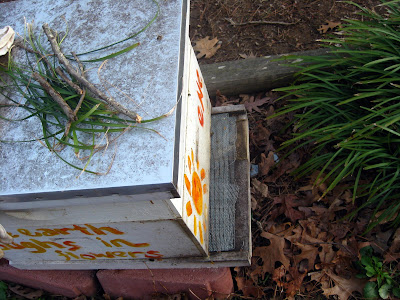
Jacketed and gloved (these were angry bees) I gingerly pulled out the screen wire blocking their entrance. I was glad I had already gathered the debris. I quickly set it on the entry as bees poured out into the 45 degree air.
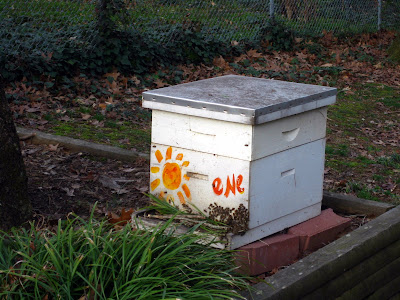
Reassuringly, I almost immediately saw the bees begin to orient, flying out and up and observing their new location. (It was too cold for most bees to fly, but they were doing it anyway.) A few bees head-bumped my veil and a few landed on my shoulders and arms, but for the most part they gathered at the entrance and tried to regroup.
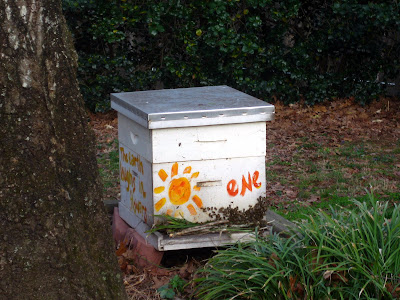
It's interesting that they are gathering on that one side of the entry. Maybe there is less debris on that part of the entry and maybe the queen will be working mainly on that side of the hive. I'll open the hive next weekend to see what's what. I plan to give them new boxes in case there is any disease, wax moth eggs, etc. in the old neglected boxes, and set them up to think of moving to north Georgia (another move, I hate to tell them) in a couple of weeks.
Preview of coming attractions: Next Saturday at 8 AM, I will be picking up a nuc for Blue Heron from Jennifer Berry at her apiary in Good Hope, Georgia.
They fly out of the entrance, up into the air about a foot, turn and observe the hive. They do this over and over until they "get" the location and the cues they need to find home again.
If you move a beehive, you should move it at least 3 miles as the crow flies from their old location to assure that the bees who leave to forage don't return to the old (now empty) location. The bees we moved last night lived about 2.5 miles as the crow (or the bee) flies from my house. It's possible that they will fly back to their original location, so I wanted to get them to orient to their new home.
Well, I've uploaded a video I made with my camera onto YouTube....it's perfectly in focus on my home computer and not great at all here, but FWIW, here is a video of the bees in orientation flying.
One way to do that is to put distracting unusual things at the hive entrance such as sticks and leaves. You don't block the entrance, but you do throw a few things on the front porch. After a day or two the bees will all be re-oriented and they will move the sticks and debris off the porch as a housecleaning chore.
This was the angriest hive of the three last night when we moved the bees, so before I removed the screen wire from the entrance, I gathered some sticks and grass to use on the entry-way.

Jacketed and gloved (these were angry bees) I gingerly pulled out the screen wire blocking their entrance. I was glad I had already gathered the debris. I quickly set it on the entry as bees poured out into the 45 degree air.

Reassuringly, I almost immediately saw the bees begin to orient, flying out and up and observing their new location. (It was too cold for most bees to fly, but they were doing it anyway.) A few bees head-bumped my veil and a few landed on my shoulders and arms, but for the most part they gathered at the entrance and tried to regroup.

It's interesting that they are gathering on that one side of the entry. Maybe there is less debris on that part of the entry and maybe the queen will be working mainly on that side of the hive. I'll open the hive next weekend to see what's what. I plan to give them new boxes in case there is any disease, wax moth eggs, etc. in the old neglected boxes, and set them up to think of moving to north Georgia (another move, I hate to tell them) in a couple of weeks.
Preview of coming attractions: Next Saturday at 8 AM, I will be picking up a nuc for Blue Heron from Jennifer Berry at her apiary in Good Hope, Georgia.
Friday, March 26, 2010
The Second Hive Move (This one goes to my house)
Julia very generously offered me one of the hives. I plan (if I can get it established and get some help to move it) to take this hive to Rabun County to the community garden (see earlier post).
We smoked these bees. We had a brand new totally worthless staple gun (back to Ace with me tomorrow) and tried our best to use an office stapler to attach hardware cloth to the entry way. The first time was a wash - didn't work and the bees were angry. Imagine not being disturbed in four years, when suddenly in two weeks your hive has been disrupted and now moved!
We smoked the hive like crazy to get the bees to go inside and to calm down. I've never in five years used this much smoke on a hive.

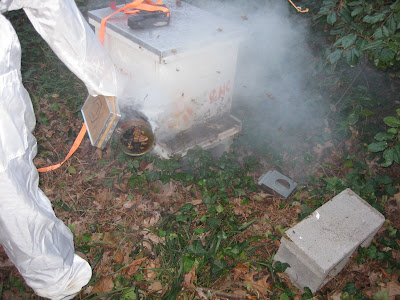
In the end we decided to jam the hardware cloth into the entrance rather than try to staple it ineffectively.
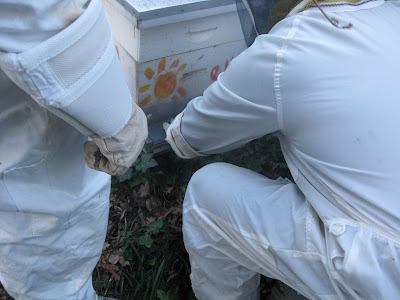
Here's the end result. It seemed pretty effective after a lot of effort. Everyone on this expedition except Julia took at least one sting. For Julia's son Noah, this was his first sting ever. He said, "I need boots!" but didn't complain about the pain.
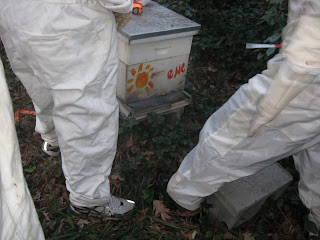
All the hives were loaded into the truck along with the extra equipment. Then they were driven to their destinations. One came to my house. Another to Julia's. The third hive with only a few bees in it went to another Julia's house. That Julia has a very weak hive and is great need of bees.
 Now the hive sits in my backyard awaiting yet another move in a couple of weeks!..

We smoked these bees. We had a brand new totally worthless staple gun (back to Ace with me tomorrow) and tried our best to use an office stapler to attach hardware cloth to the entry way. The first time was a wash - didn't work and the bees were angry. Imagine not being disturbed in four years, when suddenly in two weeks your hive has been disrupted and now moved!
We smoked the hive like crazy to get the bees to go inside and to calm down. I've never in five years used this much smoke on a hive.


In the end we decided to jam the hardware cloth into the entrance rather than try to staple it ineffectively.

Here's the end result. It seemed pretty effective after a lot of effort. Everyone on this expedition except Julia took at least one sting. For Julia's son Noah, this was his first sting ever. He said, "I need boots!" but didn't complain about the pain.


All the hives were loaded into the truck along with the extra equipment. Then they were driven to their destinations. One came to my house. Another to Julia's. The third hive with only a few bees in it went to another Julia's house. That Julia has a very weak hive and is great need of bees.
Now the hive sits in my backyard awaiting yet another move in a couple of weeks!..
Moving hives at dusk
A couple of weeks ago, Julia and I went to her friend's house to learn the story of the hives that had been pretty much untouched for four years. We found two good hives and one questionable one. We cleaned things up a bit and left these hives to regroup until we could move them. Moving happened this evening.
Mistake number one: We strapped these boxes together before we blocked the entrance. This brought the bees out in force to see what was disturbing their previously rarely disturbed box.

Julia's husband and friend put on the strap, ratcheted it tight, and we left it for a bit so the bees could calm down a little.

Then Julia's husband and her sister's friend, suited up and all prepared, carried the hive to the back of Ron (the friend's) truck.

The beehive had had a rotten bottom board which we replaced on our earlier visit. Without the strong wood of the bottom board we would not have been able to staple the #8 hardware cloth to block the entrance.
This was the first hive we loaded onto Ron's truck for delivery to Julia's backyard.

Tuesday, March 23, 2010
Swarming - the Reproduction of the Hive

Environmental cues that contribute to swarm preparation in the hive:
- Time of year (spring build-up, usually)
- Length of days (longer)
- Availability of nectar (the new hive formed by the swarm has to be able to provision itself)
- Warm weather (what cluster of bees wants to hang from a branch in the snow?)
- Congestion in the brood nest
- Good buildup of population in the hive
- Lots of young bees (70% of worker bees in the swarm are under 10 days old)
- Reduced distribution of queen pheromone (which influences the workers to build queen cells)
Usually the swarm takes place on the day of or the day after sealing the first queen cell.
Note: in traditional beekeeping practices, the beekeeper "cuts" queen cells. The teaching is that cutting the queen cells keeps the hive from swarming. Let's think about this.
The hive is going to swarm when the first queen cell is capped. The bees themselves sometimes destroy queen cells to delay swarming. They do this during bad weather or when the nectar flow has stopped so that the swarm won't leave in less than optimal conditions.
Since it works for the bees, beekeepers often try to prevent swarming in the same way, but we are not privy to hive decision making. The beekeeper opens the hive and says, "Oh, dear, I must cut out those queen cells." And with one decision, the hive may be rendered queenless because the old queen has left/is leaving with the swarm.
Hmmmmm. I don't think I will be cutting queen cells.
Another possibility upon finding swarm cells in the hive is to take a frame with queen cells on it and use it to make a split a la Michael Bush. Maybe this is the way I'll choose to go when I find swarm queen cells in my hives this year.
Sunday, March 21, 2010
Beekeeping at Rabun County Community Garden
I've been invited to bring bees to the new Rabun County community garden. The garden is located just behind the Rabun County Civic Center where the Georgia Beekeepers Association meeting was held in the fall of 2009. As you can see in the first picture, the ground has been turned over and the plots denoted with posts.
In the far corner, away from everything, you can see where I've drawn a red bee box. This is where the hive will be located. The garden is on an old school ground behind a soccer field. The location is at the edge of a creek.

The 4-H members in Rabun County built a garden shed from start to finish. They cut a tree on my friends, Mary and Robin's, land and cut the boards and then built the building. Isn't 4-H amazing! These kids built a beautiful shed with two sky-lights in the roof.

The beehive will be sitting beside a creek as a water source. I plan to bring bees up, probably the weekend after Easter, to start a hive here. One thing I'll have to order is an electric fence - there are many honey-hungry bears in Rabun County!

Here's a view that shows how protected the hive will be. At it's back are trees and shrubs lining the creek. on the left side of the picture is a ditch. Nobody will be close to this hive. We plan to put up the electric fence as well as signs about respecting the bees' space.

Subscribe to:
Posts (Atom)
Pin this post

LinkWithin
