Welcome - Explore my Blog

I've been keeping this blog for all of my beekeeping years and I am beginning my 19th year of beekeeping in April 2024. Now there are more than 1300 posts on this blog. Please use the search bar below to search the blog for other posts on a subject in which you are interested. You can also click on the "label" at the end of a post and all posts with that label will show up. At the very bottom of this page is a list of all the labels I've used.

Even if you find one post on the subject, I've posted a lot on basic beekeeping skills like installing bees, harvesting honey, inspecting the hive, etc. so be sure to search for more once you've found a topic of interest to you. And watch the useful videos and slide shows on the sidebar. All of them have captions. Please share posts of interest via Facebook, Pinterest, etc.

I began this blog to chronicle my beekeeping experiences. I have read lots of beekeeping books, but nothing takes the place of either hands-on experience with an experienced beekeeper or good pictures of the process. I want people to have a clearer picture of what to expect in their beekeeping so I post pictures and write about my beekeeping saga here.Master Beekeeper Enjoy with me as I learn and grow as a beekeeper.

Need help with an Atlanta area swarm? Visit Found a Swarm? Call a Beekeeper. ‪(404) 482-1848‬

Want to Pin this post?

Friday, January 29, 2010

The MOST Fabulous Present

On Thursday it was my friend George's birthday. He and I have known each other as professional colleagues for years. We refer back and forth and consult with each other, but beyond the professional contact, I consider George a dear friend. Well, on his birthday, he brought me a present!

I couldn't believe it - this adorable honey bee honey holder. And it's anatomically correct - all six legs are attached to the thorax (can you tell I'm studying for Master Beekeeper?).

Anyway, I came straight home and filled it with honey. I took these pictures without flash because I love how golden and glowing the bee looks, with honey in her abdomen, ready to share it with you (or anyone who comes by!)


Isn't she lovely? You lift up her wings and the stick coming out of her back is a silver scoop for delivering honey to the biscuit or whatever confection you plan to eat with honey.

Thank you, George. What a perfect and perfectly lovely gift! I feel so privileged to be remembered on George's birthday!

Posted by Picasa

Metro Atlanta Short Course in Beekeeping

Last weekend was the Metro Atlanta Short Course. We had 120 participants! There is such an increased interest in beekeeping in our country. I hope some of the 120 will actually buy bees and get started.

My job was to put together a table to show slide shows of hive inspections. So I showed up with two laptops, two different slide shows (one of the slide shows is available on this blog for you to watch), and a honeybee table cloth that my daughter gave me and a scarf, used here as table decoration that a dear friend made for me.


We had many well-qualified speakers and the participants went home with a CD of the PowerPoints of the presenters (but it didn't include my slide show on how to do a hive inspection - just a handout).

One of our best speakers (because he is such a good teacher) is Dr. Jamie Ellis. Jamie got his PhD at the University of Georgia but is now at the University of Florida. He shared many interesting bee facts with the participants. Here he is talking about how larvae occupy the cells.


At a break our participants were treated to honey ice cream. One of our members takes 6 pounds of honey to Greenwood Ice Cream which is here in Atlanta and has them create honey ice cream just for this event. It is absolutely gourmet and delicious.


In all the short course was a success.

I think our bee club still needs to work on a few things - we are a little starry eyed by the fabulous speakers we can invite, and in that way, have lost sight of a few important things.

A beekeeper leaving our course should feel confident about how to install their bees and how to open the hives for the first time, and those things are barely addressed (if at all) in our short course. But 2011 is another year and maybe we can focus on the basics for the next course.
Posted by Picasa

Sunday, January 24, 2010

How to do a Basic Hive Inspection

I ran a table at the short course yesterday in Atlanta and had this slide show running as a continuous loop. Many participants wanted to know if they had access to this after the course, so I searched to find a way to upload PowerPoint slides.

I hope all of you will find this useful. It's a YouTube video/slide show

Thursday, January 21, 2010

Science Night at Montgomery Elementary

Tonight was Science and Technology night at Montgomery Elementary School in Atlanta. I was asked to be the beekeeper and talk about the bees. Somehow I managed to get away without a photo of my display - I took a blue nuc box, frames of wax in process and completely drawn, honey to taste, lip balm, beeswax, candles, children's books about bees and a slide show loop about inspecting a bee hive that I put together for the short course this Saturday.

I did get some cute pictures of the kids who tried on my grandson's bee veil - they thought it was just the bees knees to get to try it on (and one mother). Actually several of the parents wanted to try on the veil and asked great questions. The kids mostly wanted to taste the honey!

I had a great time. Enjoy the adorable kid pictures below.


Posted by Picasa

Wednesday, January 20, 2010

Bees are Flying on my Deck and at the Bee Trees!


Today I had a break at work so I went home to see about the bees. Bees were flying at all three hives and I wanted to celebrate. So far, so good, as they say. I am concerned that we will have yet another hard freeze before winter is over and that I won't be so lucky the next time.


To add to my worry, I checked with the Farmers Almanac 2010 and found that they are predicting another hard freeze from February 8 - 11, with the freezing weather again extending all the way down to Florida.


I also stopped by Eddie's Odd Job Tree Service to check on the bee trees. Lo and behold, both trees had bees flying in and out. I was so excited, but disappointed that I didn't have my camera.

This means that both trees had viable queens going into the winter and that they at least had enough stores to make it this far. I'll stop by with baggie feeders early next week.

Tuesday, January 19, 2010

Keith Fielder on Nectar Bearing Trees of Georgia

I love it when Keith Fielder comes to talk to our bee club. He is the 2009 Beekeeper of the Year in Georgia and a Master Beekeeper (there are only 12 Master Beekeepers in Georgia). He is passionate about keeping bees and has strong opinions about what beekeepers need to be up on to be good beekeepers.

This month at Metro Atlanta, he talked about nectar bearing plants. Knowing about the nectar bearing plants in your area helps a beekeeper be informed about where to place their hives so that the bees have maximum benefit of the nectar. Knowing the bloom cycle of plants helps the beekeeper know when to super and when to remove your supers.

His talk was so interesting that I wanted to share his main points with you.

People around Atlanta talk about privet honey as a bad honey, but Keith said that privet makes a good honey in the S Georgia region. This may have to do with temperatures as it affects the privet bloom.

The tulip poplar whose blooming period signifies the nectar flow in Atlanta is found in every county in Georgia and is one of our best nectar providers for the bees. However our nectar flow in Georgia is heralded by the bloom of the red maple. Red maple, which is often found in urban areas, is already starting to bloom in Atlanta. Red maples are often near the tulip poplars. It blooms in late January and definitely in February.

Another important early nectar bearing plant is the dandelion. When he said that, I thought of the many lawns in Atlanta where the goal is to keep the dandelion at bay. A sad thought that the bees are then deprived of dandelion nectar. Luckily my house backs up to woods and this means that there are uncut dandelions behind me. Keith said that the nectar from the dandelion helps with spring build up by providing nectar and pollen as the bees are getting started in the early spring.

Another nectar bearing plant in Georgia is the Canola - it's a rape seed, but the name was changed because of the negative connotations of the word "rape." I didn't know that Canola stood for Canada Oil Low Acid???? While we do grow canola in Georgia, actually 91% of the canola crop is grown in North Dakota. In Georgia, canola blooms in late February or early March and yields a light honey.

Much of the honey in the Atlanta area is informed by both tulip poplar, which generally blooms from April until the end of May, and blackberry which blooms during the same period. Other helpful nectar bearing plants which bloom about the same time are the clovers. White clover is a tremendous source of nectar but the red clover requires a proboscis longer than the bee's and isn't really a source for our bees at all. White clover is another plant that people often hasten to cut out of their yards.

I was surprised to hear him say that tupelo (or Ogeechee tupelo, swamp tupelo, and white tupelo) is actually found all over Georgia. I thought that tupelo was only in the Georgia area that borders Florida. I'm going to be on the watch for these trees around here this year...the black tupelo is the one that is found all over Georgia.

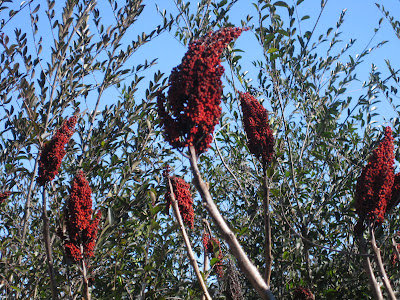
He also talked about holly--which has a light nectar and is great for comb honey; cliftonia (the buckwheat tree), gallberry (a relative of holly). I liked it that he talked about smooth sumac as a source of rich, dark honey. Over Christmas, I saw sumac berries on the trail in Franklin, NC that runs along the Little Tennessee River.
He also covered sourwood, which is in N Georgia in late July at elevations from 1500 - 3000 feet. Made me want to take beehives up to my mountain place which is at that elevation and has sourwood trees all over the three acres.

Cotton honey, which is not a honey I've ever tasted, Keith talked about as one would a fine wine. He said the taste of cotton honey is very complex and that you taste one thing at the beginning and that it "finishes" a different way. His enthusiasm for this honey was remarkable.

Several interesting points he made:
  • Some beekeepers mark their frames to know when the honey is capped and to be able to remove the frame at that point, knowing that they can say, "This is XXXX honey."
  • It takes a lot of anything to impact the taste of honey - so if you have a little anise hyssop as I do in my garden, there's hardly enough to change the honey flavor (although my daughter swears she can taste the anise flavor in my honey)
  • Jasmine and lantana can poison bees. Honey from mountain laurel can poison beekeepers.
I can't wait to hear him again this weekend when he presents at the Metro Atlanta Beekeepers Short Course at the Botanical Garden in Atlanta.

Friday, January 15, 2010

Death threat and the bee hives

Finally the temperature has risen to 52; I am actually at home being Grandma to my grandson Dylan; and the bees are flying - but only from two hives. Before lunch I noticed that the bees are having a veritable party in front of Mellona (the center hive) and are pretty enthusiastic in front of Aristaeus2.

But Bermuda, my original bee hive which, if it survives this winter, will be entering its fifth year, is painfully quiet. I watch the entrance like a hawk, but no bees appear. An occasional bee hesitates around the entrance the way a hive robber does, but no normal entering and exiting is happening.

I felt deflated at lunch, thinking my bees, my original hive, had now bitten the dust. Recognizing that bees were out and about, before Dylan and I went to lunch I made up three sugar syrup baggies (being optimistic) and left them to cool while we went to Dylan's favorite place: Chik-Fil-A.


When Dylan went to nap, I opened up the hives. I opened Bermuda first, feeling a sinking in the pit of my stomach.

Joy! Joy! Joy! Under the hive cover in the top box were the bees. They were tightly clustered around two frames in the top box. I think their numbers have diminished considerably, but they were there! And they were alive.

I immediately gave them a bag of 2:1 sugar syrup. It's still too early in Atlanta to feed them 1:1, according to Jennifer Berry's article in Bee Culture this month.


I then opened Mellona and was sad to find dead bees in the sugar syrup which was crystallized. I don't understand this but feel very sad about it. This hive is doing fine, despite the bee kill in the baggie. There are lots of bees somewhere in a lower box on the hive. I didn't explore since it was clear that they are alive and doing fine. I just wanted to put in a baggie and shut the hive back up.


After feeding all three hives, I looked at the leaves in front of Mellona. I pushed the leaves aside and saw the piles of dead bodies. Over the winter many bees die in the hives and the mortician bees can't carry the bodies away from the hive. They appeared to have simply swept these bodies out of the hive.


So for the moment the good news is that my bees are all alive - all three hives.

That can turn on a dime, with the exigencies of the weather, and more sudden cold snaps after a few warm days may kill one of my hives yet.


Posted by Picasa

Thursday, January 14, 2010

My bee hives in the snow last Friday ago

If we get snow in Atlanta, it rarely sticks. The major snows here in the 30 years I've lived here are mostly in March and late February....a freakish cold snap as spring is beginning.

Out of character for Atlanta, we had a major snow last Friday. It wasn't deep but it did have a layer of ice under it - which in Atlanta as humid as we are - stops traffic.

Here's what my hives looked like. My friend Diana told me that she knew her hives were alive through the snow because a heated area melted on the tops of her hives (due to the heat generated by the bees inside). My hives didn't accumulate that much snow and what was there didn't melt in any unique or significant way. (Can you tell I'm jealous of Diana's photo opp - and BTW, she didn't take a picture of it!)


Obviously there's no flying from these hives. The temperature remained in the teens and 20s all week, so I worried about my bees. It's around this time of year that the bees sometimes get fooled by Mother Nature. They have experienced some warmer days; the red maple is actually already blooming; and they start thinking spring is here when it isn't. So hives that have made it through the winter until now may suddenly be dead of starvation.


I'm too scared to put my ear to the side of the hive. I wish I were brave enough but I don't want to find out that a hive has died.
Posted by Picasa

Pin this post

LinkWithin

Related Posts Plugin for WordPress, Blogger...