Welcome - Explore my Blog

I've been keeping this blog for all of my beekeeping years and I am beginning my 19th year of beekeeping in April 2024. Now there are more than 1300 posts on this blog. Please use the search bar below to search the blog for other posts on a subject in which you are interested. You can also click on the "label" at the end of a post and all posts with that label will show up. At the very bottom of this page is a list of all the labels I've used.

Even if you find one post on the subject, I've posted a lot on basic beekeeping skills like installing bees, harvesting honey, inspecting the hive, etc. so be sure to search for more once you've found a topic of interest to you. And watch the useful videos and slide shows on the sidebar. All of them have captions. Please share posts of interest via Facebook, Pinterest, etc.

I began this blog to chronicle my beekeeping experiences. I have read lots of beekeeping books, but nothing takes the place of either hands-on experience with an experienced beekeeper or good pictures of the process. I want people to have a clearer picture of what to expect in their beekeeping so I post pictures and write about my beekeeping saga here.Master Beekeeper Enjoy with me as I learn and grow as a beekeeper.

Need help with an Atlanta area swarm? Visit Found a Swarm? Call a Beekeeper. ‪(404) 482-1848‬

Want to Pin this post?

Saturday, April 12, 2014

Indeed it is SWARM season!

On Monday, my house is going to be all topsy-turvy as my kitchen renovation begins and for about six to eight weeks, I will be without the ability to cook at home - at least not as I am used to.  I have spent the last few days organizing and re-organizing to make ready for the big event.

I was walking out to take some recycling to the curb (result of all my cleaning/organizing) when a neighbor and great gardener, Hal, walked up.  "Fortunate that you are here," he said.  He sounds like the perfect Southern novel when he speaks.  He told me that there was a bee swarm just down the street and he wondered if I could come see it.

I was delighted and walked with him to the corner where there was a huge swarm on a branch about seven feet up in my neighbor's tree.  Scott, the neighbor, said the bees had just landed there about 10 minutes before.  I have all of my windows open and would have heard a swarm gathering in my yard if they were my bees, so I am pretty sure they came from somewhere else.


About two cats, I'd say.  I went home to get all my swarm catching gear:  sheet, spray container of sugar syrup, ladder, banker's box, ventilated hive cover, straps, bee brush, veil, jacket, old comb, my swarm catcher and mop handle.  I came back and up walked George Andl, a neighbor, beekeeper, and fellow blogger.  George wanted to help and went home to get his gear.

When he came back, I climbed the ladder and held the branch in one hand and the plastic banker's box in the other.  I shook the branch and most of the bees fell into the banker's box.  I used the water cooler bottle of my swarm catcher to gather most of the remaining bees.

I set the banker's box on the ground and the bees began nasanov emissions.  I assume that means I got the queen but a number of bees stayed on the tree branch, drawn, I suppose, to her pheromone.  I forgot to bring anything to cover the ventilated cover and make it dark in the box, so I just sort of wrapped the sheet up over the box.  Bees continued to go into it.

Since I literally live three houses away.  I didn't strap the top onto the box, but instead completely surrounded the box with sheet and gently lifted it into my car.  


When I got home, the bees were mostly clinging to the underside of the ventilated hive cover.  I poured the bees into a waiting hive box.


When I brought the bees home, there was a small clump still up in the tree.  I went back to Scott's house and put an old nuc box under the cluster.  I put in the nuc box the old comb that I had baited the banker's box with when I shook the swarm.  I thought that might smell like "mommy" to them.  I left the nuc box with the lid ajar and went to dinner.

As dark fell,  I returned to Scott's where all the bees had pretty much gone into the nuc box.  I brought it home and set it on the banker's box so that the entry to the nuc box faced the entry to the hive in which I had put the swarm.  In the morning perhaps the nuc bees will go home to mommy in the new hive box!


Chastain Inspection with Julia

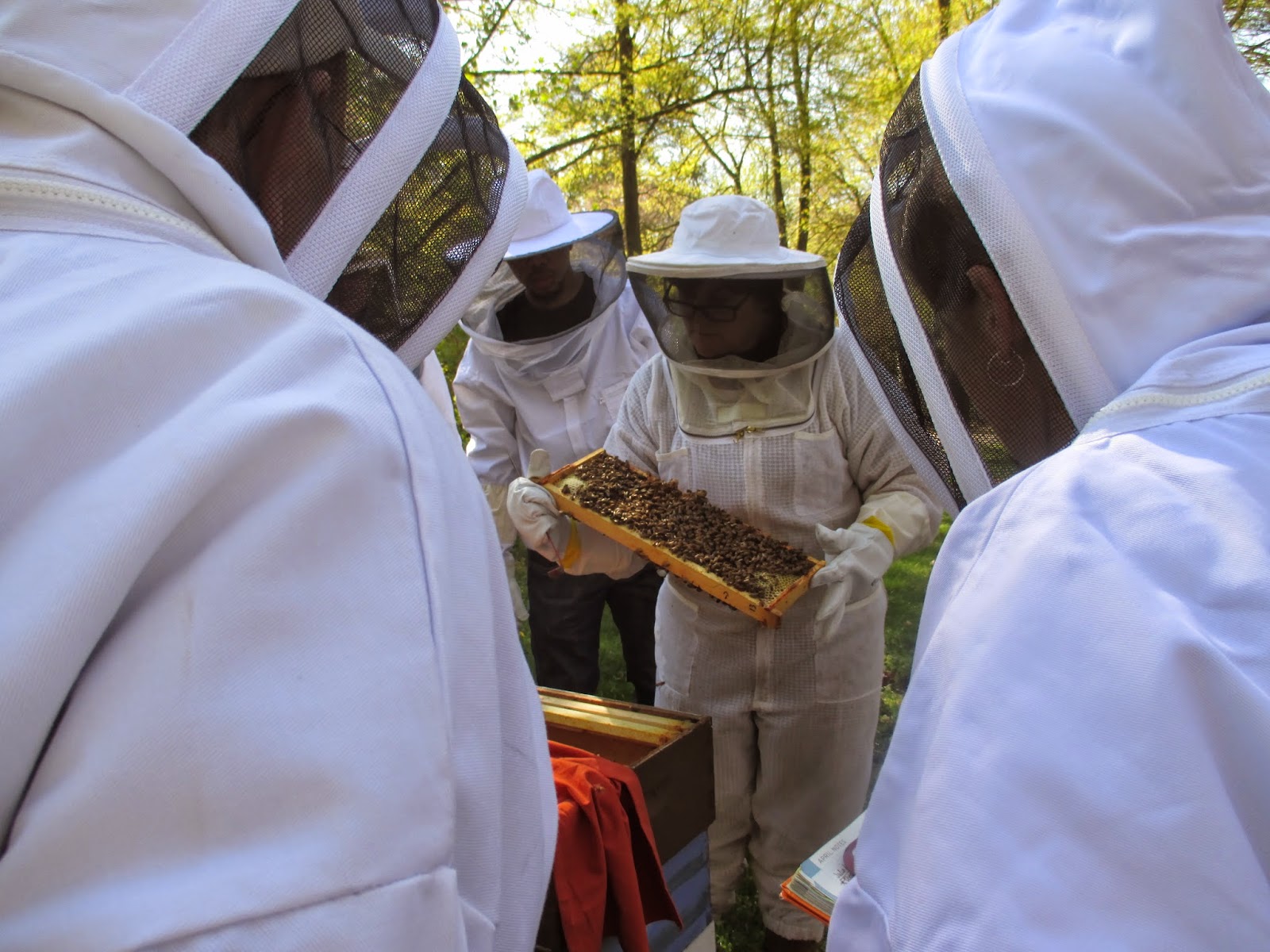
Julia ran a Chastain Conservancy inspection on Thursday.  We didn't know how it would work on a weekday, but I believe there were 11 people who signed up and were there.

We had two hives to check - her overwintered hive that hasn't done too well and the swarm that I was given about a week ago for a MABA teaching hive.  I ran an inspection there on March 15 and forgot to take a single photo.

I did take a few photos on the 9th.  We had a good day.  The inspection was in the morning.
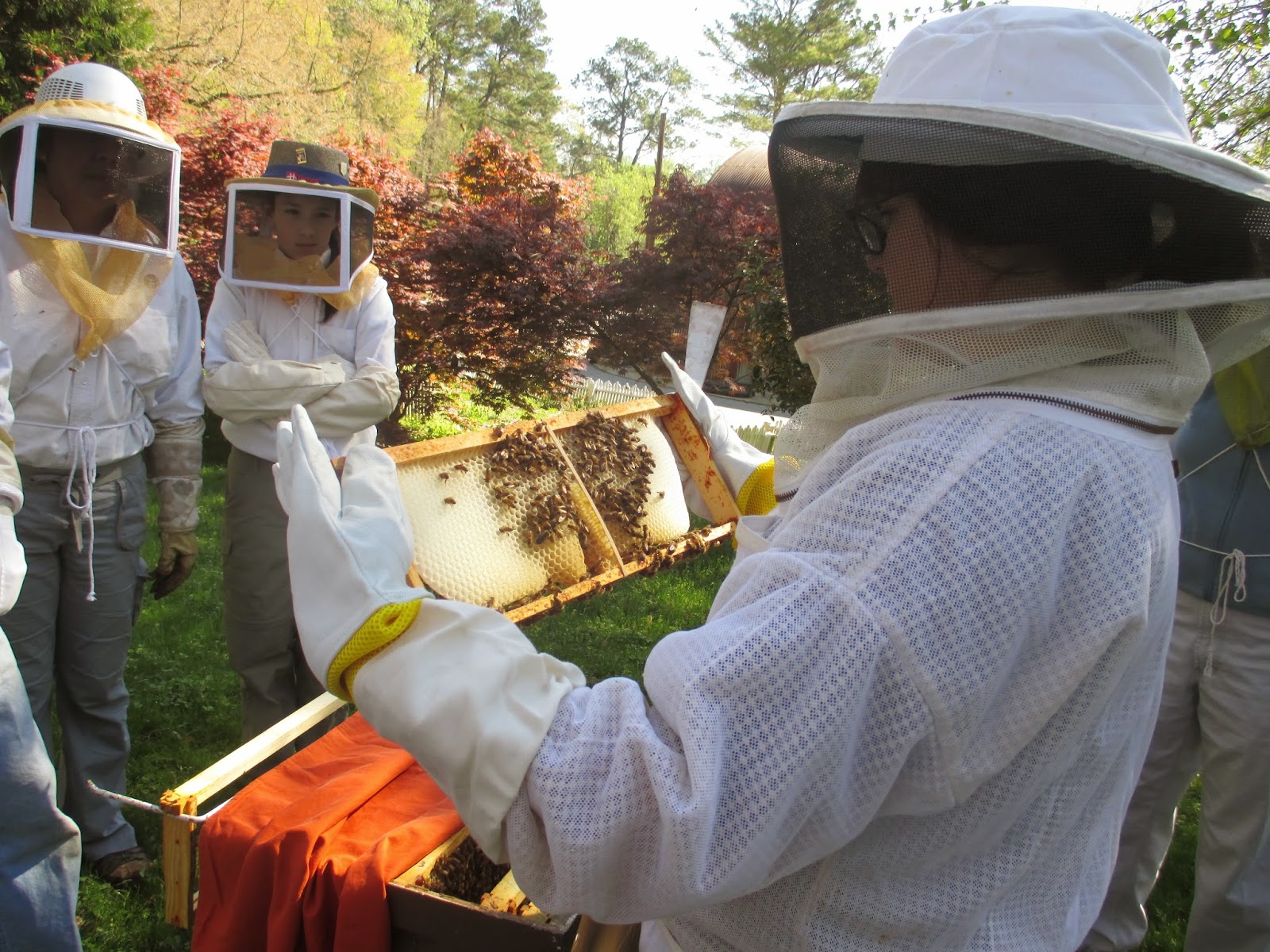
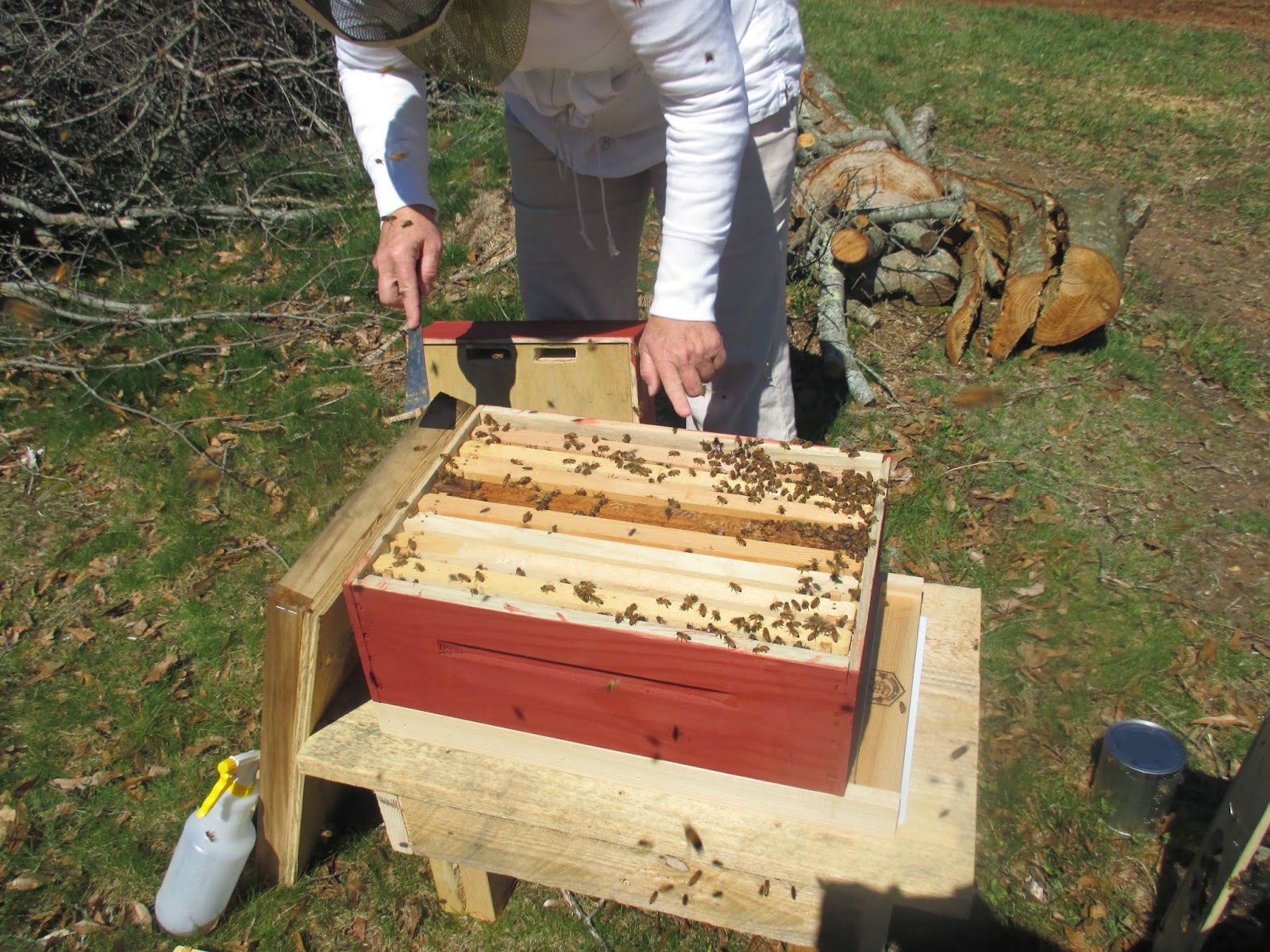
  First Julia talks to the group in general about opening hives and about how we use/don't use the smoker, foundationless frames, hive drapes, and medium boxes.


Here she is showing them and looking at a frame that I had rubber-banded into place at the inspection on the 15th.  Instead of chewing up the rubber band, the bees had incorporated it into the comb.

  We saw queen cups AND

 we saw the queen, although I apparently didn't get a photo of her (I thought I had.....).  

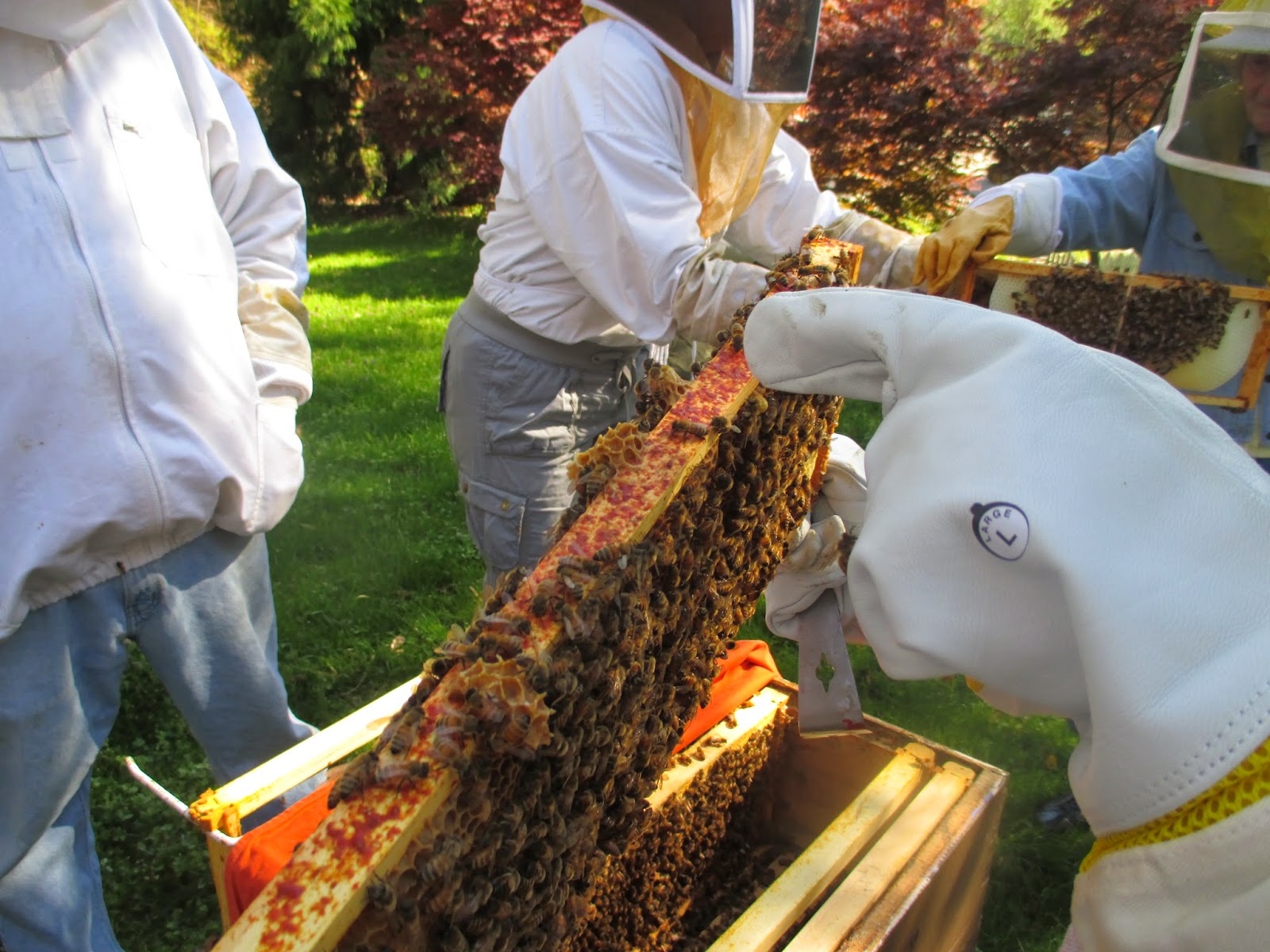
I opened the swarm hive (sorry, no photos - forgot to hand the camera to Julia).  It was a perfect demonstration of how much the bees prefer foundationless frames.  The person who donated the swarm to MABA also gave us 8 frames with plastic foundation.  I had put the swarm in two boxes - the foundation filled box below and foundationless above.  The bees had barely drawn any wax on the plastic, but had fully drawn all the frames in the top box (foundationless)!  

Even though in a tree, they would build down, and thus actually use the bottom box, I decided to go ahead and give them a box of foundationless on top.  So they are now in three boxes but are not really using the bottom box.  There was a well-trained Ga Tech engineer on the inspection and she helped me level the hive (it was rather off kilter).

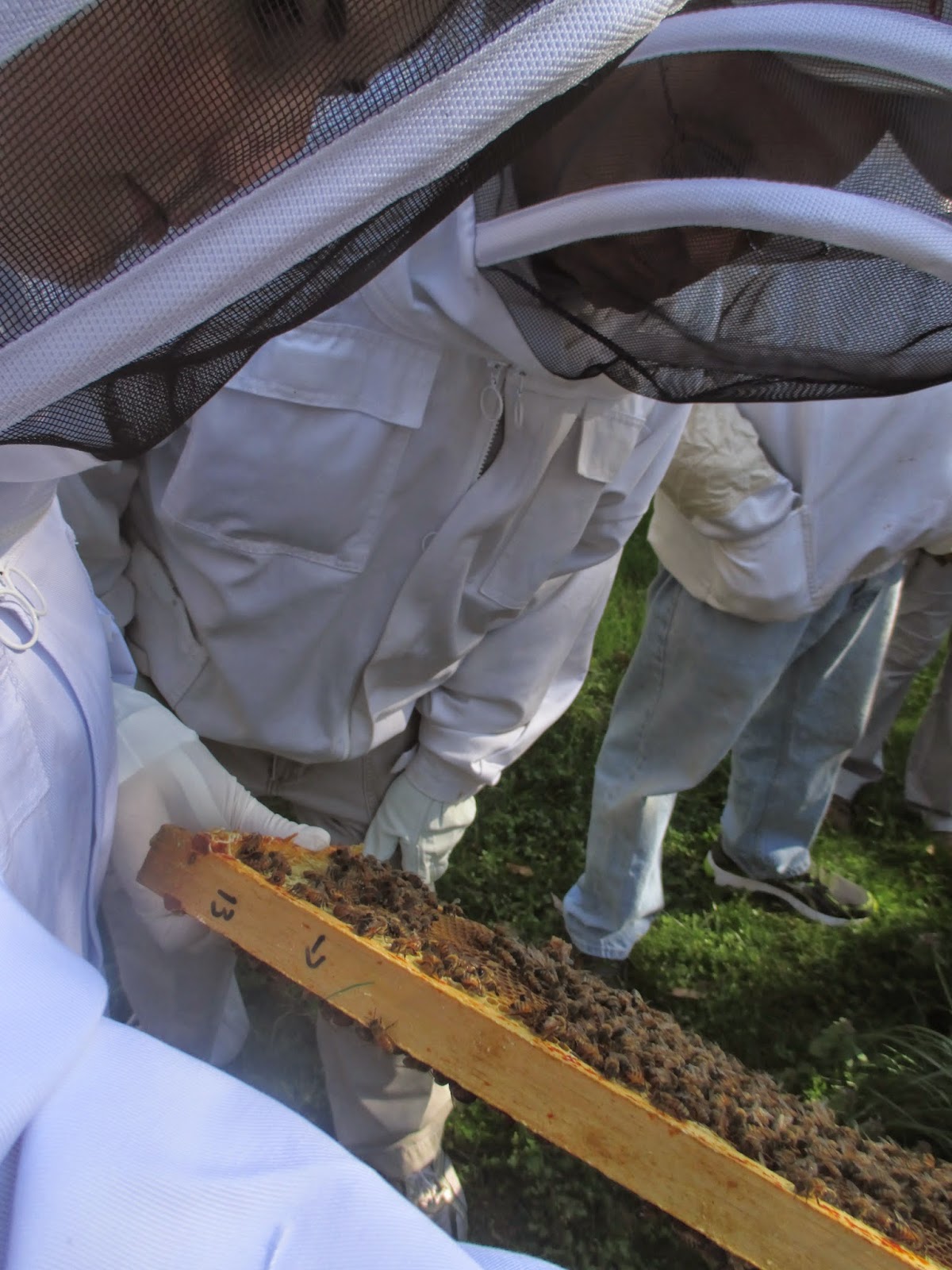
Everyone got to see brood, eggs, and the queen in Julia's hive.  They got to see the advantage of foundationless frames in mine.  It was a very successful inspection and learning experience for all who attended.


Friday, April 11, 2014

Bee-Accountable

Yesterday after the Chastain inspection (I'll upload photos in another post), I came home to check on my own hives.

What a great year this is so far!  My first hive that I checked was from Sebastian's - a major hive, doing well.  In every hive at home my goals were to make sure there was evidence of a laying queen and to see if they needed new boxes for honey.

Sebastian's hive was putting up honey with great enthusiasm.  Most of it looked dark.  I'll be interested to see how their honey changes over time and with the new blooms.  Currently holly is coming to the end of its bloom and there are lots of flowering trees of all types blooming in Atlanta.


They were also doing a lot of wet capping (see photo above).  I don't know how bees decide:  "Wet?  Dry?"  What sort of reasoning (if any) is involved in whether the honey has wet (you can see the honey dampening the back of the wax cappings) or dry (bright white cappings not touching the honey).

This hive needed an extra box as they had completely filled the top box.  So I did the work of the extra box addition before I went on the the lower boxes to look for queen evidence.

I always turn the telescoping cover upside down, set the inner cover on top of it, and do the inspection, stacking each box on the inner cover.

To checkerboard the honey box and to help me with weight, I got the new 8 frame box full of empty frames and set it on the inner cover.  I took frame #2 from the box on the hive and hung it on the frame rack on the side of the hive.

Then I reached into the new box and got frame #2 (empty).  I put it in the old box on top of the hive in position #2.  Then I took original frame #2 on the rack filled with honey and bees and put it in the now empty #2 slot in the new box on the inner cover. 

I moved on to frame #4.  Removed full #4 from the original box and hung it on the frame rack.  Pulled #4 from the new box on the inner cover and put it in the original #4 slot in the box on the hive and put the frame rack #4 full of honey and bees into the empty slot in the new box on the inner cover.  And so on through frame #8.  So #2, #4, #6 and #8 were all moved into the new box.  

Then I lifted the original box off of the hive (now half as heavy) and set it on the new box on the inner cover and continued with my inspection.  I found eggs in the third box (the hive was stacked five high) so I ended my inspection.  Lifting now boxes four and five back onto the hive was much easier and the bees have lots of open storage available to them.

Moving on to the first swarm from Tom's (been here since March 30 - so about 11 days), I checked it for eggs and honey.  They were doing great, building out frames, etc. but didn't need a new box yet.  I saw eggs and not the queen.


The next box I checked was the Northlake swarm that overwintered so well.  Bees are really buzzing around this hive and I have wondered if it had swarmed.  It's top box (#5) was full with honey and busy bees.  I added a new box (the sixth) to this one the same way I did with the Sebastian hive.


My inspection of this hive was a little disturbing in that I found the third box down (first brood box) was full of drone brood, as was most of the next box.  I did find a little worker brood and when I saw eggs they were laid in worker cells, so I'm hopeful all is well.  They certainly are bringing in the honey, even if their queen is laying drones.  I didn't see any queen cells and only a couple of queen cups, but I didn't go all the way through the hive.

The last thing I did was to add a box to the nuc split that Jeff and I made at Tom's also on the 30th.  They are bringing in pollen like mad and I wonder if their new queen has already emerged.  It was a beautiful queen cell and perhaps was a week old, so conceivably, she could have.  Anyway, I didn't inspect since the rule of thumb is to leave a split like that for three weeks, but I did give them a new box in case they needed storage room.  I didn't do it the same way, since it's just a five frame nuc and because the last thing I'd want to do is destroy/injure the queen cell or the new queen.  Instead in the new box, I put a fully drawn frame of comb in the center of the box.

So the bee news here is good.  Next weekend, I go with Joe of "Growing a Greener World" to install his nucs at his house.


Wednesday, April 09, 2014

ANOTHER Swarm at Tom's

This morning I got a call from Tom - the second hive had swarmed!  He sent me these photos:


See it on the right, hanging from the cherry laurel.  About two cats, I'd say.  Here it is up close:

It was hanging on the same cherry laurel that the first swarm had chosen only this one picked a branch lower to the ground and about a foot closer to the hives!


Jeff met me and we put a sheet under the swarm.  I brought a plastic banker's box,
 a ventilated hive top cover and straps.

First I sprayed the swarm with sugar syrup.


It was close enough to the ground that we didn't need a ladder.  We just shook the branch and the bees fell into the banker's box.  We put the ventilated hive cover on it but the bees were accumulating on top of the screen.  Then we covered the screen with two hive drapes to give some closure to the feel of the box.


Over about 20 minutes, during which Gail, Tom's wife and a graduate of the short course, made us tea and brought it to us outside - how luscious - and what luxury - who gets tea during a swarm capture!!!

The bees were emitting nasanov at the entry to the box.


We strapped the banker's box and the ventilated cover together and I drove home.  I had to be at my office at 12:15 to meet an appointment and when I arrived at my house, it was 12:00.  I never even went into the house.  I went to the backyard, grabbed a bottom board, a slatted rack and a box of frames.  I put two drawn comb frames in the center and put the box together on stacked stones (had no cinder blocks).

I took an empty super to be a funnel and poured the bees into the hive.  Then I put the frames into the hive box.  I got a third box with frames in it and gradually put the frames from it into the empty hive box.  I threw an inner cover on the box and the telescoping cover.

I jumped into the car and drove to my office and got there at 12:20.  (My office is 5 minutes from my house).  Fastest install I have ever done.  I hope the bees do well.


I don't think I can put any more bees in my backyard.  I think six, even though one is weak and pitiful, is enough for a neighborhood where there are at least five beekeepers each within a block of my house.  The next two hives go into Jeff's yard.  I'm picking up two nucs from Buster's Bees on Friday night and we'll put them over there.  I have two more nucs coming that will go to the Morningside Community Garden.  

Then I have three nucs coming that I have not a clue where I will put them!  (I was pretty pessimistic at bee ordering time that I would have any hives survive the winter.)  Maybe I'll buy an electric fence ($$$$$$$$$) and put them in the mountains.

When I came home at 2:30, my yard was aswarm with bees.  All of the hives were sending out hoards of bees to gather and forage on the warm mid-April afternoon.  The new hive was orienting and working hard to claim their location.  It's going to be a good bee year!

Sunday, April 06, 2014

A Tale of Two PrePackaged Swarms

Lately I've gotten two swarms without having to do the capture!

On Tuesday, I got a call from the MABA Swarm Call Lady (my co-editor for Spilling the Honey, Gina G.).  She knows we only have one hive at Chastain where we do our teaching inspections, so she had a swarm that had been donated to MABA for us to put there.

The man who caught the swarm, Chris, had already put the swarm in a medium box and was holding it for us to pick up.  I arranged to come very early the next morning to get the bees before time to go foraging.  I drove to his house and easy peasy, the swarm was ready to go.  I moved the bees on his frames into my medium hive, wrapped the hive with a strap, closed the entrance with his staple gun (yes, I did the stapling!) and went home.

I had a Skype appointment from 9 - 10, so I left the bees in the car with the moon roof open and returned to the car an hour later to drive the bees to Chastain.  The drive was uneventful, but I thought there were a rather large number of bees loose in the car.  When I arrived at Chastain and opened the trunk, the strap had slipped (where was Jeff when I needed him???) and the box had slid a little, leaving an opening large enough for a lot of bees to have left the hive to wander in the way-back of my car.

Over the winter one of the cinder blocks had been moved.  I replaced it but just couldn't get it level.  I carried the hive to the cinder blocks (a one box medium with a telescoping cover and a slatted rack).  The hive was still strapped together.  As I leaned down to put the hive on the cinder blocks, I lost my balance, fell forward, and the hive also, of course, fell.  What a calamity!


I righted the hive and put it on the blocks.  The bees on the top went straight for the hole in the inner cover and went down into the hive.  I hope that means the queen is OK.  Hope, hope, hope I didn't kill the queen.


I tried and tried but I couldn't get it level which pretty much means they WILL draw crooked comb.  But I had to go back to work.  If we have to rubber band every frame, that's what we will do on Thursday's inspection this week.


Then while I was in the mountains yesterday, I got a call from a man in Atlanta who had found me on the Internet.  Spencer, the beekeeper, had two hives and one of them had sent out a small swarm the day before.  He had gathered the swarm into a cardboard box.  I encouraged him to cover the box with a screen wire and I would pick it up today.  He said the swarm was very small - about the size of a dinner plate and one inch thick.

Here are Spencer's hives:


I peered into the box when I got to Spencer's house.  I could see the cluster in the corner of the box.  To use our "cat" measure, this swarm was about the size of a squirrel....not close to a cat.  The good news is that they had started emitting wax from their abdomens (see the wax in the corner) so they are eager to put a hive to rights and get started building their home.


I brought them home and put them into the empty nuc hive in my backyard.  They went into the box easily (thank goodness, since it was raining) and I set the nuc on the cinder blocks (without either falling or dropping the hive).  By dinner time the Jack Daniels box was completely empty and the bees had all gone into the nuc.  I don't know how they will do.

He treats his bees and I do not.  Sometimes bees that come from a treated yard do not do well on their own.  I am crossing my fingers and very grateful for these two free hives.  It was such a gift to get them already boxed - even if one of the boxes was a cardboard one.


Sunday, March 30, 2014

Installing the Tom Swarm

Jeff went home to his family and I drove home with the split nuc and the swarm nuc in the back of my car.  Bees were everywhere.  I got most of them out of the car,  but when I locked it for the night there were still a few clusters of bees in the car!

I set the split nuc on its on set of cinder blocks, put a little leaf and grass pieces on the landing and left it.  The queen cell looked pretty newly capped (it was light biscuit as per Billy Davis), so it probably has almost its full time left - since the queen has a way to go in her development, it will be a month before the new queen is laying and three more weeks before any new brood emerges to add to the population, so it will be mid May before this will be an active hive, if then.  So the split is a hive to increase hive numbers but not one to expect to provide honey to harvest.


The swarm is a different matter.  The queen is mature and able to lay.  The bees with her have gorged themselves on honey to prepare for the journey and prepared to make wax.  I put this huge swarm in three 8 frame boxes (the equivalent of 2 10 frame boxes plus four).  I had some unharvested honey from another hive that I gave them (2 frames) and a few frames of drawn comb, although they should be ready to make wax right away.

I put frames in the bottom box and used the next box as a funnel.

 The bees on the comb are on a frame filled with honey.


Once I got most of them into the hive box, I gently added in the frames and then put on box number three and added its frames.  It was a slow process because there were so many bees.  There were still a number of bees in the nuc box and on the lid so I left both facing the new hive.


I don't have the best track record with getting swarms to stay but I employed everything I've learned from previous errors to make this work.

1.  I used old comb in each box and a frame of honey in each box
2.  I put them on a screened bottom board, but closed it up with the sticky board.
3.  I put on an entrance reducer, reduced to the smallest entrance (as per Billy Davis)
4.  I gave them plenty of space (3 8 frame boxes and a slatted rack.)
5.  I put pine needles on the landing to help them re-orient (we are miles from Tom's house - no chance of their returning home).
6.  I used last year's not-yet-painted boxes (they like the smell better than newly painted)

For a while a large group of bees were clustered right outside the entry.  But by nightfall, all were inside and the nuc box was empty.


I put frames of honey in the swarm and put a frame of honey and pollen in the nuc.  I will however, make bee tea and feed it to both of these new hives - one recipe's worth until they get "on their bee feet."

I realize as I write this that I forgot to date the frames, most of which were foundationless.  I'll do it on my first inspection in about a week.

I did bring all the hive drapes into the house to wash as well as my car quilt (which protects my car from bee stuff), my swarm sheet, etc.  So my washing machine is on bee duty tonight.

Jeff and I need to install a Billy Davis robber screen on this and the hive we moved from Sebastian's.  I say Jeff and I because I really need him to operate the staple gun which I HATE doing.

Well, they are in the hive for the night, but I don't take anything for granted so I am crossing my fingers as hard as I can and hope they stay in the new home I have provided for them.  I am exhausted and am now going to bed after a long and very productive day.

Swarm at Tom's - Two Cat Size

Yesterday it rained in Atlanta and Tom texted me at about 1:30 PM when the sun was just occasionally breaking through, that the bees at his house were "going crazy."  He sent me this photo that he took of the front hive:


Sure looks like a swarm to me, but it also looks like a swarm that couldn't get the queen to come along so they are out and ready but needing her to join them.

I told him they might not swarm until tomorrow but they would keep trying to get the queen.  Later he reported that he came home to find the bees gone - definitely they had swarmed and left.  He didn't see them anywhere.  Later that day he saw them up in a large pine tree on the edge of his property.

As I drove up to N Georgia, he said the hive was going crazy again.  Bees were everywhere and appeared to be gathering on a tree at about chest height.  I told him I would get Jeff and come to his house at 4:30 as I drove back into Atlanta.

Jeff was already there when I arrived and they were discussing that the bees were no longer in the pine tree and the group consensus was that the bees had moved from the pine tree to the shrub on which they now hung.  It was a HUGE swarm - about the size of two cats and gathered around a branch that hung down.


We spread a sheet under it and put a nuc box (looked really inadequate but that's what I had) on the sheet under the swarm.  We had brought the huge water cooler swarm catcher bottle.  Jeff climbed a ladder and although I was going to hold the bottle, it worked better for him to do it, so he was really the swarm catcher par excellence.  

Jeff shook the branch and the swarm dropped into the nuc box.  We then had to shake the tree a couple more times.  I set the box onto the sheet again (one shake was directly into the box), and the bees began doing the nasonov butts in the air to let the other bees know the queen was in the box.  We put the nuc top on catty-corner, leaving openings for the bees to join Her Majesty and worked the other hive.  There were layers and layers of bees in this box.


Because this hive had swarmed, we wanted to make a split from the back hive.  The second hive was full of queen cells.  We took a couple of frames with good queen cells on them to make the nuc.  The hive was left with at least seven other queen cells that we saw.  It too was preparing to swarm.  

We have not been able to do good swarm control (ie, checkerboarding) because this hive was in a deep and a medium.  As a result you can't move frames in the checkerboard pattern because a deep frame can't move into a medium box.  We had given these bees all kinds of room but you can't argue with the Darwinian imperative to split and survive!  So we did our own split on the second hive.  They may still swarm.  I don't think they have already because we found a frame of eggs, indicating that the queen was probably laying today.  

We made our nuc (in a deep box) up of both deep and medium frames.  At worse they will make drone comb off of the bottom of the medium frames.  But one of the queen cells we took was on a deep.  


I'll cover installation in the next post.  You can see the capped queen cell near the rubber band and another queen cup with larva in it to the upper right.

What a Bee Day! Installing a Package at Loganberry Heritage Farm

Today was a two-three post worthy day.  At the beginning of the day, I drove to a farm between Dahlonega and Cleveland, GA.  It's a beautiful place - Loganberry Heritage Farm - where chickens run free and cows graze.  Sharon, the owner and a beekeeper, has hives there that she has been managing naturally.  We tried to get together last year but she follows the lunar calendar for guidance in beekeeping and there never was a day that I could come that was also good for opening the bee hives.

I was free to drive up today, though, so I loaded my car with bee paraphernalia and headed for north Georgia.  As I drove up, I got a telephone call from Tom.  The bees in his yard were swarming.  I couldn't do anything until I was done with Sharon, so I told him I'd be back in Atlanta and at his house at 4:30.

When I arrived at Loganberry Heritage Farm, Sharon, in a beautiful garden hat, had just returned from picking up four packages of bees to install.  She wanted me to help her check her hives from last year and to help her install one package so she could do the rest without me.

We went to look at the existing hives first.  They were located high on a windy hill.  I could see no real bee activity.  Some bees were flying in and out of the third hive but the other two looked pretty bee-less.  Sadly, these three hives were all in bad shape.  One hive had honey but no bees.  Another hive had a cluster of dead and molded bees about the size of a saucer over three frames.  The queen was dead right in the center.  The last hive had about a baseball sized cluster of bees in a medium box.

Upon talking this through, she and I decided that in the cold of the mountains where she is, up on that hill is probably too cold for the bees to winter well and perhaps they needed a more sheltered location.  She thought she might try to rescue the baseball sized hive by moving it into a nuc box and seeing if they could build back up.  Because she doesn't have any other hives that are going, she can't add to the resources by putting in a frame of brood and eggs.  I think they will not survive, but maybe she can make it happen.

We then installed the package into her beautifully painted hives, each with a hive top feeder.

First the bees are sprayed with a bee tea that Sharon had made with honey.


Then she removed the cover to the package and lifted up the feed jar.


We put the queen in her cage on the bottom bar of an empty frame (before we placed her there we removed the cork at the candy end of the cage).

  
Then it was time to shake in the bees.  We used an empty box as a funnel through which to shake the bees (keeping most of them in the box instead of on the ground.)


Then we put back in the frames for the bottom box.  We put on her hive top feeder and the inner cover.  Then we put the jar of syrup over the inner cover hole and used another hive box to surround the feeder.  These bees will be well taken care of by Sharon in the days to come.


Pin this post

LinkWithin

Related Posts Plugin for WordPress, Blogger...